
How many calories are in a can of sardines?
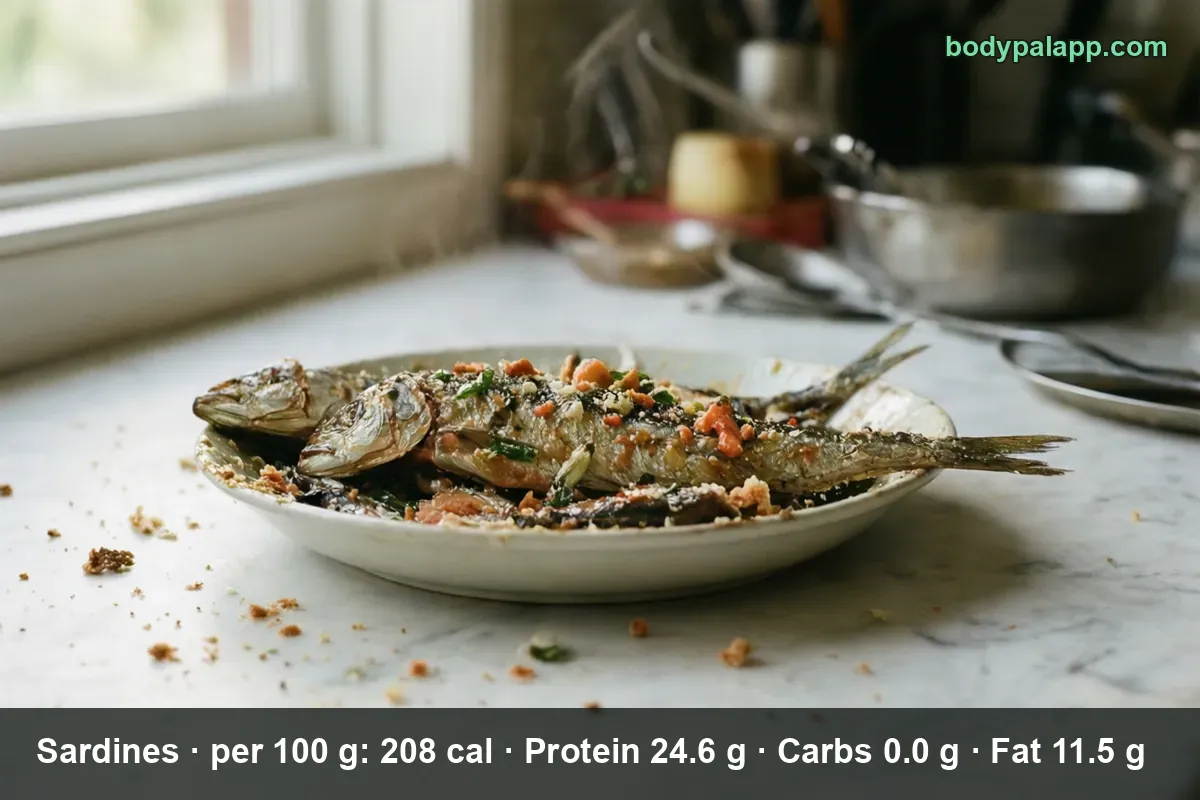
One 3.75 oz can of sardines packed in oil and drained weighs 92 g and carries 191 calories. Per 100 g the fish runs 208 calories, with 24.62 g of protein and zero carbohydrate. Almost every calorie in the can is either protein or fat, which is unusual for something this small.
On this page
- Sardine quick facts
- US servings from two sardines to a full cup
- Oil versus tomato sauce and other sardine forms
- Protein and cholesterol are the rows to watch
- How do sardines compare?
- Most popular sardines brands
- FAQ
Sardine quick facts
The record used here is SR Legacy 175139, "Fish, sardine, Atlantic, canned in oil, drained solids with bone". That is the can most Americans actually hold: flat tin, packed in oil, poured off before eating, bones left in. It is also the only sardine entry in the database that carries a full set of US household measures, including a can, a drained cup and a two-fish portion.
A second entry, FNDDS 2706293 "Fish, sardines, canned," repeats the same nutrient profile under a plainer name but has no can-sized serving attached, so it adds nothing here except a generic 75 g can weight. The numbers below are for drained solids. Nothing on this page averages one record against another.
| Nutrient | Per 100 g | Per 1 can 3.75 oz drained (92 g) | % Daily Value |
|---|---|---|---|
| Calories | 208 | 191 | — |
| Total fat | 11.45 g | 10.5 g | 14% |
| Saturated fat | 1.53 g | 1.4 g | 7% |
| Carbohydrate | 0 g | 0 g | 0% |
| Dietary fiber | 0 g | 0 g | 0% |
| Total sugars | 0 g | 0 g | — |
| Protein | 24.62 g | 22.7 g | 45% |
| Sodium | 307 mg | 282 mg | 12% |
| Cholesterol | 142 mg | 131 mg | 44% |
| Potassium | 397 mg | 365 mg | 8% |
% Daily Value is based on a 2,000-calorie diet.
Verified nutrition data
Numbers on this page come from USDA FoodData Central, the U.S. Department of Agriculture’s food composition database, and from manufacturer labels where a branded product is named. Last verified September 2026. How we verify our data →
Two rows you would expect on a Nutrition Facts panel are missing: added sugars and trans fat. USDA does not publish either value for this canned-fish record, so listing them would mean inventing numbers. The 282 mg of sodium in the can is worth a plain-English translation: roughly an eighth of a teaspoon of table salt, spread through the whole tin.
US servings from two sardines to a full cup
| Serving | Weight | Calories |
|---|---|---|
| 1 small sardine | 12 g | 25 kcal |
| 2 sardines | 24 g | 50 kcal |
| 1 oz | 28 g | 59 kcal |
| One 3.75 oz can, drained | 92 g | 191 kcal |
| 1 cup, drained | 149 g | 310 kcal |
| Per 100 g | 100 g | 208 kcal |
The small sardine, the two-fish portion, the can and the drained cup are all USDA household measures for this record. The one-ounce line and the 100 g line are our own arithmetic from the USDA 100 g figure rather than portions USDA publishes as such.
The trap in that table is the cup. A drained cup holds 149 g of fish against the can's 92 g, so it comes to 310 calories, 62% more than the can, for a product people think of as fixed at one tin. If a recipe tells you to mash a cup of sardines into a salad, you have logged closer to a can and a half. Two sardines lifted onto crackers, on the other hand, is a 50-calorie snack, about a quarter of the can.
Oil versus tomato sauce and other sardine forms
| Version | Per 100 g | Typical serving | Calories |
|---|---|---|---|
| Sardines canned in oil, drained | 208 kcal | one 3.75 oz can (92 g) | 191 kcal |
| Sardines canned in tomato sauce, drained | 185 kcal | one can (370 g) | 685 kcal |
| Canned sardines, FNDDS generic | 208 kcal | one standard can (75 g) | 156 kcal |
| Sardine sandwich | 234 kcal | one regular sandwich (135 g) | 316 kcal |
| Sardine fish oil | 902 kcal | 1 tsp (4.5 g) | 41 kcal |
Tomato sauce reads as the lighter choice per 100 g, and it is: 185 calories against 208. Two other numbers move with it, though. Sodium climbs from 307 mg to 414 mg per 100 g, and protein slides from 24.62 g to 20.86 g, because the sauce takes up room the fish used to occupy. The 685-calorie figure in that row is not a bigger fish, it is a bigger tin: the USDA serving for that record is a 370 g can, roughly four times the weight of the flat 3.75 oz tin.
The FNDDS generic entry carries the identical 208 calories per 100 g but a 75 g standard can, which lands at 156 calories. Same fish, smaller tin, different logged total. That is the sort of gap worth checking against the can in your hand rather than the first number a search returns.
Store shelves stretch the range further in both directions. USDA's Branded records put Ligo Sardines in Tomato Sauce at 107 calories per 100 g and MW Polar at 100, while Bumble Bee Sardines in Olive Oil sit at 241 and Al Amir Moroccan Sardines in Olive Oil at 232. The olive-oil tins are usually listed undrained, which is most of the difference.
Fish oil sits in the table only as a warning. At 902 calories per 100 g it is pure fat, a supplement rather than something you eat by the forkful, and a teaspoon of it is 41 calories.
Protein and cholesterol are the rows to watch
One flat tin covers 45% of the Daily Value for protein, using the FDA reference values for a 2,000-calorie diet. Very few 191-calorie foods do that. For comparison inside the same can, sodium reaches only 12% of its Daily Value and saturated fat 7%, which is the pattern that makes sardines useful when calories are tight and you want the meal to hold. MyPlate counts canned fish in the protein foods group and specifically encourages seafood twice a week.
Cholesterol is the row people miss. The can carries 131 mg, 44% of the 300 mg Daily Value, almost matching the protein percentage. The Dietary Guidelines for Americans advise keeping dietary cholesterol as low as possible within a healthy eating pattern, so if you eat two tins in a day you reach 262 mg, 87% of the label reference on that line, while still under 400 calories.
Sodium deserves one more line, because the USDA row understates the supermarket. The generic drained record is 307 mg per 100 g, but branded tomato-sauce sardines reach 1,089 mg per 100 g, roughly three and a half times that. If you are watching sodium, the oil-packed tin drained well is the better pick, and the label on the specific can beats any generic figure.
Carbohydrate is the easy row: 0 g, 0 g of fiber and 0 g of total sugars per 100 g. Among the plain fish records, only the tomato-sauce version registers anything at all, at 0.54 g of carbohydrate per 100 g.
How do sardines compare?
| Food | Per 100 g | US serving | Calories |
|---|---|---|---|
| Sardines canned in oil, drained | 208 kcal | one 3.75 oz can, 92 g | 191 kcal |
| Sardines in tomato sauce | 185 kcal | one can, 370 g | 685 kcal |
| Sardine sandwich | 234 kcal | one sandwich, 135 g | 316 kcal |
| Sardine fish oil | 902 kcal | 1 tbsp, 13.6 g | 123 kcal |
Our take: for weight loss, the drained oil-packed tin is the pick, because 191 calories buying 22.7 g of protein is close to the best trade in the canned aisle. The tomato-sauce can is lighter per gram but comes in a tin four times the size, so the total lands at 685 calories, and the sodium is higher on top of that. The sandwich is the honest middle: 316 calories, of which the bread supplies almost all of the 21.87 g of carbohydrate per 100 g. Fish oil belongs on a spoon, not a plate.
Most popular sardines brands in the United States
Ranked by how widely each product appears among foods sold in the United States, from the BodyPal food database of over 3.3 million products. Calories are the figures printed on each Nutrition Facts label, checked against USDA FoodData Central.
| Product | Calories (per 100 g) |
|---|---|
| Ligo Sardines in Tomato Sauce | 107 cal |
| Lidl Sardines in Mustard | 132 cal |
| MW Polar Sardines in Tomato Sauce | 100 cal |
| Al Amir Moroccan Sardines in Olive Oil | 232 cal |
| Bumble Bee Sardines in Olive Oil | 241 cal |
| Iberia Sardines in Tomato Sauce | 182 cal |
Brand popularity: BodyPal food database. Nutrition: manufacturer labels / USDA FoodData Central.
Sardine FAQs
How many calories are in one can of sardines?
One 3.75 oz can of sardines canned in oil and drained weighs 92 g and carries 191 calories. That follows from the USDA figure of 208 calories per 100 g. The same can delivers 22.7 g of protein and 10.5 g of fat, with no carbohydrate at all.
How many calories in 2 sardines?
Two sardines weigh about 24 g and come to 50 calories. One small sardine, 12 g and 25 calories, is the smallest USDA measure here; the pair's 5.9 g of protein is our own scaling. Two fish on crackers is a snack at about a quarter of the calories of a whole 92 g can.
Are sardines in oil or in tomato sauce lower in calories?
Per 100 g the tomato sauce version is lighter: 185 calories against 208 for sardines packed in oil and drained. The can changes the answer, because tomato-sauce tins are bigger. Sodium runs the other way too, 414 mg per 100 g in sauce against 307 mg in oil.
How much protein is in a can of sardines?
A drained 3.75 oz can gives 22.7 g of protein, 45% of the Daily Value. Per 100 g the figure is 24.62 g, so a full drained cup at 149 g works out to about 36.7 g by our own arithmetic. Sardines carry no carbohydrate, so the calories are protein and fat.
Do sardines have carbs?
No, the USDA record for sardines canned in oil lists 0 g of carbohydrate, 0 g of fiber and 0 g of total sugars per 100 g. Tomato sauce adds a trace, 0.54 g of carbohydrate per 100 g, of which 0.43 g is sugars. Neither version moves a carb count.
Are canned sardines high in sodium?
Not by canned-fish standards: the drained oil-packed record lists 307 mg of sodium per 100 g, so a 92 g can holds 282 mg, 12% of the Daily Value. Tomato-sauce sardines run 414 mg per 100 g, and branded tomato versions climb to 1,089 mg per 100 g.
Should I drain the oil from sardines?
Drain it if you want these numbers to apply, because every figure on this page is for drained solids, 208 calories per 100 g. Leftover packing oil is close to pure fat, and USDA's sardine oil record runs 902 calories per 100 g, which shows how quickly a clinging spoonful adds up.
How many calories in a sardine sandwich?
A regular sardine sandwich comes to 316 calories for 135 g, at 234 calories per 100 g. The bread does most of that work: carbohydrate jumps from 0 g to 21.87 g per 100 g while protein falls from 24.62 g to 17.87 g compared with the fish on its own.
Similar foods
- Turkey Leg — 1,136 cal per leg
- Lasagna Homemade — 424 cal per piece
- Carrot Salad — 371 cal per cup
- Spinach Pie (Spanakopita) — 254 cal per pie
- Veggie Pizza — 360 cal per slice
- Ham And Cheese Sandwich — 288 cal per sandwich
Count it without the math
Point the camera at the tin and BodyPal counts the sardines for you, oil or sauce.


How long does it take to burn off sardines?
One 3.75 oz can, drained (92 g) is 191 kcal. Enter your weight and the amount you ate to see how long it takes you to burn that off:
lb
| Activity | Time to burn 191 kcal |
|---|---|
| Walking, brisk | 38 min |
| Cycling, moderate | 24 min |
| Swimming, moderate | 27 min |
| Jogging | 22 min |
| Weight training, moderate | 42 min |
Times are for a 155 lb adult at a steady pace; change the weight to see yours. The amount is set to the portion in the text (92 g); change it to what you actually ate. BodyPal works this out from your steps automatically.
This table assumes you know your daily total. If you do not, the daily calorie calculator works it out from five numbers.