
How many calories are in scallops?
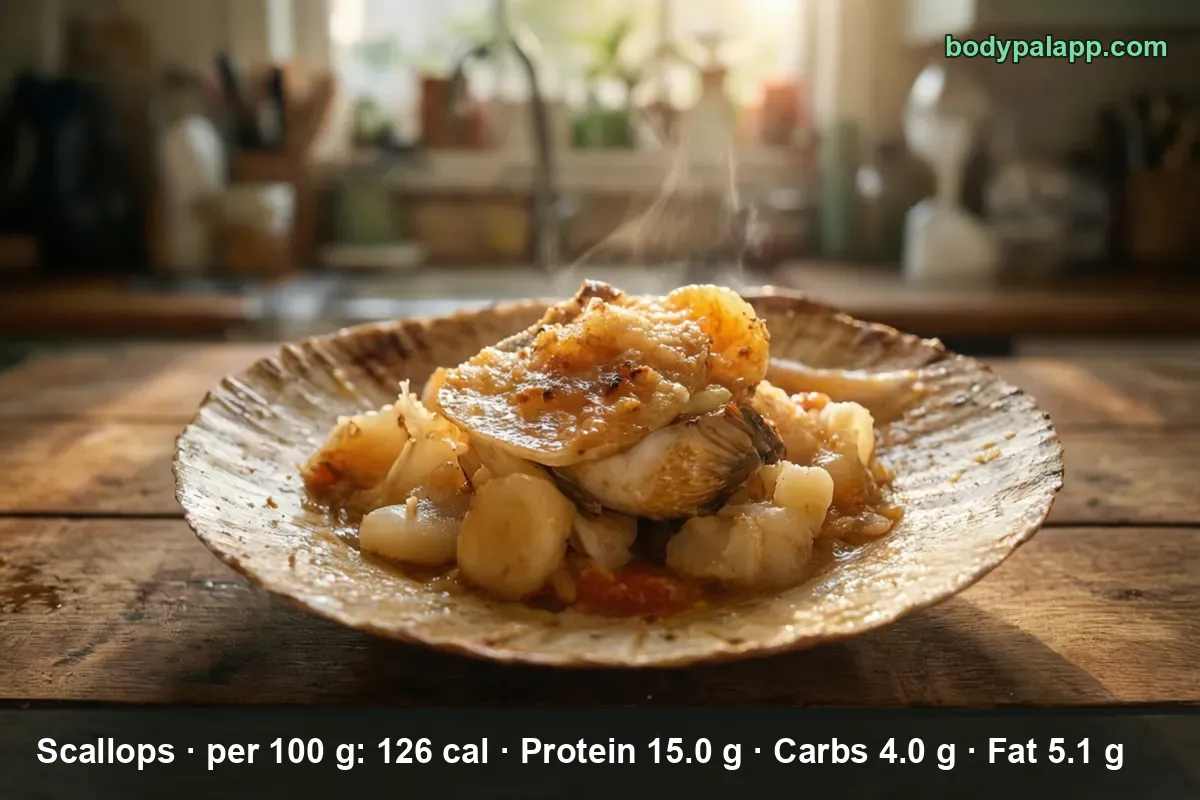
A 3 oz serving of baked or broiled scallops is 107 calories, and 100 g comes to 126 calories. That is roughly six average scallops of 15 g each, 19 calories apiece. Scallops are almost pure protein and water: 12.7 g of protein in that serving, 3.4 g of carbohydrate, 4.4 g of fat.
On this page
- Scallop quick facts
- US servings, from one scallop to a cup
- Raw, steamed, grilled and fried scallops
- Sodium is the row to watch, not fat
- How do scallops compare?
- Most popular scallops brands
- FAQ
Scallop quick facts
The numbers below come from the USDA record 2706356, "Scallops, baked or broiled", part of the FNDDS survey release. That record was picked because it matches what a person searching for this actually has on the plate: sea scallops cooked dry in a hot pan or under the broiler, the standard American treatment. Raw and steamed records exist too, and they read very differently — those are further down the page, in a table of their own.
| Nutrient | Per 100 g | Per 3 oz (85 g) | % Daily Value |
|---|---|---|---|
| Calories | 126 | 107 | — |
| Total fat | 5.14 g | 4.4 g | 6% |
| Saturated fat | 1.35 g | 1.1 g | 6% |
| Carbohydrate | 3.96 g | 3.4 g | 1% |
| Dietary fiber | 0 g | 0 g | 0% |
| Total sugars | 0.01 g | 0.0 g | — |
| Protein | 14.99 g | 12.7 g | 25% |
| Sodium | 415 mg | 353 mg | 15% |
% Daily Value is based on a 2,000-calorie diet.
Verified nutrition data
Numbers on this page come from USDA FoodData Central, the U.S. Department of Agriculture’s food composition database, and from manufacturer labels where a branded product is named. Last verified September 2026. How we verify our data →
Two rows you would see on a package label are missing here: added sugars and trans fat. USDA does not publish either value for this cooked dish, and there is no added sugar in a scallop to begin with — total sugars are 0.01 g per 100 g. Cholesterol runs 33 mg per 100 g, or 28 mg in the 3 oz serving, which is 9% of the Daily Value. Potassium is 255 mg per 100 g, 217 mg per serving, 5% of the Daily Value.
The 3 oz cooked serving is the one the Daily Value reference table from the FDA makes easiest to read against, and it is also the standard seafood portion in MyPlate's protein foods guidance. Everything on this page is scaled from the per-100-g figures in that USDA record.
US servings, from one scallop to a cup
| Serving | Weight | Calories |
|---|---|---|
| 1 scallop | 15 g | 19 kcal |
| 1 oz | 28 g | 35 kcal |
| 3 oz, cooked | 85 g | 107 kcal |
| 4 oz, cooked | 113 g | 142 kcal |
| 1 cup | 135 g | 170 kcal |
| Per 100 g | 100 g | 126 kcal |
Three of these are USDA household measures: one scallop, the 3 oz portion and the 1 cup measure. The 1 oz and 4 oz lines are our own arithmetic from the USDA 100 g figure, not USDA servings, because those are the weights people actually read off a kitchen scale or a frozen bag.
That "1 scallop, 15 g" figure is a survey average across bay and sea scallops. A jumbo sea scallop, the kind sold by count as U-10 or U-12, weighs closer to 30 g on its own, which puts a single one near 38 calories. Count matters more than it does with most foods here: the difference between a plate of six little bay scallops and a plate of six jumbos is roughly 113 calories against 227, and both look like "a serving of scallops" in a photo.
The 1 cup line is the sneaky one. A cup of cooked scallops is 135 g, more than a 4 oz portion, and it climbs to 170 calories. If you are eyeballing a seafood pasta or a sheet pan dinner and thinking "about a cup", you are logging half again as much as a restaurant 3 oz appetizer.
Raw, steamed, grilled and fried scallops
Cooking method moves this food more than almost anything else on a seafood menu. The spread between steamed and fried is 87 to 217 calories per 100 g — two and a half times, from the same scallop.
| Version | Per 100 g | Typical serving | Calories |
|---|---|---|---|
| Raw sea scallops | 69 kcal | 4 oz (113 g) | 78 kcal |
| Boiled or steamed, survey record | 87 kcal | 3 oz (85 g) | 74 kcal |
| Imitation scallops, surimi | 99 kcal | 3 oz (85 g) | 84 kcal |
| Grilled | 108 kcal | 1 cup (135 g) | 146 kcal |
| Steamed, legacy record | 111 kcal | 3 oz (85 g) | 94 kcal |
| Baked or broiled | 126 kcal | 3 oz (85 g) | 107 kcal |
| Fried | 217 kcal | 1 cup (135 g) | 293 kcal |
Raw versus cooked. Raw scallops are 69 calories per 100 g, baked ones 126. Nothing was added — water left. If you weigh 4 oz of raw scallops out of the bag, cook them and eat all of them, you ate 78 calories, not 142, because that same meat now weighs less than 4 oz. Weigh raw, log raw; weigh cooked, log cooked. Mixing the two is the single most common way people overcount or undercount shellfish.
Steamed and boiled. Two USDA records cover this and they disagree, 87 and 111 calories per 100 g, which is a water-loss difference between a survey dish and the older laboratory record rather than a difference in the food. Either way, steaming with no added fat is the lightest real preparation: 74 to 94 calories for 3 oz.
Grilled. 108 calories per 100 g, and the fat row is where you see it — 2.89 g per 100 g against 5.14 g baked. A full cup of grilled scallops is 146 calories, still less than a cup of the baked version.
Fried. 217 calories per 100 g, and a 1 cup fried basket is 293 calories. The oil is only part of it. Carbohydrate goes from 3.96 g per 100 g to 14.14 g, and fat from 5.14 g to 12.54 g, because the breading is doing the work. The older breaded-and-fried record lands in the same place, 216 calories per 100 g.
Imitation scallops. These are surimi, shaped fish paste, not shellfish: 99 calories per 100 g, 84 for 3 oz. They look cheap on calories until you read the other rows — 10.62 g of carbohydrate per 100 g, and 795 mg of sodium, nearly double the real thing.
Raw frozen sea scallop packs at US supermarkets read between 62 and 89 calories per 100 g on their labels, which works out to roughly 70 to 100 calories for the 4 oz or half-cup serving printed on the bag. Those are raw weights, and the pack numbers sit right on top of the USDA raw record.
Sodium is the row to watch, not fat
Most people brace for cholesterol or fat with shellfish. Neither is the story here. A 3 oz serving carries 4.4 g of fat, 1.1 g of it saturated, which is 6% of the Daily Value each, and 28 mg of cholesterol, 9%.
Sodium is different. Baked scallops carry 415 mg per 100 g, so 3 oz is 353 mg — 15% of the 2,300 mg Daily Value, about a sixth of a teaspoon of table salt, before you season anything. Move to a full cup and it is 560 mg, 24% of the day's allowance, for only 170 calories. The USDA steamed legacy record goes higher still, 667 mg per 100 g.
That sodium is not the cook's doing. Raw scallops already read 392 mg per 100 g: it is seawater, in the animal. Which matters if you are following the Dietary Guidelines for Americans sodium ceiling — with scallops, the pan sauce and the salt shaker are where you have room to cut, not the shellfish.
The upside on the same plate is protein density. 12.7 g of protein for 107 calories is 25% of the Daily Value from a quarter of a typical lunch's calories. Very few animal foods hit that ratio; scallops do it because they are close to pure muscle with almost no fat and no glycogen to speak of.
How do scallops compare?
| Seafood | Per 100 g | US serving | Calories |
|---|---|---|---|
| Scallops, baked or broiled | 126 kcal | 3 oz (85 g) | 107 kcal |
| Shrimp, fried | 218 kcal | 3 oz (85 g) | 185 kcal |
| Octopus | 226 kcal | 3 oz (85 g) | 192 kcal |
| Clams, fried | 230 kcal | 3 oz (85 g) | 196 kcal |
Our take: baked scallops are the lightest of these four, per gram and per 3 oz serving, and it is not close — the next one up is 73% heavier per 100 g. But read the preparation column before you feel good about it. The three comparisons are fried or oil-cooked dishes, and fried scallops at 217 calories per 100 g sit right beside them. Scallops win on the strength of how they are usually cooked in an American kitchen, dry and fast, not on some intrinsic advantage over shrimp. If you want the lightest protein on the seafood counter, broil or steam scallops and eat them at 3 oz; if they arrive breaded in a basket, treat them like fried clams, because that is what the numbers say they are.
Most popular scallops brands in the United States
Ranked by how widely each product appears among foods sold in the United States, from the BodyPal food database of over 3.3 million products. Calories are the figures printed on each Nutrition Facts label, checked against USDA FoodData Central.
| Product | Calories (per 100 g) |
|---|---|
| Neptune Sea Scallops | 88 cal |
| Sea-Trek Gold Sea Scallops | 70 cal |
| Sail Sea Scallops Roe-Off | 62 cal |
| Eastern Fisheries Raw Jumbo Sea Scallops | 62 cal |
| Eastern Seas Sea Scallops | 89 cal |
| Pacific Surf Bay Scallops | 88 cal |
Brand popularity: BodyPal food database. Nutrition: manufacturer labels / USDA FoodData Central.
Scallop FAQs
How many calories are in scallops?
A 3 oz cooked serving holds 107 calories, and 100 g of baked or broiled scallops comes to 126. That covers the sea scallops most people buy at the fish counter and cook in a hot pan or under the broiler. Steamed drops it to 87 per 100 g.
How many calories in 1 scallop?
One scallop is 19 calories at the USDA average weight of 15 g, baked or broiled. Jumbo sea scallops run closer to 30 g each, so a big one lands near 38 calories. Six average scallops weigh 90 g and come to 113 calories.
How much protein is in scallops?
A 3 oz cooked serving carries 12.7 g of protein, 25% of the Daily Value, for only 107 calories. Per 100 g, baked scallops give 14.99 g. The USDA steamed legacy record concentrates more, 20.54 g per 100 g, because that preparation loses more water.
How many calories in 4 oz of scallops?
Four ounces of cooked scallops, 113 g, is 142 calories, our own arithmetic from the USDA 100 g figure rather than a USDA serving. Four ounces of raw scallops, the weight printed on most frozen bags, is only 78 calories, because raw meat still holds its water.
Are scallops good for weight loss?
At 126 calories per 100 g, scallops are one of the lightest ways to hit a protein target: 3 oz gives 12.7 g of protein for 107 calories. Steam or broil them and skip the breading, since fried scallops jump to 217 per 100 g, over 70% more.
Are scallops high in sodium?
Higher than most people expect: baked scallops carry 415 mg per 100 g, so a 1 cup serving of 135 g is 560 mg, 24% of the Daily Value. Raw scallops already read 392 mg, so the sodium is in the shellfish itself, not the salt shaker.
How many calories in fried scallops?
Fried scallops are 217 calories per 100 g, so a 1 cup basket of 135 g is 293. The breading does more than the oil does: carbohydrate climbs from 3.96 g per 100 g baked to 14.14 g fried, and fat goes from 5.14 g to 12.54 g.
Do scallops have carbs?
A little: baked scallops hold 3.96 g of carbohydrate per 100 g, 3.4 g in a 3 oz serving, which is 1% of the Daily Value. Sugar is essentially zero at 0.01 g. Breaded and fried scallops are the exception, at 14.14 g per 100 g.
Similar foods
- Chicken Teriyaki Bowl — 428 cal per bowl
- Ramen Bowl — 311 cal per cup
- Turkey Dinner — 335 cal per dinner
- Salmon Teriyaki — 219 cal per fillet
- Sushi Nigiri — 36 cal per piece
- Steak Kabob — 246 cal per shish kabob
Count it without the math
Point the camera at the plate and BodyPal counts the scallops for you, count and cooking method included.


How long does it take to burn off scallops?
A 3 oz (85 g) cooked serving is 107 kcal. Enter your weight and the amount you ate to see how long it takes you to burn that off:
lb
| Activity | Time to burn 107 kcal |
|---|---|
| Walking, brisk | 21 min |
| Cycling, moderate | 13 min |
| Swimming, moderate | 15 min |
| Jogging | 13 min |
| Weight training, moderate | 24 min |
Times are for a 155 lb adult at a steady pace; change the weight to see yours. The amount is set to the portion in the text (85 g); change it to what you actually ate. BodyPal works this out from your steps automatically.
Burning it off is one side of it. The other is knowing your number: work out how many calories you need a day, with macros and a goal date.