
How many calories are in a turkey dinner?
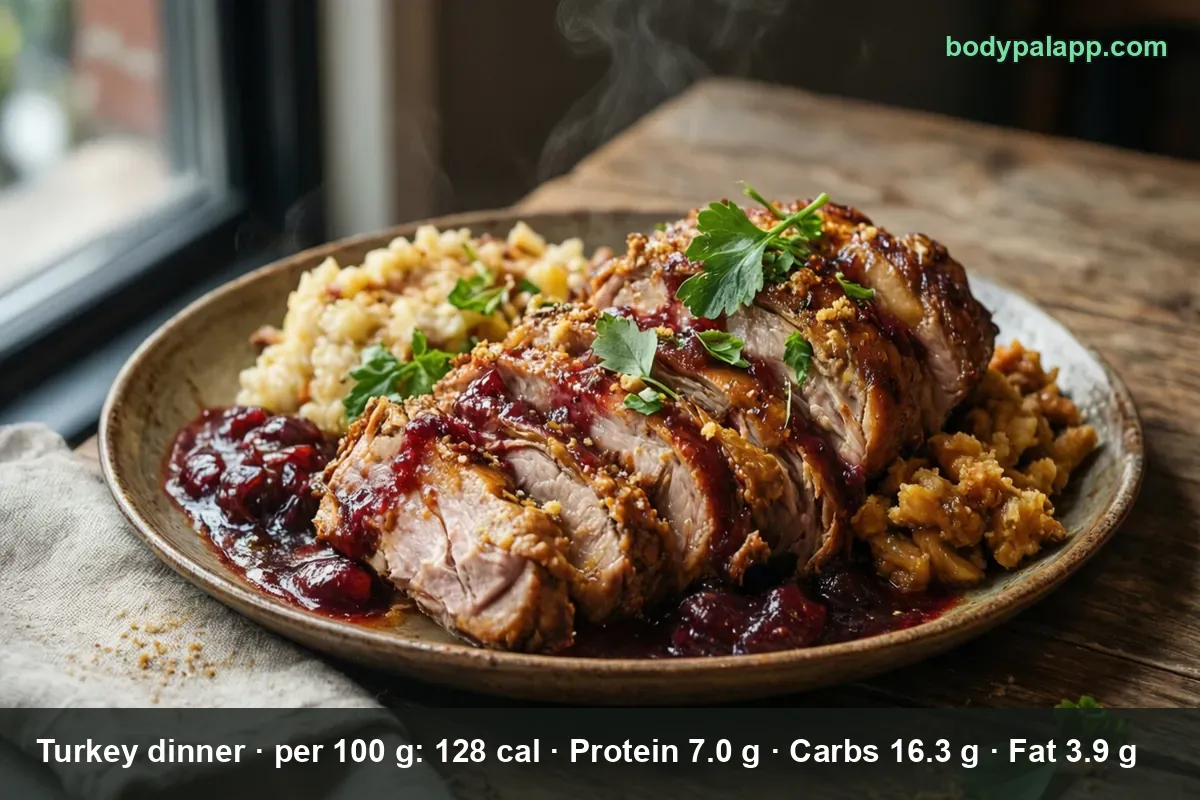
A 9.25 oz turkey dinner - turkey, gravy, dressing, potatoes and a vegetable in one tray - weighs 262 g and carries 335 calories. Per 100 g the assembled plate runs 128 calories, which is lighter per gram than the turkey breast sitting on it. The starches and the gravy are what pull the number down.
On this page
- Turkey dinner quick facts
- US servings, from one ounce to the large tray
- Turkey with gravy, roast breast and the bigger tray
- Sodium is the row to watch
- How does a turkey dinner compare?
- Most popular turkey dinner brands
- Turkey dinner FAQs
Turkey dinner quick facts
When someone searches for the calories in a turkey dinner, they are holding a plate, not a slice of breast meat. So the record used here is the whole assembled meal: FNDDS 2707118, "Turkey with gravy, dressing, potatoes, vegetable, frozen meal", at 128 calories per 100 g. USDA's older SR Legacy entry for the same dish, 173338, reports identical values, which is a useful confirmation that the composite is stable.
The tray is the reference plate because USDA measures it as a whole frozen dinner - meat, gravy, starch and vegetable in one weighed unit with a net weight on the box. A carved Thanksgiving plate built the same way behaves like it, allowing for a heavier hand with the butter and the gravy ladle.
| Nutrient | Per 100 g | Per 1 dinner (262 g) | % Daily Value |
|---|---|---|---|
| Calories | 128 | 335 | — |
| Total fat | 3.89 g | 10.2 g | 13% |
| Saturated fat | 0.88 g | 2.3 g | 11% |
| Carbohydrate | 16.32 g | 42.8 g | 16% |
| Dietary fiber | 1.3 g | 3.4 g | 12% |
| Total sugars | 4.82 g | 12.6 g | — |
| Protein | 6.97 g | 18.3 g | 37% |
| Sodium | 326 mg | 854 mg | 37% |
| Cholesterol | 14 mg | 37 mg | 12% |
| Potassium | 230 mg | 603 mg | 13% |
% Daily Value is based on a 2,000-calorie diet.
Verified nutrition data
Numbers on this page come from USDA FoodData Central, the U.S. Department of Agriculture’s food composition database, and from manufacturer labels where a branded product is named. Last verified September 2026. How we verify our data →
Two rows you would expect on a package label are missing here: added sugars and trans fat. This FNDDS edition does not publish either value for the dish, so listing them would mean inventing them. The total sugars figure, 12.6 g on the plate, has no Daily Value of its own and mostly reflects the vegetable, the cranberry-style sweetness in some trays and the milk solids in the potatoes - it is not the same thing as added sugar.
US servings, from one ounce to the large tray
| Serving | Weight | Calories |
|---|---|---|
| 1 oz | 28 g | 36 kcal |
| Half a dinner | 131 g | 168 kcal |
| One dinner, 9.25 oz | 262 g | 335 kcal |
| One large dinner, 11.75 oz | 333 g | 426 kcal |
| Per 100 g | 100 g | 128 kcal |
The 9.25 oz and 11.75 oz trays are USDA household portions for this record. The half-plate and the single ounce are our own arithmetic from the USDA 100 g figure, not USDA servings - useful if you split a tray or if you are logging a spoonful of leftovers.
Here is the trap worth knowing about. The two tray sizes hold the same food at the same density, and the only thing separating them is 71 g of weight. That gap is 91 calories, a 27% jump, and nothing on the front of either box tells you that. Read the net weight, not the picture.
Brand trays scatter around the USDA figure because the ratio of meat to potato varies. A Big Y turkey dinner with mashed potatoes, cornbread stuffing and gravy is labeled at 100 calories per 100 g, with 140 calories in a 5 oz (140 g) serving. A ShopRite holiday turkey dinner runs lighter at 82 per 100 g, or 279 calories in a quarter tray of 340 g. Big Y's turkey-with-gravy version, which is mostly meat, climbs to 168 per 100 g and 190 calories in its 4 oz (113 g) serving.
Turkey with gravy, roast breast and the bigger tray
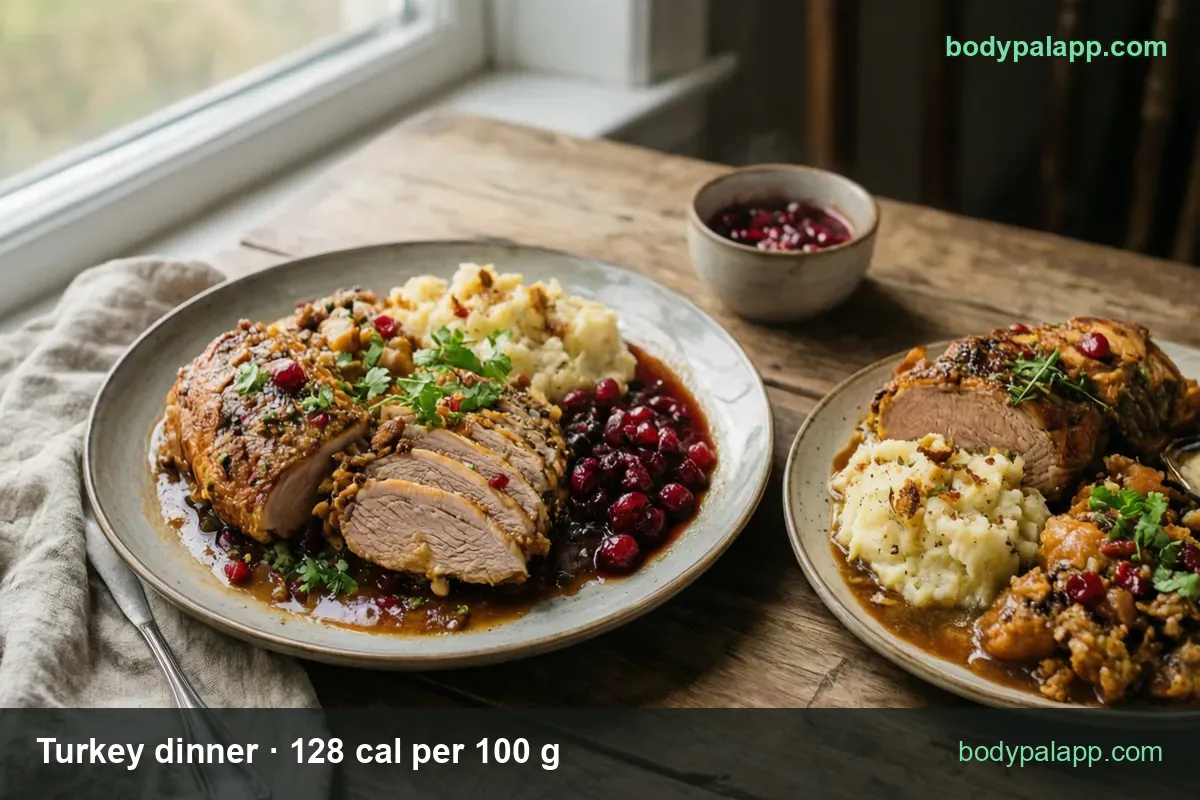
| Version | Per 100 g | Typical US portion | Calories |
|---|---|---|---|
| Turkey with gravy, no sides | 125 kcal | 1 cup (244 g) | 305 kcal |
| Roast turkey breast, meat only | 147 kcal | 3 oz (85 g) | 125 kcal |
| Roast turkey breast, meat and skin | 189 kcal | 3 oz (85 g) | 161 kcal |
| Turkey and potatoes with gravy | 122 kcal | 1 cup (242 g) | 295 kcal |
| Turkey and noodles with gravy | 140 kcal | 1 cup (224 g) | 314 kcal |
| Large frozen turkey dinner | 128 kcal | 1 meal (333 g) | 426 kcal |
Turkey with gravy alone is 125 calories per 100 g, barely under the full dinner, but a cup of it is 305 calories and 20.46 g of protein per 100 g. Take the sides away and the meal gets denser in protein without getting much denser in calories.
Roast turkey breast is the leanest thing on this page per bite of nutrition, though not per gram: 147 calories per 100 g skinless. The 3 oz portions above are our own arithmetic from the USDA 100 g figures rather than USDA household servings, because 3 oz is how Americans actually plate carved meat. That gives 125 calories, 25.6 g of protein and 84 mg of sodium.
Leave the skin on and the same 3 oz goes to 161 calories, a 29% increase, with fat rising from 2.08 g to 7.41 g per 100 g. Whether that matters depends on the rest of the plate; on a day already heavy in fat, carving under the skin is the easy save.
Swap the potatoes for noodles and the dish gets denser: 140 calories per 100 g against 122 for the potato version. Of everything measured here, the noodle version is the only composite that beats the reference dinner per gram.
The 11.75 oz tray is the same food at 333 g: 426 calories, 23.2 g of protein and roughly 1,086 mg of sodium by our own arithmetic from the 100 g figure.
Sodium is the row to watch
Calories are not the story on this plate. Sodium is. One 262 g dinner delivers 854 mg, which is 37% of the FDA Daily Value of 2,300 mg - about a third of a teaspoon of table salt in a meal that most people would call modest. The large tray takes that past 1,000 mg.
Where it comes from is clear once you line the records up. Plain roast turkey breast is 99 mg of sodium per 100 g. The same 100 g served as a finished dinner is 326 mg, more than triple. The meat is not salty; the gravy, the dressing and the seasoned potatoes are.
The protein row moves the opposite way. Skinless roast turkey breast carries 30.13 g of protein per 100 g. The assembled dinner carries 6.97 g - more than four times less at the same weight, because potatoes, gravy and vegetable make up most of the tray. The plate still lands 18.3 g of protein, 37% of the 50 g Daily Value, which is respectable for 335 calories, but it gets there on volume rather than concentration. If you want the protein without the sodium, MyPlate's protein-foods guidance points at the same answer the numbers do: carve more meat, ladle less gravy.
How does a turkey dinner compare?
| Dish | Per 100 g | US serving | Calories |
|---|---|---|---|
| Turkey dinner, full tray | 128 kcal | one dinner, 262 g | 335 kcal |
| Turkey with gravy | 125 kcal | 1 cup, 244 g | 305 kcal |
| Chicken or turkey and potatoes with gravy | 122 kcal | 1 cup, 242 g | 295 kcal |
| Chicken or turkey and noodles with gravy | 140 kcal | 1 cup, 224 g | 314 kcal |
Our take: these four dishes sit within 18 calories of each other per 100 g, so choosing between them on calorie density is pointless. Choose on what you want out of the meal instead. For weight loss, turkey with gravy is the pick - fewest calories per gram of protein by a wide margin, since it packs 20.46 g of protein into 100 g against 6.97 g for the full tray. For fullness on a budget of calories, the full dinner wins: it brings 3.4 g of fiber and a vegetable, and it is the only one of the four that eats like a complete meal. The noodle version is the one to skip; it is the densest per gram at 140 calories per 100 g and no richer in protein than the full tray, at 6.99 g against 6.97 g.
Most popular turkey dinner brands in the United States
Ranked by how widely each product appears among foods sold in the United States, from the BodyPal food database of over 3.3 million products. Calories are the figures printed on each Nutrition Facts label, checked against USDA FoodData Central.
| Product | Calories (per 100 g) |
|---|---|
| Big Y Turkey Dinner with Mashed Potatoes, Cornbread Stuffing and Gravy | 100 cal |
| ShopRite Holiday Turkey Dinner | 82 cal |
| Big Y Turkey Dinner with Gravy | 168 cal |
Brand popularity: BodyPal food database. Nutrition: manufacturer labels / USDA FoodData Central.
Turkey dinner FAQs
How many calories are in a turkey dinner?
A standard 9.25 oz turkey dinner is 335 calories for 262 g, at 128 calories per 100 g. That tray holds turkey, gravy, dressing, potatoes and a vegetable together. A carved plate built the same way lands in the same range, though home cooks pour more gravy and butter the potatoes harder.
How many calories in a frozen turkey dinner?
The 9.25 oz tray is 335 calories and the 11.75 oz tray is 426, both from the same USDA record at 128 calories per 100 g. Nothing changes except the weight: 71 g more food adds 91 calories. Check the net weight on the box before assuming which size you bought.
How many calories in a Thanksgiving plate of turkey, stuffing and mashed potatoes?
Around 335 calories for a 262 g plate, using the USDA frozen-meal record as the closest measured stand-in for that combination. Holiday plates are usually heavier, so weigh yours if you can: at 128 calories per 100 g, a 400 g plate works out to about 512 calories before extra gravy.
How much protein is in a turkey dinner?
18.3 g in one 262 g dinner, which is 37% of the 50 g Daily Value. Solid, but not high for a meat meal, because potatoes, dressing and gravy make up most of the weight. Skinless roast turkey breast carries 30.13 g of protein per 100 g, against 6.97 g for the assembled plate.
Is a turkey dinner high in sodium?
One 262 g dinner has 854 mg of sodium, 37% of the 2,300 mg Daily Value, or roughly a third of a teaspoon of table salt. The 11.75 oz tray comes to about 1,086 mg by our own arithmetic from the same 100 g figure. Roast turkey breast alone is only 99 mg per 100 g.
How many calories in turkey with gravy?
305 calories in a 1 cup (244 g) serving of turkey with gravy and no sides, at 125 calories per 100 g. It is nearly as dense per gram as the full dinner, but it carries 20.46 g of protein per 100 g - close to three times the 6.97 g in the assembled tray.
How many calories in 3 oz of roast turkey breast?
125 calories in 3 oz (85 g) of skinless roast turkey breast, scaled by our own arithmetic from the USDA figure of 147 calories per 100 g. That portion brings 25.6 g of protein and only 84 mg of sodium, just over a third of the calories of the full dinner tray.
Does the skin change the calories in turkey?
Yes - roast turkey breast with the skin is 189 calories per 100 g against 147 skinless, so a 3 oz portion moves from 125 to 161 calories - about 29% more. Fat is where the gap sits, rising from 2.08 g to 7.41 g per 100 g. Protein barely changes.
Similar foods
- Ramen Bowl — 311 cal per cup
- Salmon Teriyaki — 219 cal per fillet
- Sushi Nigiri — 36 cal per piece
- Chicken Teriyaki Bowl — 428 cal per bowl
- Scallops — 19 cal per scallop
- Chicken And Broccoli — 284 cal per cup
Count it without the math
Point the camera at the plate and BodyPal counts the turkey, the gravy and the potatoes for you.


How long does it take to burn off 335 kcal of turkey dinner?
One 9.25 oz frozen dinner (262 g) is 335 kcal. Enter your weight and the amount you ate to see how long it takes you to burn that off:
lb
| Activity | Time to burn 335 kcal |
|---|---|
| Walking, brisk | 1 hr 7 min |
| Cycling, moderate | 42 min |
| Swimming, moderate | 48 min |
| Jogging | 39 min |
| Weight training, moderate | 1 hr 14 min |
Times are for a 155 lb adult at a steady pace; change the weight to see yours. The amount is set to the portion in the text (262 g); change it to what you actually ate. BodyPal works this out from your steps automatically.
One food is easy to picture; a whole day is harder. See how many calories you need a day and what a deficit actually looks like.