
How many calories are in seitan?
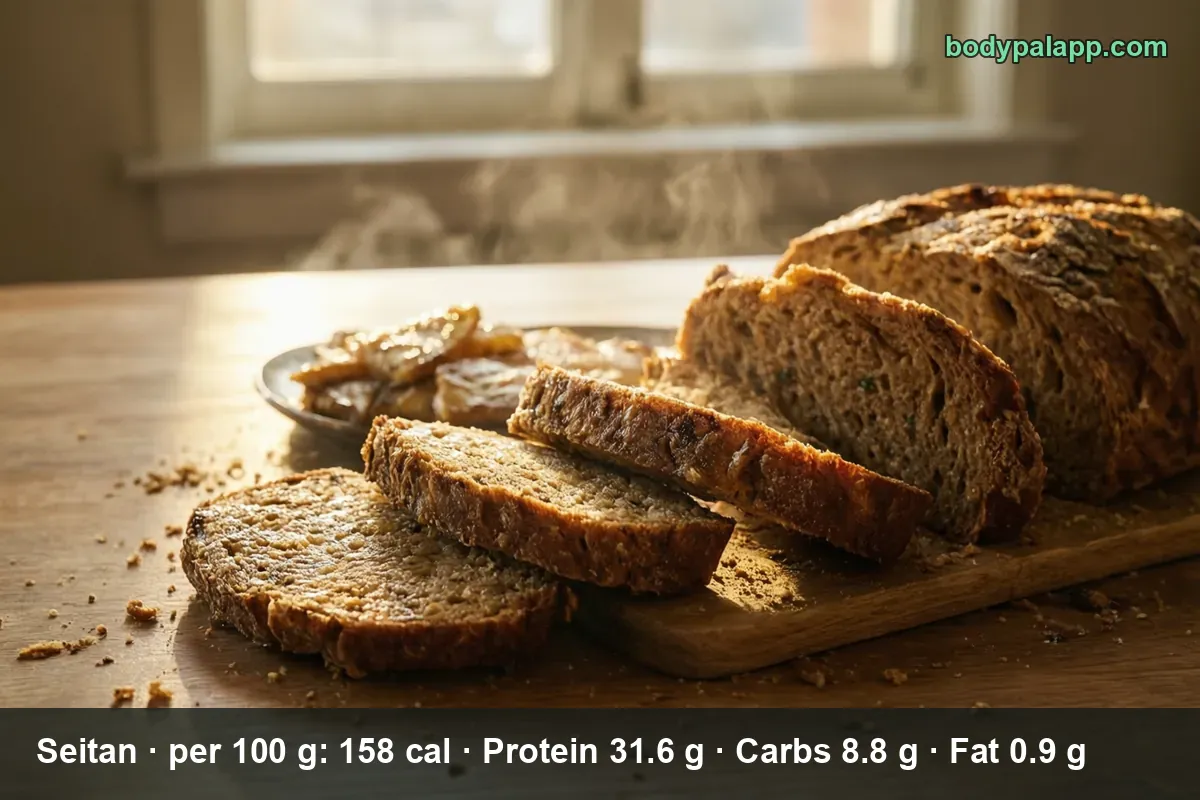
A 2 oz serving of seitan — two thick slices, 57 g — carries 90 calories. Per 100 g the same product runs 158 calories. What makes it unusual is what comes with those calories: 18 g of protein in that 2 oz serving, and almost no fat or sugar.
On this page
- Seitan quick facts
- US servings from 1 ounce to 4 ounces
- Seitan strips cubes and crumbles
- Sodium is the row to watch
- How does seitan compare?
- Most popular seitan brands
- FAQ
Seitan quick facts
There is no Foundation or Legacy record for cooked seitan in USDA FoodData Central. The only Legacy entry is dry vital wheat gluten, which is a flour, not something anyone puts on a plate. So the numbers below come from a branded label: FoodData Central 2665693, "Traditional Seitan in Chunks" from Upton's Naturals, the plainest unflavored seitan on US shelves with a full nutrient panel. Its label serving is 2 oz, about two thick slices.
| Nutrient | Per 100 g | Per 2 oz (57 g) | % Daily Value |
|---|---|---|---|
| Calories | 158 | 90 | — |
| Total fat | 0.88 g | 0.5 g | 1% |
| Saturated fat | 0 g | 0 g | 0% |
| Carbohydrate | 8.77 g | 5.0 g | 2% |
| Dietary fiber | 1.8 g | 1.0 g | 4% |
| Total sugars | 0 g | 0 g | — |
| Added sugars | 0 g | 0 g | 0% |
| Protein | 31.58 g | 18.0 g | 36% |
| Sodium | 772 mg | 440 mg | 19% |
% Daily Value is based on a 2,000-calorie diet.
Verified nutrition data
Numbers on this page come from USDA FoodData Central, the U.S. Department of Agriculture’s food composition database, and from manufacturer labels where a branded product is named. Last verified September 2026. How we verify our data →
Cholesterol is zero, as it is in every plant food, and potassium is minor: 60 mg per serving, about 1% of the Daily Value. The %DV figures follow the FDA reference amounts for a 2,000-calorie day.
Two rows deserve a second look. Protein is 36% of a full day's Daily Value inside 90 calories, which works out to almost exactly 5 calories per gram of protein. And carbohydrate is 5.0 g per serving, 2% DV, which is why seitan turns up in low-carb meal plans that ban most other wheat products. It is still wheat: seitan is pure gluten, so it is off the table for anyone avoiding it.
US servings from 1 ounce to 4 ounces
| Serving | Weight | Calories |
|---|---|---|
| 1 oz | 28 g | 44 kcal |
| 2 oz, two thick slices (label serving) | 57 g | 90 kcal |
| 3 oz, a deli-style portion | 85 g | 134 kcal |
| 4 oz, a dinner portion | 113 g | 179 kcal |
| Per 100 g | 100 g | 158 kcal |
Only one line there is a USDA serving: the 2 oz label portion at 90 calories. The 1 oz, 3 oz and 4 oz rows are our own arithmetic from the USDA 100 g figure of 158, not listed USDA servings.
The gap between the package and the plate is where people miscount. A 2 oz serving looks small next to a chicken breast, and most stir-fries and sandwich fillings use closer to 4 oz, which is 179 calories and 35.7 g of protein. That is still a light entree by weight, but the sodium doubles along with everything else, to 872 mg.
Seitan strips cubes and crumbles
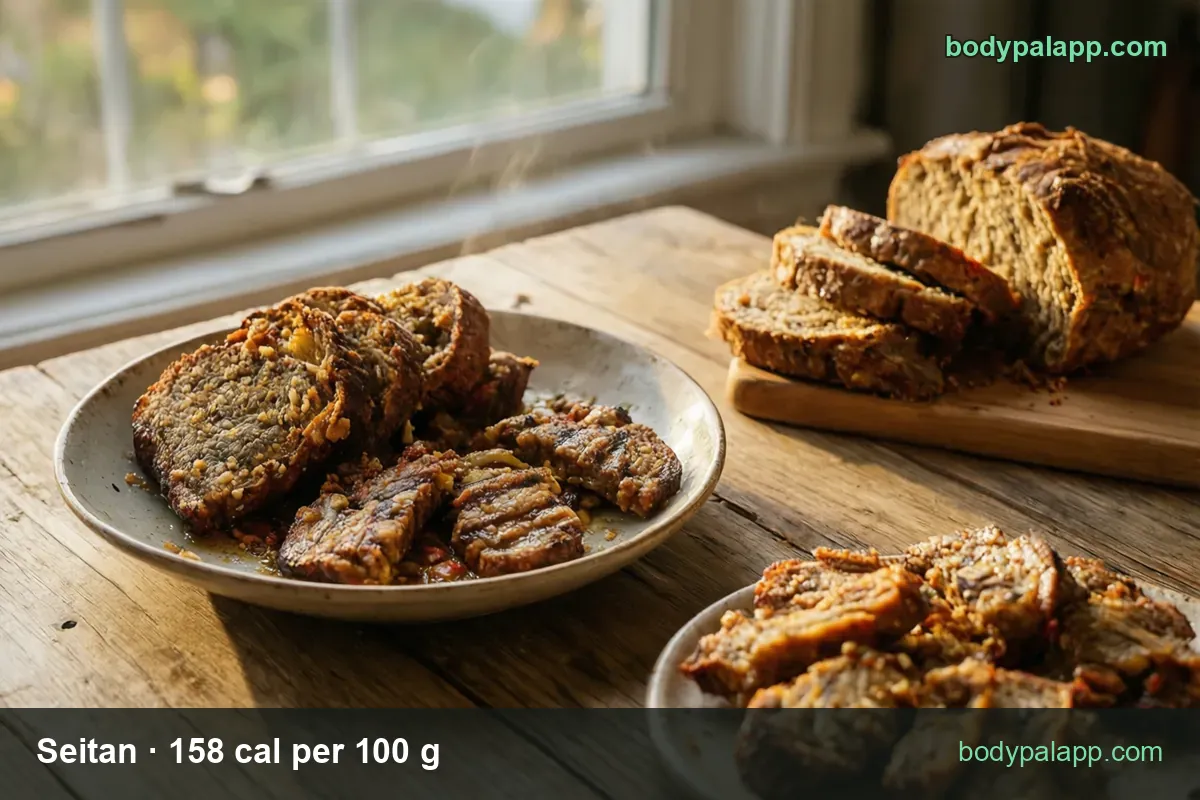
Seitan is sold in five or six shapes, and they are not interchangeable on a calorie sheet. The spread comes from water and marinade, not from the gluten itself.
| Version | Per 100 g | Typical serving | Calories |
|---|---|---|---|
| Traditional seitan, chunks | 158 kcal | 2 oz (57 g) | 90 kcal |
| Traditional seitan, strips | 158 kcal | 2 oz (57 g) | 90 kcal |
| Cubed seitan in marinade | 141 kcal | 1/3 cup (85 g) | 120 kcal |
| Seitan packed in broth | 107 kcal | 3 oz (84 g) | 90 kcal |
| Chorizo-style seitan crumbles | 175 kcal | 2 oz (57 g) | 100 kcal |
| Vital wheat gluten, dry | 370 kcal | 1/4 cup (30 g) | 111 kcal |
Chunks and strips share the same 158 per 100 g, but their protein does not: the chunks bring 18.0 g in a 2 oz serving, the strips 15.0 g, with sodium of 440 mg against 240 mg. Cubed seitan in marinade is looser at 141 per 100 g and lands at 120 calories for a 1/3 cup portion, with 21.0 g of protein and 380 mg of sodium. Broth-packed seitan is the wettest of the group at 107 per 100 g; a 3 oz serving is 90 calories, 15.0 g of protein and 250 mg of sodium. Those per-serving protein and sodium figures are our arithmetic from each label's 100 g numbers.
Chorizo-style crumbles run 175 per 100 g, or 100 calories for 2 oz — the flavored versions carry added fat and spice, and the extra 10 calories per serving is the whole price of the seasoning. The USDA record for the crumbles lists calories per serving without a full macro panel, so no protein or sodium line for it here.
The dry-versus-hydrated split is the one that catches home cooks. Vital wheat gluten is 370 calories per 100 g, more than double cooked seitan, because it is flour. A 1/4 cup scoop of the powder is 30 g and 111 calories, and those 111 calories are all the dough carries once it takes on water and swells. Water has no calories, so the flour figure and the finished figure describe the same food at two moisture levels — never average them.
Sodium is the row to watch
Seitan's calorie number is friendly. Its salt number is not. A 2 oz serving of the traditional chunks holds 440 mg of sodium, 19% of the Daily Value, and 100 g holds 772 mg, or 34%. In kitchen terms, one serving is roughly a fifth of a teaspoon of table salt hidden inside a food that tastes savory rather than salty.
That happens because gluten dough has almost no flavor of its own and is simmered in salted broth, soy sauce or tamari. The salt is in the cooking liquid, so it soaks all the way through the loaf. Brands land far apart: 772 mg per 100 g for the traditional chunks, 447 mg for the cubed style, 421 mg for the strips, 298 mg for the broth-packed original. That is a 2.6-fold range for what is nominally the same food.
The Dietary Guidelines for Americans put the adult ceiling at 2,300 mg of sodium a day. A 4 oz seitan dinner at 872 mg spends more than a third of it before the sauce, and stir-fry sauce is usually salty too. If you are watching sodium, choose the broth-packed style and season the pan yourself.
The upside is on the other side of the panel. Protein is 31.58 g per 100 g, 63% of the Daily Value, and MyPlate counts seitan among protein foods alongside beans and soy. Because it is wheat gluten, its amino acid profile is short on lysine, so beans, lentils or soy elsewhere in the day round it out.
How does seitan compare?
| Product | Per 100 g | US serving | Calories | Protein |
|---|---|---|---|---|
| Traditional seitan, chunks | 158 kcal | 2 oz (57 g) | 90 kcal | 18.0 g |
| Seitan packed in broth | 107 kcal | 3 oz (84 g) | 90 kcal | 15.0 g |
| Cubed seitan in marinade | 141 kcal | 1/3 cup (85 g) | 120 kcal | 21.0 g |
| Vital wheat gluten, dry | 370 kcal | 1/4 cup (30 g) | 111 kcal | 22.5 g |
Our take: the two 90-calorie rows tell the story. For the same 90 calories you get 57 g of the traditional chunks or 84 g of the broth-packed version, so the wetter product gives you half again as much food on the fork and 190 mg less sodium — that is the pick if you are eating for fullness or watching salt. If you are eating for protein per calorie, the traditional chunks win among the ready-to-eat rows at 5.0 calories per gram of protein. The dry gluten column is a trap: 370 per 100 g looks alarming next to the others, but nobody eats it dry, and its serving of 111 calories sits right in line with the rest.
Most popular seitan brands in the United States
Ranked by how widely each product appears among foods sold in the United States, from the BodyPal food database of over 3.3 million products. Calories are the figures printed on each Nutrition Facts label, checked against USDA FoodData Central.
| Product | Calories (per 100 g) |
|---|---|
| Upton's Naturals Traditional Seitan | 158 cal |
| Upton's Naturals Chorizo Seitan Crumbles | 175 cal |
| Upton's Naturals Bacon Seitan Strips | 140 cal |
| Sweet Earth Traditional Seitan Strips | 158 cal |
| WestSoy Seitan Wheat Protein Cubed | 141 cal |
| Pacific Foods Seitan Original | 107 cal |
Brand popularity: BodyPal food database. Nutrition: manufacturer labels / USDA FoodData Central.
Seitan FAQs
How many calories are in seitan?
90 calories in a 2 oz serving, which is two thick slices weighing 57 g, and 158 calories per 100 g. That is the traditional unflavored kind. Seitan packed in broth drops to 107 per 100 g, while chorizo-style crumbles climb to 175 per 100 g.
How much protein is in 100 g of seitan?
31.58 g of protein per 100 g, which is 63% of the Daily Value. The 2 oz label serving still carries 18 g, or 36% DV, for 90 calories. That works out to about 5 calories per gram of protein, and very little else rides along.
How many calories in 4 oz of seitan?
179 calories in 4 oz (113 g), our own arithmetic from the USDA 100 g figure of 158, not a listed USDA serving. That plate brings 35.7 g of protein and 872 mg of sodium, which is 38% of the Daily Value for sodium in one sitting.
Is seitan good for weight loss?
90 calories for 18 g of protein is about as efficient as a plant food gets, so seitan works well in a calorie deficit. The catch is sodium: 440 mg per serving, 19% DV. If you are watching salt, the broth-packed version at 298 mg per 100 g is the better pick.
Why is seitan so high in sodium?
440 mg in a 2 oz serving, 19% of the Daily Value, because the gluten is simmered in salted broth or tamari rather than water. Brands differ a lot: the traditional chunks run 772 mg per 100 g, the broth-packed version only 298 mg. The salt soaks all the way through.
How many calories in vital wheat gluten?
370 calories per 100 g of the dry flour, and 111 calories in a 1/4 cup (30 g) scoop. That is more than double cooked seitan's 158 per 100 g, because hydrating the gluten adds water, not calories. The dry powder is also 75.16 g protein per 100 g.
Is seitan a complete protein?
31.58 g of protein per 100 g, but it is all wheat gluten, which is low in the amino acid lysine. Pairing it with beans, lentils or soy over the day covers the gap, and MyPlate treats all of them as protein foods. The calorie math does not change.
How many calories in homemade seitan?
About 111 calories per 1/4 cup (30 g) of vital wheat gluten, the only calorie-carrying ingredient in a basic dough, and that is our own arithmetic from the USDA 370 per 100 g figure. Water adds none. Broth, soy sauce and oil are what raise the number.
Similar foods
- Eye of round steak — 135 cal for 3 oz cooked
- Roast Beef — 142 cal per 3 oz
- Steelhead trout — 143 cal for 3 oz cooked
- Shrimp Pad Thai — 294 cal per cup
- Spaghetti And Meatballs — 961 cal per plate
- Toor Dal — 348 cal per cup
Count it without the math
Point the camera at the plate and BodyPal counts the seitan for you, slices and sauce alike.


How long does it take to burn off seitan?
A 2 oz (57 g) serving is 90 kcal. Enter your weight and the amount you ate to see how long it takes you to burn that off:
lb
| Activity | Time to burn 90 kcal |
|---|---|
| Walking, brisk | 18 min |
| Cycling, moderate | 11 min |
| Swimming, moderate | 13 min |
| Jogging | 11 min |
| Weight training, moderate | 20 min |
Times are for a 155 lb adult at a steady pace; change the weight to see yours. The amount is set to the portion in the text (57 g); change it to what you actually ate. BodyPal works this out from your steps automatically.
Burning it off is one side of it. The other is knowing your number: work out how many calories you need a day, with macros and a goal date.