
How many calories are in a shrimp sushi roll?
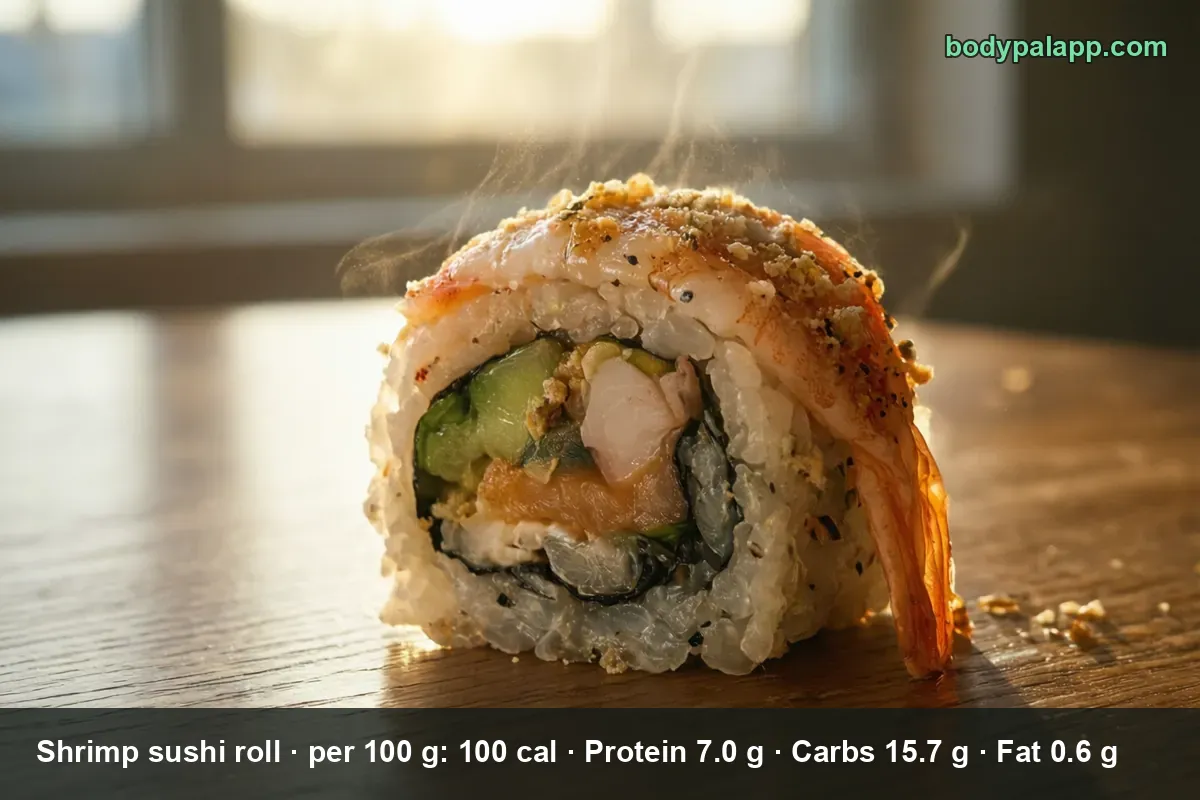
A shrimp sushi roll cut into six pieces weighs about 180 g and carries 180 calories — a flat 100 calories per 100 g, which puts it mid-pack in a case where the rolls run from 93 to 103. A single piece is 30. What that tidy number hides is the sodium: 644 mg sits inside one roll.
On this page
- Shrimp sushi roll quick facts
- US servings from one piece to a whole roll
- Other rolls in the same case
- Sodium is the row to watch
- How does a shrimp sushi roll compare?
- Most popular shrimp sushi roll brands
- Shrimp sushi roll FAQs
Shrimp sushi roll quick facts
The row used here is FNDDS 2708964, "Sushi roll, shrimp", from the 2021–2023 survey release. It is the only USDA record written specifically for a shrimp roll, and it describes the finished thing you actually pick up with chopsticks: seasoned rice, nori, shrimp and filling, already assembled. Building the number from raw shrimp plus dry rice would miss the sugar and salt that go into the rice, and those are where a surprising share of this food's profile lives.
The serving column below is the whole roll — six pieces, 180 g — because that is the unit a takeout box or a supermarket tray hands you.
| Nutrient | Per 100 g | Per 1 roll, 6 pieces (180 g) | % Daily Value |
|---|---|---|---|
| Calories | 100 | 180 | — |
| Total fat | 0.55 g | 1.0 g | 1% |
| Saturated fat | 0.15 g | 0.3 g | 1% |
| Carbohydrate | 15.67 g | 28.2 g | 10% |
| Dietary fiber | 0.7 g | 1.3 g | 4% |
| Total sugars | 0.92 g | 1.7 g | — |
| Protein | 7.01 g | 12.6 g | 25% |
| Sodium | 358 mg | 644 mg | 28% |
% Daily Value is based on a 2,000-calorie diet.
Verified nutrition data
Numbers on this page come from USDA FoodData Central, the U.S. Department of Agriculture’s food composition database, and from manufacturer labels where a branded product is named. Last verified September 2026. How we verify our data →
Two label rows are missing on purpose. Added sugars and trans fat are not published for mixed dishes in this FNDDS release, so there is no honest figure to print — the seasoned rice certainly contains some added sugar, but USDA does not quantify it here. Cholesterol and potassium do exist for this record: 51 mg and 53 mg per 100 g, which work out to 92 mg of cholesterol (31% DV) and 95 mg of potassium (2% DV) in one roll. The cholesterol is worth a second look, and it gets one further down.
US servings from one piece to a whole roll
| Serving | Weight | Calories |
|---|---|---|
| 1 piece | 30 g | 30 kcal |
| 1 oz | 28.3 g | 28 kcal |
| 1 cup, cut pieces | 150 g | 150 kcal |
| 1 roll, 6 pieces | 180 g | 180 kcal |
| 8 pieces, larger cut | 240 g | 240 kcal |
| Per 100 g | 100 g | 100 kcal |
The 30 g piece, the 150 g cup and the 180 g roll are USDA household measures attached to this record. The eight-piece line and the one-ounce line are our own arithmetic from the USDA 100 g figure, not USDA servings — some counters cut a roll into eight, and an ounce is only useful as a mental yardstick.
That cup measure is the trap. A cup of cut sushi pieces is 150 g, which is five pieces and 150 calories — it is a volume for a leftovers container, not a way anyone eats sushi. If a recipe or a tracker offers you "1 cup" for a roll, you are logging five-sixths of a roll, and the sodium scales with it: 537 mg, again by our own arithmetic from the 100 g figure. Count pieces instead. Pieces are what the tray gives you.
Other rolls in the same case
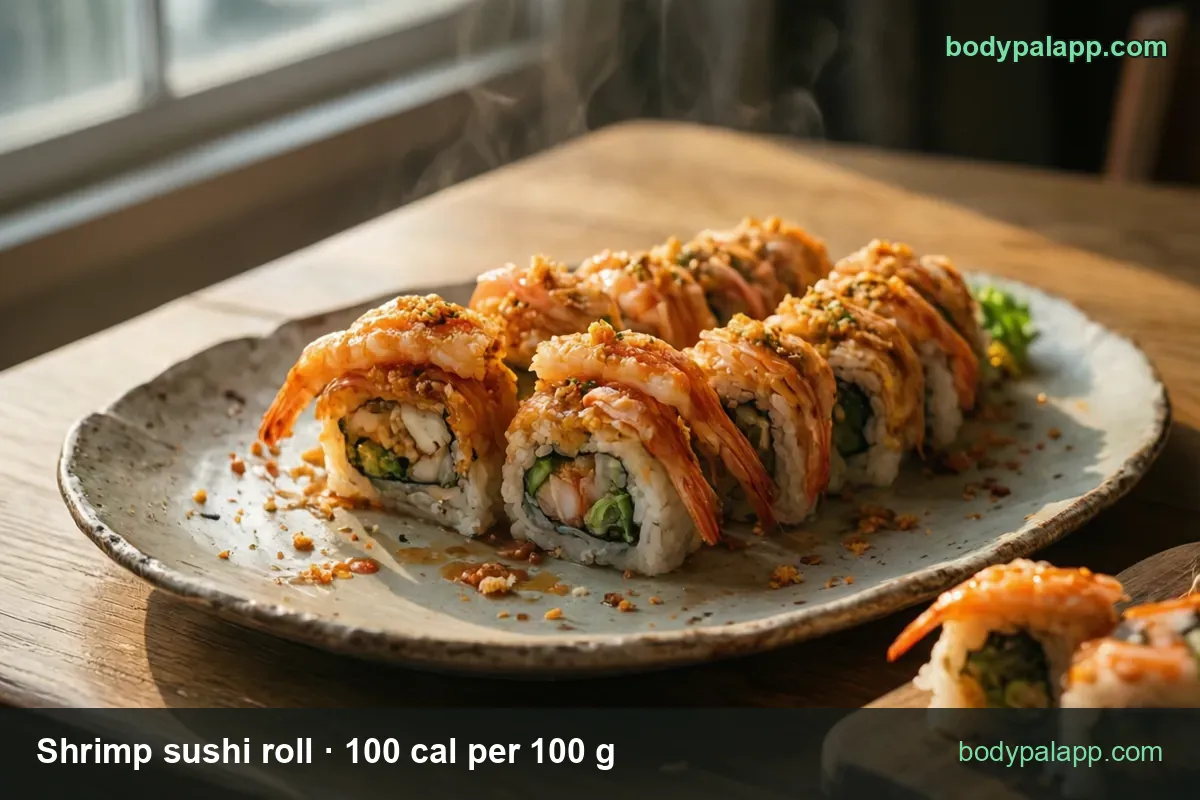
Swapping the fish barely moves the calories, because in every one of these rolls the rice is doing most of the work. What changes is protein and fat.
| Version | Per 100 g | Typical piece | Calories |
|---|---|---|---|
| Shrimp roll | 100 kcal | 1 piece (30 g) | 30 kcal |
| Tuna roll | 97 kcal | 1 piece (30 g) | 29 kcal |
| Salmon roll | 103 kcal | 1 piece (30 g) | 31 kcal |
| California roll | 94 kcal | 1 piece (30 g) | 28 kcal |
| Avocado roll | 93 kcal | 1 piece (30 g) | 28 kcal |
| Shrimp nigiri | 103 kcal | 1 piece (30 g) | 31 kcal |
Across all six, the spread is three calories a piece. The avocado roll is the lightest per 100 g at 93 and the salmon roll and shrimp nigiri the heaviest at 103, and nobody has ever changed their day by choosing between them.
Protein tells a different story. The shrimp roll holds 7.01 g per 100 g; the California roll, built on imitation crab, holds 2.92 g — 2.4 times less, for essentially the same calories. Fat splits the same way in reverse: 0.55 g per 100 g in the shrimp roll against 1.28 g in the salmon roll, since salmon brings its own oil. Shrimp nigiri, at 9.1 g of protein per 100 g, is the most protein-dense option in the case precisely because it is mostly shrimp with a small pad of rice under it rather than a rice cylinder.
One quiet detail from the database: USDA's catch-all "Sushi, NFS" row carries the exact numbers of the California roll — 94 calories, 2.92 g of protein, 18.39 g of carbohydrate per 100 g. If a tracker shows you a generic "sushi" entry, that is very likely what you are logging, and it understates the protein of a real shrimp roll by more than half.
A shrimp tempura roll is a different food, and USDA does not publish a row for it, so there is no number here to quote. Directionally, the plain roll starts from 1.0 g of fat for the whole thing; battered, fried shrimp and a drizzle of creamy sauce are the only things on this page capable of moving that line by a lot.
Sodium is the row to watch
At 180 calories, a whole roll is 9% of a 2,000-calorie day. Its sodium is 28% of a day — three times its calorie share. That 644 mg is roughly a quarter teaspoon of table salt, and it is baked in before the soy sauce, which typically adds several hundred milligrams more per tablespoon. The Dietary Guidelines for Americans put the limit at less than 2,300 mg a day, the same figure the FDA uses for the Daily Value on the Nutrition Facts label. Two rolls and a dish of soy sauce can take most of it.
Cholesterol is the other outlier: 92 mg per roll, 31% of the Daily Value, in a food carrying 1.0 g of total fat. That combination is unusual, and it comes entirely from the shellfish. If you are watching sodium or cholesterol on a doctor's advice, the shrimp roll is the sushi item to count rather than wave through.
The good news sits in the protein column. Twelve and a half grams for 180 calories is 25% of the Daily Value in a dish most people file under "snack," and it comes from the seafood group that MyPlate asks Americans to eat about eight ounces of per week. Fat is 1% DV. As lunch architecture goes, that is a rare shape.
How does a shrimp sushi roll compare?
| Roll | Per 100 g | US serving | Calories |
|---|---|---|---|
| Shrimp roll | 100 kcal | 1 piece (30 g) | 30 kcal |
| Tuna roll | 97 kcal | 1 piece (30 g) | 29 kcal |
| Salmon roll | 103 kcal | 1 piece (30 g) | 31 kcal |
| California roll | 94 kcal | 1 piece (30 g) | 28 kcal |
Our take: pick by protein, not by calories, because the calories are already identical. For weight loss, two shrimp rolls at 360 calories buy 25.2 g of protein and will hold you longer than two California rolls would, and the tuna roll is the one alternative that matches the shrimp on protein while carrying less than half the fat. For fullness, add miso or edamame rather than a third roll — a third roll adds 644 mg more sodium for 180 calories, and the salt, not the calories, is what this meal spends fastest.
Most popular shrimp sushi roll brands in the United States
Ranked by how widely each product appears among foods sold in the United States, from the BodyPal food database of over 3.3 million products. Calories are the figures printed on each Nutrition Facts label, checked against USDA FoodData Central.
| Product | Calories (per 100 g) |
|---|---|
| Bento Sushi Spicy Shrimp Roll | 229 cal |
| Genji Shrimp Tempura Kabuki Roll | 181 cal |
| Fujisan Shrimp Tempura Roll | 180 cal |
| Snowfox Sharry Dog Shrimp Tempura Roll | 179 cal |
| AFC Baby Shrimp Cream Cheese Roll | 160 cal |
| Banzai Shrimp & Avocado Roll | 113 cal |
Brand popularity: BodyPal food database. Nutrition: manufacturer labels / USDA FoodData Central.
Shrimp sushi roll FAQs
How many calories are in a shrimp sushi roll?
A six-piece shrimp sushi roll is 180 calories, based on USDA's figure of 100 calories per 100 g and a 180 g roll. That is lighter than most restaurant appetizers, and the rice accounts for nearly all of the 28.2 g of carbohydrate. The shrimp adds 12.6 g of protein.
How many calories are in one piece of shrimp sushi roll?
One piece is 30 calories at a typical 30 g. Six pieces make the standard roll, so a whole roll lands at 180. If your tray holds eight pieces instead, that is 240 g and 240 calories, by our own arithmetic from the USDA 100 g figure rather than a USDA serving.
How much protein is in a shrimp sushi roll?
A whole shrimp sushi roll delivers 12.6 g of protein, which is 25% of the Daily Value. Per 100 g that is 7.01 g. A tuna roll is slightly higher at 7.4 g per 100 g, while a California roll built on imitation crab falls to 2.92 g for the same calories.
Is a shrimp sushi roll high in sodium?
Yes. One roll carries 644 mg of sodium, 28% of the Daily Value, at only 180 calories. That is roughly a quarter teaspoon of table salt before you touch the soy sauce. On a sushi tray, sodium rather than calories is the number that runs out first.
Shrimp roll vs California roll: which has fewer calories?
A California roll is slightly lighter at 94 calories per 100 g against 100 for the shrimp roll, so 28 calories a piece versus 30. The protein gap is the real story: 7.01 g per 100 g in the shrimp roll against 2.92 g in the California roll, a difference of 2.4 times.
How many carbs are in a shrimp sushi roll?
A six-piece roll holds 28.2 g of carbohydrate, 10% of the Daily Value, and 1.3 g of that is fiber. Almost all of it is the seasoned rice rather than the filling. Per 100 g the roll runs 15.67 g of carbohydrate and 0.92 g of total sugars.
How much cholesterol is in shrimp sushi?
One roll supplies 92 mg of cholesterol, 31% of the Daily Value, and it comes from the shrimp rather than from fat, since the whole roll holds just 1.0 g of total fat. Per 100 g the figure is 51 mg, which is high for a dish this light on calories.
Does a shrimp tempura roll have more calories than a shrimp sushi roll?
A shrimp tempura roll has no USDA row, so the only firm number here is the plain roll's 180 calories for six pieces. Batter, frying oil and a creamy drizzle all add fat that USDA does not quantify, so treat any tempura figure you see as an estimate rather than a measured value.
Similar foods
- Injera — 118 cal per injera (12 in)
- Shrimp Tempura Roll — 432 cal per roll, 8 pieces
- Fish Cake — 180 cal per cake or patty
- Bagel — 277 cal per bagel
- Sesame bagel — 277 cal per medium bagel
- Bread — 75 cal per medium slice
Count it without the math
Point the camera at the tray and BodyPal counts the pieces for you, rice and all.


How long does it take to burn off 180 kcal of shrimp sushi roll?
One roll of six pieces (180 g) is 180 kcal. Enter your weight and the amount you ate to see how long it takes you to burn that off:
lb
| Activity | Time to burn 180 kcal |
|---|---|
| Walking, brisk | 36 min |
| Cycling, moderate | 22 min |
| Swimming, moderate | 26 min |
| Jogging | 21 min |
| Weight training, moderate | 40 min |
Times are for a 155 lb adult at a steady pace; change the weight to see yours. The amount is set to the portion in the text (180 g); change it to what you actually ate. BodyPal works this out from your steps automatically.
One food is easy to picture; a whole day is harder. See how many calories you need a day and what a deficit actually looks like.