
How many calories are in a summer shandy?
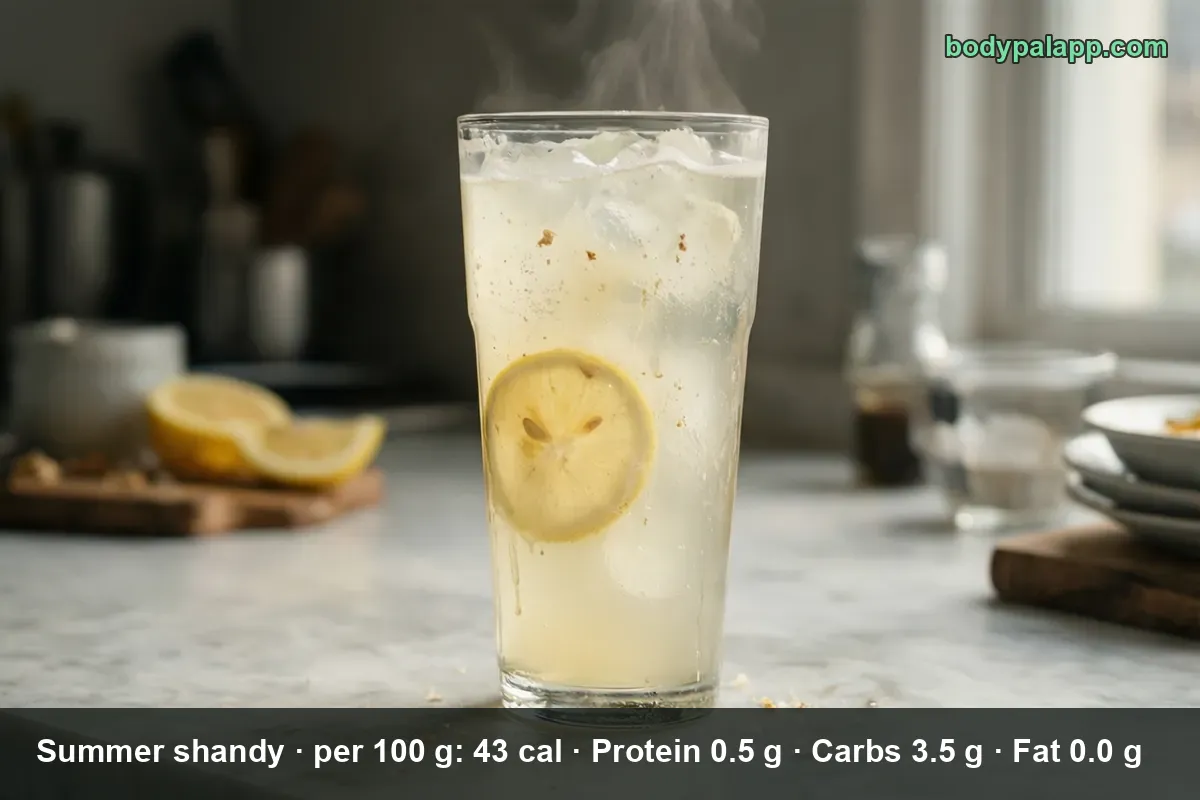
A 12 fl oz can of summer shandy carries 155 calories, and the beer it is built on runs 43 calories per 100 g. That is a modest number for a full can, and almost two thirds of it is alcohol rather than carbohydrate. Pour the same drink into a 16 fl oz glass and it climbs to 206.
On this page
- Summer shandy quick facts
- US servings from one ounce to a 40 oz bottle
- Shandy bases from light beer to hard lemonade
- Where the 155 calories actually come from
- How does a summer shandy compare?
- Summer shandy FAQs
Summer shandy quick facts
A shandy is beer cut with lemonade, and USDA FoodData Central has no record under either "shandy" or "radler." The honest base is plain beer: FNDDS 2710616, "Beer", at 43 calories per 100 g. That record was picked over the identical SR Legacy entry 168746 because it carries the household measures Americans actually pour, the 12 fl oz can and the 16 fl oz glass.
The tempting alternative was one of the sweetened malt rows, and it is the wrong pick. Those sit at 68 calories per 100 g and land at 245 for a 12 fl oz serve, because they are lemonade-flavored malt drinks, not beer with lemonade stirred in. If your can is a heavily sweetened seltzer-style product, read its own label instead.
| Nutrient | Per 100 g | Per 1 can or bottle, 12 fl oz (360 g) | % Daily Value |
|---|---|---|---|
| Calories | 43 | 155 | — |
| Total fat | 0 g | 0 g | 0% |
| Saturated fat | 0 g | 0 g | 0% |
| Carbohydrate | 3.55 g | 12.8 g | 5% |
| Dietary fiber | 0 g | 0 g | 0% |
| Total sugars | 0 g | 0 g | — |
| Protein | 0.46 g | 1.7 g | 3% |
| Sodium | 4 mg | 14 mg | 1% |
% Daily Value is based on a 2,000-calorie diet.
Verified nutrition data
Numbers on this page come from USDA FoodData Central, the U.S. Department of Agriculture’s food composition database, and from manufacturer labels where a branded product is named. Last verified September 2026. How we verify our data →
Two rows you would see on a package are missing here on purpose. FNDDS does not report added sugars or trans fat for beverages, so neither figure is published on this page. That matters for a shandy specifically, because the lemonade half is exactly where added sugar would show up, and this record cannot see it.
Cholesterol is 0 mg. Potassium is 27 mg per 100 g, which works out to 97 mg in a 12 fl oz can, or 2% of the Daily Value set by the FDA.
US servings from one ounce to a 40 oz bottle
| Serving | Weight | Calories |
|---|---|---|
| 1 fl oz | 30 g | 13 kcal |
| 1 oz | 28 g | 12 kcal |
| 1 can or bottle, 12 fl oz | 360 g | 155 kcal |
| 1 glass, 16 fl oz | 480 g | 206 kcal |
| 1 bottle, 40 fl oz | 1200 g | 516 kcal |
| Per 100 g | 100 g | 43 kcal |
The 1 fl oz, 12 fl oz, 16 fl oz and 40 fl oz lines are USDA household measures attached to the beer record. The 1 oz row is our own arithmetic from the USDA 100 g figure, not a USDA serving, and it is there only because kitchen scales weigh in ounces while glassware is measured in fluid ounces.
That distinction is where most people miscount. A fluid ounce of shandy weighs about 30 g, so "one ounce" on a scale and "one ounce" in a glass are not the same amount of drink. And the jump from a can to a glass is bigger than it feels: 12 fl oz is 155 calories, 16 fl oz is 206, so the taller glass adds 51 calories to the identical beverage. Three of those over an afternoon is a full extra can.
The 40 fl oz bottle is the one worth respecting. At 516 calories it is more than three cans, and it is usually finished by one person because it does not resemble a serving.
Shandy bases from light beer to hard lemonade
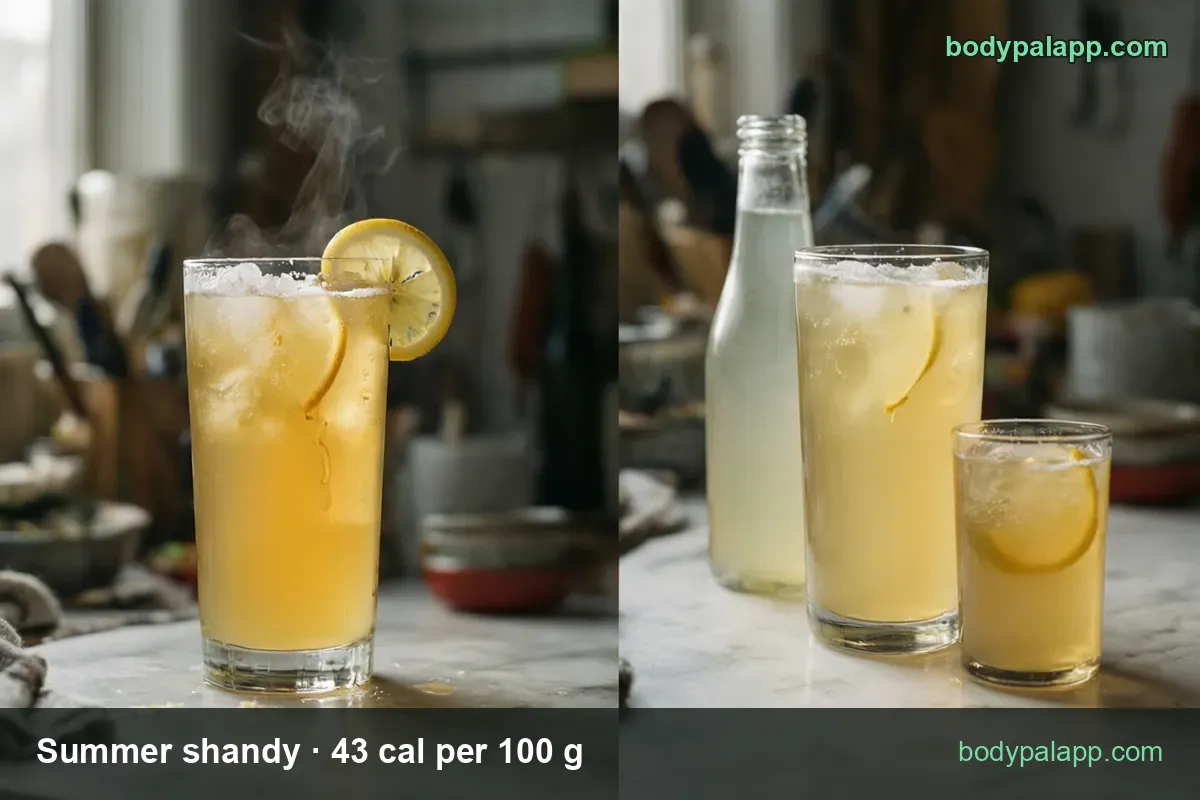
Shandy is a recipe, not a single product, so the calorie count follows whatever went into the glass. Each of these is a separate USDA record, scaled to the same 12 fl oz (360 g) pour.
| Version | Per 100 g | 12 fl oz serving | Calories |
|---|---|---|---|
| Light beer shandy | 29 kcal | 360 g | 104 kcal |
| Regular beer base | 43 kcal | 360 g | 155 kcal |
| Nonalcoholic beer base | 37 kcal | 360 g | 133 kcal |
| Hard cider | 56 kcal | 360 g | 202 kcal |
| Higher-alcohol craft base | 58 kcal | 360 g | 209 kcal |
| Hard lemonade | 68 kcal | 360 g | 245 kcal |
A light beer base is the cheapest way to build one, at 104 calories and 5.9 g of carbohydrate per 12 fl oz. A higher-alcohol craft base runs 209 for the same volume while carrying only 1.0 g of carbohydrate, which is the clearest proof that the carb column is not driving the total.
The hard lemonade record is the other end. At 245 calories per 12 fl oz it is 90 above the beer base, with 36.3 g of carbohydrate and 35.2 g of total sugars in the same serving. If your "shandy" came out of a can that tastes like lemonade first and beer second, that row is the closer match.
The nonalcoholic base is the interesting one. It is lighter overall at 133 calories, but 29.0 g of that serving is carbohydrate, nearly all of it sugar, because the alcohol calories were replaced by residual sweetness. Lower calories, more carbs, opposite trade.
Where the 155 calories actually come from
Run the macros and they do not add up to the total. Carbohydrate contributes 12.8 g and protein 1.7 g in a 12 fl oz can, which accounts for roughly 58 of the 155 calories. There is no fat at all. The remaining 97 calories come from alcohol, which has no Daily Value and never appears in a macro column.
This is why a shandy tracks badly if you log macros only. Three cans is a bit over 460 calories with a carbohydrate total that still reads as unremarkable, around 15% of the Daily Value, while the calorie total has quietly matched a full meal.
The %DV line is genuinely mild everywhere else: 5% carbohydrate, 3% protein, 1% sodium, 0% fat, 0% saturated fat. Sodium in particular is a non-issue at 14 mg per can, so if you are watching sodium, this is not the drink to worry about. The Dietary Guidelines for Americans treat alcohol calories as calories that displace nutrition rather than add it, and this record is a clean illustration: outside 1.7 g of protein and 97 mg of potassium, there is almost nothing in the can but energy. The CDC's alcohol pages are the right place for drinking limits, which are a separate question from calorie counting.
One more caution on the number itself. USDA has no shandy record, so 155 is the beer base, and a commercial can that adds lemonade concentrate will read higher on its own label. When a brand publishes a figure, that figure wins.
How does a summer shandy compare?
| Drink | Per 100 g | US serving | Calories |
|---|---|---|---|
| Summer shandy, beer base | 43 kcal | 12 fl oz, 360 g | 155 kcal |
| Light beer | 29 kcal | 12 fl oz, 360 g | 104 kcal |
| Hard cider | 56 kcal | 12 fl oz, 360 g | 202 kcal |
| Sweetened malt beverage | 68 kcal | 12 fl oz, 360 g | 245 kcal |
Our take: light beer is the only drink on this table that comes in under the shandy, and it does so by 51 calories a can. If you are cutting, that swap is the whole decision, and it costs you flavor rather than volume. If you want the citrus taste and you are choosing between a shandy and a canned sweetened malt drink, the shandy wins by 90 calories per 12 fl oz and by 23.5 g of carbohydrate. Hard cider sits in between at 202, closer to the malt drink than to the beer.
Summer shandy FAQs
How many calories are in a summer shandy?
A 12 fl oz can is 155 calories, based on the USDA beer record at 43 calories per 100 g. About 97 of those calories come from alcohol and only 58 from the 12.8 g of carbohydrate and 1.7 g of protein. A commercial can with added lemonade will read a little higher.
How many calories are in a 16 oz summer shandy?
A 16 fl oz glass weighs 480 g and comes to 206 calories, 51 more than the 12 fl oz can. It is the same drink in taller glassware, which is the easiest way to add calories without noticing. A 40 fl oz bottle reaches 516 calories on the same math.
How many carbs are in a summer shandy?
12.8 g of carbohydrate in a 12 fl oz can, which is 5% of the Daily Value. Per 100 g the figure is 3.55 g. A light beer base drops that to 5.9 g per 12 fl oz, while a hard lemonade base pushes it up to 36.3 g for the same volume.
Is a shandy lower in calories than beer?
Not on USDA numbers: the base for a shandy is beer itself at 43 calories per 100 g, so 155 per 12 fl oz is the beer figure, and adding lemonade can only push it up. Light beer at 104 calories per 12 fl oz is the genuinely lighter option here.
How much alcohol is in a summer shandy?
The USDA record behind the 155 calories does not publish alcohol by volume, so this page does not quote a percentage. What the numbers do show is that about 97 of those calories are alcohol calories, since carbohydrate and protein account for only 58 of them.
Does a summer shandy have sugar?
The USDA beer record lists 0 g of total sugars, but that is the beer half only. FNDDS does not report added sugars for beverages, so lemonade sugar is invisible here. For scale, a sweetened hard lemonade at the same 12 fl oz carries 35.2 g of total sugars.
Is a shandy keto friendly?
At 12.8 g of carbohydrate per 12 fl oz, one can uses a large share of a very low-carb day, and a sweetened version at 36.3 g uses more than most such plans allow. A higher-alcohol craft base is the low-carb outlier at 1.0 g, though it costs 209 calories.
What is the difference between a shandy and a radler?
Mostly the citrus, not the 155 calories. A shandy is beer mixed with lemonade or lemon soda, a radler is the German version, traditionally beer with grapefruit or lemon soda. Neither has its own USDA record, so both are counted from the beer base at 43 calories per 100 g, or 155 per 12 fl oz.
Similar foods
- Beer — 155 cal for 12 fl oz can
- Beer (Lager) — 153 cal per can
- Corona Beer — 153 cal per bottle
- Guinness Stout Beer — 153 cal per bottle
- Heineken Beer — 153 cal per bottle
- Beer Pint — 206 cal per pint
Count it without the math
Point the camera at the glass and BodyPal counts the shandy for you, can or 16 oz pour.


How long does it take to burn off summer shandy?
A 12 fl oz can (360 g) is 155 kcal. Enter your weight and the amount you ate to see how long it takes you to burn that off:
lb
| Activity | Time to burn 155 kcal |
|---|---|
| Walking, brisk | 31 min |
| Cycling, moderate | 19 min |
| Swimming, moderate | 22 min |
| Jogging | 18 min |
| Weight training, moderate | 34 min |
Times are for a 155 lb adult at a steady pace; change the weight to see yours. The amount is set to the portion in the text (360 g); change it to what you actually ate. BodyPal works this out from your steps automatically.
This table assumes you know your daily total. If you do not, the daily calorie calculator works it out from five numbers.