
How many calories are in toast?
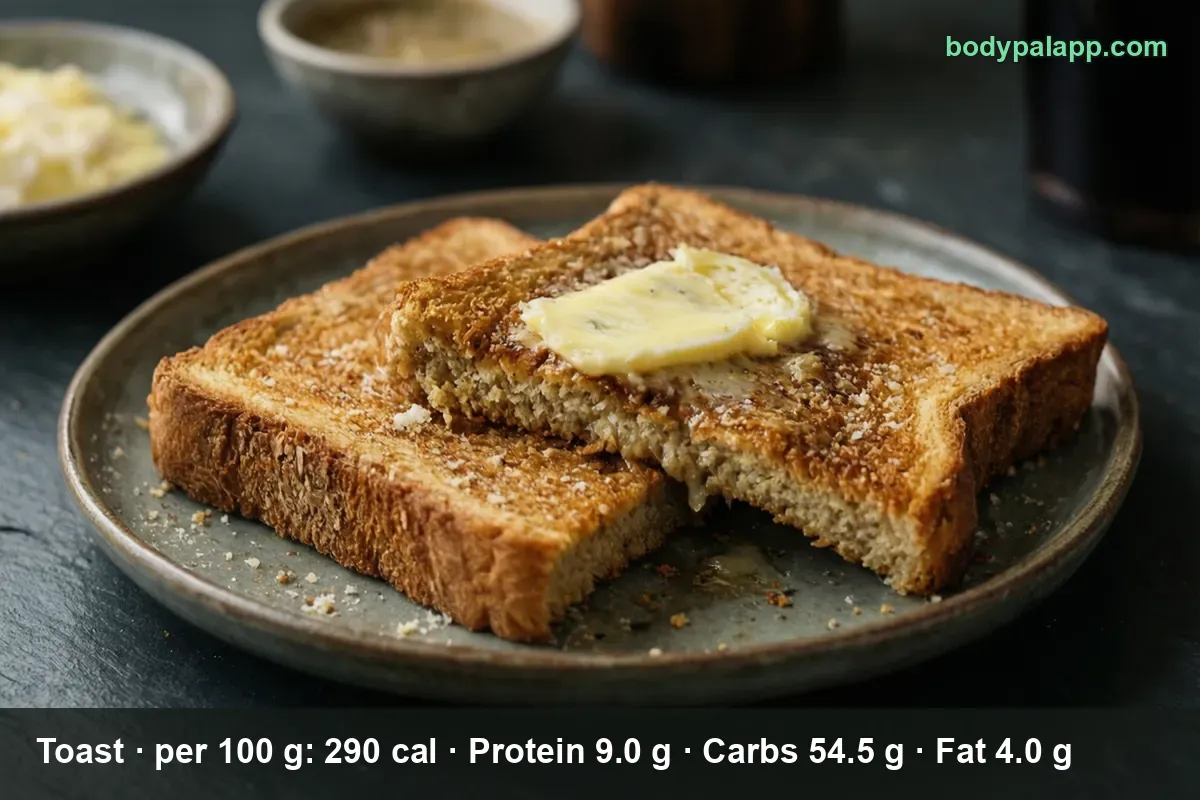
One slice of toast from a standard loaf of commercial white bread weighs 22 g and carries 64 calories. Per 100 g, toasted white bread runs 290 calories — a big-looking number for something this light, but a slice is small, so the plate stays cheap right up until the butter knife comes out.
On this page
- Toast quick facts
- US servings, from a thin slice to two slices
- White, whole wheat, sourdough and the rest
- Sodium is the row that moves first
- How does toast compare?
- Toast FAQs
Toast quick facts
The record behind every number on this page is SR Legacy 174925, "Bread, white, commercially prepared, toasted". It is the one entry that ships with real household measures for a slice — thin, regular and large — which is exactly how people eat it. Other toasted breads (whole wheat, rye, sourdough, gluten-free) each have their own record, and they get their own section further down rather than being blended into an average here.
If you type "toast" into a search box you also hit French toast dishes, melba toast crackers and a wall of Cinnamon Toast Crunch products. Those are different foods, not versions of this one, and none of them are included below.
| Nutrient | Per 100 g | Per 1 slice (22 g) | % Daily Value |
|---|---|---|---|
| Calories | 290 | 64 | — |
| Total fat | 4 g | 0.9 g | 1% |
| Saturated fat | 0.76 g | 0.2 g | 1% |
| Carbohydrate | 54.5 g | 12.0 g | 4% |
| Dietary fiber | 2.9 g | 0.6 g | 2% |
| Total sugars | 6.2 g | 1.4 g | — |
| Protein | 9 g | 2.0 g | 4% |
| Sodium | 537 mg | 118 mg | 5% |
% Daily Value is based on a 2,000-calorie diet.
Verified nutrition data
Numbers on this page come from USDA FoodData Central, the U.S. Department of Agriculture’s food composition database, and from manufacturer labels where a branded product is named. Last verified September 2026. How we verify our data →
Two label rows you would expect are missing on purpose. USDA does not publish added sugars or trans fat for this record, so rather than guess at them, they are left out. The 6.2 g of total sugars per 100 g is mostly what the loaf was baked with, and total sugars carry no Daily Value of their own, which is why that cell is a dash. Cholesterol is negligible at 1 mg per 100 g, and a slice brings 29 mg of potassium, about 1% of the 4,700 mg Daily Value published by the FDA.
US servings, from a thin slice to two slices
| Serving | Weight | Calories |
|---|---|---|
| 1 thin slice | 17 g | 49 kcal |
| 1 slice, standard | 22 g | 64 kcal |
| 1 slice, large | 27 g | 78 kcal |
| 2 slices | 44 g | 128 kcal |
| 1 oz | 28 g | 82 kcal |
| Per 100 g | 100 g | 290 kcal |
The thin, standard and large slices are USDA household measures for this exact record — the agency weighed them so you don't have to. The two-slice line is our own arithmetic from the 22 g slice, not a USDA serving, because two is what actually comes out of a toaster.
Here is the part most calorie counts skip. The same loaf, the same bread, the same toaster: a thin slice is 49 calories and a large slice is 78. That is a 29-calorie gap with nothing changed but how the bread was cut. Sandwich loaves sold as "thin sliced" or "light" are usually near the low end, while bakery-cut and Texas-style slices sit above the large figure. If you log toast every morning, weighing your loaf once and dividing by the slice count is worth more than any per-slice estimate you can find online, including this one.
White, whole wheat, sourdough and the rest
| Toast | Per 100 g | Typical serving | Calories |
|---|---|---|---|
| White | 290 kcal | 1 slice (22 g) | 64 kcal |
| Whole wheat | 306 kcal | 1 oz (28 g) | 87 kcal |
| Sourdough / French bread | 319 kcal | 1 oz (28 g) | 90 kcal |
| Rye | 284 kcal | 1 oz (28 g) | 81 kcal |
| Multigrain | 288 kcal | 1 oz (28 g) | 82 kcal |
| Gluten-free | 273 kcal | 1 oz (28 g) | 77 kcal |
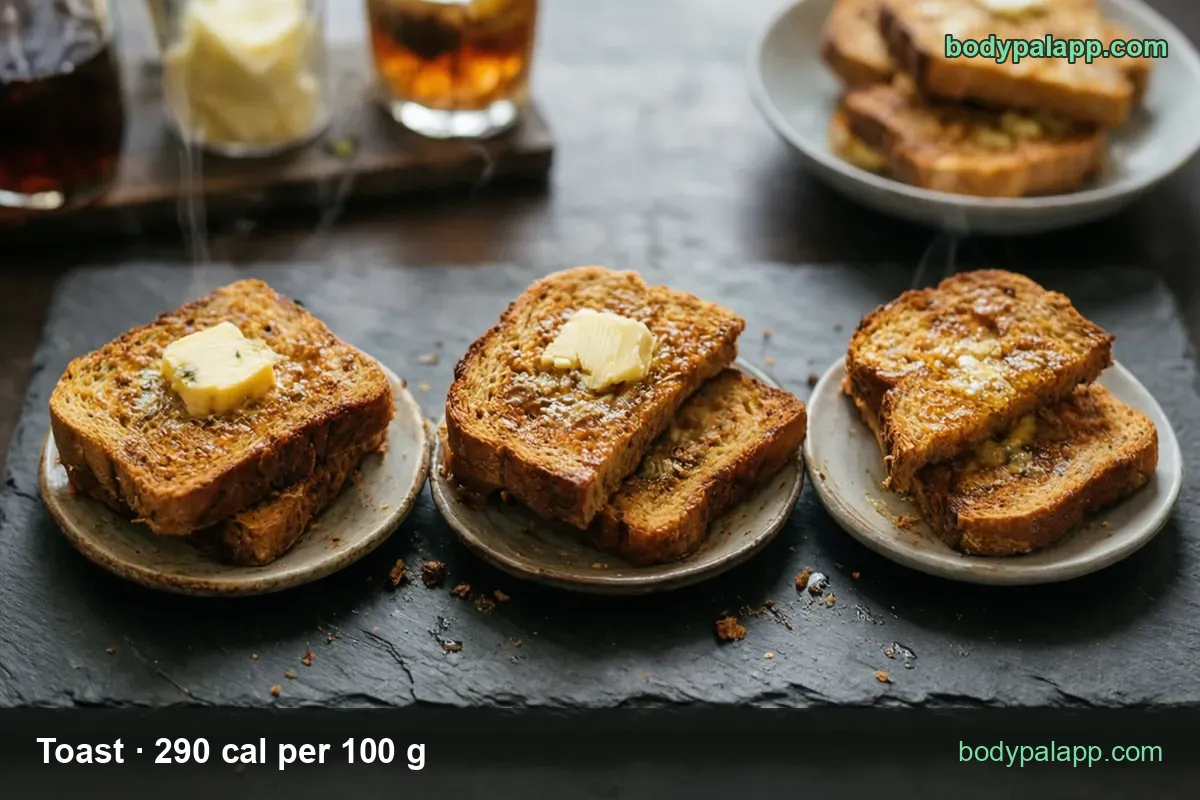
Six breads, and the whole spread is 46 calories per 100 g — from gluten-free at 273 to sourdough at 319. Rye, multigrain and gluten-free all sit under white. Whichever loaf you buy, the slice size moves your total more than the grain does.
Sourdough and other French-style breads are the densest of the group after toasting, at 319 calories per 100 g, because the crumb is drier and tighter to begin with. Gluten-free toast is the lightest at 273, but that is a starch-based loaf: it carries 4.74 g of protein per 100 g against 9 g in white bread, so it is thinner nutritionally as well as lighter.
Whole wheat is the interesting one. It reads as the "healthy" choice and it is genuinely more calorie-dense than white — 306 against 290 per 100 g. What you buy with those extra calories is 7.5 g of fiber per 100 g instead of 2.9 g, roughly 2.6 times as much, plus 16.27 g of protein against 9 g. That fiber load is the reason MyPlate asks for at least half your grains to be whole grains. Multigrain toast goes further still at 8.1 g of fiber per 100 g, the highest of the six.
Sodium is the row that moves first
Calories are not the row that fills up fastest on toast. Two slices are 128 calories, about 6% of a 2,000-calorie day, but they carry 236 mg of sodium, which is 10% of the 2,300 mg Daily Value. Salt hits its ceiling faster than energy does — and that is bare toast, before butter, before a slice of cheese, before bacon.
The gap between breads is wider than the calorie gap. Toasted French and sourdough bread runs 720 mg of sodium per 100 g, rye 664 mg, white 537 mg, whole wheat 565 mg, and multigrain the lowest at 414 mg. Two slices of dense sourdough can carry more salt than a small bag of chips.
None of this makes bread a problem food; the Dietary Guidelines for Americans puts grains at the base of the pattern for a reason. But if sodium is the number you are told to watch, the multigrain loaf is the quiet win and it costs you almost nothing in calories: 288 per 100 g against 290 for white.
How does toast compare?
| Toasted bread | Per 100 g | US serving | Calories |
|---|---|---|---|
| White toast | 290 kcal | 1 slice (22 g) | 64 kcal |
| Whole-wheat toast | 306 kcal | 1 oz (28 g) | 87 kcal |
| Sourdough / French toast slice | 319 kcal | 1 oz (28 g) | 90 kcal |
| Toasted plain bagel | 287 kcal | 1 oz (28 g) | 81 kcal |
Our take: the bagel is the trap in this table. Per 100 g it is the lightest thing here at 287 calories, lighter than white toast, and it still wrecks a breakfast — because nobody eats one ounce of bagel, while a slice of toast really does stop at 22 g. Toast wins on portion control, not on density. For weight loss, plain white toast at 64 calories a slice is the cheapest way to get bread on the plate. For staying full to lunch, take the whole wheat: 87 calories an ounce buys you 2.6 times the fiber, and fiber is what makes breakfast last.
Toast FAQs
How many calories are in 1 slice of toast?
64 calories in a standard 22 g slice of toasted white bread, which works out to 290 calories per 100 g. A thin slice drops to 49 calories at 17 g, and a large slice climbs to 78 at 27 g. The cut of the loaf matters more than the brand.
How many calories are in 2 slices of toast?
128 calories for two standard 22 g slices of white toast, which is our own arithmetic from the USDA 100 g figure rather than a USDA serving. That is about 6% of a 2,000-calorie day. Two thin slices come to 98 calories, two large ones to 156.
Does toasting bread add calories?
No, toasting adds nothing: the 64 calories in a 22 g slice are the same before and after, because heat only drives off water. Per 100 g a toasted slice reads higher than an untoasted one, at 290 calories, but that is because the slice itself now weighs less.
How many calories in toast with butter?
Start from 64 calories for the 22 g slice and add whatever your butter label says. USDA does not publish a combined toast-with-butter record, so no honest single number exists here. Butter is dense enough that a generous spread can outweigh the bread it sits on, which is worth weighing once.
Is whole wheat toast better than white toast?
For fiber, yes: 7.5 g per 100 g against 2.9 g in white, about 2.6 times as much, plus 16.27 g of protein against 9 g. For calories, no — whole wheat is denser at 306 per 100 g versus 290. You are buying fullness, not a calorie saving.
How much sodium is in a slice of toast?
118 mg in a 22 g slice of white toast, 5% of the 2,300 mg Daily Value, from 537 mg per 100 g. Two slices reach 236 mg, or 10%. Sourdough is saltier at 720 mg per 100 g, and multigrain is the mildest of the common loaves at 414 mg.
How many carbs are in a slice of toast?
12.0 g of carbohydrate in a 22 g slice, which is 4% of the 275 g Daily Value, from 54.5 g per 100 g. Of that, 0.6 g is fiber and 1.4 g is total sugars. Two slices bring the plate to 24 g of carbohydrate before anything goes on top.
Is toast good for weight loss?
A slice at 64 calories is one of the cheapest ways to get bread on a plate, and it comes pre-portioned, which is the real advantage. The toppings decide the outcome: the bread is 64 calories, and butter, jam or cheese can easily triple that before you sit down.
Similar foods
- Butter Naan — 262 cal per piece
- Cornbread — 187 cal per piece
- Hawaiian Bread — 115 cal per slice
- Kaiser Roll — 167 cal per roll
- Pizza Crust — 293 cal per 100 g
- Toast Bread — 73 cal per slice
Count it without the math
Point the camera at the plate and BodyPal counts the slices, the butter and all.


How long does it take to burn off toast?
One slice (22 g) is 64 kcal. Enter your weight and the amount you ate to see how long it takes you to burn that off:
lb
| Activity | Time to burn 64 kcal |
|---|---|
| Walking, brisk | 13 min |
| Cycling, moderate | 8 min |
| Swimming, moderate | 9 min |
| Jogging | 8 min |
| Weight training, moderate | 14 min |
Times are for a 155 lb adult at a steady pace; change the weight to see yours. The amount is set to the portion in the text (22 g); change it to what you actually ate. BodyPal works this out from your steps automatically.
Burning it off is one side of it. The other is knowing your number: work out how many calories you need a day, with macros and a goal date.