
How many calories are in a turkey club sandwich?
A regular deli-style turkey club weighs 145 g and lands at 339 calories. Per 100 g the sandwich runs 234 calories, which is ordinary for a lunch. The catch is that restaurant clubs are rarely regular. The large build, the one that arrives cut into four triangles, is 290 g and 679 calories.
On this page
- Turkey club sandwich quick facts
- US servings, from a slider to a large deli club
- White bread, wheat bread and the cheese layer
- Chicken club versions, grilled and crispy
- Sodium is the row that gets you
- How does a turkey club compare?
- Most popular turkey club sandwich brands
- FAQ
Turkey club sandwich quick facts
The row used here is FNDDS 2706997, "Club sandwich or sub, restaurant", from the 2021–2023 survey release. It is the record that matches what most people are actually holding: sliced turkey, bacon, lettuce, tomato and mayonnaise on toast, made in a deli or a restaurant kitchen rather than at home. It is also the only club record USDA gives real household sizes for, including a slider and a large. Homemade builds on white or wheat bread sit lower and get their own section below.
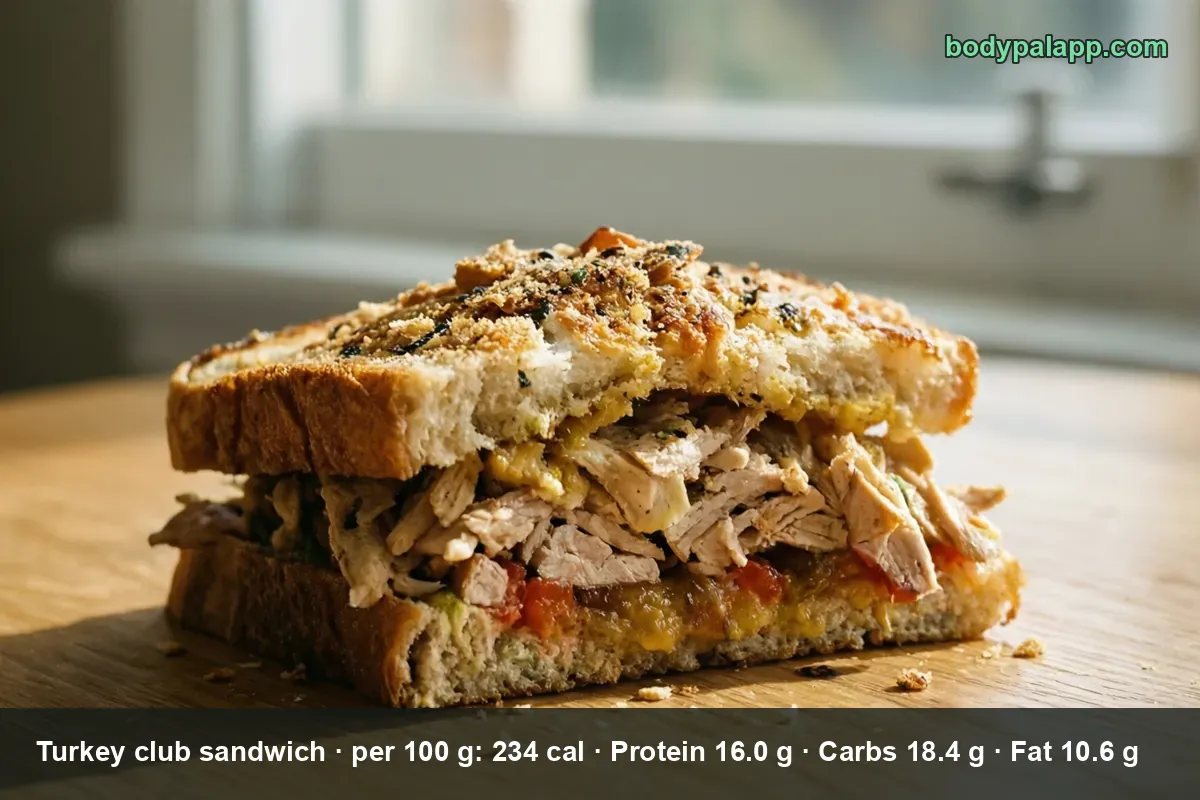
One thing to expect from the photo: plenty of clubs, including the one shown, are built on two slices of bread instead of the classic three-slice, triple-decker stack. That changes the weight, not the calories per gram, which is exactly why the serving table matters more than the recipe.
| Nutrient | Per 100 g | Per 1 regular sandwich (145 g) | % Daily Value |
|---|---|---|---|
| Calories | 234 | 339 | — |
| Total fat | 10.55 g | 15.3 g | 20% |
| Saturated fat | 4.42 g | 6.4 g | 32% |
| Carbohydrate | 18.43 g | 26.7 g | 10% |
| Dietary fiber | 0.8 g | 1.2 g | 4% |
| Total sugars | 2.47 g | 3.6 g | — |
| Protein | 15.99 g | 23.2 g | 46% |
| Sodium | 814 mg | 1180 mg | 51% |
% Daily Value is based on a 2,000-calorie diet.
Verified nutrition data
Numbers on this page come from USDA FoodData Central, the U.S. Department of Agriculture’s food composition database, and from manufacturer labels where a branded product is named. Last verified September 2026. How we verify our data →
Two label rows are missing on purpose. USDA does not publish added sugars or trans fat for this mixed-dish record, so guessing them would be inventing numbers. Cholesterol is 41 mg per 100 g, or 59 mg per regular sandwich (20% DV), and potassium is 271 mg per 100 g, or 393 mg per sandwich (8% DV).
US servings, from a slider to a large deli club
| Serving | Weight | Calories |
|---|---|---|
| 1 oz | 28 g | 66 kcal |
| One miniature or slider | 75 g | 176 kcal |
| One regular sandwich | 145 g | 339 kcal |
| One large, or a 6-inch sub | 290 g | 679 kcal |
| Per 100 g | 100 g | 234 kcal |
The slider, the regular and the large are USDA household measures for this record, so those three weights are not our estimates. The 1 oz line is our own arithmetic from the USDA 100 g figure, not a USDA serving, and it is useful mainly for weighing leftovers.
Here is the part people miss. The recipe does not change across that table, only the size does. At a fixed 234 calories per 100 g, a slider is 176 calories and a large is 679 — a 3.9-fold spread on the same sandwich. If you log "turkey club" without a weight, you are guessing within a 500-calorie range. Half of a regular sandwich, 72.5 g by our own arithmetic from the 100 g figure, is about 170 calories, which is why splitting one at a deli counter works so well.
White bread, wheat bread and the cheese layer
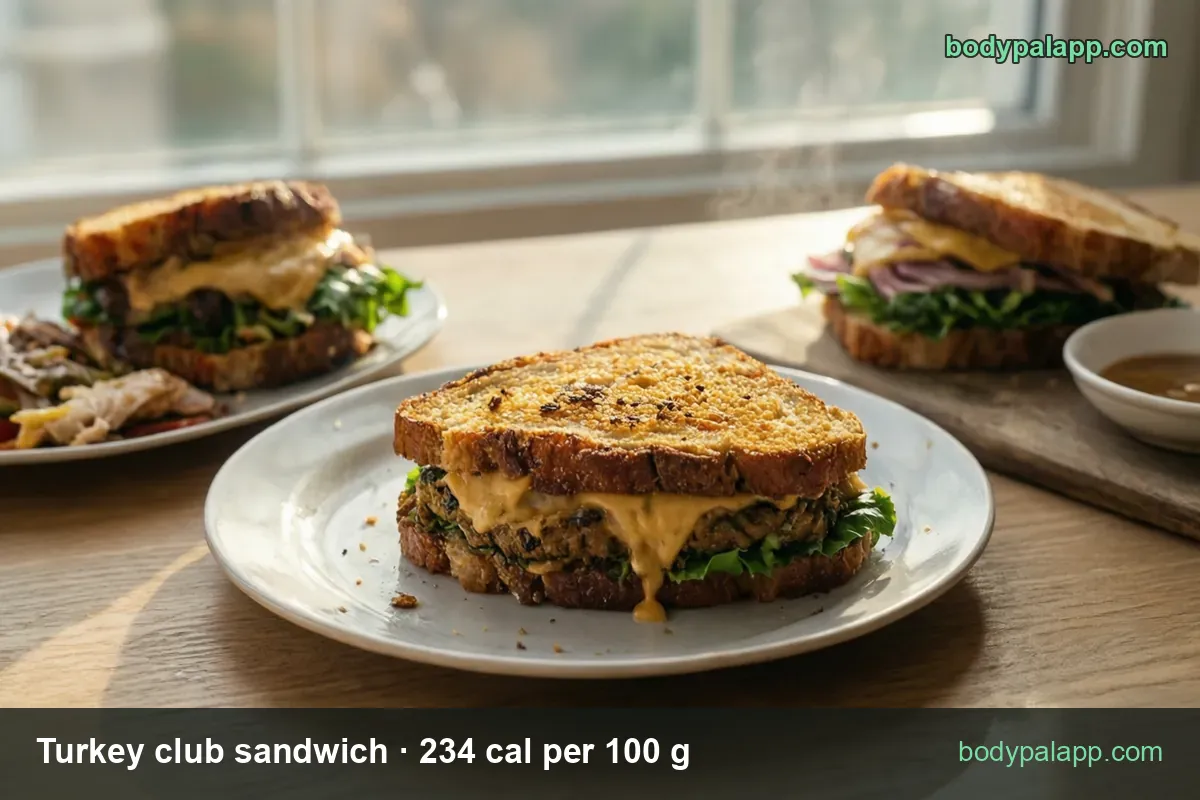
Made at home, the club gets lighter, mostly because it gets smaller and holds less mayonnaise. USDA lists four home-style builds, and the differences between them are smaller than most people assume.
| Version | Per 100 g | Typical sandwich | Calories |
|---|---|---|---|
| On white bread | 222 kcal | 130 g | 289 kcal |
| On wheat bread | 220 kcal | 130 g | 286 kcal |
| With cheese, white bread | 241 kcal | 155 g | 374 kcal |
| With cheese, wheat bread | 239 kcal | 155 g | 370 kcal |
| Restaurant club | 234 kcal | 145 g | 339 kcal |
Swapping white for wheat is worth 3 calories on a 130 g sandwich. As a calorie decision it is noise. As a fiber decision it is the biggest single change on this page: the wheat build carries 2.4 g of fiber per 100 g against 1 g for white, so a 130 g sandwich goes from 1.3 g to 3.1 g — 5% of the Daily Value against 11%. The bread moves the fiber row, not the calorie row.
Cheese is the layer that actually costs something. It adds 19 calories per 100 g on the white build, and because a cheese club is also a heavier sandwich, the plated difference is 289 against 374 calories. Sodium follows the same path: about 1,000 mg for the plain white club at 130 g, against roughly 1,243 mg once cheese goes in at 155 g, both scaled from the USDA 100 g values rather than taken from a USDA serving.
Store-made clubs bracket all of this. USDA's branded records run from a Readymeals turkey club at 178 calories per 100 g up to an Archer Farms ham and turkey club at 271 — a Signature Cafe club wrap is denser still, at 282 — with a whole 255 g sandwich hitting 691 calories — more than the restaurant large.
Chicken club versions, grilled and crispy
A good share of "club sandwich" searches end up on a chicken version, and the numbers there are not interchangeable with turkey.
| Version | Per 100 g | US serving | Calories |
|---|---|---|---|
| Grilled chicken, bacon and tomato club with cheese | 220 kcal | 1 sandwich (268 g) | 590 kcal |
| Crispy chicken, bacon and tomato club with cheese | 257 kcal | 100 g | 257 kcal |
Per gram, the grilled chicken club sits at the bottom of the range here, at 220 calories per 100 g, level with the home-built club on wheat. Per sandwich it far outweighs the regular turkey club, at 590 calories against 339, because a fast-food chicken club is a 268 g object and a deli turkey club is 145 g. Breading and frying it pushes the density to 257 calories per 100 g, above the restaurant turkey club; USDA gives no household sandwich weight for the crispy record, so it stays on a 100 g basis here.
Sodium is the row that gets you
Calories are not the interesting number on a turkey club. Sodium is. One regular sandwich delivers 1,180 mg, which is 51% of the FDA Daily Value of 2,300 mg — about half a teaspoon of table salt, before any pickle, chips or soup on the side. Cured turkey, bacon, cheese and bread each bring their own salt, and they stack.
Order the large and you are at roughly 2,361 mg, or 103% of the Daily Value, from lunch alone. That is the single most useful fact on this page for anyone tracking blood pressure numbers with a doctor.
Saturated fat runs the same way: 6.4 g in a regular sandwich is 32% of the DV, and 12.8 g in a large is 64%. The Dietary Guidelines for Americans put the target at under 10% of daily calories.
The good news balances it. At 23.2 g, a regular club covers 46% of the protein Daily Value, which is a lot for a 339-calorie lunch and puts it well ahead of most deli sandwiches of the same weight. If you are building meals around protein foods, the turkey does real work here.
How does a turkey club compare?
| Sandwich | Per 100 g | US serving | Calories |
|---|---|---|---|
| Restaurant turkey club | 234 kcal | 1 sandwich (145 g) | 339 kcal |
| Club on white bread | 222 kcal | 1 sandwich (130 g) | 289 kcal |
| Club on wheat, with cheese | 239 kcal | 1 sandwich (155 g) | 370 kcal |
| Grilled chicken club | 220 kcal | 1 sandwich (268 g) | 590 kcal |
Our take: for weight loss, the home-built club on wheat at a 130 g size is the pick — 286 calories, 3.1 g of fiber and roughly 995 mg of sodium scaled from the USDA figures. For a filling lunch that still fits a normal day, the regular restaurant club at 339 calories and 23.2 g of protein is a solid order, as long as you skip the large. Of these four records, only the wheat club with cheese is denser per 100 g than the restaurant version, yet the grilled chicken club beats every one of them on the plate at 590 calories, purely on size. Weigh the sandwich, not the recipe.
Most popular turkey club sandwich brands in the United States
Ranked by how widely each product appears among foods sold in the United States, from the BodyPal food database of over 3.3 million products. Calories are the figures printed on each Nutrition Facts label, checked against USDA FoodData Central.
| Product | Calories (per 100 g) |
|---|---|
| Portland Club Sandwich | 198 cal |
| Readymeals Turkey Club Sandwich | 178 cal |
| Archer Farms Ham & Turkey Club Sandwich | 271 cal |
| Kretschmar Premium Deli Club Sandwich | 232 cal |
| Signature Cafe Turkey Club Sandwich Wrap | 282 cal |
| Archer Farms Club Sandwich | 243 cal |
Brand popularity: BodyPal food database. Nutrition: manufacturer labels / USDA FoodData Central.
Turkey club sandwich FAQs
How many calories are in a turkey club sandwich?
A regular restaurant turkey club of 145 g has 339 calories, at 234 calories per 100 g. A miniature or slider version at 75 g is 176 calories, and a large sandwich or 6-inch sub at 290 g reaches 679 calories. The weight, not the filling, decides which of those numbers applies to you.
How many calories are in half a turkey club sandwich?
Half a regular club is about 170 calories, since a full 145 g sandwich is 339. That half also carries roughly 11.6 g of protein and about 590 mg of sodium, a quarter of the Daily Value. These halves are our own arithmetic from the USDA 100 g figure of 234 calories, not a USDA serving.
How much protein is in a turkey club sandwich?
A regular 145 g turkey club has 23.2 g of protein, which is 46% of the Daily Value, from 15.99 g per 100 g. A large sandwich at 290 g doubles that to about 46 g. For a lunch of 339 calories, that protein-per-calorie ratio is better than most deli sandwiches of the same size.
How much sodium is in a turkey club sandwich?
One regular sandwich has 1,180 mg of sodium, which is 51% of the FDA Daily Value of 2,300 mg, or about half a teaspoon of table salt. A large club at 290 g reaches roughly 2,361 mg, about 103% of the DV. Cured turkey, bacon, cheese and bread each add salt.
Is a turkey club sandwich healthy?
It depends far more on size than on ingredients: a regular 145 g club gives 339 calories and 23.2 g of protein, a genuinely good trade. The weak rows are sodium at 51% of the Daily Value and saturated fat at 32%, plus only 1.2 g of fiber. If you are watching sodium, the home-built version is the better pick.
Does wheat bread make a turkey club lower in calories?
Barely: a club on wheat bread is 220 calories per 100 g against 222 for white, so a 130 g sandwich is 286 calories instead of 289. The real gain is fiber: 2.4 g per 100 g against 1 g, meaning 3.1 g in that sandwich instead of 1.3 g, or 11% of the Daily Value against 5%.
Turkey club vs chicken club - which has fewer calories?
Per gram the grilled chicken club wins at 220 calories per 100 g against 234 for the restaurant turkey club. Per sandwich the turkey club wins easily: 339 calories at 145 g against 590 calories for a 268 g fast-food chicken club. A crispy breaded chicken club is denser still, at 257 calories per 100 g.
How many calories does the cheese add to a club sandwich?
About 19 calories per 100 g: a club on white bread is 222, and the same sandwich with cheese is 241. Because cheese clubs are also built bigger, the plated gap is wider, at 289 calories for a 130 g plain sandwich against 374 for a 155 g cheese version. Sodium climbs by roughly 240 mg too.
Similar foods
- Beef brisket — 208 cal per thick slice
- Chicken — 203 cal for 3 oz roasted
- Roast Chicken — 203 cal per 3 oz
- Chile relleno — 326 cal per chile relleno
- Tempura shrimp — 109 cal for 6 large shrimp
- Asada taco — 243 cal per taco
Count it without the math
Point the camera at the plate and BodyPal counts the club for you, bacon layer and all.


How long does it take to burn off 339 kcal of turkey club?
One regular sandwich (145 g) is 339 kcal. Enter your weight and the amount you ate to see how long it takes you to burn that off:
lb
| Activity | Time to burn 339 kcal |
|---|---|
| Walking, brisk | 1 hr 8 min |
| Cycling, moderate | 42 min |
| Swimming, moderate | 48 min |
| Jogging | 40 min |
| Weight training, moderate | 1 hr 15 min |
Times are for a 155 lb adult at a steady pace; change the weight to see yours. The amount is set to the portion in the text (145 g); change it to what you actually ate. BodyPal works this out from your steps automatically.
This table assumes you know your daily total. If you do not, the daily calorie calculator works it out from five numbers.