
How Many Calories in a Turkey Reuben?
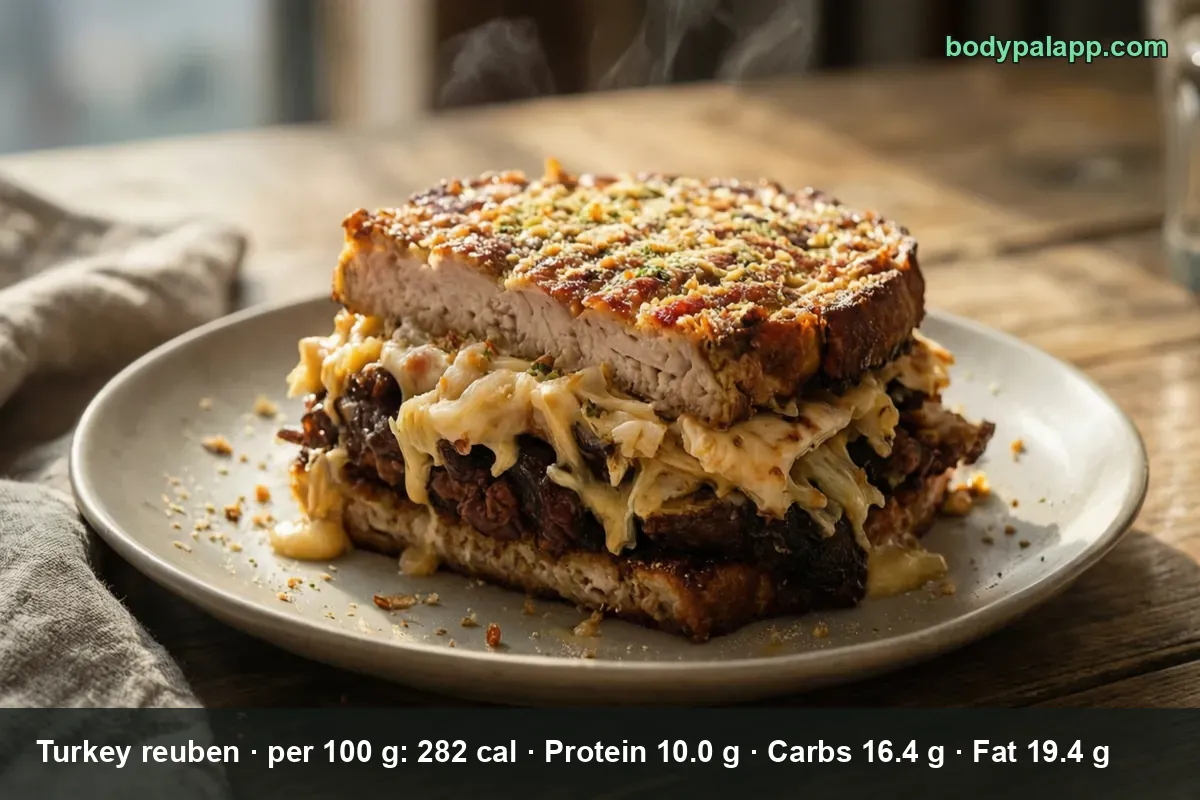
A deli-size turkey reuben weighs about 215 g and carries 606 calories. Per 100 g the sandwich runs 282 calories, which puts it near the top of the sandwich case. Swapping turkey in for corned beef trims the meat, not the sandwich: the dressing, the melted Swiss and the buttered griddle set the number.
On this page
- Turkey reuben quick facts
- US servings, from one ounce to the whole deli sandwich
- Half a reuben, and the turkey sandwiches it gets confused with
- Sodium and saturated fat are the rows to watch
- How does a turkey reuben compare?
- Most popular turkey reuben brands
- Turkey reuben FAQs
Turkey reuben quick facts
There is no federal record called "turkey reuben." The one record that describes the dish as it is actually built — rye bread, sauerkraut, melted cheese, a mayo-based dressing, griddled in fat — is FNDDS 2706952, "Reuben sandwich", from the 2021-2023 survey cycle. That is the sandwich in your hand, so it is the row this page uses.
Deli turkey is leaner than corned beef, and a turkey build sits a little below the record in fat. But the gap is small next to what the dressing and the cheese add, and USDA does not publish a separate turkey version to measure it with. One serving in that record is a whole sandwich, 215 g.
| Nutrient | Per 100 g | Per 1 sandwich (215 g) | % Daily Value |
|---|---|---|---|
| Calories | 282 | 606 | — |
| Total fat | 19.43 g | 41.8 g | 54% |
| Saturated fat | 5.79 g | 12.4 g | 62% |
| Carbohydrate | 16.42 g | 35.3 g | 13% |
| Dietary fiber | 2.2 g | 4.7 g | 17% |
| Total sugars | 3.48 g | 7.5 g | — |
| Protein | 10.01 g | 21.5 g | 43% |
| Sodium | 688 mg | 1479 mg | 64% |
| Cholesterol | 43 mg | 92 mg | 31% |
| Potassium | 134 mg | 288 mg | 6% |
% Daily Value is based on a 2,000-calorie diet.
Verified nutrition data
Numbers on this page come from USDA FoodData Central, the U.S. Department of Agriculture’s food composition database, and from manufacturer labels where a branded product is named. Last verified September 2026. How we verify our data →
Two rows you would see on a packaged label are missing here. Added sugars and trans fat are not published for this record in this FNDDS release, so rather than guess at the dressing's sugar or the griddle's fat, both lines are left off entirely.
The 1,479 mg of sodium is worth sitting with for a second: that is roughly two-thirds of a teaspoon of table salt, in a single sandwich, before the pickle spear.
US servings, from one ounce to the whole deli sandwich
| Serving | Weight | Calories |
|---|---|---|
| 1 oz | 28.4 g | 80 kcal |
| Half a sandwich | 107.5 g | 303 kcal |
| One sandwich, deli size | 215 g | 606 kcal |
| Per 100 g | 100 g | 282 kcal |
The whole sandwich at 215 g is the USDA household measure — the one portion here you do not have to do arithmetic for. The half and the ounce are our own arithmetic from the USDA 100 g figure, not USDA servings, which matters because delis do not cut evenly and the half you get handed may be 120 g rather than 107.5 g.
Weight is the variable that actually moves this number, and reubens are not standardized. A thin-cut sandwich from a grocery counter can land near 180 g; a stacked deli version with a double layer of turkey pushes past 300 g and takes the calories over 800. If you weigh the sandwich, use the per-100-g column and skip the serving table entirely.
Half a reuben, and the turkey sandwiches it gets confused with
Half a reuben is the version most people actually eat at lunch, and it is the only genuine variant of the dish that USDA data supports. Everything below it in this table is a different sandwich — a plain turkey sandwich, which is what search results tend to hand you when you look up "turkey reuben calories." They are not the same food, and the spread is large.
| Version | Per 100 g | Typical piece | Calories |
|---|---|---|---|
| Half turkey reuben | 282 kcal | 1/2 sandwich (107.5 g) | 303 kcal |
| Turkey sandwich on wheat, with cheese | 214 kcal | 1 regular (135 g) | 289 kcal |
| Turkey sandwich on white | 189 kcal | 1 regular (115 g) | 217 kcal |
| Turkey sandwich on wheat, no cheese | 187 kcal | 1 regular (115 g) | 215 kcal |
| Turkey sub, restaurant | 180 kcal | 1 regular or 6-inch sub (195 g) | 351 kcal |
| Turkey wrap | 232 kcal | 100 g | 232 kcal |
Read that column from the bottom up and the picture is clear. A plain turkey sandwich on wheat is 187 calories per 100 g. The reuben is 282 — about 50 percent more, gram for gram, with the same bird inside. The difference is Russian dressing, a slice of Swiss that melts under the broiler, and butter on the griddle.
The turkey wrap is listed per 100 g because tortilla sizes vary too much for a single piece weight to mean anything. The restaurant sub is the one that surprises people: it is the lowest number per gram in the whole table at 180, but it is served in a 195 g piece, so it still totals 351 calories.
Packaged deli sandwiches from the refrigerated case are a different animal again. Retail turkey sandwiches from brands like Boar's Head and Archer Farms run 173 to 222 calories per 100 g on their labels, well under the reuben, because none of them are griddled and none carry a dressing that heavy. There is no packaged turkey reuben on the US market at all.
Sodium and saturated fat are the rows to watch
Calories are not the interesting story on this sandwich. Two other rows are.
Saturated fat comes in at 12.4 g, which is 62% of the FDA Daily Value of 20 g. One lunch, and most of the day's allowance is committed. Total fat supplies about 376 of the 606 calories — more than three-fifths of the sandwich — while carbohydrate accounts for roughly 141. The rye bread is genuinely the smallest problem on the plate at 13% DV for carbs.
Sodium is 1,479 mg, 64% of the 2,300 mg DV. Sauerkraut is brined, the dressing is salted, the Swiss is salted, and the turkey is cured. Add a pickle and a bag of chips and you are past a full day before dinner. The CDC notes that average US intake already sits above that limit without help from sandwiches like this one, which is the practical reason to make the reuben an occasional order rather than a weekly one.
The protein is real, though: 21.5 g, 43% of the DV, which meets the kind of target MyPlate sets for a main meal. It just arrives inside 606 calories. If you want the protein without the rest of it, the plain turkey sandwich is the more efficient trade — about 15 g of protein in 215 calories, scaled from the USDA 100 g row.
How does a turkey reuben compare?
| Sandwich | Per 100 g | US serving | Calories |
|---|---|---|---|
| Turkey reuben | 282 kcal | one sandwich, 215 g | 606 kcal |
| Turkey sandwich on white, with cheese | 215 kcal | 1 regular, 135 g | 290 kcal |
| Turkey sandwich on wheat, with cheese | 214 kcal | 1 regular, 135 g | 289 kcal |
| Turkey sandwich or sub, restaurant | 180 kcal | 1 regular, 130 g | 234 kcal |
Our take: the reuben is more than double either turkey-and-cheese sandwich in this table, and it is the highest number per gram by a wide margin. If you are cutting calories, order the plain turkey on wheat and you save close to 390 calories on a comparable lunch. If you want the reuben, take the half — 303 calories, 740 mg of sodium, and it still tastes like the thing you wanted. Ordering the whole sandwich and calling it a light lunch is the one move the numbers do not support.
Most popular turkey reuben brands in the United States
Ranked by how widely each product appears among foods sold in the United States, from the BodyPal food database of over 3.3 million products. Calories are the figures printed on each Nutrition Facts label, checked against USDA FoodData Central.
| Product | Calories (per 100 g) |
|---|---|
| Boar's Head Ovengold Turkey Sandwich | 204 cal |
| Boar's Head Turkey Sandwich with White American Cheese | 173 cal |
| Boar's Head Turkey Sandwich | 177 cal |
| Boar's Head Tuscan Turkey Sandwich | 189 cal |
| Archer Farms Sriracha Turkey Sandwich | 222 cal |
| 18th Street Select Turkey Sandwich | 205 cal |
Brand popularity: BodyPal food database. Nutrition: manufacturer labels / USDA FoodData Central.
Turkey reuben FAQs
How many calories are in a turkey reuben?
606 calories for one deli-size sandwich weighing 215 g, based on the USDA record for a Reuben, which runs 282 calories per 100 g. That single sandwich also carries 41.8 g of fat and 21.5 g of protein, so it eats like a full meal rather than a light lunch.
How many calories in half a turkey reuben?
303 calories for half a sandwich, 107.5 g, which is our own arithmetic from the USDA 100 g figure rather than a listed USDA serving. Half also means about 740 mg of sodium and 6.2 g of saturated fat, which is where splitting the sandwich actually pays off.
How much sodium is in a turkey reuben?
1,479 mg of sodium in one 215 g sandwich, 64% of the Daily Value and roughly two-thirds of a teaspoon of table salt. The sauerkraut, the Swiss and the dressing all bring salt, and the CDC notes that average American intake is already above the 2,300 mg limit.
How much protein does a turkey reuben have?
21.5 g of protein per sandwich, 43% of the Daily Value. That is decent for a sandwich, but it costs 606 calories to get there, so the protein-per-calorie ratio is weaker than a plain turkey sandwich on wheat, which delivers about 15 g in 215 calories once you scale the USDA 100 g row.
Does a turkey reuben have a lot of saturated fat?
12.4 g of saturated fat per sandwich, 62% of the 20 g Daily Value, in one lunch. Total fat is 41.8 g, 54% of the DV. Griddling in butter, melted Swiss and a mayo-based dressing stack up faster than most people expect from a sandwich built on turkey.
Is a turkey reuben healthier than a corned beef reuben?
606 calories either way, because USDA publishes a single Reuben sandwich record and no separate turkey version, so the swap cannot be quantified from federal data. Corned beef is fattier and saltier than deli turkey, but the dressing, the melted cheese and the griddle carry most of this sandwich.
How many calories in a turkey reuben without dressing?
289 calories is the closest USDA stand-in: a turkey sandwich on wheat with cheese, 135 g, no dressing and no griddle. That is less than half the 606-calorie reuben. USDA does not publish a dressing-free reuben, so treat this as the nearest comparable record rather than an exact match.
How many carbs are in a turkey reuben?
35.3 g of carbohydrate per sandwich, only 13% of the Daily Value, plus 4.7 g of fiber and 7.5 g of total sugars. Rye bread is the smallest problem on this plate; fat supplies far more of the 606 calories than the two slices of bread do.
Similar foods
- Burger — 418 cal per hamburger
- Fish taco — 275 cal per taco
- Ribeye Steak — 495 cal per 8 oz steak
- Hot wings — 571 cal for 6 wings
- Burger Patty — 230 cal per patty
- Pork Shoulder — 229 cal per 3 oz
Count it without the math
Point the camera at the plate and BodyPal counts the reuben for you, dressing and all.


How long does it take to burn off turkey reuben?
One sandwich (215 g) is 606 kcal. Enter your weight and the amount you ate to see how long it takes you to burn that off:
lb
| Activity | Time to burn 606 kcal |
|---|---|
| Walking, brisk | 2 hr 1 min |
| Cycling, moderate | 1 hr 16 min |
| Swimming, moderate | 1 hr 27 min |
| Jogging | 1 hr 11 min |
| Weight training, moderate | 2 hr 15 min |
Times are for a 155 lb adult at a steady pace; change the weight to see yours. The amount is set to the portion in the text (215 g); change it to what you actually ate. BodyPal works this out from your steps automatically.
This table assumes you know your daily total. If you do not, the daily calorie calculator works it out from five numbers.