
How many calories are in beans and rice?
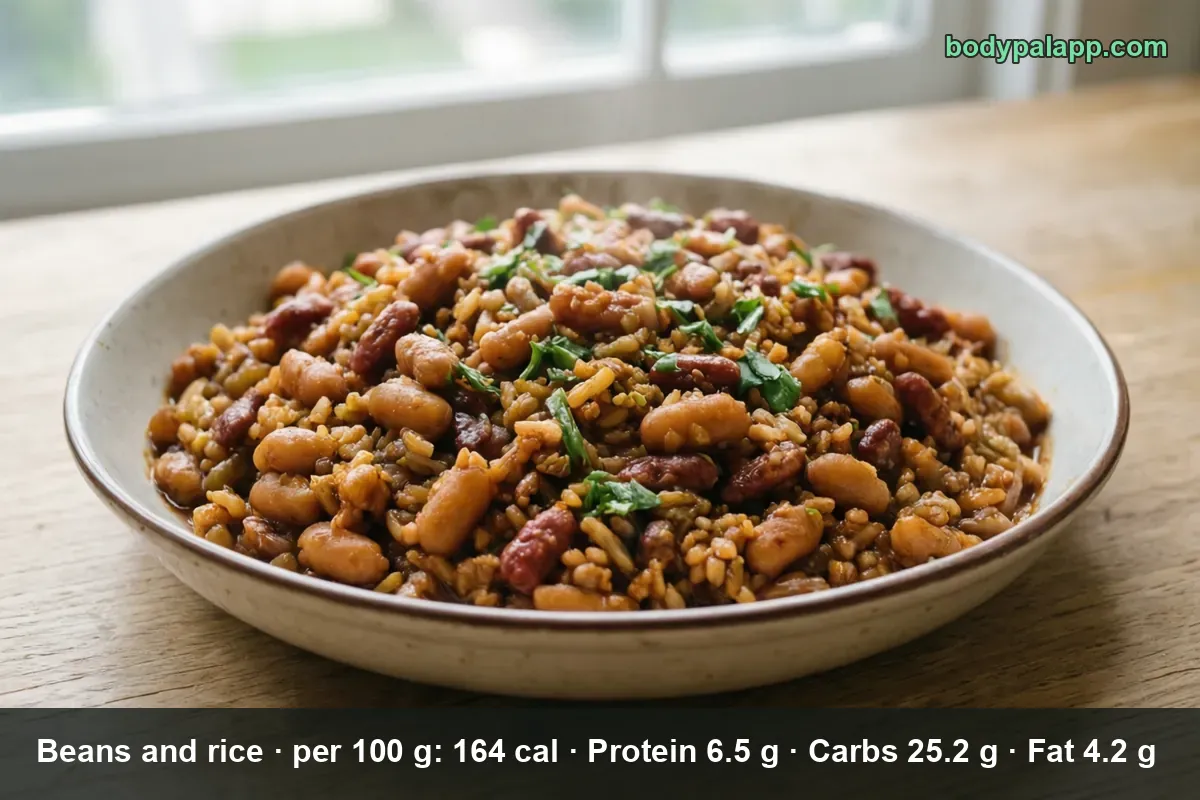
A 1-cup serving of beans and rice weighs 170 g and holds 279 calories. Per 100 g the dish runs 164 calories, which is light for something this filling: a cup carries 11.1 g of protein and 6.3 g of fiber, and the fat is mostly whatever went into the pot.
On this page
- Beans and rice quick facts
- US servings, from one ounce to a full dinner plate
- Brown rice, black beans and pinto: what swapping changes
- With meat, with tomatoes, or ordered out
- Fiber and protein are the rows that pay off
- How does beans and rice compare?
- Most popular beans and rice brands
- Beans and rice FAQs
Beans and rice quick facts
The row used here is FNDDS 2708990, "Beans and white rice" — the plain home-cooked dish, beans and rice already combined and already cooked. That matters, because most of the other USDA entries that mention both words are assembled meals: burritos, tacos, burrito bowls. Those carry a tortilla, cheese and sometimes sour cream, so their numbers describe a different plate entirely. If what is in front of you is a scoop of beans over rice, this is the record that matches it.
Everything below is scaled from the same row, so the per-cup column and the per-100-g column never disagree.
| Nutrient | Per 100 g | Per 1 cup (170 g) | % Daily Value |
|---|---|---|---|
| Calories | 164 | 279 | — |
| Total fat | 4.21 g | 7.2 g | 9% |
| Saturated fat | 0.6 g | 1.0 g | 5% |
| Carbohydrate | 25.19 g | 42.8 g | 16% |
| Dietary fiber | 3.7 g | 6.3 g | 22% |
| Total sugars | 0.21 g | 0.4 g | — |
| Protein | 6.5 g | 11.1 g | 22% |
| Sodium | 231 mg | 393 mg | 17% |
% Daily Value is based on a 2,000-calorie diet.
Verified nutrition data
Numbers on this page come from USDA FoodData Central, the U.S. Department of Agriculture’s food composition database, and from manufacturer labels where a branded product is named. Last verified September 2026. How we verify our data →
Two rows you would see on a package are missing here: added sugars and trans fat. This edition of FNDDS does not publish either value for any beans-and-rice record, so listing them would mean inventing them. Cholesterol is 0 mg, since nothing in the plain dish comes from an animal. Potassium is worth a line of its own: 327 mg per 100 g, 556 mg in a cup, which is 12% of the 4,700 mg Daily Value.
US servings, from one ounce to a full dinner plate
| Serving | Weight | Calories |
|---|---|---|
| 1 oz | 28.4 g | 46 kcal |
| 1/2 cup, side portion | 85 g | 139 kcal |
| 1 cup | 170 g | 279 kcal |
| 2 cups, dinner plate | 340 g | 558 kcal |
| Per 100 g | 100 g | 164 kcal |
Only the 1-cup line is a USDA household measure. The half cup, the two cups and the ounce are our own arithmetic from the USDA 100 g figure, not USDA servings, which is why they land on clean fractions of 279.
The cup is where people get caught. A cup of beans and rice weighs 170 g, because beans pack differently and the mix carries sauce. And a dinner plate is almost never one cup. Two cups is the realistic restaurant-style plate — 558 calories before anything is spooned on top. If you are eating it as a side next to a protein, half a cup at 139 calories is the honest measure.
Brown rice, black beans and pinto: what swapping changes
| Version | Per 100 g | Typical serving | Calories |
|---|---|---|---|
| Beans and white rice | 164 kcal | 1 cup (170 g) | 279 kcal |
| Beans and brown rice | 162 kcal | 1 cup (170 g) | 275 kcal |
| Black beans and white rice | 160 kcal | 1 cup (170 g) | 272 kcal |
| Pinto beans and white rice | 167 kcal | 1 cup (170 g) | 284 kcal |
| Black beans and brown rice | 158 kcal | 1 cup (170 g) | 269 kcal |
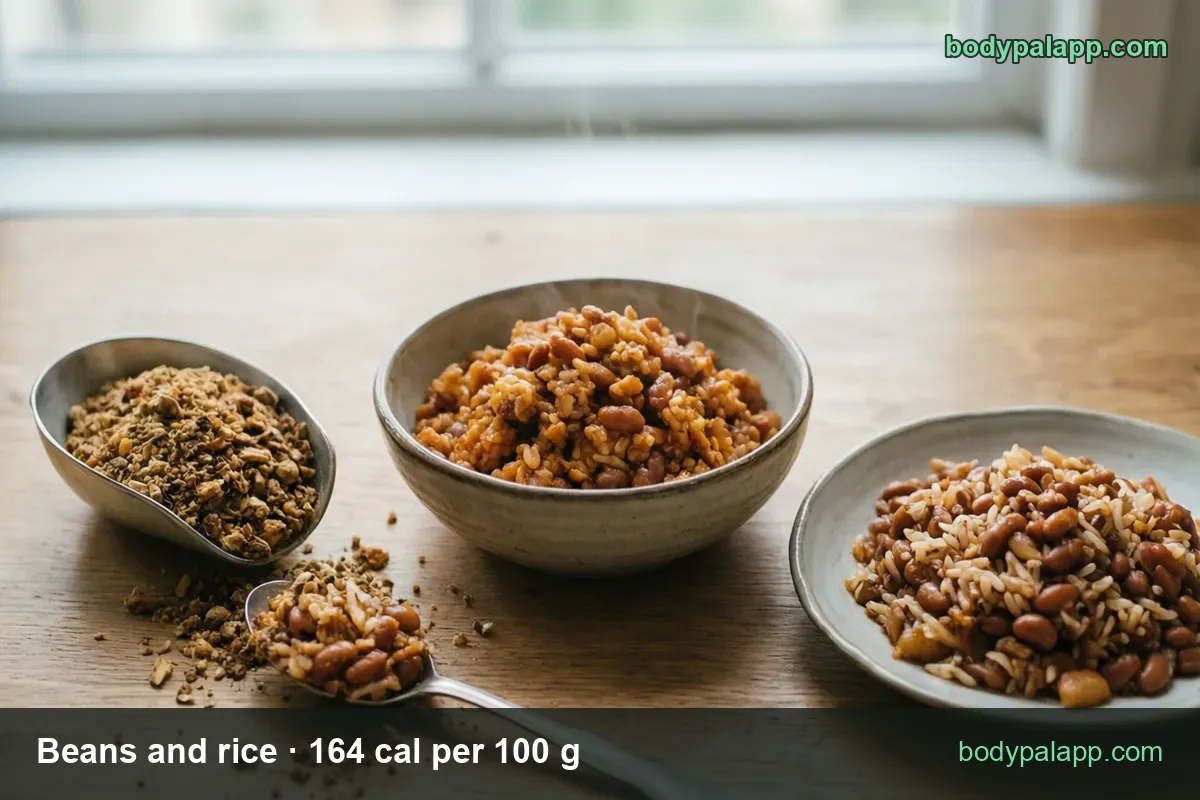
Here is the finding most pages miss: switching to brown rice does almost nothing to the calories. It is 162 per 100 g against 164, or 275 a cup against 279 — a four-calorie difference that any spoon in the pot erases. What brown rice actually buys is fiber, 3.9 g per 100 g instead of 3.7 g. Choose it for that, not for a calorie cut that is not really there.
The beans move things a little more. Black beans come in lowest at 160 per 100 g and pinto highest at 167, a 12-calorie spread across a cup. Black beans are also the leaner pick on protein, 6.01 g per 100 g against 6.5 g for the generic mix, so if protein is what you are after, the plain version wins that one. Stack both swaps and you get black beans with brown rice at 158 per 100 g, 269 a cup — the lightest of the four straight swaps, and the highest in fiber at 5.3 g per 100 g.
With meat, with tomatoes, or ordered out
| Version | Per 100 g | Typical serving | Calories |
|---|---|---|---|
| Beans and rice, with meat | 162 kcal | 1 cup (170 g) | 275 kcal |
| Beans and rice, with tomatoes | 137 kcal | 1 cup (170 g) | 233 kcal |
| Beans and rice, restaurant or fast food | 185 kcal | 1 cup (170 g) | 315 kcal |
Adding meat does not raise the calories per 100 g at all — 162 against 164 — because the meat displaces some of the starch. It does raise the protein, to 7.49 g per 100 g, and the sodium, to 263 mg. Tomatoes are the real cut: 137 per 100 g, 233 a cup, since watery tomato dilutes the whole pot.
The restaurant version is the outlier, and it is the number worth remembering. Ordered out, the same dish is 185 per 100 g — 315 in a cup, 36 more than the home version. Nearly the entire gap is fat: 6.99 g per 100 g against 4.21 g at home. Nobody added a second ingredient; somebody added oil.
Fiber and protein are the rows that pay off
One cup covers 22% of the 28 g fiber Daily Value and 22% of the 50 g protein Daily Value while costing 279 calories. Very few plates of starch do that. Beans count in two MyPlate groups at once, as a protein food and as a vegetable, and the fiber number is why the combination sits well against the Dietary Guidelines for Americans, which flag fiber as under-consumed by most adults.
Sodium is the row to keep an eye on. At 393 mg a cup, the home version uses 17% of the 2,300 mg Daily Value — roughly a sixth of a teaspoon of table salt. That is fine. The restaurant record is a different story: the SR Legacy entry for Latino-style arroz con frijoles negros lists 420 mg of sodium per 100 g, nearly double the 231 mg of the home dish, and that is before anything else on the tray. If you are watching sodium, cooking it yourself is the lever that matters more than which bean you pick.
How does beans and rice compare?
| Version | Per 100 g | US serving | Calories |
|---|---|---|---|
| Beans and white rice | 164 kcal | 1 cup (170 g) | 279 kcal |
| Beans and brown rice | 162 kcal | 1 cup (170 g) | 275 kcal |
| Black beans and white rice | 160 kcal | 1 cup (170 g) | 272 kcal |
| Beans and rice, restaurant | 185 kcal | 1 cup (170 g) | 315 kcal |
Our take: the version you cook barely matters, and the place you cook it matters a lot. The three home rows sit within four calories of each other per 100 g, so agonizing over white against brown against black beans is wasted effort — pick brown rice and black beans for the fiber and stop there. The 315-calorie restaurant cup, 13% heavier than the home version on identical ingredients, is where the calories actually come from. For weight loss, the useful moves are cooking it yourself and measuring the scoop; for staying full, two cups at 558 calories buys 22.2 g of protein and 12.6 g of fiber, which is a genuinely hard lunch to beat at that price.
Most popular beans and rice brands in the United States
Ranked by how widely each product appears among foods sold in the United States, from the BodyPal food database of over 3.3 million products. Calories are the figures printed on each Nutrition Facts label, checked against USDA FoodData Central.
| Product | Calories (per 100 g) |
|---|---|
| Zatarain's Big Easy Red Beans & Rice | 150 cal |
| Ben's Original Ready Rice Red Beans & Rice | 143 cal |
| Minute Black Beans & Rice | 144 cal |
| Uncle Ben's Mexican Style Pinto Beans & Rice | 141 cal |
| Zatarain's Red Beans & Rice with Sausage | 161 cal |
| Eden Organic Caribbean Rice & Beans | 92 cal |
Brand popularity: BodyPal food database. Nutrition: manufacturer labels / USDA FoodData Central.
Beans and rice FAQs
How many calories are in a cup of beans and rice?
A 1-cup serving weighs 170 g and holds 279 calories, based on the USDA FNDDS record for beans and white rice at 164 calories per 100 g. That cup also carries 11.1 g of protein, 6.3 g of fiber, 42.8 g of carbohydrate and 7.2 g of fat.
How many calories are in half a cup of rice and beans?
Half a cup is 85 g and 139 calories, our own arithmetic from the USDA 100 g figure rather than a USDA serving. That is the realistic size when beans and rice sit next to a main protein instead of being the meal, and it brings 5.6 g of protein and 3.1 g of fiber.
How much protein is in one cup of rice and beans?
One cup gives 11.1 g of protein, which is 22% of the 50 g Daily Value, from 6.5 g per 100 g. Adding meat pushes the record to 7.49 g per 100 g. Black beans with white rice go the other way, 6.01 g per 100 g, so the plain mix is the better protein pick.
How much fiber is in beans and rice?
A cup delivers 6.3 g of fiber, 22% of the 28 g Daily Value, from 3.7 g per 100 g. Brown rice raises it slightly to 3.9 g per 100 g. The bigger jump comes from the beans: black beans with brown rice reach 5.3 g per 100 g, close to 9 g in a full cup.
Is brown rice and beans lower in calories than white rice and beans?
Barely. Brown rice and beans is 162 calories per 100 g against 164 for white, which works out to 275 a cup against 279. That four-calorie gap is smaller than the error in any home scoop. The real difference is fiber, 3.9 g per 100 g instead of 3.7 g.
How many calories in black beans and rice?
Black beans and white rice run 160 calories per 100 g, so a 170 g cup is 272 calories. Swap in brown rice as well and the USDA record drops to 158 per 100 g, or 269 a cup. Both are the leanest straight combinations, and both beat the generic mix on fiber.
Why is restaurant rice and beans higher in calories?
The USDA record for restaurant and fast-food beans and rice is 185 calories per 100 g against 164 at home, or 315 a cup instead of 279. Almost the whole difference is fat: 6.99 g per 100 g versus 4.21 g. Kitchens cook the rice in more oil and finish the beans with fat.
How much sodium is in beans and rice?
The home dish has 231 mg of sodium per 100 g, so a cup is 393 mg, or 17% of the 2,300 mg Daily Value. Restaurant versions run much higher: the USDA record for Latino-style arroz con frijoles negros lists 420 mg per 100 g, close to double, before anything else on the plate.
Similar foods
- Penne pasta — 169 cal per cup
- Pasta — 168 cal per cup penne
- Baba ganoush — 110 cal for 1/4 cup
- Prosciutto — 55 cal for 3 thin slices
- Rice — 205 cal per cup, cooked
- Quinoa — 222 cal per cup cooked
Count it without the math
Point the camera at the plate and BodyPal counts the beans, the rice and the oil they were cooked in.


How long does it take to burn off beans and rice?
A 1-cup (170 g) serving is 279 kcal. Enter your weight and the amount you ate to see how long it takes you to burn that off:
lb
| Activity | Time to burn 279 kcal |
|---|---|
| Walking, brisk | 56 min |
| Cycling, moderate | 35 min |
| Swimming, moderate | 40 min |
| Jogging | 33 min |
| Weight training, moderate | 1 hr 2 min |
Times are for a 155 lb adult at a steady pace; change the weight to see yours. The amount is set to the portion in the text (170 g); change it to what you actually ate. BodyPal works this out from your steps automatically.
Burning it off is one side of it. The other is knowing your number: work out how many calories you need a day, with macros and a goal date.