
How many calories are in black-eyed peas?
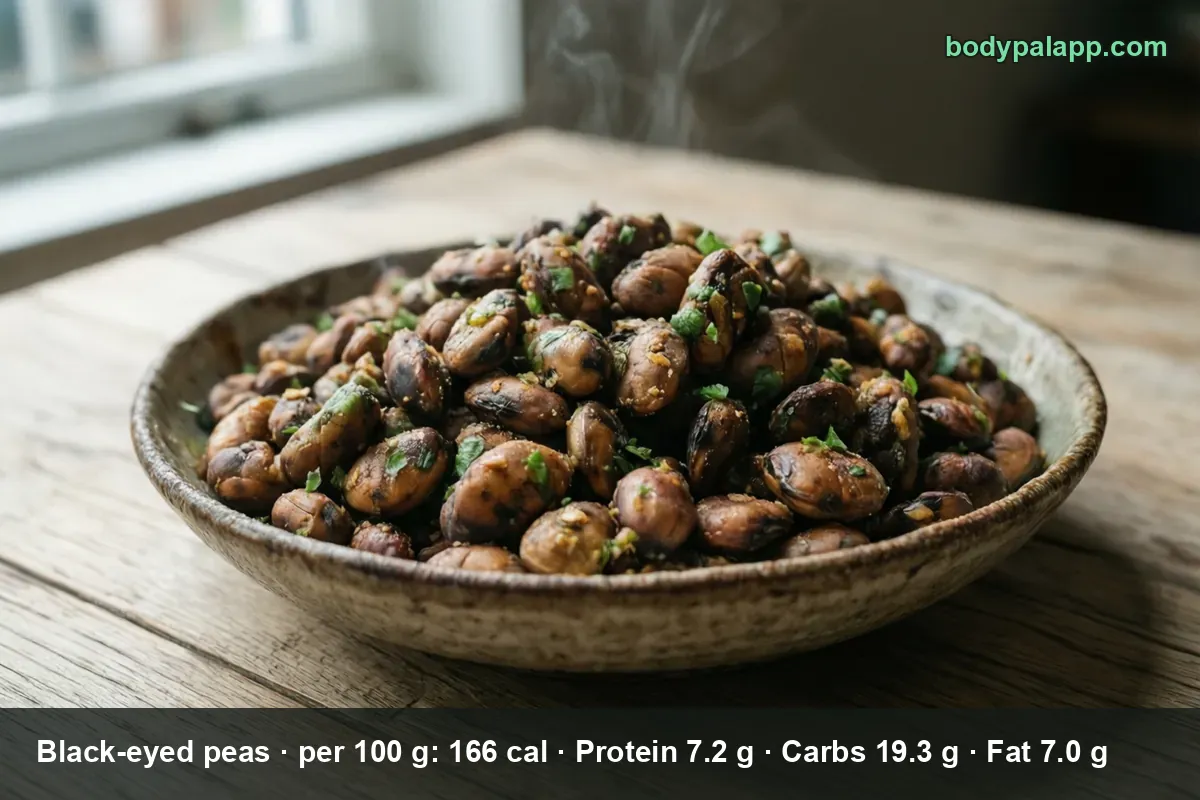
A 1-cup serving of cooked black-eyed peas weighs 185 g and carries 307 calories. Per 100 g they run 166 calories. That cup also brings 13.3 g of protein and 11.1 g of fiber, which is 40% of a day's worth — the number that makes this bean worth its plate space.
On this page
- Black-eyed pea quick facts
- US servings from one ounce to a full cup
- Cooked from dried frozen or canned
- Fiber is the win and sodium is the price
- How do black-eyed peas compare?
- Most popular black-eyed peas brands
- FAQ
Black-eyed pea quick facts
The record on this page is FNDDS 2707413, "Blackeyed peas, from dried". That is the version most people are actually holding: dried peas simmered and seasoned, the way they show up in a Sunday pot or a New Year's bowl of Hoppin' John. USDA also keeps an "NFS" entry for when nobody knows what the peas started as, and its numbers are identical to this one, so nothing is lost by picking the dried version.
One thing to expect before you read the table: the fat and sodium rows sit higher than a bag of dry peas would lead you to guess. FNDDS logs a prepared dish, seasoning included, not a rinsed bean. That is why 100 g comes in at 7 g of fat and 220 mg of sodium.
| Nutrient | Per 100 g | Per 1 cup (185 g) | % Daily Value |
|---|---|---|---|
| Calories | 166 | 307 | — |
| Total fat | 7 g | 13.0 g | 17% |
| Saturated fat | 1 g | 1.9 g | 9% |
| Carbohydrate | 19.29 g | 35.7 g | 13% |
| Dietary fiber | 6 g | 11.1 g | 40% |
| Total sugars | 3.07 g | 5.7 g | — |
| Protein | 7.18 g | 13.3 g | 27% |
| Sodium | 220 mg | 407 mg | 18% |
% Daily Value is based on a 2,000-calorie diet.
Verified nutrition data
Numbers on this page come from USDA FoodData Central, the U.S. Department of Agriculture’s food composition database, and from manufacturer labels where a branded product is named. Last verified September 2026. How we verify our data →
Two rows you will not find here: added sugars and trans fat. USDA does not publish either value for this prepared record, so listing them would mean guessing. Cholesterol is a clean zero, as it is in every plant food, and one cup delivers 477 mg of potassium, about 10% of the FDA Daily Value of 4,700 mg.
US servings from one ounce to a full cup
| Serving | Weight | Calories |
|---|---|---|
| 1 oz cooked | 28.4 g | 47 kcal |
| 1 oz dry, after cooking | 72 g | 120 kcal |
| 1/2 cup cooked | 92.5 g | 154 kcal |
| 1 cup cooked | 185 g | 307 kcal |
| Per 100 g | 100 g | 166 kcal |
The 1-cup line and the 1 oz dry yield are USDA measures. The half cup at 92.5 g and the ounce of cooked peas at 28.4 g are our own arithmetic from the USDA 100 g figure, not USDA servings.
The two ounce rows are the reason this table exists. An ounce of cooked peas is 47 calories. An ounce of dry peas is a different object entirely: it drinks up water, ends the pot at roughly 72 g, and lands at 120 calories. Same unit on the label, two and a half times the food. If your recipe measures the peas before they hit the water, count the dry weight and ignore what comes out of the pot.
The cup-versus-ounce gap is just as wide. A full cup is 307 calories; a single ounce of the same cooked peas is 47. That is close to a sevenfold spread between two servings people describe with the same casual "a serving of black-eyed peas."
Cooked from dried frozen or canned
| Version | Per 100 g | Typical serving | Calories |
|---|---|---|---|
| Cooked from dried, seasoned | 166 kcal | 1 cup (185 g) | 307 kcal |
| Black-eyed peas, NFS | 166 kcal | 1 cup (185 g) | 307 kcal |
| Cooked from frozen | 151 kcal | 1 cup (185 g) | 279 kcal |
| Cooked from canned | 150 kcal | 1 cup (185 g) | 278 kcal |
Here is the surprise most pages get backward: the canned version is not the heavier one. At 150 calories per 100 g it comes in 16 calories lighter than peas cooked from dried, because canned peas are usually warmed rather than simmered with fat. Fat per 100 g drops from 7 g to 3.17 g.
What the can does add is salt. Sodium goes from 220 mg per 100 g in the from-dried record to 312 mg in the canned one, roughly 40% more. Frozen peas split the difference in the other direction and are the lightest on sodium at 126 mg per 100 g. So the trade is simple: cans cost you sodium, home cooking costs you fat, and frozen dodges both.
Store labels tell the same story from a different angle. Canned brands read far lower than the USDA cooked record — Great Value canned black-eyed peas list 62 calories per 100 g and 81 for a 1/2-cup (130 g) serving, and Eden Organic lists 69 per 100 g — because a label counts drained beans with no seasoning at all. Other packs such as 365 No Salt Added sit near 118 per 100 g. Neither figure is wrong; they are counting a different plate than the one you eat from.
Fiber is the win and sodium is the price
Eleven grams of fiber in one cup is a genuinely large number. It is 40% of the 28 g Daily Value, and it arrives with 13.3 g of protein, 27% of the 50 g DV. Very few foods hand over two-fifths of a day's fiber and a quarter of its protein in the same bowl, which is why beans get counted in both the vegetable and the protein groups on MyPlate.
The cost sits two rows down. That same cup carries 407 mg of sodium, 18% of the 2,300 mg Daily Value — a little under a fifth of the day from one side dish, or about a sixth of a teaspoon of table salt. If you are watching sodium, cooking from dried or frozen with your own seasoning is the lever, and a rinsed can gives back some of it too.
Saturated fat, by contrast, is a non-issue: 1.9 g per cup, 9% DV, well inside the pattern the Dietary Guidelines for Americans describes. And at 35.7 g of carbohydrate per cup, 13% DV, black-eyed peas are a moderate-carb food with a third of those carbs offset by fiber — not the carb bomb their reputation suggests.
How do black-eyed peas compare?
| Legume | Per 100 g | US serving | Calories |
|---|---|---|---|
| Black-eyed peas | 166 kcal | 1 oz cooked (28.4 g) | 47 kcal |
| Lentils | 166 kcal | 1 oz cooked (28.4 g) | 47 kcal |
| Lima beans | 165 kcal | 1 oz cooked (28.4 g) | 47 kcal |
| Chickpeas | 163 kcal | 1 oz cooked (28.4 g) | 46 kcal |
The ounce column is scaled from each 100 g figure rather than lifted from a USDA household measure. All four foods land within 3 calories per 100 g of each other, so the calorie question between cooked legumes is close to settled before you ask it.
Our take: pick by the other columns, not by calories. For weight loss, chickpeas are marginally the lightest at 163 per 100 g and carry the least fat at 2.58 g, while black-eyed peas carry the most at 7 g — the fat is cooked in, not grown in. For protein per bite, chickpeas win at 8.81 g per 100 g against 7.18 g for black-eyed peas. Black-eyed peas earn their place on fiber and on the fact that a cup of them satisfies like a main course, so use them where a starchy side would otherwise sit.
Most popular black-eyed peas brands in the United States
Ranked by how widely each product appears among foods sold in the United States, from the BodyPal food database of over 3.3 million products. Calories are the figures printed on each Nutrition Facts label, checked against USDA FoodData Central.
| Product | Calories (per 100 g) |
|---|---|
| Luigi Vitelli Black Eyed Peas | 85 cal |
| 365 Whole Foods Market Black-Eyed Peas | 77 cal |
| Great Value Black Eyed Peas | 118 cal |
| Great Value Black Eyed Peas Canned | 62 cal |
| 365 No Salt Added Black-Eyed Peas | 118 cal |
| Eden Organic Black Eyed Peas | 69 cal |
Brand popularity: BodyPal food database. Nutrition: manufacturer labels / USDA FoodData Central.
Black-eyed pea FAQs
How many calories are in 1 cup of black-eyed peas?
One cup of cooked black-eyed peas weighs 185 g and holds 307 calories, based on the USDA record for peas cooked from dried at 166 calories per 100 g. The same cup carries 13.3 g of protein, 11.1 g of fiber and 35.7 g of carbohydrate. A half cup is 154 calories.
How many calories in canned black-eyed peas?
Canned black-eyed peas run 150 calories per 100 g, or 278 for a 185 g cup — slightly fewer than the 166 per 100 g for peas cooked from dried. The reason is fat, not the bean: canned peas are warmed rather than simmered with seasoning fat, so fat drops from 7 g to 3.17 g per 100 g.
How much protein is in black-eyed peas?
A cup gives 13.3 g of protein, 27% of the 50 g Daily Value, from 7.18 g per 100 g. Canned and frozen versions are a shade higher per 100 g at about 8.19 g and 8.23 g, because they carry less added cooking fat diluting the weight. That is real main-course protein for a side dish.
How much fiber do black-eyed peas have?
One cup delivers 11.1 g of dietary fiber, 40% of the 28 g Daily Value, from 6 g per 100 g. Frozen and canned versions edge slightly ahead at 6.2 g per 100 g. Two-fifths of a day's fiber from one bowl puts black-eyed peas among the strongest fiber sources on an American plate.
Do black-eyed peas have a lot of carbs?
A cup has 35.7 g of carbohydrate, 13% of the 275 g Daily Value, from 19.29 g per 100 g. Of that cup, 11.1 g is fiber, so nearly a third of the carbohydrate is the part that does not behave like starch. Total sugars are low at 5.7 g per cup.
Are canned black-eyed peas high in sodium?
Canned black-eyed peas carry 312 mg of sodium per 100 g, against 220 mg for peas cooked from dried and only 126 mg for frozen. A 185 g cup of the from-dried version is already 407 mg, 18% of the 2,300 mg Daily Value. Draining and rinsing the can removes part of it.
Are black-eyed peas a vegetable or a protein?
A cup's 13.3 g of protein makes it both, officially. MyPlate counts beans and peas in the vegetable group and in the protein foods group, and the numbers back it: 11.1 g of fiber comes along with that protein. Use them as your protein or as your vegetable at a meal, not as both.
Are black-eyed peas good for weight loss?
At 166 calories per 100 g they are moderate, not low, but the fiber does the work: 11.1 g per cup is 40% of a day and keeps a 307-calorie serving filling for hours. If you are counting closely, cook them from frozen at 151 per 100 g and season them yourself.
Similar foods
- Potato wedges — 138 cal for 3 oz
- Ear of Corn — 99 cal per medium ear
- Sweet Potato — 103 cal per medium, baked
- Papaya salad — 190 cal per plate
- Carrot — 53 cal per cup chopped
- Onion — 46 cal per cup sliced
Count it without the math
Point the camera at the bowl and BodyPal counts the black-eyed peas for you, cup or half cup.


How long does it take to burn off 307 kcal of black-eyed peas?
A 1-cup (185 g) serving is 307 kcal. Enter your weight and the amount you ate to see how long it takes you to burn that off:
lb
| Activity | Time to burn 307 kcal |
|---|---|
| Walking, brisk | 1 hr 1 min |
| Cycling, moderate | 38 min |
| Swimming, moderate | 44 min |
| Jogging | 36 min |
| Weight training, moderate | 1 hr 8 min |
Times are for a 155 lb adult at a steady pace; change the weight to see yours. The amount is set to the portion in the text (185 g); change it to what you actually ate. BodyPal works this out from your steps automatically.
Burning it off is one side of it. The other is knowing your number: work out how many calories you need a day, with macros and a goal date.