
How many calories are in bone broth?
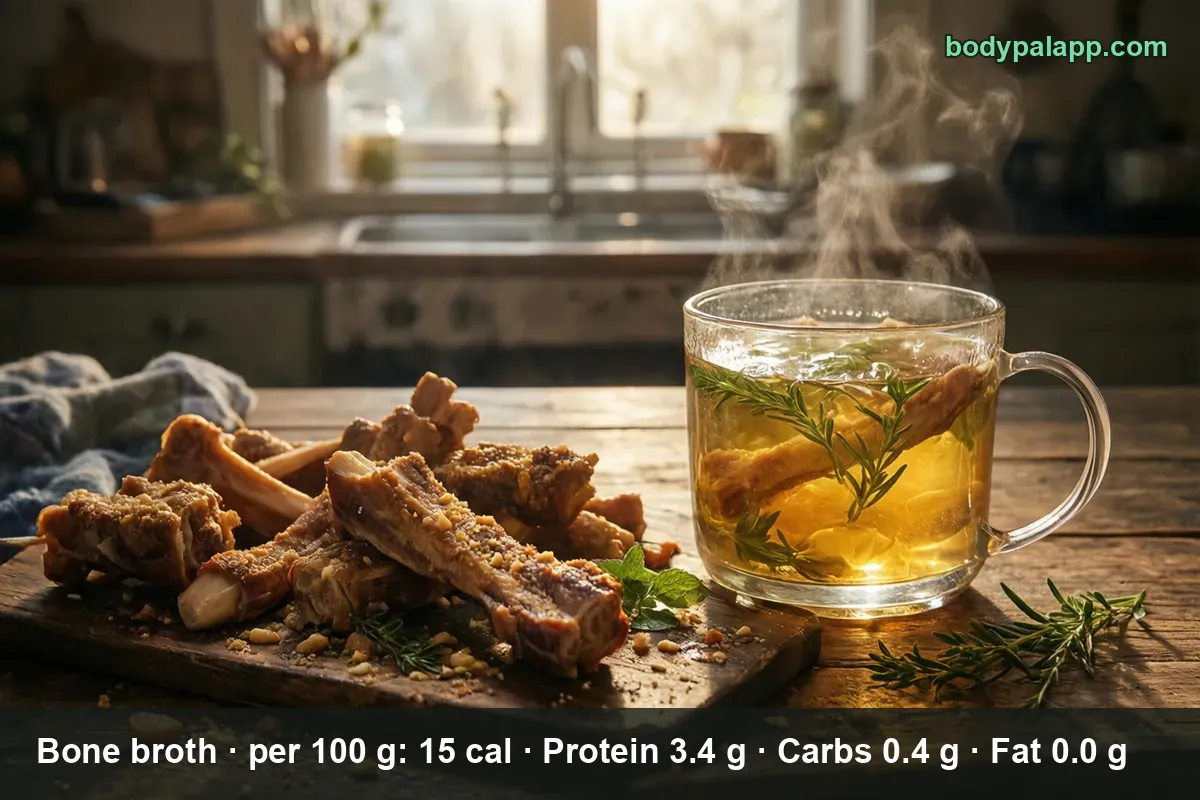
A 1-cup (240 g) serving of chicken bone broth is 36 calories, and per 100 g it runs 15 calories, lighter than almost anything else you would drink warm. Nearly all of it is protein: 8.2 g in that cup, with no fat and 1 g of carbohydrate on the label.
On this page
- Bone broth quick facts
- US servings from one ounce to a whole carton
- Beef and unsalted bone broth
- Bone broth versus regular chicken broth
- Nearly every calorie is protein
- Sodium is the row to watch
- How does bone broth compare?
- Most popular bone broth brands
- Bone broth FAQs
Bone broth quick facts
There is no Foundation, SR Legacy or FNDDS entry for bone broth. The generic "chicken broth" records in the database are a different drink altogether, carrying a fifth to three-fifths of the protein, so using one of them would understate the cup in your hand by a wide margin. The numbers here come from Swanson Chicken Bone Broth, 32 oz Carton, the label that shows up most often on US shelves and the record the person searching is usually holding.
| Nutrient | Per 100 g | Per 1 cup (240 g) | % Daily Value |
|---|---|---|---|
| Calories | 15 | 36 | — |
| Total fat | 0 g | 0 g | 0% |
| Carbohydrate | 0.43 g | 1.0 g | 0% |
| Protein | 3.4 g | 8.2 g | 16% |
| Sodium | 149 mg | 358 mg | 16% |
% Daily Value is based on a 2,000-calorie diet.
Verified nutrition data
Numbers on this page come from USDA FoodData Central, the U.S. Department of Agriculture’s food composition database, and from manufacturer labels where a branded product is named. Last verified September 2026. How we verify our data →
Six rows that usually appear here are missing. Saturated fat, dietary fiber and total sugars are not declared on this label, and neither are added sugars, cholesterol or potassium, so a clear strained broth leaves them blank rather than at zero. The Daily Values used above are the FDA reference amounts for adults.
Homemade bone broth has no USDA record at all, and its calories depend almost entirely on how much fat you skim off the top after chilling. A broth left unskimmed can carry visible fat that a carton never has, so the numbers on this page describe store-bought broth only.
US servings from one ounce to a whole carton
| Serving | Weight | Calories |
|---|---|---|
| 1 oz | 28 g | 4 kcal |
| 1/2 cup (4 fl oz) | 120 g | 18 kcal |
| 1 cup (8 fl oz), the label serving | 240 g | 36 kcal |
| 1 mug (12 fl oz) | 355 g | 53 kcal |
| 1 carton (32 fl oz) | 960 g | 144 kcal |
| Per 100 g | 100 g | 15 kcal |
Only the 1-cup line is a USDA serving. The half cup, the 12-ounce mug, the ounce and the full carton are our own arithmetic from the USDA 100 g figure, not USDA servings.
That carton line is the useful one. Drinking a whole 32-ounce box across an afternoon costs 144 calories, roughly what two slices of bread would, which is why bone broth turns up so often as a between-meals habit rather than a meal. The 12-ounce mug most people actually pour, bigger than the label cup, still lands at 53 calories.
Beef and unsalted bone broth
| Version | Per 100 g | Typical serving | Calories |
|---|---|---|---|
| Chicken bone broth, store-bought | 15 kcal | 1 cup, 240 g | 36 kcal |
| Beef bone broth | 16 kcal | 1 cup, 245 g | 39 kcal |
| Organic unsalted chicken bone broth | 21 kcal | 1 cup, 240 g | 50 kcal |
| Low-sodium organic chicken bone broth | 19 kcal | 1 cup, 240 g | 46 kcal |
| Chicken broth, canned, prepared with water | 16 kcal | 1 cup, 244 g | 39 kcal |
| Chicken broth, ready-to-serve | 6 kcal | 1 cup, 240 g | 14 kcal |
The spread across real US brands is narrow. College Inn and Field Day both list 19 calories per 100 g, Full Circle Market's beef broth 16, Swanson 15, and Pacific Foods organic unsalted the highest at 21. Per cup that is a range of 36 to 50 calories, so brand choice moves the number by about 14 calories at most.
Beef bone broth is the one people expect to be heavier, and it is, but barely: 39 calories a cup against 36, and part of that gap is the cup itself, measured at 245 g rather than 240 g. Beef also brings a little more protein, 9.0 g against 8.2 g, with 0 g of carbohydrate on the Full Circle label.
The unsalted and organic versions are the mild surprise. Taking the salt out does not take calories out; Pacific Foods unsalted is the richest broth in this table at 21 calories per 100 g, because a broth that leans on the bones rather than the seasoning tends to be more concentrated.
Bone broth versus regular chicken broth
This is the comparison that matters most, and the two products are not close. A cup of ready-to-serve chicken broth gives 1.5 g of protein and 14 calories. A cup of bone broth gives 8.2 g and 36 calories. That is over five times the protein for a drink that looks identical in the mug.
Canned broth prepared with an equal volume of water sits between them, at 16 calories per 100 g and 4.9 g of protein a cup. If you swapped a cup of bone broth for a cup of ready-to-serve broth to save calories, you would save 22 and give up 6.7 g of protein. That is a bad trade for anyone using broth as a hunger stopgap.
The ready-to-serve cup at 240 g is our own arithmetic from the USDA 100 g figure, since that record is published per 100 g rather than per cup.
Nearly every calorie is protein
Run the math on the cup and the picture is unusual. Protein carries 4 calories per gram, so 8.2 g accounts for 33 of the 36 calories in a cup: 91% of the total. The remaining few come from the single gram of carbohydrate. Fat contributes nothing, because the Swanson label lists 0 g.
Almost no other drink is built like that. It puts 16% of the Daily Value for protein into a serving that costs less than 2% of a 2,000-calorie day, which is why bone broth is worth logging separately from the herbal tea or black coffee it often replaces in the afternoon.
The Dietary Guidelines for Americans put most adults in the 46 to 56 g a day range for protein at minimum. Two mugs of bone broth cover a meaningful slice of that without touching the fat or carbohydrate budget.
Sodium is the row to watch
If any number on this page should give you pause, it is 358 mg of sodium a cup, 16% of the Daily Value. That is about a sixth of the day's allowance in a drink most people treat as free. Two mugs from a 12-ounce pour push past 1,000 mg before you have eaten anything.
Salted brands go higher. One College Inn record lists 233 mg per 100 g, which works out to 559 mg a cup, or 24% of the Daily Value; two cups of that version is close to half a day's sodium. At the other end, Field Day's organic broth lists 44 mg per 100 g, about 106 mg a cup, and Pacific Foods unsalted 149 mg a cup. If you are watching sodium, the unsalted carton is the pick, and the calorie cost of switching is 14 calories a cup.
For scale, 358 mg is roughly what you would get from about a sixth of a teaspoon of table salt.
How does bone broth compare?
| Broth | Per 100 g | US serving | Calories | Protein |
|---|---|---|---|---|
| Chicken bone broth | 15 kcal | 1 cup, 240 g | 36 kcal | 8.2 g |
| Beef bone broth | 16 kcal | 1 cup, 245 g | 39 kcal | 9.0 g |
| Chicken broth, canned, prepared | 16 kcal | 1 cup, 244 g | 39 kcal | 4.9 g |
| Bouillon, dry, prepared with water | 4 kcal | 1 cup, 241 g | 10 kcal | 0.7 g |
Our take: for weight loss, every option in this table is cheap enough that the calories are not the deciding factor. Only the dry bouillon is lighter than bone broth, at 10 calories a cup, and it hands back nearly all the protein to get there. For fullness, bone broth wins outright, since 8.2 g of protein in a hot cup does more to hold off a snack than 0.7 g in salty water. Pick bone broth when you want the protein, plain broth when it is a cooking liquid, and read the sodium line before you buy either.
Most popular bone broth brands in the United States
Ranked by how widely each product appears among foods sold in the United States, from the BodyPal food database of over 3.3 million products. Calories are the figures printed on each Nutrition Facts label, checked against USDA FoodData Central.
| Product | Calories (per 100 g) |
|---|---|
| College Inn Chicken Bone Broth | 19 cal |
| Swanson Chicken Bone Broth | 15 cal |
| Full Circle Market Beef Bone Broth | 16 cal |
| Field Day Organic Chicken Bone Broth | 19 cal |
| Pacific Foods Organic Unsalted Chicken Bone Broth | 21 cal |
Brand popularity: BodyPal food database. Nutrition: manufacturer labels / USDA FoodData Central.
Bone broth FAQs
How many calories are in a cup of bone broth?
A 1-cup (240 g) serving is 36 calories, based on the Swanson chicken bone broth label in USDA FoodData Central. That works out to 15 calories per 100 g. Half a cup is 18 calories, a 12-ounce mug about 53, and the full 32-ounce carton 144.
How much protein is in bone broth?
One cup carries 8.2 g of protein, 16% of the Daily Value, in a drink with no fat and 1 g of carbohydrate. Per 100 g that is 3.4 g. Field Day's organic broth is higher at 10.0 g per cup, and Pacific Foods unsalted sits at 8.9 g.
Does bone broth have carbs?
Yes, but barely: 1.0 g per cup, which rounds to 0% of the Daily Value for carbohydrate. Per 100 g the label lists 0.43 g. The Full Circle beef bone broth record lists 0 g outright. Sugars are not declared on these labels, so no sugar figure exists.
How much sodium is in bone broth?
A cup of Swanson chicken bone broth has 358 mg of sodium, 16% of the 2,300 mg Daily Value, so one cup takes about a sixth of the day. Salted versions run higher: one College Inn record works out to 559 mg a cup. Pacific Foods unsalted is 149 mg.
Is bone broth keto friendly?
With 1.0 g of carbohydrate and 36 calories per cup, bone broth fits a low-carb or keto plan comfortably. The protein is 8.2 g, and the Swanson record lists no fat at all, so nothing is hiding in the calorie count. Full Circle beef broth lists 0 g of carbohydrate.
Chicken or beef bone broth, which has fewer calories?
Chicken is slightly lighter: 36 calories a cup against 39 for Full Circle beef bone broth, which is measured at 245 g per cup rather than 240 g. Per 100 g the gap is 15 against 16 calories. Beef brings a little more protein, 9.0 g against 8.2 g.
Can you drink bone broth while fasting?
Bone broth is not calorie-free: one cup is 36 calories and 8.2 g of protein, so it breaks a strict water fast. On plans that allow a small calorie allowance, half a cup at 18 calories is the lighter option. Check the rules of the fast you are following.
Is bone broth better than regular chicken broth?
For protein, yes: 8.2 g a cup against 1.5 g for ready-to-serve chicken broth, over five times more, for 36 calories versus 14. Canned broth prepared with water lands between them at 4.9 g a cup. Bone broth is also lower in sodium than both USDA broth records.
Similar foods
- Milk — 149 cal per cup
- Wild Rice — 166 cal per cup, cooked
- Quinoa — 222 cal per cup cooked
- Rice — 205 cal per cup, cooked
- Pasta — 168 cal per cup penne
- Penne pasta — 169 cal per cup
Count it without the math
Point the camera at the mug and BodyPal counts the broth for you, carton brand and all.


How long does it take to burn off bone broth?
A 1-cup (240 g) serving is 36 kcal. Enter your weight and the amount you ate to see how long it takes you to burn that off:
lb
| Activity | Time to burn 36 kcal |
|---|---|
| Walking, brisk | 7 min |
| Cycling, moderate | 4 min |
| Swimming, moderate | 5 min |
| Jogging | 4 min |
| Weight training, moderate | 8 min |
Times are for a 155 lb adult at a steady pace; change the weight to see yours. The amount is set to the portion in the text (240 g); change it to what you actually ate. BodyPal works this out from your steps automatically.
Burning it off is one side of it. The other is knowing your number: work out how many calories you need a day, with macros and a goal date.