
How many calories are in breakfast sausage?
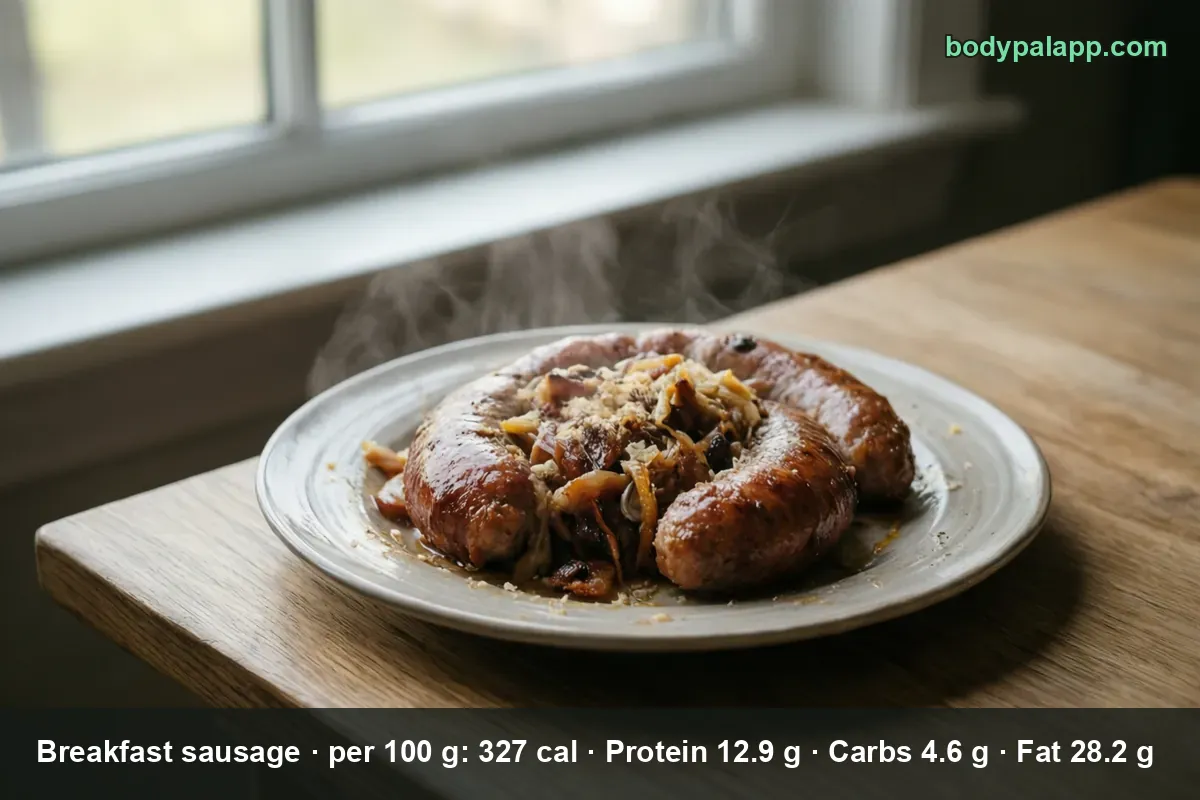
Two breakfast sausage links weigh 38 g on a US plate and come to 124 calories. Per 100 g the beef links run 327 calories, which puts them among the densest things on a breakfast plate. One link on its own is only 19 g and 62 calories, so the count depends almost entirely on how many you take.
On this page
- Breakfast sausage quick facts
- US servings from one link to a full plate
- Pork beef and turkey links side by side
- Patties maple links and the deli cousins
- Sodium beats protein on this label
- How does breakfast sausage compare?
- Most popular breakfast sausage brands
- Breakfast sausage FAQs
Breakfast sausage quick facts
The number above comes from the SR Legacy record 174616, "Sausage, breakfast sausage, beef, pre-cooked, unprepared". Three USDA entries describe the same product, and this is the only one that carries a full carbohydrate picture, sugars and fiber included, plus a household measure of one link. That link measure is what makes the page usable: nobody eats 100 g of sausage, they eat two links or three.
The newer Foundation edition of the identical product, 324157, lands at 328 calories per 100 g with a little less carbohydrate. Two labs, two years, one calorie apart. That is about as much agreement as you get in a meat aisle.
| Nutrient | Per 100 g | Per 2 links (38 g) | % Daily Value |
|---|---|---|---|
| Calories | 327 | 124 | — |
| Total fat | 28.22 g | 10.7 g | 14% |
| Saturated fat | 11.3 g | 4.3 g | 21% |
| Carbohydrate | 4.61 g | 1.8 g | 1% |
| Dietary fiber | 0 g | 0 g | 0% |
| Total sugars | 1 g | 0.4 g | — |
| Protein | 12.9 g | 4.9 g | 10% |
| Sodium | 904 mg | 344 mg | 15% |
| Cholesterol | 60 mg | 23 mg | 8% |
| Potassium | 285 mg | 108 mg | 2% |
% Daily Value is based on a 2,000-calorie diet.
Verified nutrition data
Numbers on this page come from USDA FoodData Central, the U.S. Department of Agriculture’s food composition database, and from manufacturer labels where a branded product is named. Last verified September 2026. How we verify our data →
There is no added sugars row here, and no trans fat row either. The SR Legacy edition simply does not measure them, so rather than borrow a figure from a retail label we leave the line out. The total sugars figure, 1 g per 100 g, is small enough that the distinction changes nothing on a breakfast plate. Daily Values follow the FDA reference amounts for a 2,000-calorie day.
US servings from one link to a full plate
| Serving | Weight | Calories |
|---|---|---|
| 1 link | 19 g | 62 kcal |
| 2 links | 38 g | 124 kcal |
| 3 links | 57 g | 186 kcal |
| 1 oz | 28.4 g | 93 kcal |
| Per 100 g | 100 g | 327 kcal |
Only the single link and the 100 g row are USDA measures. The two-link, three-link and one-ounce rows are our own arithmetic from the USDA 100 g figure, not USDA servings, which is the honest way to say that a link is a link and the rest is multiplication.
The size is the thing people get wrong. A breakfast sausage link is 19 g, roughly the weight of a AA battery, so a plate that looks generous with three of them is still only 186 calories. Compare that with a single 57 g turkey patty at 100 calories and you can see why counting pieces beats guessing by eye. It also explains why the same "sausage and eggs" entry in a food diary can swing 124 calories between one link and three.
One ounce is the trap. People reach for ounces because that is how meat is sold, but 28.4 g of breakfast sausage is one and a half links, not one link and not two. At 93 calories it sits awkwardly between the two servings anyone actually plates.
Pork beef and turkey links side by side
| Version | Per 100 g | Typical serving | Calories |
|---|---|---|---|
| Beef links, USDA main record | 327 kcal | 2 links (38 g) | 124 kcal |
| Beef links, Foundation edition | 328 kcal | 1 link (18.6 g) | 61 kcal |
| Pork links, cooked and pan-fried | 325 kcal | 1 oz (28.4 g) | 92 kcal |
| Turkey links | 178 kcal | 2 links (45 g) | 80 kcal |
Pork and beef are interchangeable on calories. The pork record sits at 325 per 100 g against 327 for beef, a difference smaller than the variation between two links out of the same package. Where they part company is protein: the cooked pan-fried pork record carries 18.53 g per 100 g against 12.9 g for the uncooked beef, partly because pork sausage is leaner in that particular record and partly because cooking has already taken the water out of it.
Turkey is the switch that actually moves the number. At 178 calories per 100 g, turkey links are about 45% lighter per gram than pork or beef, and the turkey links are usually cut slightly bigger, so two of them at 45 g still come to only 80 calories. That is a 44-calorie saving on a two-link side, before you change anything else about the meal.
Cooking does not change what is on the label, only what is on the plate. The link goes into the pan at 19 g and comes out lighter, because water and some of the fat leave it. The calories that drip into the skillet are gone from your count, but there is no USDA figure for how much, so the safe habit is to log the link, not the weight of what survived the pan.
Patties maple links and the deli cousins
| Version | Per 100 g | Typical serving | Calories |
|---|---|---|---|
| Turkey patty | 175 kcal | 1 patty (57 g) | 100 kcal |
| Maple links, retail label | 290 kcal | 4 pan-fried links (62 g) | 180 kcal |
| Polish sausage, pork | 326 kcal | 3 oz (85 g) | 277 kcal |
Patties look heavier than links and often are not. A turkey patty runs 57 g for 100 calories, while a pork patty from a US retail label is 312 calories per 100 g and lands at the same 100 calories for a much smaller 32 g piece. Same number on the plate, nearly double the food.
Maple is the flavor most people assume is the expensive one. It is, but only mildly: a maple retail label runs 290 calories per 100 g against 274 for the same brand's plain original, and four maple links at 62 g come to 180 calories against 170 for the plain ones. Ten calories is the price of the syrup. The turkey version of the same line, at 164 calories per 100 g, is the lightest number anywhere on this page.
Polish sausage is the one to watch, and not because it is denser. At 326 calories per 100 g it is a dead heat with breakfast sausage. The problem is that it is served in 3 oz lengths rather than 19 g links, so the same food costs 277 calories instead of 124.
Sodium beats protein on this label
Here is the row nobody reads. Two links deliver 344 mg of sodium, 15% of the 2,300 mg Daily Value, while delivering only 4.9 g of protein, 10% of the 50 g Daily Value. The salt outruns the protein, which is unusual for something people log as a protein food.
Three links, the portion most diners plate, take it to 515 mg, or 22% of the day's sodium in one small side — about a fifth of a teaspoon of table salt before the eggs, the toast or the hash browns get their turn. If you are watching sodium, this is the item on the breakfast plate worth swapping first. MyPlate counts sausage as a protein food, but at 4.9 g per two links it is a thin one; an egg does better for fewer calories and far less salt.
Saturated fat tells a similar story. Two links carry 4.3 g, 21% of the 20 g Daily Value, and three links carry 6.4 g, or 32%. The Dietary Guidelines for Americans put the ceiling at 10% of daily calories, which on a 2,000-calorie day lands close to that 20 g Daily Value. A side dish that takes a fifth of it deserves to be counted as more than a garnish.
How does breakfast sausage compare?
| Sausage | Per 100 g | US serving | Calories |
|---|---|---|---|
| Breakfast sausage, beef | 327 kcal | 2 links (38 g) | 124 kcal |
| Pork sausage, pan-fried | 325 kcal | 1 oz (28.4 g) | 92 kcal |
| Polish sausage, pork | 326 kcal | 3 oz (85 g) | 277 kcal |
| Kielbasa, fully cooked | 325 kcal | 3 oz (85 g) | 276 kcal |
Our take: all four records sit inside a two-calorie band per 100 g, so choosing between sausages on calorie density is pointless. What separates them is the serving size the format forces on you, and breakfast sausage wins that fight by being cut small. Protein is the real tiebreaker: pan-fried pork sausage leads with 18.53 g per 100 g, kielbasa trails at 10.84 g, and breakfast sausage sits between them at 12.9 g. If you want sausage on the plate and a number under 150, two breakfast links at 124 and a single ounce of pan-fried pork at 92 are the servings that get you there; both 3 oz options land near 277.
Most popular breakfast sausage brands in the United States
Ranked by how widely each product appears among foods sold in the United States, from the BodyPal food database of over 3.3 million products. Calories are the figures printed on each Nutrition Facts label, checked against USDA FoodData Central.
| Product | Calories (per 100 g) |
|---|---|
| Johnsonville Breakfast Sausage Patty | 312 cal |
| Johnsonville Original Recipe Breakfast Sausage | 309 cal |
| Johnsonville Maple Breakfast Sausage Naturals | 290 cal |
| Johnsonville Breakfast Sausage Original | 274 cal |
| Johnsonville Turkey Breakfast Sausage Patty | 175 cal |
| Johnsonville Turkey Original Breakfast Sausage | 164 cal |
Brand popularity: BodyPal food database. Nutrition: manufacturer labels / USDA FoodData Central.
Breakfast sausage FAQs
How many calories are in one breakfast sausage link?
One link weighs 19 g and carries 62 calories, from the USDA beef breakfast sausage record at 327 calories per 100 g. That single link also brings 172 mg of sodium and 2.5 g of protein. Almost nobody stops at one, which is where the count starts to matter.
How many calories are in 2 breakfast sausage links?
Two links weigh 38 g together and come to 124 calories. That is 10.7 g of fat, 4.3 g of it saturated, 4.9 g of protein and 344 mg of sodium, which is 15% of the Daily Value for sodium against 10% for protein. Two links is the standard side portion.
How many calories are in a breakfast sausage patty?
About 100 calories for a 32 g cooked pork patty from a US retail label, and also 100 calories for a 57 g turkey patty. Per 100 g that is 312 for the pork and 175 for the turkey, so the turkey patty is nearly twice the food for the same number.
Is turkey breakfast sausage lower in calories than pork?
Yes, by about 45%. Turkey links come in at 178 calories per 100 g and turkey patties at 175, against 325 to 328 for the pork and beef records. Two turkey links at 45 g are 80 calories, while two beef links at 38 g are 124.
How much sodium is in breakfast sausage?
Two links carry 344 mg of sodium, 15% of the 2,300 mg Daily Value. Three links push that to 515 mg, or 22%, roughly a fifth of a teaspoon of table salt before anything else joins the plate. Per 100 g the record shows 904 mg.
How much protein is in breakfast sausage?
Two links give 4.9 g of protein, only 10% of the 50 g Daily Value, while those same two links use 15% of the sodium allowance. Per 100 g the beef record holds 12.9 g. Cooked pan-fried pork sausage is denser at 18.53 g per 100 g.
Does cooking change the calories in breakfast sausage?
A 19 g link starts at 62 calories and loses weight rather than calories in the pan. Water and some fat leave it, so the cooked link is smaller but nearly as caloric. USDA has no figure for what drips out, so log the link you put in the pan.
Are breakfast sausage links keto friendly?
Two links hold 1.8 g of carbohydrate and no fiber, so 1.8 g net for 124 calories. Per 100 g the beef record shows 4.61 g of carbohydrate against 1.42 g for plain pork sausage, because breakfast blends carry sugar and seasoning that plain sausage does not.
Similar foods
- Toast with butter — 100 cal per slice with butter
- Pancake — 423 cal for 3 medium pancakes
- Crepe — 179 cal per crepe
- Omelet — 305 cal for 3-egg omelet
- Egg — 72 cal per large egg
- Pork Roll — 197 cal for 2 slices
Count it without the math
Point the camera at the plate and BodyPal counts the links for you, patties and all.


How long does it take to burn off 124 kcal of breakfast sausage?
Two links (38 g) is 124 kcal. Enter your weight and the amount you ate to see how long it takes you to burn that off:
lb
| Activity | Time to burn 124 kcal |
|---|---|
| Walking, brisk | 25 min |
| Cycling, moderate | 16 min |
| Swimming, moderate | 18 min |
| Jogging | 15 min |
| Weight training, moderate | 28 min |
Times are for a 155 lb adult at a steady pace; change the weight to see yours. The amount is set to the portion in the text (38 g); change it to what you actually ate. BodyPal works this out from your steps automatically.
This table assumes you know your daily total. If you do not, the daily calorie calculator works it out from five numbers.