
How many calories are in a Cadbury Creme Egg?
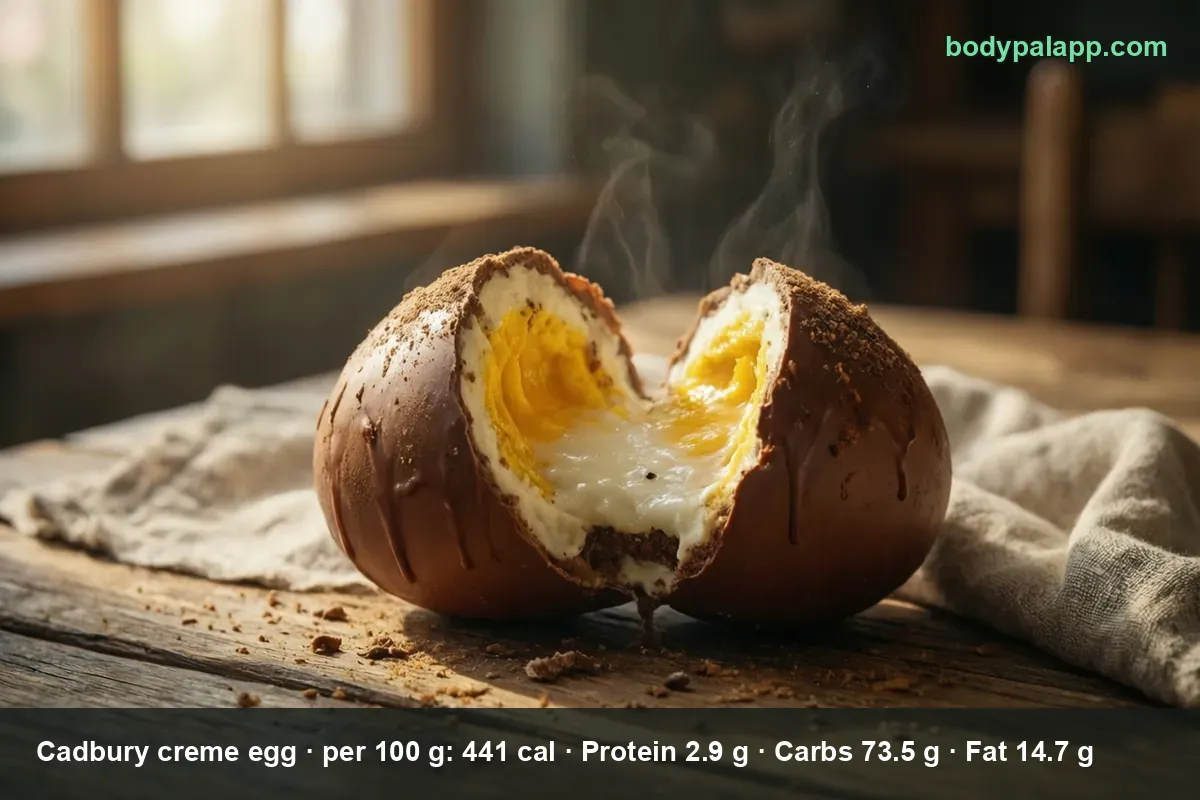
One Cadbury Creme Egg weighs 34 g and carries 150 calories. Per 100 g the egg runs 441 calories, which puts it in the same density band as plain milk chocolate. What makes it unusual is the split: 25 g of carbohydrate against 5 g of fat, and almost all of that carbohydrate is sugar.
On this page
- Cadbury creme egg quick facts
- US servings from half an egg to a four-pack
- Mini eggs chocolate fondant and peanut butter versions
- Added sugar is the row to watch
- How does a creme egg compare?
- Most popular cadbury creme egg brands
- Cadbury creme egg FAQs
Cadbury creme egg quick facts
The numbers below come from the current US label for milk chocolate creme eggs with soft fondant center (FDC 2658053, Cadbury, The Hershey Company). It is the record that matches the thing in your hand: one wrapped egg, 34 g, sold as a single piece. There is no Foundation, SR Legacy or FNDDS entry for a creme egg, so the branded label filed under the product's own barcode is the only source with a full nutrient panel.
Two other Cadbury records exist for the same candy. One is a straight reissue of this label under a different barcode, with identical numbers. The other is an older filing that also lands on 441 calories per 100 g but rounds the macros differently — 5.88 g protein, 17.65 g fat, 70.59 g carbohydrate. Same egg, older paperwork. We use the current label rather than averaging across the three, because mixing filings would produce a nutrient profile that appears on no wrapper anywhere.
| Nutrient | Per 100 g | Per 1 egg (34 g) | % Daily Value |
|---|---|---|---|
| Calories | 441 | 150 | — |
| Total fat | 14.71 g | 5.0 g | 6% |
| Saturated fat | 8.82 g | 3.0 g | 15% |
| Carbohydrate | 73.53 g | 25.0 g | 9% |
| Dietary fiber | 0 g | 0 g | 0% |
| Total sugars | 64.71 g | 22.0 g | — |
| Added sugars | 58.8 g | 20.0 g | 40% |
| Protein | 2.94 g | 1.0 g | 2% |
| Sodium | 59 mg | 20 mg | <1% |
% Daily Value is based on a 2,000-calorie diet.
Verified nutrition data
Numbers on this page come from USDA FoodData Central, the U.S. Department of Agriculture’s food composition database, and from manufacturer labels where a branded product is named. Last verified September 2026. How we verify our data →
Cholesterol is 5 mg per egg (2% DV) and potassium 70 mg (1% DV). Nothing has been dropped from the panel for lack of data — the fiber and trans fat rows are genuine zeros on the label, not gaps. Sodium is negligible at 20 mg, well under 1% of the daily limit, so salt is not the story here.
US servings from half an egg to a four-pack
| Serving | Weight | Calories |
|---|---|---|
| Half an egg | 17 g | 75 kcal |
| 1 oz | 28 g | 123 kcal |
| One egg, the single wrapper | 34 g | 150 kcal |
| Two eggs | 68 g | 300 kcal |
| Four-pack | 136 g | 600 kcal |
| Per 100 g | 100 g | 441 kcal |
Only one line in that table is a USDA serving: the single 34 g egg, which is what the manufacturer declares on the label. The half egg, the ounce, the pair and the four-pack are our own arithmetic scaled from the USDA 100 g figure, not listed servings. They are worth spelling out anyway, because nobody buys creme eggs by the ounce and plenty of people buy them by the four-pack.
The four-pack is where this candy stops behaving like a snack. At 600 calories it sits alongside a fast-food burger and fries, and unlike a burger it brings no protein or fiber with it. Half an egg, at 75 calories, is the version that slots into an ordinary day without any arithmetic gymnastics.
Mini eggs chocolate fondant and peanut butter versions
| Version | Per 100 g | Typical piece | Calories |
|---|---|---|---|
| Cadbury Creme Egg, standard | 441 kcal | 1 egg (34 g) | 150 kcal |
| Cadbury Mini Creme Eggs | 481 kcal | 3 pieces (27 g) | 130 kcal |
| Cadbury Chocolate Creme Egg | 471 kcal | 1 egg (34 g) | 160 kcal |
| Reese's Peanut Butter Creme Egg | 529 kcal | 1 egg (34 g) | 180 kcal |
| Russell Stover Vanilla Creme Egg | 429 kcal | 1 egg (28 g) | 120 kcal |
| Russell Stover Peanut Butter Creme Egg | 464 kcal | 1 egg (28 g) | 130 kcal |
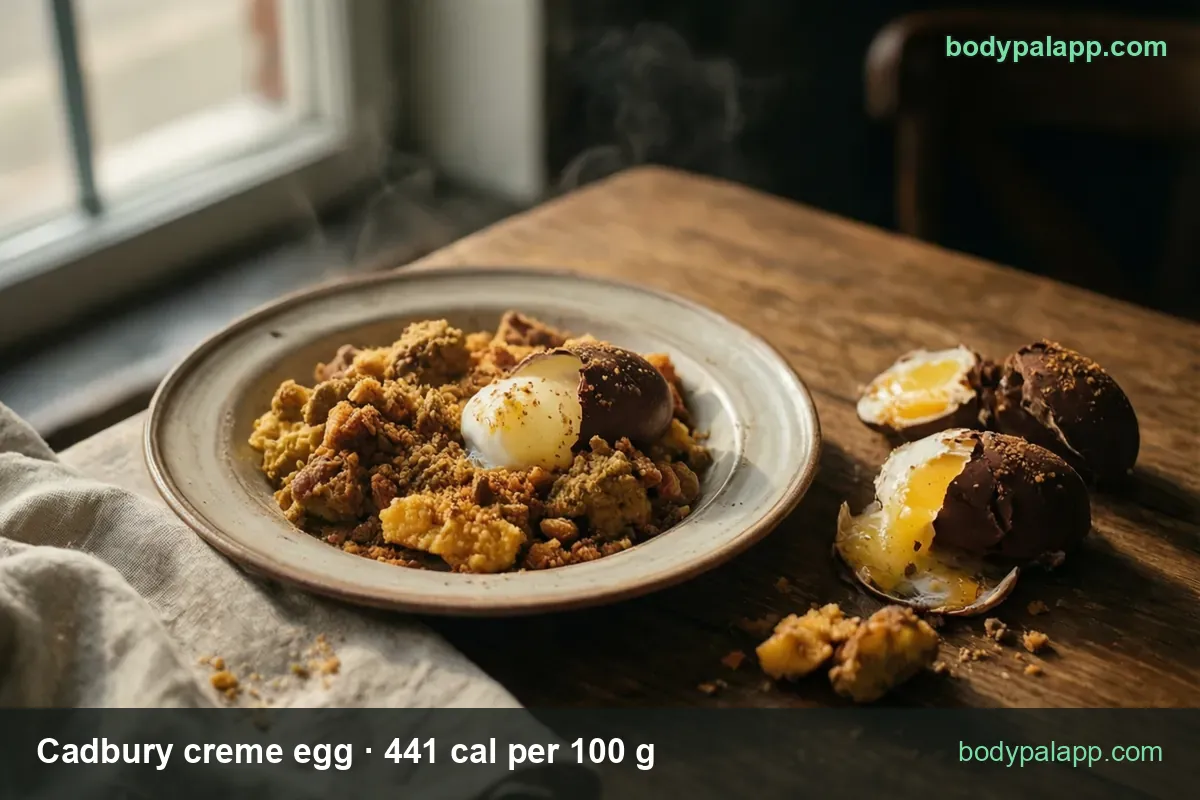
The mini eggs are the trap. They are more calorie-dense than the full-size egg, 481 against 441 per 100 g, because shrinking an egg raises the ratio of chocolate shell to fondant and the shell is the fattier half. Three minis weigh 27 g and cost 130 calories, which is 20 short of a whole standard egg. Most people eat more than three.
Swapping the vanilla fondant for chocolate fondant adds 10 calories per egg. Going to peanut butter adds 30 and changes the shape of the food entirely: the Reese's version is 32.35 g of fat per 100 g against 14.71 g in the Cadbury, with correspondingly less sugar. Only the Russell Stover vanilla egg is lighter per 100 g than the Cadbury, and it is also the lightest piece on the table at 120 calories, mostly because it is a smaller egg to begin with.
Added sugar is the row to watch
Fat is not the interesting number on this label. Five grams of total fat is 6% of the FDA Daily Value, which is trivial. Saturated fat at 3.0 g is 15%, noticeable but not alarming for a single piece of candy.
Added sugar is a different story. One egg carries 20 g of added sugar against a Daily Value of 50 g — 40% of the day's allowance in four bites. By our own arithmetic at 4.2 g per teaspoon, that is just under five teaspoons. The Dietary Guidelines for Americans suggest keeping added sugars under 10% of daily calories, which on a 2,000-calorie day is the same 50 g. Two eggs put you at 80% of it before breakfast counts.
There is nothing in the egg to slow that down. Zero fiber, 1 g of protein. Compare it with the snack advice on MyPlate, where the useful move is pairing a sweet with something that has protein or fiber attached. If you're watching added sugar specifically, half an egg at 10 g is the version that leaves room for the rest of the day.
How does a creme egg compare?
| Creme egg | Per 100 g | US serving | Calories |
|---|---|---|---|
| Cadbury Creme Egg | 441 kcal | 1 egg, 34 g | 150 kcal |
| Reese's Peanut Butter Creme Egg | 529 kcal | 1 egg, 34 g | 180 kcal |
| Russell Stover Vanilla Creme Egg | 429 kcal | 1 egg, 28 g | 120 kcal |
| Dove Coconut Creme Eggs | 583 kcal | 2 eggs, 24 g | 140 kcal |
Our take: the Cadbury egg is the middle of this basket per piece and near the bottom per gram, so its reputation as the heavy one is mostly about size. Russell Stover is the only egg here that is lighter both per 100 g and per piece, and it wins on weight rather than virtue — 28 g instead of 34 g. Dove's coconut egg is the densest thing in the table at 583 calories per 100 g, but the serving is two tiny eggs, so it lands at 140. If you're counting calories, buy by the piece and read the gram weight; if you're counting sugar, the Cadbury egg is the one to watch, because its calories are sugar in a way the Reese's egg's are not.
Most popular cadbury creme egg brands in the United States
Ranked by how widely each product appears among foods sold in the United States, from the BodyPal food database of over 3.3 million products. Calories are the figures printed on each Nutrition Facts label, checked against USDA FoodData Central.
| Product | Calories (per 100 g) |
|---|---|
| Reese's Peanut Butter Creme Egg | 529 cal |
| Cadbury Creme Egg | 441 cal |
| Cadbury Mini Creme Eggs | 481 cal |
| Cadbury Chocolate Creme Egg | 471 cal |
| Russell Stover Vanilla Creme Egg | 429 cal |
| Dove Milk Chocolate Coconut Creme Eggs | 583 cal |
Brand popularity: BodyPal food database. Nutrition: manufacturer labels / USDA FoodData Central.
Cadbury creme egg FAQs
How many calories are in a Cadbury Creme Egg?
One standard egg weighs 34 g and carries 150 calories, which works out to 441 calories per 100 g. That is the number on the current US label for the milk chocolate egg with the soft fondant center, and it covers the shell and the filling together, not the wrapper.
How much sugar is in a Cadbury Creme Egg?
A 34 g egg holds 22 g of total sugars, and 20 g of that is added sugar, which is 40% of the FDA Daily Value in one piece. By our own arithmetic that is just under five teaspoons. Carbohydrate for the whole egg is 25 g, so sugar is almost all of it.
How many calories in a Cadbury Mini Creme Egg?
Three mini eggs weigh 27 g and come to 130 calories, so a single mini runs about 43 calories by our own arithmetic. Per 100 g the minis are denser than the full-size egg, 481 against 441, because a smaller egg carries more chocolate shell for each gram of fondant.
Is a Cadbury Creme Egg more caloric than a Reese's Creme Egg?
No — both come as a 34 g piece, but the Reese's peanut butter version is 180 calories against 150. The gap is fat: 32.35 g per 100 g in the Reese's against 14.71 g in the Cadbury. The Cadbury egg carries more sugar, the Reese's more fat and protein.
How much saturated fat is in a creme egg?
One egg has 3.0 g of saturated fat, 15% of the Daily Value, out of 5.0 g of total fat. Per 100 g that is 8.82 g saturated. The chocolate shell supplies nearly all of it, since the fondant center is sugar and water rather than fat.
How many calories in half a Cadbury Creme Egg?
Half an egg is 17 g and 75 calories, our own arithmetic from the USDA 100 g figure rather than a listed serving. Half also cuts added sugar to 10 g, or 20% of the Daily Value. Splitting one is the simplest way to keep the treat inside a normal snack budget.
How many calories in a 4-pack of Cadbury Creme Eggs?
Four eggs weigh 136 g and total 600 calories, scaled by us from the 34 g piece. That also stacks up 80 g of added sugar, 160% of the Daily Value, and 12 g of saturated fat. A four-pack is closer to a meal than to a snack.
Does a Cadbury Creme Egg have any protein?
Barely: 1 g per egg, 2% of the Daily Value, from the milk in the chocolate. Per 100 g the egg carries 2.94 g of protein and no fiber at all. Nothing in it slows the sugar down, which is why it eats more like a sugar hit than a snack.
Similar foods
- Toast with butter — 100 cal per slice with butter
- Pancake — 423 cal for 3 medium pancakes
- Crepe — 179 cal per crepe
- Omelet — 305 cal for 3-egg omelet
- Egg — 72 cal per large egg
- Cake donut — 308 cal per large donut
Count it without the math
Point the camera at the wrapper and BodyPal counts the egg for you, fondant and all.


How long does it take to burn off 150 kcal of Cadbury Creme egg?
One egg (34 g) is 150 kcal. Enter your weight and the amount you ate to see how long it takes you to burn that off:
lb
| Activity | Time to burn 150 kcal |
|---|---|
| Walking, brisk | 30 min |
| Cycling, moderate | 19 min |
| Swimming, moderate | 21 min |
| Jogging | 18 min |
| Weight training, moderate | 33 min |
Times are for a 155 lb adult at a steady pace; change the weight to see yours. The amount is set to the portion in the text (34 g); change it to what you actually ate. BodyPal works this out from your steps automatically.
This table assumes you know your daily total. If you do not, the daily calorie calculator works it out from five numbers.