
How many calories are in cauliflower pizza crust?
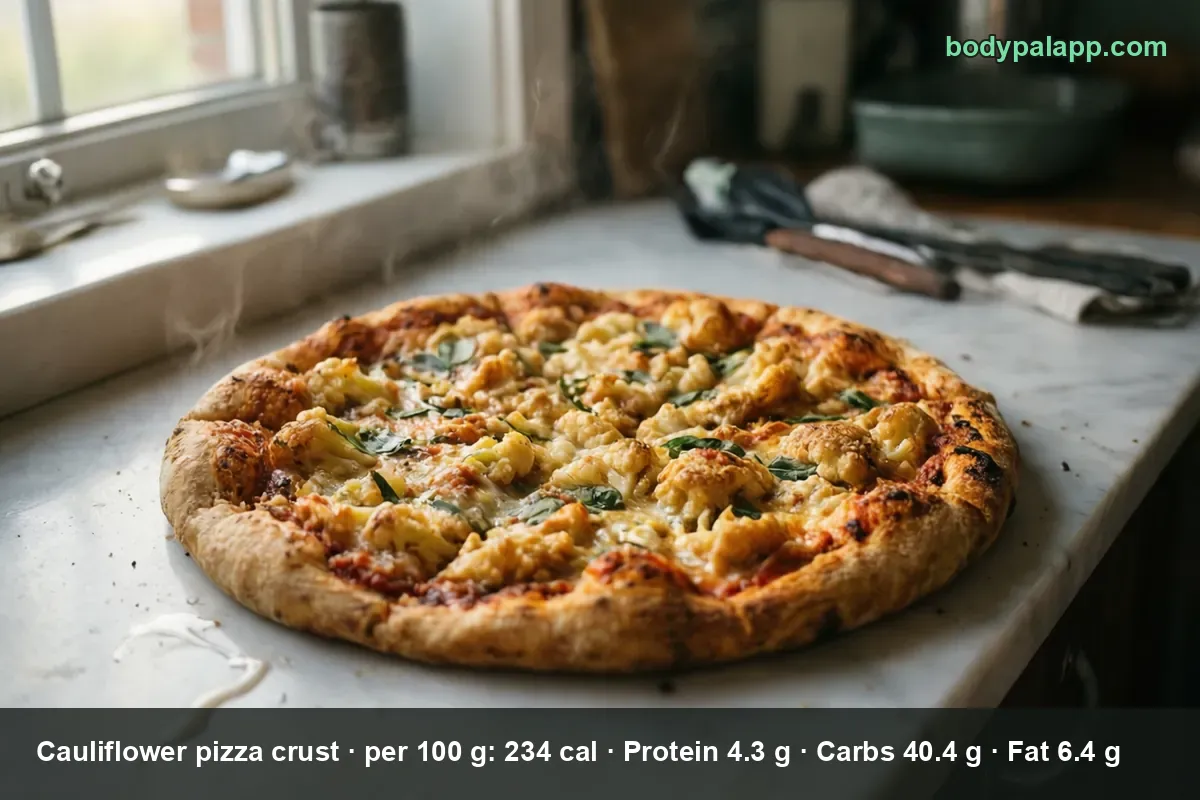
A 1/3-crust serving weighs 47 g and carries 110 calories. Per 100 g the crust runs 234 calories, so the whole 141 g round is 330 calories before a spoon of sauce touches it. The calories in cauliflower pizza crust sit far closer to bread than the vegetable on the box suggests.
On this page
- Cauliflower pizza crust quick facts
- Servings, from one slice to the whole crust
- Brand by brand: 80 to 200 calories a serving
- Is cauliflower crust actually low carb?
- Sodium is the row to watch
- How does cauliflower pizza crust compare?
- Most popular cauliflower pizza crust brands
- FAQ
Cauliflower pizza crust quick facts
Cauliflower crust is a supermarket product, not a whole food, so it lives only in the Branded half of USDA FoodData Central. There is no Foundation or FNDDS entry to fall back on. The row below is Green Giant Cauliflower Pizza Crust, fdc_id 2462532, the most-logged version in our database and one of the few with a complete label: added sugars, cholesterol and potassium all filled in.
That matters because the person searching is holding a frozen disc from the freezer aisle, not a bag of florets. Everything here is per the crust alone, with nothing on it.
| Nutrient | Per 100 g | Per 1/3 crust (47 g) | % Daily Value |
|---|---|---|---|
| Calories | 234 | 110 | — |
| Total fat | 6.38 g | 3.0 g | 4% |
| Saturated fat | 0 g | 0 g | 0% |
| Cholesterol | 32 mg | 15 mg | 5% |
| Carbohydrate | 40.43 g | 19.0 g | 7% |
| Dietary fiber | 4.3 g | 2.0 g | 7% |
| Total sugars | 2.13 g | 1.0 g | — |
| Added sugars | 2.1 g | 1.0 g | 2% |
| Protein | 4.26 g | 2.0 g | 4% |
| Sodium | 489 mg | 230 mg | 10% |
| Potassium | 191 mg | 90 mg | 2% |
% Daily Value is based on a 2,000-calorie diet.
Verified nutrition data
Numbers on this page come from USDA FoodData Central, the U.S. Department of Agriculture’s food composition database, and from manufacturer labels where a branded product is named. Last verified September 2026. How we verify our data →
Two rows are worth a second look. Saturated fat reads a flat 0 g against 6.38 g of total fat, which is unusual for a baked dough and tells you the fat is coming from a liquid oil rather than butter or cheese. And almost all of the sugar on this label is added sugar, 2.1 g of the 2.13 g total, though a serving contributes only 2% of the day's limit. Daily Values follow the FDA's Nutrition Facts label reference amounts.
Servings, from one slice to the whole crust
| Serving | Weight | Calories |
|---|---|---|
| One slice, 1/6 of the crust | 23.5 g | 55 kcal |
| 1 oz | 28.4 g | 66 kcal |
| 1/3 crust, the label serving | 47 g | 110 kcal |
| 2/3 crust | 94 g | 220 kcal |
| One whole crust | 141 g | 330 kcal |
| Per 100 g | 100 g | 234 kcal |
Only one line here is a USDA serving: the 1/3 crust at 47 g. The slice, the ounce, the two-thirds and the whole crust are our own arithmetic from the USDA 100 g figure, not USDA servings.
That single label serving is where most of the counting goes wrong. A frozen cauliflower crust is sold as one 141 g round meant for one or two people, and the Nutrition Facts panel prices a third of it. Eat the whole thing yourself and you have logged 330 calories of base, not 110. Split it in half with someone and you are at 165 each, which no line on the box will tell you.
The slice figure is the useful one at the table. Cut the round into six and each piece is 55 calories of crust, so toppings are what move the number after that.
Brand by brand: 80 to 200 calories a serving
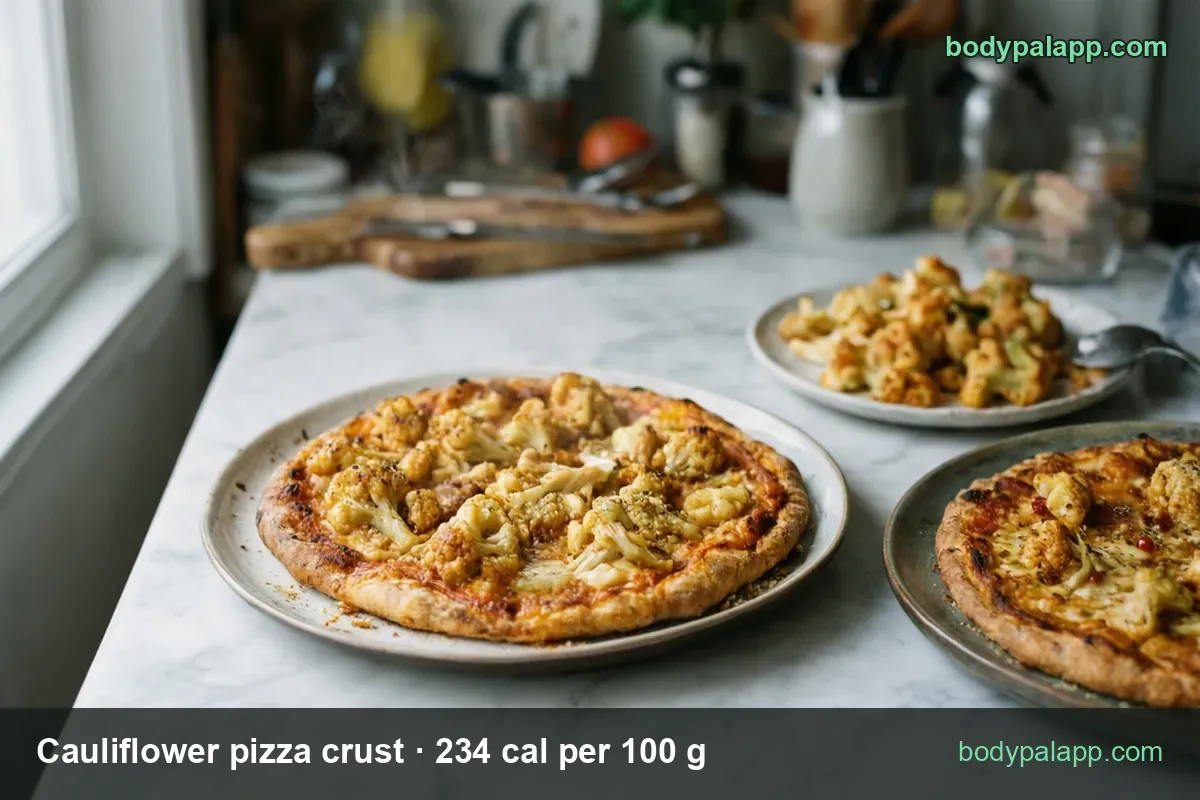
Here is the finding that no ingredient list prepares you for: the gap between cauliflower crusts is wider than the gap between cauliflower and ordinary dough. Across the USDA Branded records these products run from 151 to 327 calories per 100 g, more than a twofold spread, and the label servings are not the same size either.
| Crust | Per 100 g | Label serving | Calories | Sodium per 100 g |
|---|---|---|---|---|
| Green Giant Cauliflower Pizza Crust | 234 kcal | 1/3 crust (47 g) | 110 kcal | 489 mg |
| Green Giant Original | 151 kcal | 1/4 crust (53 g) | 80 kcal | 340 mg |
| Caulipower | 327 kcal | 1/3 crust (52 g) | 170 kcal | 327 mg |
| Caulipower Paleo | 298 kcal | 1/3 crust (57 g) | 170 kcal | 456 mg |
| Milton's Craft Bakers | 303 kcal | 1/2 crust (66 g) | 200 kcal | 485 mg |
| Cali'flour Foods Plain | 200 kcal | 1/3 crust (45 g) | 90 kcal | 444 mg |
| The Edgy Veggie | 255 kcal | 1.8 oz (51 g) | 130 kcal | 725 mg |
Green Giant's Original is the lightest of the set at 151 calories per 100 g, a thinner crust with less flour and less oil per gram. Green Giant also sells a Tuscan version with herbs baked in; its USDA record carries the same numbers as the Original under a different barcode, so treat the two as one entry.
Caulipower sits at the other end. Its standard crust is built on a rice flour base, which pushes carbohydrate to 53.85 g per 100 g and calories to 327, the highest in the table. The Paleo version swaps rice flour for nut and coconut flour: calories barely move, 298 per 100 g, but the fat nearly doubles to 17.54 g and the fiber climbs to 5.3 g. Both land at 170 calories a serving.
Cali'flour Foods is a different food wearing the same name. There is no flour at all, just cauliflower, cheese and egg, and the numbers show it: 6.67 g of carbohydrate per 100 g, 15.56 g of protein and 7.78 g of saturated fat. It is the only crust here that would fit a genuinely low-carb day, and the one where the saturated fat deserves the closest look.
Milton's bakes cheese into the dough and sells a bigger serving, half a crust at 66 g, which is how a 303-calorie-per-100 g product turns into 200 calories on the panel.
Is cauliflower crust actually low carb?
For the crust most people buy, no. Green Giant's record shows 40.43 g of carbohydrate per 100 g, which is 19.0 g in a 47 g serving and 57 g if you eat the whole round. Cauliflower is in there, but so is flour, and flour is what holds a crust together.
Fiber softens the picture a little. At 4.3 g per 100 g the crust brings 2.0 g in a serving, 7% of the 28 g Daily Value, which is better than most white pizza dough manages. Protein does not help: 4.26 g per 100 g works out to 2.0 g a serving, 4% DV.
If low carb is the actual goal, the cheese-and-egg style crust is the one that delivers, at 6.67 g of carbohydrate per 100 g against Green Giant's 40.43 g. If the goal is simply eating more vegetables, MyPlate's vegetable guidance is a cleaner route than a frozen crust, since the cauliflower here is one ingredient among several rather than the whole product.
Sodium is the row to watch
A single 1/3-crust serving carries 230 mg of sodium, 10% of the day's Daily Value, and that is the naked crust. Sauce, cheese and pepperoni all arrive on top of it. Eat the whole 141 g round and the base alone is 690 mg, roughly 30% of the day, which for a home-built pizza is a lot to spend before the first topping.
For scale, 230 mg is about a tenth of a teaspoon of table salt. The Dietary Guidelines for Americans put the ceiling at 2,300 mg a day, and pizza is already one of the larger sodium contributors in the American diet.
Green Giant's main crust, at 489 mg per 100 g, is the saltiest in the table above except for The Edgy Veggie, which reaches 725 mg per 100 g. That last one is the trap: a 51 g piece of it delivers 370 mg of sodium, 16% DV, for only 130 calories. Low calorie and low sodium are not the same axis, and on cauliflower crusts they often point in opposite directions.
How does cauliflower pizza crust compare?
| Crust | Per 100 g | US serving | Calories |
|---|---|---|---|
| Green Giant cauliflower crust | 234 kcal | 1/3 crust, 47 g | 110 kcal |
| Caulipower cauliflower crust | 327 kcal | 1/3 crust, 52 g | 170 kcal |
| Green Giant Original | 151 kcal | 1/4 crust, 53 g | 80 kcal |
| Cali'flour Foods plain crust | 200 kcal | 1/3 crust, 45 g | 90 kcal |
Our take: for straight calorie counting, Green Giant Original wins, 80 calories a serving and the lowest density of the four at 151 per 100 g. For staying full on fewer carbohydrates, Cali'flour is the pick, 90 calories with 15.56 g of protein per 100 g and almost no starch. Caulipower is the one to watch, since 170 calories a third means a whole crust to yourself is over 500 before toppings. And be honest about portions: whichever box you buy, weigh what you actually eat rather than trusting the third printed on the panel.
Most popular cauliflower pizza crust brands in the United States
Ranked by how widely each product appears among foods sold in the United States, from the BodyPal food database of over 3.3 million products. Calories are the figures printed on each Nutrition Facts label, checked against USDA FoodData Central.
| Product | Calories (per 100 g) |
|---|---|
| Green Giant Cauliflower Pizza Crust | 234 cal |
| Green Giant Cauliflower Pizza Crust Original | 151 cal |
| Green Giant Tuscan Cauliflower Pizza Crust | 151 cal |
| Caulipower Cauliflower Pizza Crusts | 327 cal |
| Milton's Craft Bakers Cauliflower Crust | 303 cal |
| Cali'flour Foods Plain Cauliflower Crust | 200 cal |
Brand popularity: BodyPal food database. Nutrition: manufacturer labels / USDA FoodData Central.
Cauliflower pizza crust FAQs
How many calories are in a cauliflower pizza crust?
A whole 141 g Green Giant crust is 330 calories, and the label serving of 1/3 crust, 47 g, is 110. Per 100 g the crust runs 234 calories. Other brands range from 151 to 327 per 100 g, so check the box you bought before logging.
How many calories are in 1/3 of a cauliflower crust?
110 calories for a 47 g third of a Green Giant crust, which is the serving printed on the panel. That third also brings 19.0 g of carbohydrate, 2.0 g of protein and 230 mg of sodium. A Caulipower third weighs 52 g and comes to 170 calories instead.
Is cauliflower pizza crust low carb?
Usually not: Green Giant's crust holds 40.43 g of carbohydrate per 100 g, or 19.0 g in a serving, because flour still binds the dough. The exception is the cheese-and-egg style crust from Cali'flour Foods at 6.67 g per 100 g, which is the only genuinely low-carb option here.
How many carbs are in Green Giant cauliflower pizza crust?
40.43 g of carbohydrate per 100 g, which is 19.0 g in the 47 g label serving and 57 g in a whole 141 g crust. Fiber accounts for 4.3 g per 100 g, 2.0 g a serving. The lighter Green Giant Original record shows 30.19 g per 100 g.
How many calories are in a Caulipower crust?
170 calories for the label serving of 1/3 crust, 52 g, at 327 calories per 100 g. That is the highest density of any cauliflower crust in the USDA records, because rice flour forms the base: 53.85 g of carbohydrate per 100 g. The Paleo version is 298 per 100 g.
How much sodium is in cauliflower pizza crust?
230 mg in a 47 g serving, 10% of the Daily Value, and 489 mg per 100 g. A whole crust is 690 mg before sauce or cheese. Brands vary widely: Caulipower is 327 mg per 100 g, while The Edgy Veggie reaches 725 mg, or 370 mg in one 51 g piece.
Is cauliflower pizza crust gluten free?
The USDA record lists 40.43 g of carbohydrate per 100 g but says nothing about which flour supplies it, so gluten status has to come off the package. Caulipower's base is rice flour, its Paleo crust uses nut and coconut flour, and Cali'flour uses no flour at all.
Is cauliflower pizza crust healthier than regular crust?
USDA publishes no standalone record for plain wheat pizza crust, only finished pizzas, so there is no clean number to set against 234 calories per 100 g. What the data does show: with 40.43 g of carbohydrate per 100 g, this is a bread product with vegetables in it, not a vegetable.
Similar foods
- Potato wedges — 138 cal for 3 oz
- Cornmeal — 581 cal per cup
- Ear of Corn — 99 cal per medium ear
- Sweet Potato — 103 cal per medium, baked
- Papaya salad — 190 cal per plate
- Carrot — 53 cal per cup chopped
Count it without the math
Point the camera at the pizza and BodyPal counts the crust and the toppings for you.


How long does it take to burn off 110 kcal of cauliflower crust?
A 1/3 crust serving (47 g) is 110 kcal. Enter your weight and the amount you ate to see how long it takes you to burn that off:
lb
| Activity | Time to burn 110 kcal |
|---|---|
| Walking, brisk | 22 min |
| Cycling, moderate | 14 min |
| Swimming, moderate | 16 min |
| Jogging | 13 min |
| Weight training, moderate | 24 min |
Times are for a 155 lb adult at a steady pace; change the weight to see yours. The amount is set to the portion in the text (47 g); change it to what you actually ate. BodyPal works this out from your steps automatically.
Want the bigger picture? Calculate your daily calorie needs — your maintenance figure, a target for losing or gaining, and the date you get there.