
How Many Calories in Chicken Alfredo Pasta?
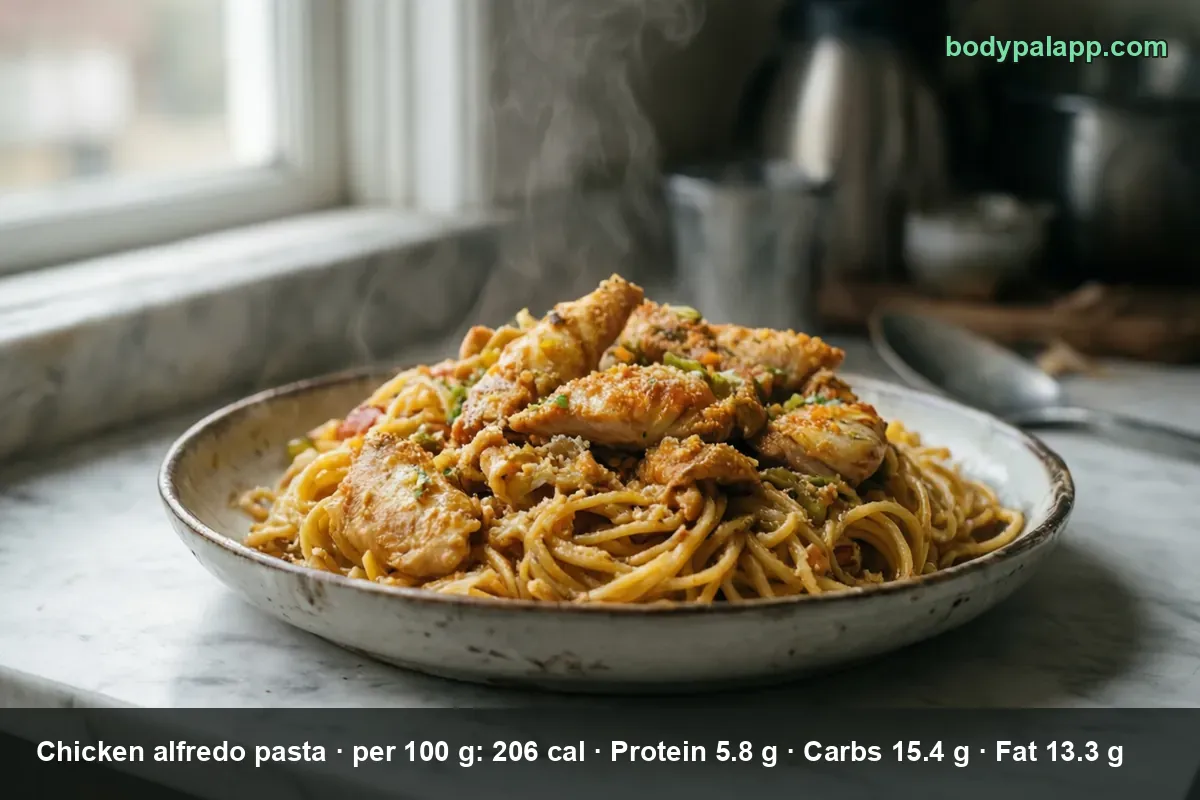
A 1-cup (250 g) restaurant serving of chicken alfredo pasta is 515 calories, and the dish runs 206 calories per 100 g. Fat does most of the work: 33.3 g in that cup against 38.5 g of carbohydrate, which is why the sauce, not the pasta, sets the number. A restaurant plate is usually bigger than one cup.
On this page
- Chicken alfredo quick facts
- US servings, from a half cup to a two-cup plate
- Homemade, frozen and sauce-only versions
- Saturated fat and sodium are the rows to watch
- How does chicken alfredo compare?
- Most popular chicken alfredo pasta brands
- FAQ
Chicken alfredo quick facts
The row that matches what most people order is FNDDS 2708867, "Pasta with cream sauce and poultry, restaurant". It is the whole plate: noodles, cream sauce and chicken together, which is what "chicken alfredo pasta" means to anyone searching for it. The sauce-only records are a different food. Alfredo sauce with poultry carries just 1.44 g of carbohydrate per 100 g, so it describes a ladle, not a dinner.
USDA also publishes a home recipe row and a ready-to-heat row for the same dish. Those stay in the variants section below, because the difference between them is how the food was cooked, not where the numbers came from.
| Nutrient | Per 100 g | Per 1 cup (250 g) | % Daily Value |
|---|---|---|---|
| Calories | 206 | 515 | — |
| Total fat | 13.33 g | 33.3 g | 43% |
| Saturated fat | 4.235 g | 10.6 g | 53% |
| Carbohydrate | 15.41 g | 38.5 g | 14% |
| Dietary fiber | 0.9 g | 2.3 g | 8% |
| Total sugars | 0.59 g | 1.5 g | — |
| Protein | 5.83 g | 14.6 g | 29% |
| Sodium | 561 mg | 1403 mg | 61% |
| Cholesterol | 24 mg | 60 mg | 20% |
| Potassium | 60 mg | 150 mg | 3% |
% Daily Value is based on a 2,000-calorie diet.
Verified nutrition data
Numbers on this page come from USDA FoodData Central, the U.S. Department of Agriculture’s food composition database, and from manufacturer labels where a branded product is named. Last verified September 2026. How we verify our data →
Two label rows are missing on purpose. USDA does not publish added sugars or trans fat for this mixed-dish record, so guessing at them would be worse than leaving them out. Total sugars are genuinely low here at 1.5 g a cup; a savory cream sauce has almost nothing sweet in it.
One number is worth pausing on. Multiply the fat by nine and you get about 300 calories of the 515, close to three-fifths of the serving. By weight the plate is only 15.41% carbohydrate, which surprises people who file this dish under "pasta."
US servings, from a half cup to a two-cup plate
| Serving | Weight | Calories |
|---|---|---|
| 1 oz | 28.4 g | 58 kcal |
| 1/2 cup, side portion | 125 g | 258 kcal |
| 1 cup | 250 g | 515 kcal |
| 1.5 cups | 375 g | 773 kcal |
| 2 cups, restaurant plate | 500 g | 1030 kcal |
| Per 100 g | 100 g | 206 kcal |
Only the 1-cup line is a USDA household measure. The half cup, the ounce, the cup and a half and the two-cup plate are our own arithmetic from the USDA 100 g figure, not USDA servings, so treat them as clean scaling rather than measured portions.
The cup is where people go wrong. A 1-cup measure of this dish weighs 250 g, and a restaurant portion of pasta is rarely that small. Two cups is closer to what arrives on a plate, and that plate is 1,030 calories before bread, before oil, before a glass of anything. If you serve yourself at home with a measuring cup, one level cup plus a salad is a normal 500-to-600-calorie dinner. If you eat out and finish the plate, you have logged roughly half a day.
Weighing beats measuring here. Sauce clings, noodles pack differently in a cup depending on how hard you press, and 30 g more on the plate is 62 calories. A scale removes the argument.
Homemade, frozen and sauce-only versions
| Version | Per 100 g | Typical serving | Calories |
|---|---|---|---|
| Restaurant, the main row | 206 kcal | 1 cup (250 g) | 515 kcal |
| Homemade | 157 kcal | 1 cup (250 g) | 393 kcal |
| Ready-to-heat, frozen or refrigerated | 170 kcal | 1 cup (250 g) | 425 kcal |
| Fettuccine alfredo, no chicken | 204 kcal | 1 cup (250 g) | 510 kcal |
| With added vegetables | 191 kcal | 1 cup (250 g) | 478 kcal |
| Alfredo sauce alone | 156 kcal | 1 cup (260 g) | 406 kcal |
| Alfredo sauce mix, dry powder | 535 kcal | 1 oz (28.4 g) | 152 kcal |
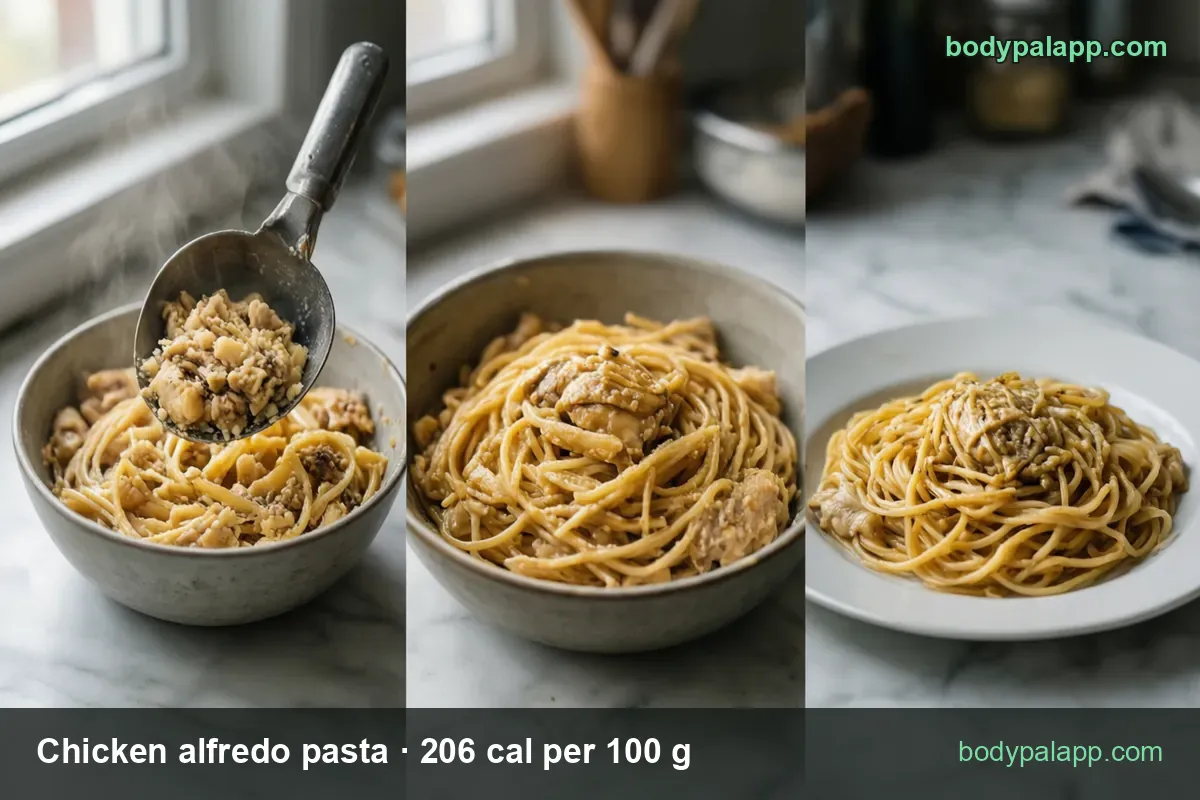
Cooking it yourself is the single biggest lever on this page. The home recipe row is 157 calories per 100 g against 206 in a restaurant, so the same 250 g cup is 393 instead of 515. Nothing about the pasta changed. The restaurant kitchen simply finishes the sauce with more butter and cream.
Adding vegetables works in the same direction for a duller reason: broccoli and peppers weigh something and carry almost nothing, so the mix falls to 191 calories per 100 g. You are not eating a lighter sauce, you are eating less sauce per forkful.
The dry mix line looks alarming at 535 calories per 100 g, but that is powder in a packet before any liquid goes in. Compare it to a plate and you will overcount by more than a factor of two.
Frozen entrees sit in their own band. In USDA's Branded database, the six chicken alfredo trays we checked run from 99 to 143 calories per 100 g, well under the restaurant row, because the trays are lighter on sauce and heavier on vegetables. A Lean Cuisine alfredo pasta with chicken and broccoli package is 280 calories for 283 g; a Stouffer's chicken fettuccini alfredo package is 389 for 297 g. Both are still a full dinner, but neither is a 1,030-calorie plate.
Saturated fat and sodium are the rows to watch
The calorie count is not the interesting part of this dish. The saturated fat is. One cup delivers 10.6 g, which is 53% of the FDA Daily Value of 20 g. The Dietary Guidelines for Americans recommend keeping saturated fat under 10% of calories, about 22 g on a 2,000-calorie day, so a two-cup plate at 21.2 g uses essentially all of it.
Sodium runs close behind. A cup is 1,403 mg, 61% of the 2,300 mg Daily Value, roughly two-thirds of a teaspoon of table salt. Two cups is 2,805 mg, or 122% of the limit in one sitting. The homemade row cuts that to 625 mg a cup, the largest proportional drop of any nutrient between the two records.
Protein is the row that disappoints. A cup gives 14.6 g, 29% of the Daily Value, at a cost of 515 calories. That works out to about 2.8 g of protein per 100 calories, which is low for a dish sold on the strength of its chicken. Pasta with cream sauce and no chicken already has 3.72 g of protein per 100 g, so the chicken is contributing roughly 2.1 g per 100 g. If protein is what you came for, MyPlate's protein foods guidance is a better map than an alfredo plate: the same 14.6 g arrives in far fewer calories from grilled chicken on its own.
If you are watching sodium or saturated fat, the homemade version is the better pick, and it is not close. If you are eating out, ordering the plate and boxing half of it turns 1,030 calories into 515 without any negotiation with the kitchen.
How does chicken alfredo compare?
| Dish | Per 100 g | US serving | Calories |
|---|---|---|---|
| Chicken alfredo pasta, restaurant | 206 kcal | 1 cup, 250 g | 515 kcal |
| Chicken alfredo, home recipe | 157 kcal | 1 cup, 250 g | 393 kcal |
| Pasta with cream sauce and meat, restaurant | 213 kcal | 1 cup, 250 g | 533 kcal |
| Alfredo sauce with poultry, sauce only | 156 kcal | 1 cup, 260 g | 406 kcal |
Our take: the meat version is the only row here that beats the restaurant chicken plate per 100 g, and it wins by seven calories, which tells you the protein barely matters. Cream does. Note the last row too, because it is the trap on this list: a cup of alfredo sauce with poultry and no pasta at all is 406 calories, only 109 fewer than a full cup of the finished dish. Sauce is where the calories live, so ordering it on the side and using half of it saves more than swapping the noodles. For weight loss, cook it at home and measure one cup: 393 calories with 625 mg of sodium. For a night out, split the plate.
Most popular chicken alfredo pasta brands in the United States
Ranked by how widely each product appears among foods sold in the United States, from the BodyPal food database of over 3.3 million products. Calories are the figures printed on each Nutrition Facts label, checked against USDA FoodData Central.
| Product | Calories (per 100 g) |
|---|---|
| Lean Cuisine Alfredo Pasta with Chicken & Broccoli | 99 cal |
| Michelina's Fettuccine Alfredo with Chicken & Broccoli | 110 cal |
| Signature Cafe Chicken Alfredo | 143 cal |
| Stouffer's Chicken Fettuccini Alfredo | 131 cal |
| Barilla Chicken Alfredo with Rotini | 129 cal |
| Healthy Choice Cafe Steamers Chicken Fettuccini Alfredo | 99 cal |
Brand popularity: BodyPal food database. Nutrition: manufacturer labels / USDA FoodData Central.
Chicken alfredo pasta FAQs
How many calories are in chicken alfredo pasta?
A 1-cup (250 g) restaurant serving is 515 calories, or 206 calories per 100 g. That cup also carries 33.3 g of fat and 1,403 mg of sodium. Most plates served in a restaurant hold closer to two cups, which doubles the count to 1,030 calories.
How many calories in one cup of chicken alfredo?
515 calories for a 1-cup (250 g) restaurant portion, built from 33.3 g of fat, 38.5 g of carbohydrate and 14.6 g of protein. Fat supplies about 300 of those calories, nearly three-fifths of the total. Half a cup, the side-dish size, is 258 calories.
How many calories in a restaurant plate of chicken alfredo?
Two cups (500 g) is the usual restaurant plate, and that is 1,030 calories with 2,805 mg of sodium, 122% of the daily limit, plus 21.2 g of saturated fat. Those are our own multiples of the USDA 100 g figure, not a USDA serving.
How much protein is in chicken alfredo pasta?
A 1-cup serving has 14.6 g of protein, 29% of the Daily Value. That is modest for 515 calories, about 2.8 g of protein per 100 calories. Pasta with cream sauce and no chicken already has 3.72 g per 100 g, so the chicken adds roughly 2.1 g per 100 g.
How many carbs are in chicken alfredo?
38.5 g of carbohydrate in a 1-cup (250 g) serving, 14% of the Daily Value, with 2.3 g of fiber and 1.5 g of total sugars. By weight the dish is only 15.41% carbohydrate, because sauce and chicken make up much of the plate. Fat drives the calories, not starch.
How much sodium is in chicken alfredo pasta?
One cup carries 1,403 mg of sodium, 61% of the 2,300 mg Daily Value and roughly two-thirds of a teaspoon of table salt. A two-cup plate reaches 2,805 mg, past the whole day's limit. The homemade version is far lower at 625 mg per cup.
Chicken alfredo vs fettuccine alfredo, which has more calories?
Fettuccine alfredo without chicken is 204 calories per 100 g against 206 with chicken, so a 1-cup serving is 510 versus 515 calories, a gap of five. What the chicken adds is protein: 5.83 g per 100 g against 3.72 g. The sauce, not the meat, sets the calorie count.
How many calories in homemade chicken alfredo?
393 calories per 1-cup (250 g) serving, at 157 calories per 100 g, which is 122 calories less than the restaurant version. Home kitchens use less butter and cream, and sodium drops from 1,403 mg to 625 mg per cup. Saturated fat falls from 10.6 g to 9.0 g.
Similar foods
- Prosciutto — 55 cal for 3 thin slices
- Mac And Cheese — 513 cal per cup
- Baba ganoush — 110 cal for 1/4 cup
- Penne pasta — 169 cal per cup
- Pasta — 168 cal per cup penne
- Maple Syrup — 216 cal for 1/4 cup
Count it without the math
Point the camera at the plate and BodyPal counts the pasta, the sauce and the chicken for you.


How long does it take to burn off 515 kcal of chicken alfredo?
A 1-cup (250 g) serving is 515 kcal. Enter your weight and the amount you ate to see how long it takes you to burn that off:
lb
| Activity | Time to burn 515 kcal |
|---|---|
| Walking, brisk | 1 hr 43 min |
| Cycling, moderate | 1 hr 4 min |
| Swimming, moderate | 1 hr 14 min |
| Jogging | 1 hr 1 min |
| Weight training, moderate | 1 hr 54 min |
Times are for a 155 lb adult at a steady pace; change the weight to see yours. The amount is set to the portion in the text (250 g); change it to what you actually ate. BodyPal works this out from your steps automatically.
This table assumes you know your daily total. If you do not, the daily calorie calculator works it out from five numbers.