
How many calories are in chicken biryani?
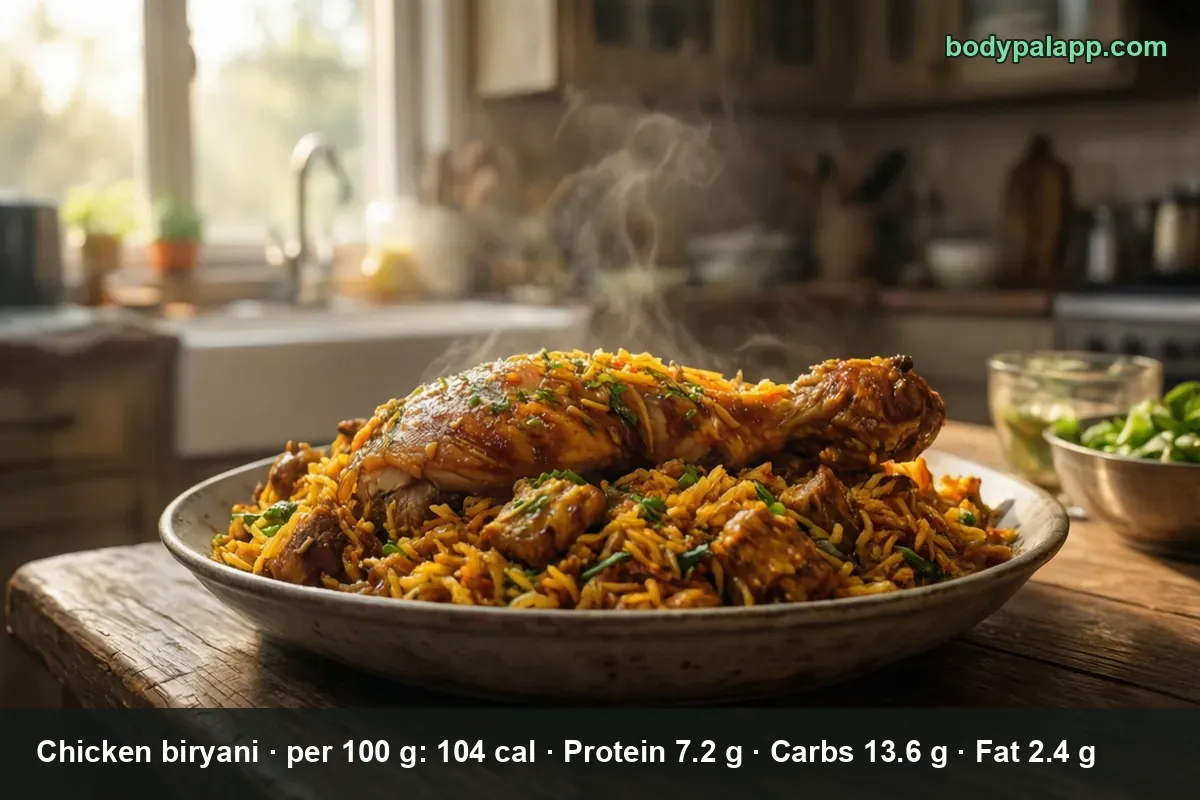
A 1-cup serving of chicken biryani weighs 196 g and carries 204 calories. Per 100 g the dish runs 104 calories, lighter than most people expect from a rice plate loaded with chicken. The reason is moisture: the rice absorbs stock and yogurt, and both dilute the calories in every bite.
On this page
- Chicken biryani quick facts
- US servings, from one ounce to a full plate
- Home-style biryani vs the frozen tray
- Protein is the row that pays, sodium is the one to watch
- How does chicken biryani compare?
- Most popular chicken biryani brands
- Chicken biryani FAQs
Chicken biryani quick facts
The record behind every number here is FNDDS 2706538, "Biryani with chicken", from the 2021-2023 survey release. It sits in the rice mixed dishes category and describes the finished dish as it reaches the plate, rice, chicken, fat and spices already cooked together. That is what somebody scooping biryani out of a takeout container is actually holding, so it drives the main figure rather than any of the frozen retail entrees, which follow their own recipes and appear further down the page.
One thing worth setting straight before the table: the cup is a cup of cooked biryani, not of dry rice. Nobody weighs basmati before it goes into the pot at dinner, and the 104 calories per 100 g only makes sense for the hydrated, finished dish.
| Nutrient | Per 100 g | Per 1 cup (196 g) | % Daily Value |
|---|---|---|---|
| Calories | 104 | 204 | — |
| Total fat | 2.38 g | 4.7 g | 6% |
| Saturated fat | 0.91 g | 1.8 g | 9% |
| Carbohydrate | 13.55 g | 26.6 g | 10% |
| Dietary fiber | 1.1 g | 2.2 g | 8% |
| Total sugars | 1.88 g | 3.7 g | — |
| Protein | 7.15 g | 14.0 g | 28% |
| Sodium | 161 mg | 316 mg | 14% |
% Daily Value is based on a 2,000-calorie diet.
Verified nutrition data
Numbers on this page come from USDA FoodData Central, the U.S. Department of Agriculture’s food composition database, and from manufacturer labels where a branded product is named. Last verified September 2026. How we verify our data →
Two rows you would see on a package label are missing above: added sugars and trans fat, because this FNDDS release does not publish either value for the dish. Cholesterol and potassium are published: a cup gives 49 mg of cholesterol, 16% of the Daily Value, and 502 mg of potassium, 11%. The FDA's Daily Value reference is the basis for every percentage on this page.
US servings, from one ounce to a full plate
| Serving | Weight | Calories |
|---|---|---|
| 1 oz | 28.4 g | 29 kcal |
| Half a cup | 98 g | 102 kcal |
| 1 cup | 196 g | 204 kcal |
| One typical serving | 245 g | 255 kcal |
| A cup and a half, dinner plate | 294 g | 306 kcal |
| Per 100 g | 100 g | 104 kcal |
Two of those weights come straight from USDA: the 196 g cup and the 245 g serving, the second listed as a typical portion with the household quantity unspecified. The half cup, the cup and a half and the ounce are our own arithmetic from the USDA 100 g figure, not USDA servings.
The gap between a cup and a plate is where most logging errors happen. People eyeball a mounded dinner plate and log "1 cup," when 294 g of biryani is closer to the truth and 102 calories higher. Restaurant portions of biryani are rarely modest, and a shared family platter split three ways can put two cups in front of each person before the raita arrives.
One more caveat the USDA record cannot cover: a kitchen that finishes the rice with a heavy hand of ghee or butter is cooking something richer than this survey average. There is no separate USDA line for that version, so treat 104 calories per 100 g as a well-made home or restaurant standard, not a ceiling.
Home-style biryani vs the frozen tray
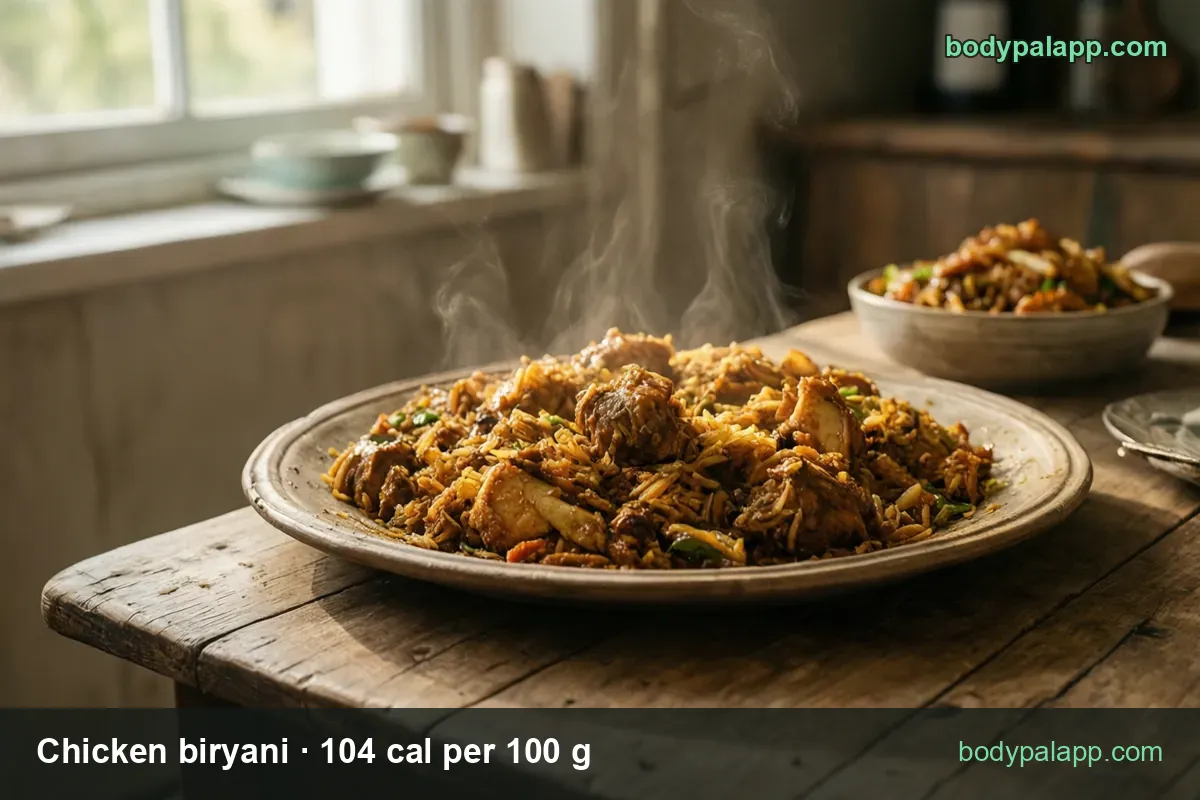
Frozen biryani is a different food in calorie terms. Retail trays concentrate the rice, use more oil, and skip the moisture that keeps the home-cooked version light. The result is 113 to 170 calories per 100 g against 104, and a package that gets eaten in one sitting.
| Version | Per 100 g | Typical piece | Calories |
|---|---|---|---|
| Home-style chicken biryani, cooked | 104 kcal | 1 cup (196 g) | 204 kcal |
| Sukhi's Chicken Biryani, frozen | 113 kcal | 10 oz tray (284 g) | 321 kcal |
| Deep Indian Kitchen Chicken Biryani, frozen | 149 kcal | 1 tray (255 g) | 380 kcal |
| Saffron Road Chicken Biryani, frozen | 163 kcal | 10 oz entree (283 g) | 461 kcal |
| Tandoor Chef Chicken Biryani, frozen | 170 kcal | 1 tray (283 g) | 481 kcal |
Sukhi's is the only tray in this set under 350 calories, and it is the only one whose density comes close to home-style biryani. At the other end, Tandoor Chef's 283 g tray is 481 calories, and Saffron Road's entree of the same weight is 461. Two more packages sit near the top of that range: Mosul Kubba's 283 g container at 481 calories and Seven Spoons at 459 for a 328 g portion.
Put the two side by side and the comparison is uncomfortable. A 283 g tray at 461 calories looks like roughly the same amount of food as a 196 g cup at 204, because rice packs down and a tray spreads it flat. It is more than double the calories for what reads as one serving either way.
Protein is the row that pays, sodium is the one to watch
A cup of chicken biryani delivers 14.0 g of protein, 28% of the Daily Value, while supplying about 10% of a 2,000-calorie day. That ratio is the dish's best feature. Protein arriving faster than calories is what makes a plate satisfying, and MyPlate's protein foods guidance treats mixed dishes like this one as a legitimate way to hit the target rather than a compromise.
Saturated fat stays low: 1.8 g a cup, 9% of the Daily Value, which is well inside the 10%-of-calories limit the Dietary Guidelines for Americans set for saturated fat. Fiber is modest at 2.2 g, 8%, since white basmati carries little of it.
Sodium is the number that changes with the version you eat. Home-style biryani gives 316 mg a cup, 14% of the Daily Value, about an eighth of a teaspoon of table salt. Frozen trays reach 461 mg per 100 g, close to three times the 161 mg in the cooked dish, so a single tray can move the sodium needle further than the calorie one. If you are watching sodium, the home pot is the better pick by a wide margin.
How does chicken biryani compare?
| Dish | Per 100 g | US serving | Calories | Protein per 100 g |
|---|---|---|---|---|
| Chicken biryani | 104 kcal | 1 cup (196 g) | 204 kcal | 7.15 g |
| Brown rice with vegetables and gravy | 105 kcal | 1 cup (196 g) | 206 kcal | 2.24 g |
| Brown rice with carrots, no added fat | 104 kcal | 1 cup (196 g) | 204 kcal | 2.31 g |
| Brown rice with dark green vegetables | 105 kcal | 1 cup (196 g) | 206 kcal | 2.72 g |
Cup weights for the three rice dishes are our own arithmetic from their USDA 100 g figures, matched to the 196 g biryani cup so the rows line up.
Our take: all four land within one calorie per 100 g of each other, which makes the calorie column almost useless for choosing between them. Protein is what separates the plates. Biryani carries 7.15 g per 100 g against 2.24 to 2.72 g in the meatless rice dishes, roughly three times as much for the same calories. If you are picking a rice plate for a calorie budget, biryani is the one that also feeds you protein; if you are picking a side dish to sit next to something else, the plain rice rows do that job.
Most popular chicken biryani brands in the United States
Ranked by how widely each product appears among foods sold in the United States, from the BodyPal food database of over 3.3 million products. Calories are the figures printed on each Nutrition Facts label, checked against USDA FoodData Central.
| Product | Calories (per 100 g) |
|---|---|
| Saffron Road Chicken Biryani | 163 cal |
| Deep Indian Kitchen Chicken Biryani | 149 cal |
| Mosul Kubba Chicken Biryani | 170 cal |
| Tandoor Chef Chicken Biryani | 170 cal |
| Seven Spoons Chicken Biryani | 140 cal |
| Sukhi's Chicken Biryani | 113 cal |
Brand popularity: BodyPal food database. Nutrition: manufacturer labels / USDA FoodData Central.
Chicken biryani FAQs
How many calories are in chicken biryani?
A 1-cup serving of 196 g has 204 calories, and the dish runs 104 calories per 100 g in the USDA record. A larger plate closer to 245 g comes to 255 calories. Frozen retail trays are denser and land between 321 and 481 calories per package.
How many calories in 1 cup of chicken biryani?
One cup, 196 g, is 204 calories. That cup also carries 14.0 g of protein, 26.6 g of carbohydrate and 4.7 g of fat, so it behaves like a small complete meal rather than a side. A cup and a half, 294 g, comes to 306 calories.
How much protein is in chicken biryani?
A cup delivers 14.0 g of protein, 28% of the Daily Value, from 7.15 g per 100 g. That beats most rice dishes: brown rice with vegetables and gravy sits near 2.24 g per 100 g, so biryani carries roughly three times the protein by weight.
How many carbs are in chicken biryani?
A cup has 26.6 g of total carbohydrate, 10% of the Daily Value, including 2.2 g of fiber and 3.7 g of total sugars. Per 100 g that is 13.55 g. Meatless rice side dishes run higher, between 18 and 22 g per 100 g.
Is chicken biryani good for weight loss?
At 104 calories per 100 g it is one of the lighter rice plates on an Indian menu, and a 204-calorie cup carrying 14.0 g of protein is filling for what it costs. Portion size decides the outcome: a cup and a half is already 306 calories.
How many calories in a plate of chicken biryani?
A typical USDA serving of 245 g is 255 calories. A generous restaurant plate is closer to a cup and a half, 294 g and 306 calories, which is our own arithmetic from the USDA 100 g figure. Ghee-heavy restaurant cooking can push past both numbers.
How many calories in frozen chicken biryani?
Between 321 and 481 calories per package. Sukhi's 284 g tray is 321, Deep Indian Kitchen's 255 g tray 380, Saffron Road's 283 g entree 461 and Tandoor Chef's 283 g tray 481. Frozen versions run 113 to 170 calories per 100 g against 104 for home-style.
How much sodium is in chicken biryani?
A cup has 316 mg of sodium, 14% of the Daily Value, from 161 mg per 100 g. That is about an eighth of a teaspoon of table salt. Frozen trays are the bigger issue, reaching 461 mg per 100 g, close to three times the home-style level.
Similar foods
- Pork And Beans — 273 cal per cup
- Turkey deli meat — 89 cal for 3 slices
- Chicken Tikka Masala — 257 cal per cup
- Tuna steak — 185 cal per steak, 6 oz
- Chinese Chicken and Broccoli — 206 cal per cup
- Clam Chowder — 237 cal per cup
Count it without the math
Point the camera at the plate and BodyPal counts the rice and the chicken together.


How long does it take to burn off 204 kcal of chicken biryani?
A 1-cup (196 g) serving is 204 kcal. Enter your weight and the amount you ate to see how long it takes you to burn that off:
lb
| Activity | Time to burn 204 kcal |
|---|---|
| Walking, brisk | 41 min |
| Cycling, moderate | 26 min |
| Swimming, moderate | 29 min |
| Jogging | 24 min |
| Weight training, moderate | 45 min |
Times are for a 155 lb adult at a steady pace; change the weight to see yours. The amount is set to the portion in the text (196 g); change it to what you actually ate. BodyPal works this out from your steps automatically.
This table assumes you know your daily total. If you do not, the daily calorie calculator works it out from five numbers.