
How many calories are in chicken broth?
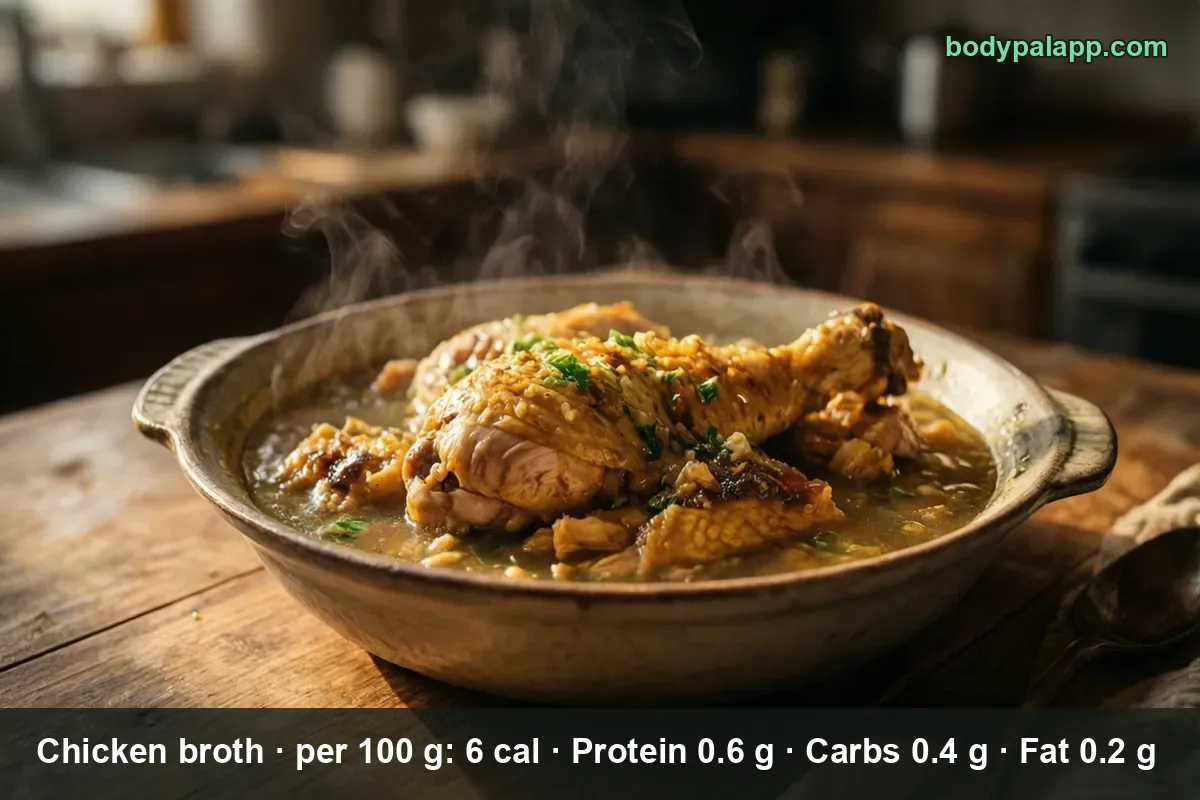
A 1-cup (240 g) serving of ready-to-serve chicken broth is 14 calories, and per 100 g it is just 6 calories. That is under 1% of a day's energy. The number people should actually read on the carton is the sodium line: 890 mg in that same cup.
On this page
- Chicken broth quick facts
- US servings from a half cup to a whole can
- Lower sodium and canned versions
- Bouillon cubes and powder
- Sodium is the row that matters
- How does chicken broth compare?
- Most popular chicken broth brands
- Chicken broth FAQs
Chicken broth quick facts
The record used here is SR Legacy 174536, "Soup, chicken broth, ready-to-serve". That is the carton or can you pour straight into a pot: no concentrate, no cube, no water added at home. It is the form most people have in hand when they look this up, and it lines up with what the big US labels print, from 1 to 6 calories per 100 g.
A cup is the unit that matters here, because nobody weighs broth. USDA publishes no household portion for this record, so the 240 g cup and the 411 g can below come from College Inn and Swanson label servings.
| Nutrient | Per 100 g | Per 1 cup (240 g) | % Daily Value |
|---|---|---|---|
| Calories | 6 | 14 | — |
| Total fat | 0.21 g | 0.5 g | <1% |
| Saturated fat | 0.01 g | 0.0 g | 0% |
| Carbohydrate | 0.44 g | 1.1 g | <1% |
| Dietary fiber | 0 g | 0 g | 0% |
| Total sugars | 0.43 g | 1.0 g | — |
| Protein | 0.64 g | 1.5 g | 3% |
| Sodium | 371 mg | 890 mg | 39% |
% Daily Value is based on a 2,000-calorie diet.
Verified nutrition data
Numbers on this page come from USDA FoodData Central, the U.S. Department of Agriculture’s food composition database, and from manufacturer labels where a branded product is named. Last verified September 2026. How we verify our data →
There is no added sugars row and no trans fat row on this page, because the SR Legacy edition of this record does not measure either. Cholesterol is 2 mg per 100 g, so 5 mg in a cup, and potassium is 18 mg per 100 g, or 43 mg in a cup. Neither moves a daily total.
US servings from a half cup to a whole can
| Serving | Weight | Calories |
|---|---|---|
| 1 oz | 28.4 g | 2 kcal |
| 1/2 cup (4 fl oz) | 120 g | 7 kcal |
| 1 cup (8 fl oz) | 240 g | 14 kcal |
| 1 can (14.5 fl oz) | 411 g | 25 kcal |
| 2 cups | 480 g | 29 kcal |
| Per 100 g | 100 g | 6 kcal |
The cup and the can are label servings. The half cup, the two cups and the ounce are our own arithmetic from the USDA 100 g figure, not USDA servings.
Emptying a whole 14.5 fl oz can into a risotto adds 25 calories to the pan and roughly 1,525 mg of sodium, again our own scaling of the 371 mg per 100 g figure. That sodium number is worth more attention than the calories, because it is what the rest of the dish gets built on top of.
Brand labels round down hard. College Inn's canned broth is listed at 1 calorie per 100 g, about 4 for the whole 411 g can, and its organic version at 4 per 100 g, 10 a cup. Swanson's is 6 per 100 g, 14 a cup, which is exactly the USDA figure. Anything in that range is noise in a food diary.
Lower sodium and canned versions
| Version | Per 100 g | Typical serving | Calories | Sodium |
|---|---|---|---|---|
| Ready-to-serve (main record) | 6 kcal | 1 cup (240 g) | 14 kcal | 890 mg |
| Reduced sodium, ready-to-serve | 7 kcal | 1 cup (240 g) | 17 kcal | 554 mg |
| Canned, prepared with equal water | 16 kcal | 1 cup (244 g) | 39 kcal | 747 mg |
| Low sodium, canned | 16 kcal | 1 cup (240 g) | 38 kcal | 72 mg |
| Condensed, undiluted | 31 kcal | 1/2 cup (126 g) | 39 kcal | 783 mg |
Reduced-sodium broth is the odd one: it carries slightly more energy than the regular carton, 17 calories a cup against 14, because the protein is higher at 1.36 g per 100 g. Three extra calories in exchange for 336 mg less sodium is a trade most people would take without thinking.
Condensed broth is the trap in this table. Undiluted it is 31 calories per 100 g, five times the ready-to-serve figure, and 621 mg of sodium in the same 100 g. Diluted 1:1 as the can instructs, it lands at 16 per 100 g and 39 a cup, still nearly triple the carton. If a soup recipe tastes saltier than the last time you made it, the can you grabbed is usually the reason.
The sodium figures for the canned and condensed rows are our arithmetic from the USDA 100 g values against the serving weights shown, not USDA serving lines.
Bouillon cubes and powder
| Form | Per 100 g | Serving | Calories | Sodium |
|---|---|---|---|---|
| Bouillon cube, dry | 267 kcal | 1 cube (4 g) | 11 kcal | 955 mg |
| Bouillon powder, dry | 267 kcal | 1 tsp (2 g) | 5 kcal | 478 mg |
| Cube prepared with water | 5 kcal | 1 cup (243 g) | 12 kcal | 792 mg |
Dry bouillon is 267 calories per 100 g, the densest thing on this page by a wide margin, but nobody eats 100 g of it. One cube is 4 g, so 11 calories, which is less than a cup of the ready-to-serve carton.
The sodium tells a different story. That single 4 g cube holds 955 mg of sodium, more than the 890 mg in a full cup of liquid broth, because dry bouillon runs 23,875 mg of sodium per 100 g. Drop it in a mug of water and you have made a 12-calorie drink; USDA puts that prepared cup at 792 mg of sodium, 34% of a day's sodium. The cube's serving numbers are scaled from the USDA 100 g values, not USDA serving lines.
Sodium is the row that matters
The FDA sets the Daily Value for sodium at 2,300 mg. One cup of ordinary chicken broth spends 890 mg of that, 39%, on 14 calories. In salt terms it is roughly a bit more than a third of a teaspoon of table salt, before anything else goes in the pot.
Two cups in a soup base, which is a normal amount for two servings, is 1,780 mg, or 77% of the day, from an ingredient most people would not think to log. The Dietary Guidelines for Americans put average US intake well above that 2,300 mg limit already, and cooking liquid is one of the quiet contributors.
If sodium is the thing you are watching, the ranking is clear: low-sodium canned broth at 72 mg a cup, then reduced-sodium ready-to-serve at 554 mg, then the regular carton at 890 mg, then a bouillon cube at 955 mg. The calorie spread across that whole list is 11 to 38 a serving, small enough to ignore.
Protein is the other row people ask about, and the honest answer is that there isn't much: 1.5 g in a cup, 3% of the 50 g Daily Value. Broth is a flavor base and a warm drink, not a protein source.
How does chicken broth compare?
| Broth | Per 100 g | US serving | Calories |
|---|---|---|---|
| Chicken broth, ready-to-serve | 6 kcal | 1 cup, 240 g | 14 kcal |
| Reduced sodium, ready-to-serve | 7 kcal | 1 cup, 240 g | 17 kcal |
| Canned, prepared with water | 16 kcal | 1 cup, 244 g | 39 kcal |
| Bouillon, dry | 267 kcal | 1 cube, 4 g | 11 kcal |
Our take: pick by sodium, not by calories. The whole spread here is 11 to 39 calories a serving, a rounding error in any day's total, while the sodium runs from 72 mg to 955 mg for the same warm cup. For everyday cooking the reduced-sodium carton is the better default, since 17 calories a cup buys you 336 mg less sodium than the regular one. Save the cube for when you need a strong flavor hit in a small amount of liquid, and count its salt, not its calories.
Most popular chicken broth brands in the United States
Ranked by how widely each product appears among foods sold in the United States, from the BodyPal food database of over 3.3 million products. Calories are the figures printed on each Nutrition Facts label, checked against USDA FoodData Central.
| Product | Calories (per 100 g) |
|---|---|
| College Inn Chicken Broth (can) | 1 cal |
| College Inn Chicken Broth | 2 cal |
| College Inn 100% Natural Chicken Broth | 2 cal |
| College Inn Organic Chicken Broth | 4 cal |
| College Inn Chicken Broth (can, 411 g) | 5 cal |
| Swanson Chicken Broth | 6 cal |
Brand popularity: BodyPal food database. Nutrition: manufacturer labels / USDA FoodData Central.
Chicken broth FAQs
How many calories are in 1 cup of chicken broth?
A 1-cup (240 g) serving of ready-to-serve chicken broth is 14 calories, working out from 6 calories per 100 g. That is under 1% of a 2,000-calorie day. A half cup is 7 calories and a whole 14.5 fl oz can is 25, so the amount you pour barely moves a food diary.
How much sodium is in chicken broth?
A cup of ready-to-serve chicken broth has 890 mg of sodium, 39% of the FDA Daily Value of 2,300 mg, from 371 mg per 100 g. Reduced-sodium versions bring that to 554 mg a cup, and low-sodium canned broth drops it all the way to about 72 mg.
Is chicken broth good for weight loss?
At 14 calories a cup it is one of the cheapest warm things you can drink, which is why it turns up in a lot of calorie-controlled cooking. It carries only 1.5 g of protein, so it will not keep you full on its own. The sodium, 890 mg a cup, is the real limit on how much you use.
Chicken broth vs chicken stock: what's the calorie difference?
USDA publishes no separate ready-to-serve stock record, so the closest comparison is canned broth prepared with equal water at 16 calories per 100 g and 39 a cup, against 6 and 14 for the ready-to-serve carton. Stock is usually simmered longer with bones, so expect it nearer the heavier figure.
How many calories in a bouillon cube?
One 4 g chicken bouillon cube is about 11 calories, scaled from 267 calories per 100 g for the dry product. Dissolved in a cup of water it makes a 12-calorie drink. The catch is the salt: that one cube carries roughly 955 mg of sodium, 42% of a day.
Does chicken broth have carbs?
Almost none: 0.44 g of carbohydrate per 100 g, so 1.1 g in a cup, under 1% of the Daily Value. Total sugars are 0.43 g per 100 g, about 1.0 g a cup, and there is no fiber at all. A cup of broth fits into a low-carb day without any arithmetic.
How much protein is in chicken broth?
A cup gives 1.5 g of protein, 3% of the 50 g Daily Value, from 0.64 g per 100 g. Reduced-sodium broth is a bit higher at 1.36 g per 100 g, and undiluted condensed broth reaches 4.42 g per 100 g. None of these make broth a meaningful protein source.
Is low-sodium chicken broth healthier?
It depends on your salt intake, but the gap is large: 72 mg of sodium a cup for low-sodium canned broth against 890 mg for the regular carton, with calories moving only from 14 to 38. If you are watching sodium, the low-sodium version is the better pick and the extra calories are trivial.
Similar foods
- Milk — 149 cal per cup
- Wild Rice — 166 cal per cup, cooked
- Quinoa — 222 cal per cup cooked
- Rice — 205 cal per cup, cooked
- Pasta — 168 cal per cup penne
- Penne pasta — 169 cal per cup
Count it without the math
Point the camera at the bowl and BodyPal counts the broth for you, cube or carton.


Burning it off is one side of it. The other is knowing your number: work out how many calories you need a day, with macros and a goal date.