
How many calories are in a chicken kabob?
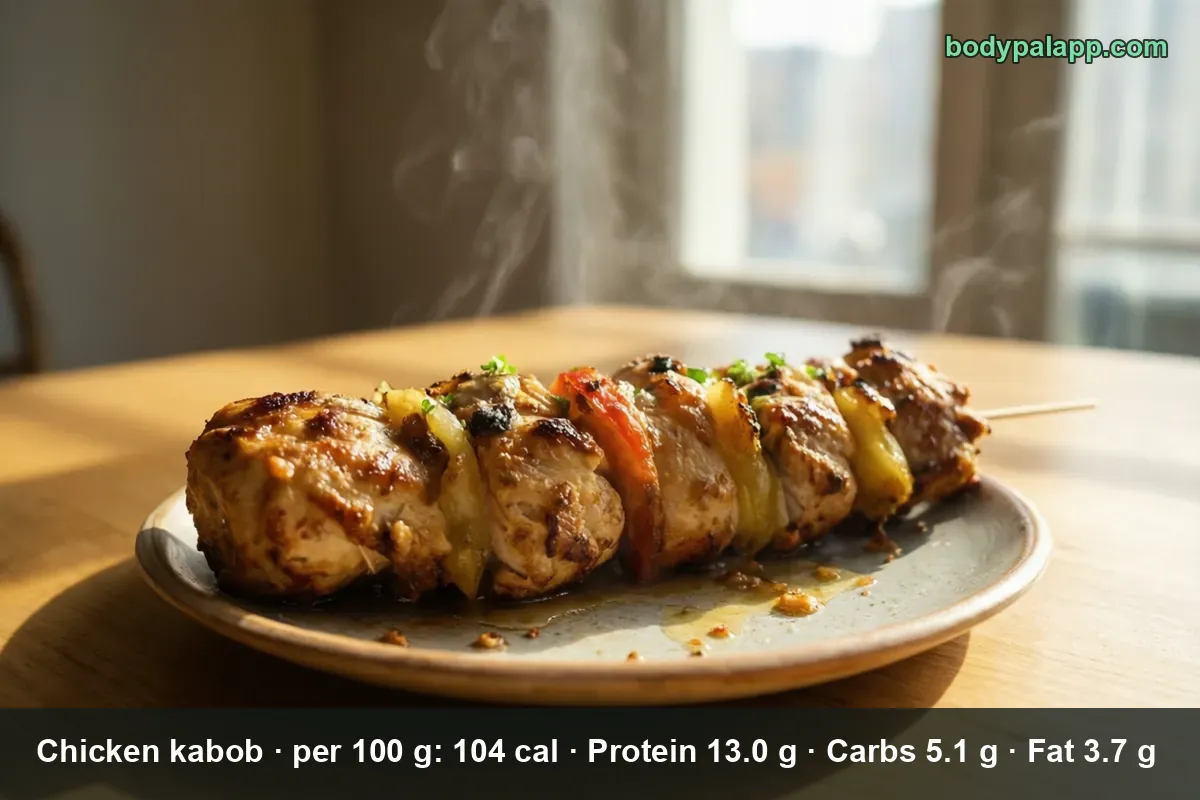
One chicken shish kabob, chicken chunks with bell pepper and onion on a 202 g skewer, is 210 calories. Per 100 g the dish runs 104 calories, light for something built almost entirely out of meat. The 26.3 g of protein is the reason to order it; the 699 mg of sodium is the reason to read the marinade.
On this page
- Chicken kabob quick facts
- Servings, from one ounce to two skewers
- Store-bought kabobs and other versions
- Protein is the win, sodium is the catch
- How does a chicken kabob compare?
- Most popular chicken kabob brands
- FAQ
Chicken kabob quick facts
The number that matters is the one for the thing on your plate: a grilled skewer of chicken with peppers and onion. That is FNDDS 2706783, "Chicken or turkey shish kabob with vegetables, excluding potatoes", the only USDA entry that treats chicken kabob as a finished dish rather than a raw cut, and the only one with a real household serving attached: one shish kabob, 202 g.
Everything below scales from that row. Note that it is the cooked, off-the-grill weight. A skewer weighed raw before it goes over the fire weighs more than 202 g, because meat sheds water as it cooks, so log it after grilling or your day comes out high.
| Nutrient | Per 100 g | Per 1 shish kabob (202 g) | % Daily Value |
|---|---|---|---|
| Calories | 104 | 210 | — |
| Total fat | 3.69 g | 7.5 g | 10% |
| Saturated fat | 0.83 g | 1.7 g | 8% |
| Carbohydrate | 5.06 g | 10.2 g | 4% |
| Dietary fiber | 0.8 g | 1.6 g | 6% |
| Total sugars | 2.37 g | 4.8 g | — |
| Protein | 13.04 g | 26.3 g | 53% |
| Sodium | 346 mg | 699 mg | 30% |
% Daily Value is based on a 2,000-calorie diet.
Verified nutrition data
Numbers on this page come from USDA FoodData Central, the U.S. Department of Agriculture’s food composition database, and from manufacturer labels where a branded product is named. Last verified September 2026. How we verify our data →
Two rows you would see on a package label are missing here on purpose: USDA does not publish added sugars or trans fat for its survey dishes, so there is nothing honest to print. Cholesterol comes to 103 mg per skewer, 34% of the Daily Value, and potassium to 505 mg, 11%. The 4.8 g of total sugars is almost all onion and pepper, plus whatever sweetener the marinade brought along.
Servings, from one ounce to two skewers
| Serving | Weight | Calories |
|---|---|---|
| 1 oz | 28 g | 29 kcal |
| 1/2 cup, chunks off the skewer | 77 g | 80 kcal |
| 1 cup, chunks off the skewer | 154 g | 160 kcal |
| One shish kabob | 202 g | 210 kcal |
| Two shish kabobs | 404 g | 420 kcal |
| Per 100 g | 100 g | 104 kcal |
Only two of those are USDA household measures: the 202 g skewer and the 154 g cup. The half cup, the ounce and the two-skewer line are our own arithmetic from the USDA 100 g figure, not USDA servings.
That cup line is where most food logs go wrong. Pull the chicken and vegetables off the skewer, pile them in a measuring cup, and you get 154 g, which logs as 160 calories. The skewer they came from was 202 g and 210 calories. The cup is not lying; it simply holds less than a full skewer, and loose chunks settle differently every time. A whole skewer eaten as a skewer is about 50 calories more than the cup you would have measured. Weigh the skewer, or count skewers, and skip the cup entirely.
Two skewers, the normal restaurant plate, is 420 calories before rice or pita. That is still a moderate entree, and it delivers 52.6 g of protein, over the full 50 g Daily Value in one sitting.
Store-bought kabobs and other versions
| Version | Per 100 g | Typical piece | Calories |
|---|---|---|---|
| Shish kabob with vegetables, USDA dish | 104 kcal | 1 skewer, 202 g | 210 kcal |
| Store-bought skewer with peppers and onion | 79 kcal | 1 kabob, 151 g | 119 kcal |
| Flame-cooked stickless chicken kabob | 131 kcal | 84 g pouch serving | 110 kcal |
| Sausage-style chicken kabob | 128 kcal | 1 kabob, 78 g | 100 kcal |
| Chicken breast kabob with vegetables, grocery | 116 kcal | 4 oz, 112 g | 130 kcal |
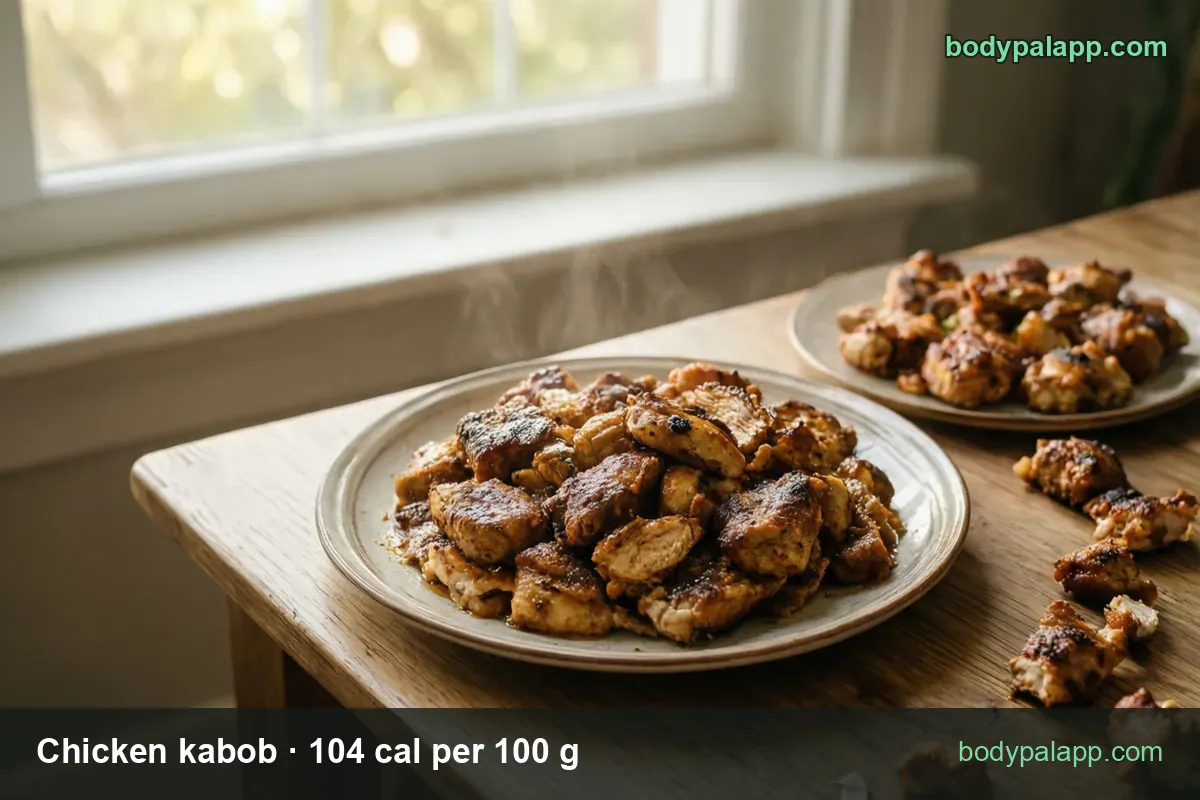
The pattern is easy to miss. Stickless supermarket kabobs from Foster Farms sit at 131 calories per 100 g and Johnsonville's sausage-style kabobs at 128, both well above the 104 of the classic skewer, because there is no pepper or onion diluting the meat. Take the vegetables away and every gram is chicken.
Go the other direction and the Archer Farms skewer sold on a wooden stick at Target is 79 calories per 100 g, the lightest per gram of any version here, since it carries more bell pepper and onion than chicken relative to its weight. Its piece is nearly twice the weight of a Johnsonville kabob for only 19 more calories.
So "one kabob" is worth between 100 and 210 calories depending entirely on which one you are holding, and the per-piece number moves more with size than with recipe. Check the package weight before you log a store-bought skewer as a homemade one.
Protein is the win, sodium is the catch
At 26.3 g of protein per skewer, a single chicken kabob covers 53% of the FDA Daily Value for protein for 210 calories. Very few hot dishes hit half a day of protein for a tenth of a day's calories, which is why grilled skewers keep showing up in MyPlate's protein foods guidance as a lean way to fill that group.
Fat is quiet, too: 7.5 g total and only 1.7 g saturated, 8% of the Daily Value. Nothing about the dish forces you to be careful there.
Sodium is the row to actually watch. One skewer is 699 mg, 30% of the 2,300 mg Daily Value, which is roughly a third of a teaspoon of table salt. Chicken breast is not naturally salty; the marinade is doing all of it. Order the two-skewer plate and you are at 1,398 mg before the rice, the sauce or the pita. If you are watching sodium, one skewer plus a plain side is the better build, and a homemade marinade heavy on lemon, garlic and oregano rather than soy sauce cuts the number most.
How does a chicken kabob compare?
| Dish | Per 100 g | Protein per 100 g | Fat per 100 g |
|---|---|---|---|
| Chicken kabob with vegetables | 104 kcal | 13.04 g | 3.69 g |
| Chili with chicken | 100 kcal | 14.11 g | 3.71 g |
| Chicken creole, no rice | 103 kcal | 13.80 g | 4.22 g |
| Chicken curry | 107 kcal | 6.48 g | 6.48 g |
USDA lists those three neighbors as cup dishes without publishing a gram weight for the cup, so there is no honest per-serving column to print for them; per 100 g is the fair comparison, and the kabob's own serving is the 202 g skewer.
Our take: on calories alone these four are the same food, spread across just 7 calories per 100 g. Protein is where they separate. The kabob, chili and creole all land near 13 to 14 g per 100 g; curry drops to 6.48 g and carries the most fat at 6.48 g, because the calories there come from a coconut-and-oil sauce instead of meat. If you want the most protein per calorie off a grill, the kabob and the chili are the picks, and the kabob is the one you can portion by counting skewers instead of guessing at a ladle.
Most popular chicken kabob brands in the United States
Ranked by how widely each product appears among foods sold in the United States, from the BodyPal food database of over 3.3 million products. Calories are the figures printed on each Nutrition Facts label, checked against USDA FoodData Central.
| Product | Calories (per 100 g) |
|---|---|
| Foster Farms Flame Cooked Stickless Chicken Kabobs | 131 cal |
| Foster Farms Take Out Chicken Kabobs | 131 cal |
| Johnsonville Chicken Kabobs | 128 cal |
| Festival Foods Chicken Kabobs with Chicken Breast & Vegetables | 116 cal |
| Archer Farms Chicken Kabobs with Bell Peppers & Onions | 79 cal |
Brand popularity: BodyPal food database. Nutrition: manufacturer labels / USDA FoodData Central.
Chicken kabob FAQs
How many calories are in one chicken kabob?
One chicken kabob is 210 calories. That is a 202 g skewer of chicken chunks with bell pepper and onion, the USDA household serving for the dish. Per 100 g it comes to 104 calories, and the same skewer carries 26.3 g of protein and 7.5 g of fat.
How many calories in a cup of chicken kabob?
A cup of kabob chunks pulled off the skewer weighs 154 g and comes to 160 calories. That is 50 calories less than a whole skewer, because a cup of loose chunks holds less than the 202 g USDA counts as one shish kabob. Measure the skewer, not the cup.
How much protein is in a chicken kabob?
One skewer gives you 26.3 g of protein, 53% of the Daily Value on a 2,000-calorie diet. Per 100 g that is 13.04 g, high for a dish that is part vegetable. The usual two-skewer restaurant plate reaches 52.6 g, past the full 50 g Daily Value on its own.
Is chicken kabob good for weight loss?
At 104 calories per 100 g, chicken kabob is one of the lighter hot entrees off a grill. A 210-calorie skewer carrying 26.3 g of protein is a strong trade if you are counting, since protein is the part that keeps you full. The catch is sodium: 699 mg per skewer, 30% of a day.
How much sodium is in a chicken kabob?
One 202 g skewer carries 699 mg of sodium, 30% of the 2,300 mg Daily Value and about a third of a teaspoon of table salt. The chicken itself is not salty; the marinade is. Two skewers put you at 1,398 mg before the rice, sauce or pita.
Are store-bought chicken kabobs higher in calories?
Foster Farms flame-cooked stickless kabobs run 131 calories per 100 g and Johnsonville's 128, against 104 for the USDA skewer with vegetables, so per gram, usually yes. Their pieces are smaller, though, so a single Johnsonville kabob is 100 calories. Denser meat, less pepper and onion.
Do the vegetables on the skewer add calories?
Barely: bell pepper and onion are why the dish sits at 104 calories per 100 g instead of the 131 of an all-meat stickless kabob, so they cut the density rather than raising it. They contribute 5.06 g of carbohydrate and 0.8 g of fiber per 100 g, most of the 2.37 g of sugars too.
How many calories in 4 oz of chicken kabob?
About 118 calories for 4 oz (113 g), our own arithmetic from the USDA 104-per-100-g figure rather than a USDA serving. That is a little over half a skewer, with roughly 14.7 g of protein. Grocery kabobs at 116 to 131 calories per 100 g land higher at the same weight.
Similar foods
- Chicken Kebab — 210 cal per shish kabob
- Chicken Satay — 210 cal per skewer
- Chicken Skewer — 210 cal per skewer
- Salmon Maki Roll — 185 cal per roll
- Salmon Sushi Roll — 185 cal per roll
- Sushi Sashimi — 150 cal per serving
Count it without the math
Point the camera at the plate and BodyPal counts the skewer for you, peppers and all.


How long does it take to burn off 210 kcal of chicken kabob?
One shish kabob skewer (202 g) is 210 kcal. Enter your weight and the amount you ate to see how long it takes you to burn that off:
lb
| Activity | Time to burn 210 kcal |
|---|---|
| Walking, brisk | 42 min |
| Cycling, moderate | 26 min |
| Swimming, moderate | 30 min |
| Jogging | 25 min |
| Weight training, moderate | 47 min |
Times are for a 155 lb adult at a steady pace; change the weight to see yours. The amount is set to the portion in the text (202 g); change it to what you actually ate. BodyPal works this out from your steps automatically.
One food is easy to picture; a whole day is harder. See how many calories you need a day and what a deficit actually looks like.