
How many calories are in chicken satay?
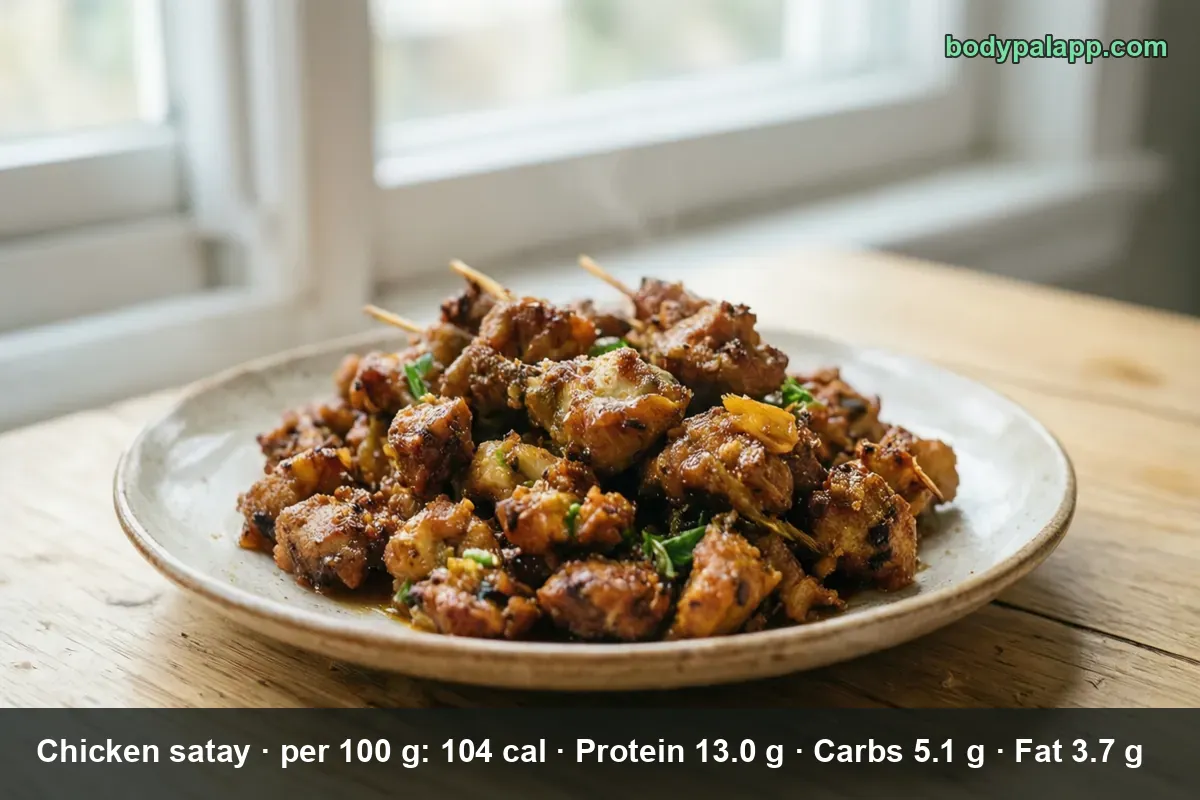
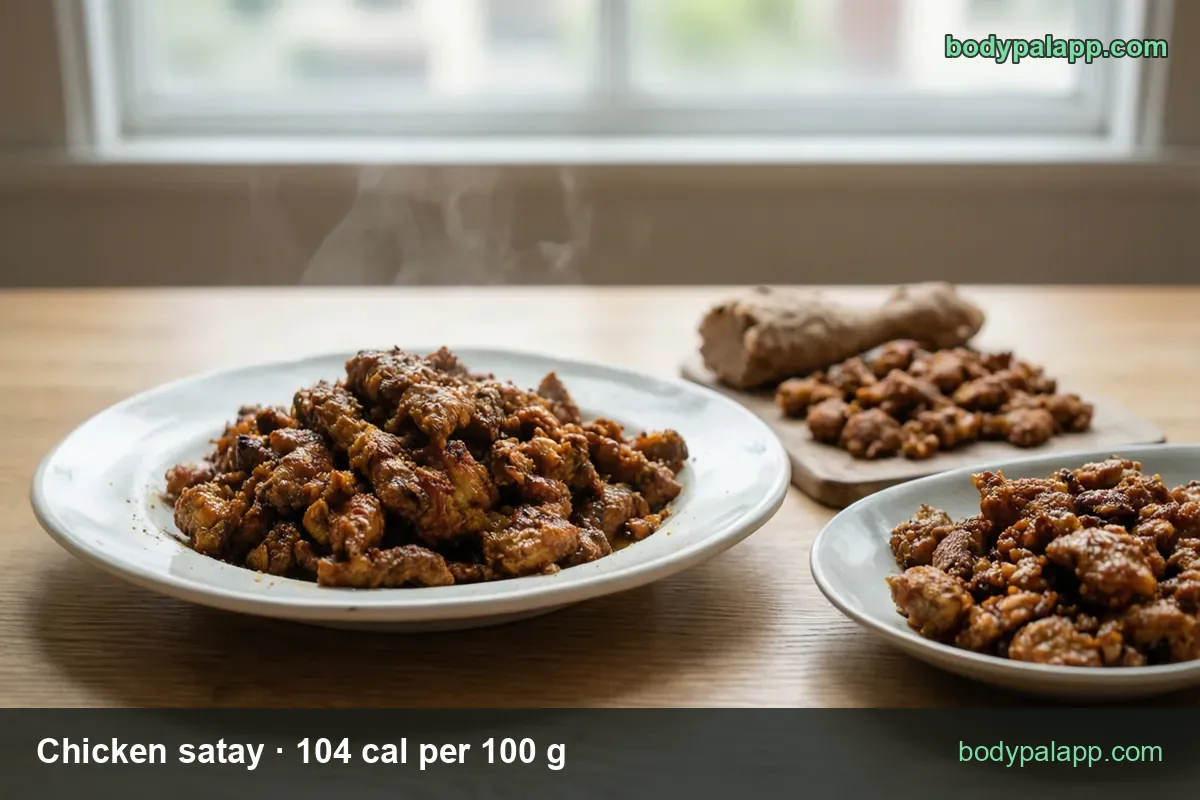
One USDA chicken satay skewer weighs 202 g and carries 210 calories. Per 100 g the grilled meat and vegetables run 104 calories, a hair under chicken curry at 107. A cup of the same pieces, pulled off the stick, is 160. Protein does the heavy lifting: 26.3 g on one skewer, or 53% of a day's value.
You'd need to walk about 42 minutes to burn the 210 calories in one skewer (202 g).
How long does it take to burn off chicken satay?
One skewer (202 g) is 210 kcal. Enter your weight and the amount you ate to see how long it takes you to burn that off:
lb
| Activity | Time to burn 210 kcal |
|---|---|
| Walking, brisk | 42 min |
| Cycling, moderate | 26 min |
| Swimming, moderate | 30 min |
| Jogging | 25 min |
| Weight training, moderate | 47 min |
Times are for a 155 lb adult at a steady pace; change the weight to see yours. The amount is set to the portion in the text (202 g); change it to what you actually ate. BodyPal works this out from your steps automatically.
On this page
- Chicken satay quick facts
- US servings, from one ounce to a whole skewer
- Skewers, cups and frozen satay pieces
- Peanut sauce is the swing factor
- Protein is the reason to order it
- How does chicken satay compare?
- Most popular chicken satay brands
- FAQ
Chicken satay quick facts
Satay does not have its own generic entry in USDA FoodData Central. The closest full record is FNDDS 2706783, "Chicken or turkey shish kabob with vegetables, excluding potatoes" — marinated chicken pieces cooked on a stick with vegetables, which is what lands on the plate at most Thai and Indonesian places in the US. It is the only generic entry with a complete nutrient profile and a household measure, "1 shishkabob," so every number on this page hangs off it.
Branded satay products exist in the database, but they publish calories, protein, carbohydrate and fat only. Those stay in the variants table below, where their missing rows do no damage.
| Nutrient | Per 100 g | Per 1 skewer (202 g) | % Daily Value |
|---|---|---|---|
| Calories | 104 | 210 | — |
| Total fat | 3.69 g | 7.5 g | 10% |
| Saturated fat | 0.83 g | 1.7 g | 8% |
| Carbohydrate | 5.06 g | 10.2 g | 4% |
| Dietary fiber | 0.8 g | 1.6 g | 6% |
| Total sugars | 2.37 g | 4.8 g | — |
| Protein | 13.04 g | 26.3 g | 53% |
| Sodium | 346 mg | 699 mg | 30% |
% Daily Value is based on a 2,000-calorie diet.
Verified nutrition data
Numbers on this page come from USDA FoodData Central, the U.S. Department of Agriculture’s food composition database, and from manufacturer labels where a branded product is named. Last verified September 2026. How we verify our data →
Two rows you would see on a package are missing here: added sugars and trans fat. The FNDDS edition behind this record does not publish either, so guessing them would be worse than leaving them out. The marinade's 2.37 g of total sugars per 100 g is real, but nothing tells us how much of it was poured in versus how much came from the vegetables. Cholesterol lands at 103 mg a skewer (34% DV) and potassium at 505 mg (11% DV).
US servings, from one ounce to a whole skewer
| Serving | Weight | Calories |
|---|---|---|
| 1 oz | 28 g | 29 kcal |
| 3 oz | 85 g | 88 kcal |
| 4 oz | 113 g | 118 kcal |
| 1 cup, pieces off the stick | 154 g | 160 kcal |
| 1 skewer | 202 g | 210 kcal |
| Per 100 g | 100 g | 104 kcal |
Only two of those are USDA household measures: the 202 g skewer and the 154 g cup. The ounce rows are our own arithmetic from the USDA 100 g figure, not USDA servings, which is exactly how you should treat them when you log a portion someone else cut for you.
The gap between the skewer and the cup is the trap. Same food, same database row, but 48 g of difference — and 50 calories. People log a cup because a cup feels like a normal portion, then eat a stick that is a third heavier. Restaurant satay sticks cut the other way: they are usually far lighter than a 202 g kabob, closer to an ounce or two of meat apiece, which puts a single appetizer stick nearer 29 to 60 calories. Four of them on a plate with sauce is the real order.
Skewers, cups and frozen satay pieces
| Version | Per 100 g | Typical serving | Calories |
|---|---|---|---|
| Chicken satay skewer, USDA generic | 104 kcal | 1 shishkabob, 202 g | 210 kcal |
| Same food, cup portion | 104 kcal | 1 cup, 154 g | 160 kcal |
| Frozen chicken breast satay appetizer | 125 kcal | 1 satay, 28 g | 35 kcal |
| Store-bought chicken kabob | 128 kcal | 1 kabob, 78 g | 100 kcal |
| Satay chicken in creamy sauce | 114 kcal | 2/3 cup, 140 g | 160 kcal |
| Peanut satay sauce | 200 kcal | 2 Tbsp, 35 g | 70 kcal |
Here is the difference nobody explains: the generic USDA record includes the vegetables threaded between the meat, and vegetables are mostly water. Strip them off and you are eating denser food. The frozen breast satays run 125 calories per 100 g and the store-bought kabobs 128, against 104 for the mixed skewer. Per gram, meat-only satay is about 20% more calories — but you also get more protein for it, 21.4 g per 100 g in the frozen breast satays against 13.04 g in the mixed version.
Store shelves back this up. Foster Farms stickless kabobs sit at 131 calories per 100 g, Festival Foods chicken-and-vegetable kabobs at 116, Snapdragon's satay chicken in creamy sauce at 114. Sauce pulls the number down per gram by adding water and carbohydrate; bare grilled breast pushes it up.
Peanut sauce is the swing factor
The meat is not what makes satay a heavy dish. The dip is. Peanut satay sauce runs 200 calories per 100 g, so a 2 Tbsp pour of 35 g adds 70 calories and 240 mg of sodium to whatever it lands on. That is a third again on top of a 210-calorie skewer, and it arrives in about four seconds.
Two skewers with a generous double dip is 420 calories of chicken and 140 of sauce, and the sauce contributes almost nothing but fat, sugar and salt. Order the sauce on the side and use half of it and you keep the protein while cutting roughly 35 calories per dip. It is the single highest-leverage change on the plate.
Protein is the reason to order it
One skewer covers 53% of the Daily Value for protein — 26.3 g — while costing 10% of the fat allowance and 8% of the saturated fat allowance. That ratio is unusual for something that comes off a grill with a sauce on it, and it is why satay works as a lunch anchor: build a 350–450 calorie meal around a skewer and rice and the protein target takes care of itself. MyPlate's protein foods guidance treats lean poultry as the reference case, and this is lean poultry with vegetables attached.
Sodium is the row that spoils it. A skewer carries 699 mg, or 30% of the FDA Daily Value of 2,300 mg, before any dipping sauce. That is a little under a third of a teaspoon of table salt in one appetizer. Add the 240 mg from 2 Tbsp of peanut sauce and a two-skewer plate is past 1,600 mg — most of a day for anyone watching blood pressure. The frozen breast satays are worse per gram at 643 mg per 100 g, nearly double the generic record's 346 mg, because the marinade is doing all the flavoring on meat with no vegetables to dilute it.
Cholesterol lands at 103 mg per skewer, 34% DV. If you are watching sodium, satay is the better pick only when the sauce stays on the side.
How does chicken satay compare?
| Dish | Per 100 g | Protein per 100 g | US serving | Calories |
|---|---|---|---|---|
| Chicken satay, skewer with vegetables | 104 kcal | 13.04 g | 4 oz, 113 g | 118 kcal |
| Chicken curry | 107 kcal | 6.48 g | 4 oz, 113 g | 121 kcal |
| Chili with chicken | 100 kcal | 14.11 g | 4 oz, 113 g | 113 kcal |
| Chicken creole, no rice | 103 kcal | 13.8 g | 4 oz, 113 g | 116 kcal |
All four 4 oz portions are our own arithmetic from each record's 100 g figure, so they are directly comparable to each other.
Our take: on calories alone these four are the same dish — a 7-calorie spread per 100 g, which is noise. Protein splits them. Chicken curry gives you less than half the protein of satay for slightly more calories, because coconut-based sauce replaces meat by weight; chili with chicken edges satay at 14.11 g. Satay also carries the least fat per 100 g at 3.69 g, though chili at 3.71 g is inside the rounding error. For weight loss, satay with the sauce on the side is the pick of the four. For fullness per calorie, chili with chicken and satay tie, and curry is the one to skip.
Most popular chicken satay brands in the United States
Ranked by how widely each product appears among foods sold in the United States, from the BodyPal food database of over 3.3 million products. Calories are the figures printed on each Nutrition Facts label, checked against USDA FoodData Central.
| Product | Calories (per 100 g) |
|---|---|
| InnovAsian Fully Cooked Chicken Breast Satays | 125 cal |
| Johnsonville Chicken Kabobs | 128 cal |
| Foster Farms Flame Cooked Stickless Chicken Kabobs | 131 cal |
| Snapdragon Satay Chicken | 114 cal |
| Festival Foods Chicken Kabobs with Chicken Breast & Vegetables | 116 cal |
Brand popularity: BodyPal food database. Nutrition: manufacturer labels / USDA FoodData Central.
Chicken satay FAQs
How many calories are in one chicken satay skewer?
210 calories for the USDA skewer, which weighs 202 g and includes the vegetables threaded on the stick. That works out to 104 calories per 100 g. Restaurant satay sticks are usually much lighter than 202 g, so a single appetizer stick often lands nearer 30 to 60 calories before any dipping sauce.
How much protein is in chicken satay?
26.3 g of protein in one 202 g skewer, which is 53% of the Daily Value, from 13.04 g per 100 g. Meat-only versions are higher: frozen chicken breast satays hit 21.43 g per 100 g because there are no vegetables on the stick diluting the count by weight.
Is chicken satay high in sodium?
Yes — 699 mg in one skewer, 30% of the 2,300 mg Daily Value, and that is before the dip. The marinade is the source, at 346 mg per 100 g. Two skewers with peanut sauce clears 1,600 mg. Order sauce on the side if sodium matters to you.
How many calories does peanut satay sauce add?
70 calories for 2 Tbsp, or 35 g, since prepared peanut satay sauce runs 200 calories per 100 g. It also brings 240 mg of sodium. On a 210-calorie skewer that is a third again, added in seconds, which makes the dip the biggest single variable on the plate.
Is chicken satay good for weight loss?
210 calories for 26.3 g of protein is a strong ratio, so satay works well in a calorie deficit — as long as the sauce stays on the side. The skewer costs only 10% of the day's fat allowance. The 70-calorie peanut dip and a side of rice are where satay meals actually get heavy.
How many carbs are in chicken satay?
10.2 g of carbohydrate in a 202 g skewer, 4% of the Daily Value, from 5.06 g per 100 g. Of that, 4.8 g is total sugars from the marinade and the vegetables, and 1.6 g is fiber. USDA does not publish added sugars for this record, so the marinade's share is unknown.
Chicken satay vs chicken curry: which has fewer calories?
Satay, barely: 104 calories per 100 g against 107 for chicken curry, or 118 versus 121 for a 4 oz portion. The real gap is protein — 13.04 g per 100 g in satay against 6.48 g in curry, because coconut sauce replaces meat by weight. Satay is the more filling choice.
How many calories are in a cup of chicken satay?
160 calories in one cup, which USDA puts at 154 g of chicken and vegetables off the stick. That is 50 calories less than a whole 202 g skewer of the same food. If you log a cup but eat a full skewer, you are undercounting by about a quarter.
Similar foods
- Pork And Beans — 273 cal per cup
- Turkey deli meat — 89 cal for 3 slices
- Chicken Tikka Masala — 257 cal per cup
- Tuna steak — 185 cal per steak, 6 oz
- Chinese Chicken and Broccoli — 206 cal per cup
- Clam Chowder — 237 cal per cup
Count it without the math
Point the camera at the plate and BodyPal counts the skewers and the dip for you.

