
How many calories are in a chicken skewer?
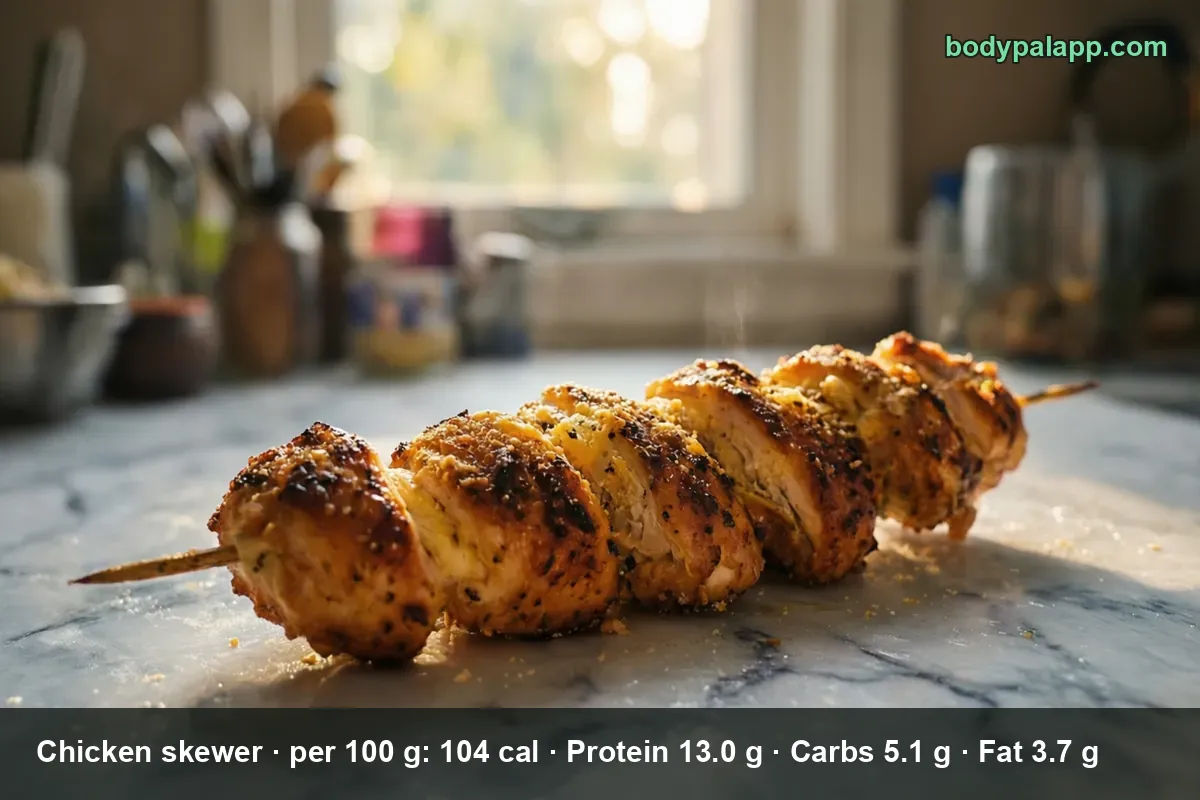
One grilled chicken skewer weighs about 202 g and carries 210 calories. Per 100 g it runs 104 calories, and that low density is the whole story: chunks of chicken alternating with peppers, onion and zucchini, no breading, no rice underneath, nothing fried. The protein lands at 26.3 g for the stick.
On this page
- Chicken skewer quick facts
- US servings, from one ounce to two skewers
- Satay, teriyaki and store-cooked kabobs
- Sodium is the row to watch, not the fat
- How does a chicken skewer compare?
- Most popular chicken skewer brands
- Chicken skewer FAQs
Chicken skewer quick facts
There is no USDA entry filed under the words "chicken skewer." The dish is indexed the way American menus used to spell it, as a kabob, and the record that matches the food on the stick is FNDDS 2706783, "Chicken or turkey shish kabob with vegetables, excluding potatoes". That is chicken cubes threaded with vegetables and cooked over heat, which is exactly what comes off a backyard grill or a Mediterranean counter.
The record also carries its own household measure, "1 shishkabob," worth 202 g. That matters, because it means the 210-calorie figure below is a USDA serving and not something scaled by hand. The vegetables are counted in that weight, and they are the reason the density stays at 104 per 100 g instead of the 128 to 150 you see on packaged all-meat skewers.
| Nutrient | Per 100 g | Per 1 skewer (202 g) | % Daily Value |
|---|---|---|---|
| Calories | 104 | 210 | — |
| Total fat | 3.69 g | 7.5 g | 10% |
| Saturated fat | 0.83 g | 1.7 g | 8% |
| Carbohydrate | 5.06 g | 10.2 g | 4% |
| Dietary fiber | 0.8 g | 1.6 g | 6% |
| Total sugars | 2.37 g | 4.8 g | — |
| Protein | 13.04 g | 26.3 g | 53% |
| Sodium | 346 mg | 699 mg | 30% |
% Daily Value is based on a 2,000-calorie diet.
Verified nutrition data
Numbers on this page come from USDA FoodData Central, the U.S. Department of Agriculture’s food composition database, and from manufacturer labels where a branded product is named. Last verified September 2026. How we verify our data →
Two rows are missing on purpose. FNDDS does not publish added sugars or trans fat for mixed dishes, so there is nothing honest to print in those cells — the 4.8 g of total sugars in a skewer comes from the onion, the peppers and whatever went into the marinade, not from a spoonful of sugar you can look up. Cholesterol is 103 mg per skewer, 34% of the Daily Value, and potassium is 505 mg, or 11%.
US servings, from one ounce to two skewers
| Serving | Weight | Calories |
|---|---|---|
| 1 oz | 28 g | 29 kcal |
| 1 cup, pieces pulled off the stick | 154 g | 160 kcal |
| 4 oz | 113 g | 118 kcal |
| One skewer | 202 g | 210 kcal |
| Two skewers | 404 g | 420 kcal |
| Per 100 g | 100 g | 104 kcal |
Only two of those are USDA household measures: the whole skewer at 202 g and the cup of loose pieces at 154 g. The ounce rows and the two-skewer row are our own arithmetic from the USDA 100 g figure, not USDA servings.
The cup line is the one that trips people up. A cup of chicken kabob pieces is 160 calories, which sounds like most of a skewer, but it is only three quarters of one by weight. If you slide the meat off the stick into a bowl and log "1 cup," you have quietly dropped 50 calories and about 6 g of protein from your day. Log the stick, not the bowl, unless you actually measured the bowl.
The raw-versus-cooked question has an answer here too, and it is short: this record is cooked. Raw chicken breast loses roughly a quarter of its weight on the grill, so 8 oz of raw cubes on two skewers comes off the fire at about 6 oz of meat. Weigh skewers after cooking, or you will overcount by a third.
Satay, teriyaki and store-cooked kabobs
| Version | Per 100 g | Typical serving | Calories |
|---|---|---|---|
| Grilled chicken skewer with vegetables | 104 kcal | 1 skewer (202 g) | 210 kcal |
| Chicken satay | 125 kcal | 1 satay stick (28 g) | 35 kcal |
| Teriyaki chicken skewer | 115 kcal | 2 skewers (113 g) | 130 kcal |
| Garlic and herb chicken skewer | 150 kcal | 2 skewers (100 g) | 150 kcal |
| BBQ bourbon chicken skewer | 106 kcal | 4 oz (113 g) | 120 kcal |
| Store-cooked chicken kabob | 128 kcal | 1 kabob (78 g) | 100 kcal |
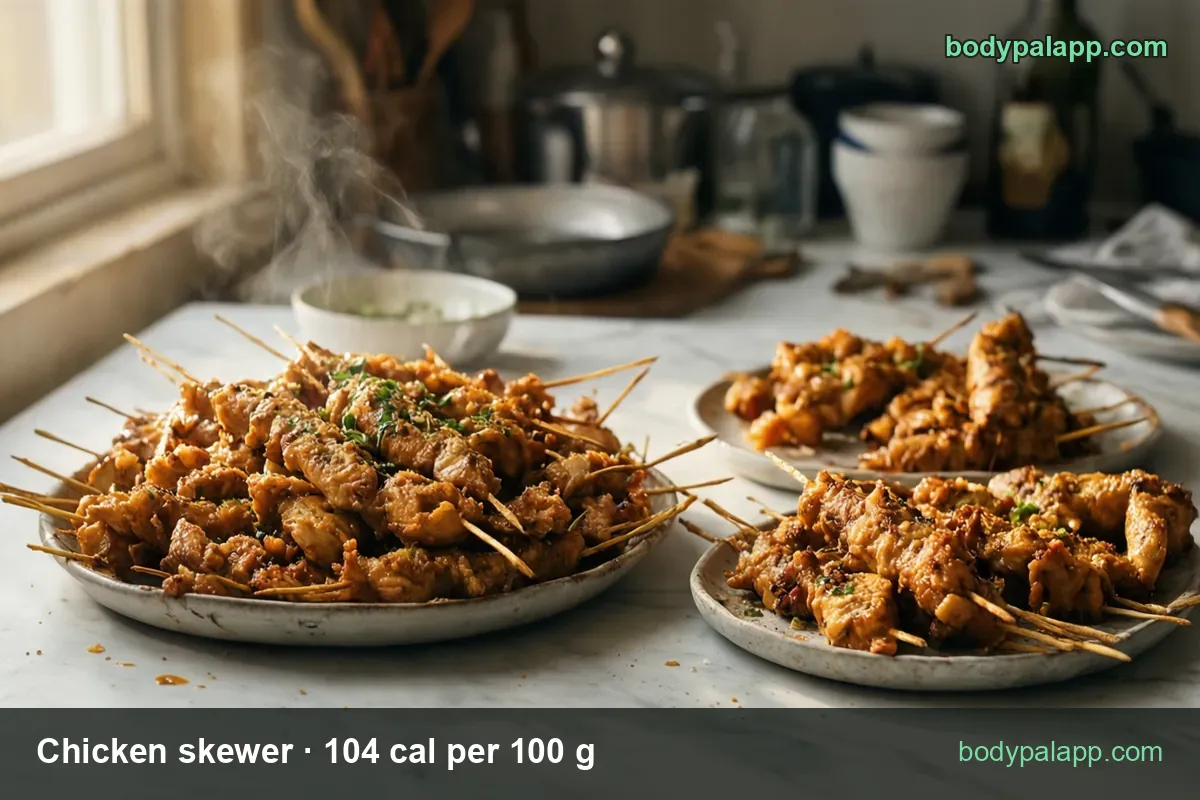
Satay looks like the cheap option at 35 calories a stick, and per stick it is — those appetizer skewers are tiny, 28 g of meat, barely two bites. Per 100 g it is denser than the grilled version, 125 against 104, because there are no vegetables padding the weight. Order six of them and you are at 210 calories, the same as one full dinner skewer, with the peanut sauce still to come.
The packaged skewers cluster in a tight band. Expresco's garlic and herb sticks run 150 per 100 g, Oberto's chicken breast skewers 148, Foster Farms 131, Johnsonville kabobs 128, Custom Made Meals teriyaki 115 and Archer Farms Thai style 107. Every one of them is denser than the homemade record, and the gap at the top is about 40%. Nothing sinister is happening — the meat-to-vegetable ratio is simply higher, and marinades add oil and sugar.
Teriyaki is the one worth calling out for a different reason. At 115 per 100 g it is not a calorie problem; two skewers are 130 calories. The sauce shows up in the sodium column instead, which is where this food actually gets expensive.
Sodium is the row to watch, not the fat
One skewer carries 699 mg of sodium, 30% of the Daily Value in a single item. The fat, meanwhile, is 7.5 g, or 10% — a rounding error in a day of eating. If you are watching one number on this plate, watch the salt, not the grease. That 699 mg is roughly a third of a teaspoon of table salt.
The Dietary Guidelines for Americans put the ceiling at 2,300 mg a day for adults. Two skewers put 1,398 mg on the board, 61% of the day, before the rice, the pita, the sauce or anything else. Packaged skewers vary from about 407 to 630 mg per 100 g against 346 mg for the FNDDS record, so a store-bought stick can push the same portion higher still. Rinsing is not an option here; the marinade is in the meat.
The trade you get for that salt is genuinely good. Protein is a Daily Value of 50 g, and one skewer delivers 26.3 g, which is 53% of it for 210 calories, about 11% of a 2,000-calorie day. Very few hot main courses hand over half the day's protein for a tenth of the calories. If you are building meals around the protein foods group, this is close to the ideal shape: lean meat, vegetables attached, nothing added to carry it.
How does a chicken skewer compare?
| Chicken dish | Per 100 g | US serving | Calories |
|---|---|---|---|
| Chicken skewer with vegetables | 104 kcal | 1 skewer (202 g) | 210 kcal |
| Chili with chicken | 100 kcal | 1 cup (253 g) | 253 kcal |
| Chicken creole, no rice | 103 kcal | 1 cup (244 g) | 251 kcal |
| Chicken hash | 110 kcal | 1 cup (225 g) | 248 kcal |
Our take: all four of these sit within 10 calories of each other per 100 g, which tells you the density is set by the chicken and not by the cooking. What separates them is how much of it lands in front of you. The skewer is the lightest plate of the four at 210 calories, simply because a stick holds 202 g while a cup of stew holds 225 to 253 g. For weight loss, take the skewer and skip the rice. For satiety on the same calories, the hash is the weakest of the four — 9.57 g of protein per 100 g against 13.04 g for the skewer, because potatoes are doing part of the work.
Most popular chicken skewer brands in the United States
Ranked by how widely each product appears among foods sold in the United States, from the BodyPal food database of over 3.3 million products. Calories are the figures printed on each Nutrition Facts label, checked against USDA FoodData Central.
| Product | Calories (per 100 g) |
|---|---|
| Expresco Grilled Garlic & Herb Chicken Skewers | 150 cal |
| Custom Made Meals Teriyaki Kalbi Chicken Skewers | 115 cal |
| Johnsonville Chicken Kabobs | 128 cal |
| Foster Farms Take Out Chicken Kabobs | 131 cal |
| Oberto Chicken Skewers | 148 cal |
| Archer Farms Thai Style Chicken Skewers | 107 cal |
Brand popularity: BodyPal food database. Nutrition: manufacturer labels / USDA FoodData Central.
Chicken skewer FAQs
How many calories are in one chicken skewer?
210 calories for one grilled chicken skewer with vegetables, weighing 202 g, at 104 calories per 100 g. That is the USDA household serving for the FNDDS shish kabob record, vegetables included. A packaged all-meat skewer is denser, running 128 to 150 calories per 100 g instead.
How much protein is in a chicken skewer?
26.3 g of protein in one 202 g skewer, which is 53% of the 50 g Daily Value, for only 210 calories. Per 100 g that works out to 13.04 g. Two skewers cover the protein of a full day in most 2,000-calorie plans, at 420 calories total.
How many calories in 2 chicken skewers?
420 calories for two skewers at 202 g each, our own arithmetic from the USDA 100 g figure rather than a USDA serving. That plate also carries 52.6 g of protein and 1,398 mg of sodium, which is 61% of the 2,300 mg daily limit before any side dish.
How many calories in a chicken satay skewer?
35 calories for one appetizer satay stick of 28 g, at 125 calories per 100 g. Satay is denser than a grilled kabob because there are no vegetables on the stick, so six satay sticks equal one dinner skewer at 210 calories. Peanut sauce is counted separately.
How much sodium is in a chicken skewer?
699 mg of sodium per skewer, or 30% of the Daily Value, from 346 mg per 100 g. That is roughly a third of a teaspoon of table salt in one item. Packaged and teriyaki skewers run higher, in the range of 407 to 630 mg per 100 g, because the sauce is part of the marinade.
Do chicken skewers have carbs?
10.2 g of carbohydrate in one 202 g skewer, 4% of the Daily Value, with 1.6 g of that as fiber and 4.8 g as total sugars. All of it comes from the peppers, onion and marinade rather than the meat. A plain all-meat skewer with no vegetables would be close to zero.
Are chicken skewers good for weight loss?
At 104 calories per 100 g with 13.04 g of protein, a chicken skewer is one of the better-shaped hot mains you can log: 210 calories buys 53% of the day's protein. If you are watching sodium, note the 699 mg per skewer and keep the sides unsalted. The rice under it is what usually breaks the math.
Is a chicken kabob the same as a chicken skewer?
Yes, and USDA files it as a kabob: the 104 calories per 100 g figure comes from the record "Chicken or turkey shish kabob with vegetables." Menus in the United States use skewer, kabob and kebab for the same food. A store-cooked kabob of 78 g is 100 calories, denser at 128 per 100 g because it is mostly meat.
Similar foods
- Chicken Kabob — 210 cal per shish kabob
- Chicken Kebab — 210 cal per shish kabob
- Chicken Satay — 210 cal per skewer
- Salmon Maki Roll — 185 cal per roll
- Salmon Sushi Roll — 185 cal per roll
- Sushi Sashimi — 150 cal per serving
Count it without the math
Point the camera at the plate and BodyPal counts the skewers for you, vegetables and all.


How long does it take to burn off chicken skewer?
One skewer (202 g) is 210 kcal. Enter your weight and the amount you ate to see how long it takes you to burn that off:
lb
| Activity | Time to burn 210 kcal |
|---|---|
| Walking, brisk | 42 min |
| Cycling, moderate | 26 min |
| Swimming, moderate | 30 min |
| Jogging | 25 min |
| Weight training, moderate | 47 min |
Times are for a 155 lb adult at a steady pace; change the weight to see yours. The amount is set to the portion in the text (202 g); change it to what you actually ate. BodyPal works this out from your steps automatically.
This table assumes you know your daily total. If you do not, the daily calorie calculator works it out from five numbers.