
How many calories are in a chicken kebab?
One USDA shish kabob of chicken and vegetables weighs 202 g and carries 210 calories. Per 100 g the same skewer runs 104 calories, which makes it one of the leanest hot mains on a grill menu. Most of that weight is chicken and onion, not sauce, and the protein lands at 26.3 g.
On this page
- Chicken kebab quick facts
- US servings, from one ounce to a whole skewer
- Store-bought kabobs and other chicken kebab versions
- Protein is the win, sodium is the catch
- How does a chicken kebab compare?
- Most popular chicken kebab brands
- Chicken kebab FAQs
Chicken kebab quick facts
The number above comes from one record: FNDDS 2706783, "Chicken or turkey shish kabob with vegetables, excluding potatoes", from the 2021-2023 survey release. It is the only USDA entry that describes the thing a searcher is actually holding, which is meat and onion and pepper cooked on a stick, with no rice and no potatoes riding along. The record covers chicken and turkey together, so a turkey skewer logs the same way. Branded kabobs exist in the database too, but most of them are sold raw or frozen, so they answer a different question and sit in their own section below.
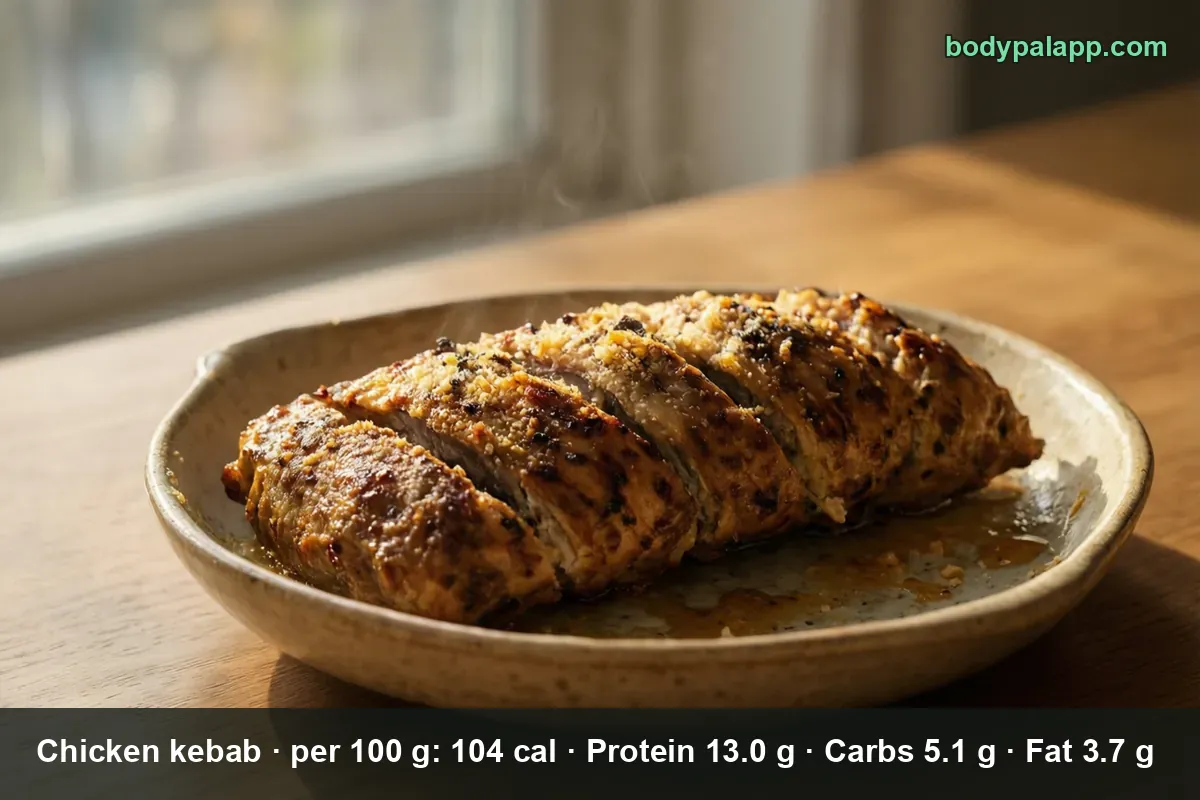
Two caveats before the table. USDA does not publish a separate row for ground-chicken kofta, the log-shaped version pictured above, so the figures here describe the skewered-chunk build with vegetables. And there is no USDA record for a kebab wrapped in pita or lavash, which means the bread has to be counted as its own line in your log.
| Nutrient | Per 100 g | Per 1 shish kabob (202 g) | % Daily Value |
|---|---|---|---|
| Calories | 104 | 210 | — |
| Total fat | 3.69 g | 7.5 g | 10% |
| Saturated fat | 0.83 g | 1.7 g | 8% |
| Carbohydrate | 5.06 g | 10.2 g | 4% |
| Dietary fiber | 0.8 g | 1.6 g | 6% |
| Total sugars | 2.37 g | 4.8 g | — |
| Protein | 13.04 g | 26.3 g | 53% |
| Sodium | 346 mg | 699 mg | 30% |
% Daily Value is based on a 2,000-calorie diet.
Verified nutrition data
Numbers on this page come from USDA FoodData Central, the U.S. Department of Agriculture’s food composition database, and from manufacturer labels where a branded product is named. Last verified September 2026. How we verify our data →
Added sugars and trans fat are missing on purpose: this FNDDS edition does not publish either value for the dish, so there is nothing honest to put in those rows. Cholesterol runs 51 mg per 100 g, or 103 mg on a full skewer, which is 34% of the Daily Value. Potassium is 250 mg per 100 g, so a skewer delivers 505 mg, about 11% of a day. The 2.37 g of sugars per 100 g is from the onion and pepper, not from anything added.
US servings, from one ounce to a whole skewer
| Serving | Weight | Calories |
|---|---|---|
| 1 oz | 28 g | 29 kcal |
| Per 100 g | 100 g | 104 kcal |
| Half a skewer | 101 g | 105 kcal |
| 4 oz cooked | 113 g | 118 kcal |
| 1 cup, chopped | 154 g | 160 kcal |
| 1 shish kabob | 202 g | 210 kcal |
Only two of those are USDA household measures: the whole skewer at 202 g and the chopped cup at 154 g. The half skewer, the 4 oz portion and the single ounce are our own arithmetic from the USDA 100 g figure, not USDA servings, so treat them as clean scaling rather than a measured entry.
The gap between the two real measures is the trap. Pull the meat and vegetables off the stick, pack them into a measuring cup, and you have 154 g and 160 calories. Leave the same food on the stick and you are logging 202 g and 210 calories. That is a 50-calorie swing on one dish, decided by the container and not by the cooking. If you eat kebab twice a week and guess wrong every time, the measure alone moves your week by more than a hundred calories.
One more note on weight. Grill menus rarely say how heavy a skewer is, and street skewers are often smaller than the USDA 202 g. If yours looks like two-thirds of the plate photo, log the half-skewer line and move on.
Store-bought kabobs and other chicken kebab versions
| Version | Per 100 g | Typical piece | Calories |
|---|---|---|---|
| Chicken shish kabob with vegetables, USDA baseline | 104 kcal | 1 shish kabob, 202 g | 210 kcal |
| Johnsonville chicken kabobs, raw | 128 kcal | 1 kabob, 78 g | 100 kcal |
| Foster Farms flame cooked stickless chicken kabobs | 131 kcal | 84 g | 110 kcal |
| Archer Farms chicken kabobs with bell peppers and onions | 79 kcal | 1 kabob, 151 g | 119 kcal |
| Festival Foods chicken kabobs with chicken breast and vegetables | 116 kcal | 4 oz, 112 g | 130 kcal |
| Chicken curry, for contrast | 107 kcal | 4 oz, 113 g | 121 kcal |
Look at the per-100-g column rather than the per-piece column and the packaged aisle stops making sense. Archer Farms lists 79 calories per 100 g, Foster Farms 131. That is 66% more energy in the same weight of food, under the same two words on the label. The difference is how much of the pack is vegetable and how much marinade oil went on before it was sealed.
Raw and cooked matter here as well. The Johnsonville kabob is a raw product, so its 78 g is the weight going onto the grill, not the weight coming off. Grilled meat loses water and dripping fat, and the usual kitchen rule of thumb is that 4 oz raw comes off the grill near 3 oz. The Foster Farms number is a fully cooked figure, which is why it sits higher per 100 g than a raw pack of similar meat: the water has already gone. When you log a store kabob, use the state you are eating it in.
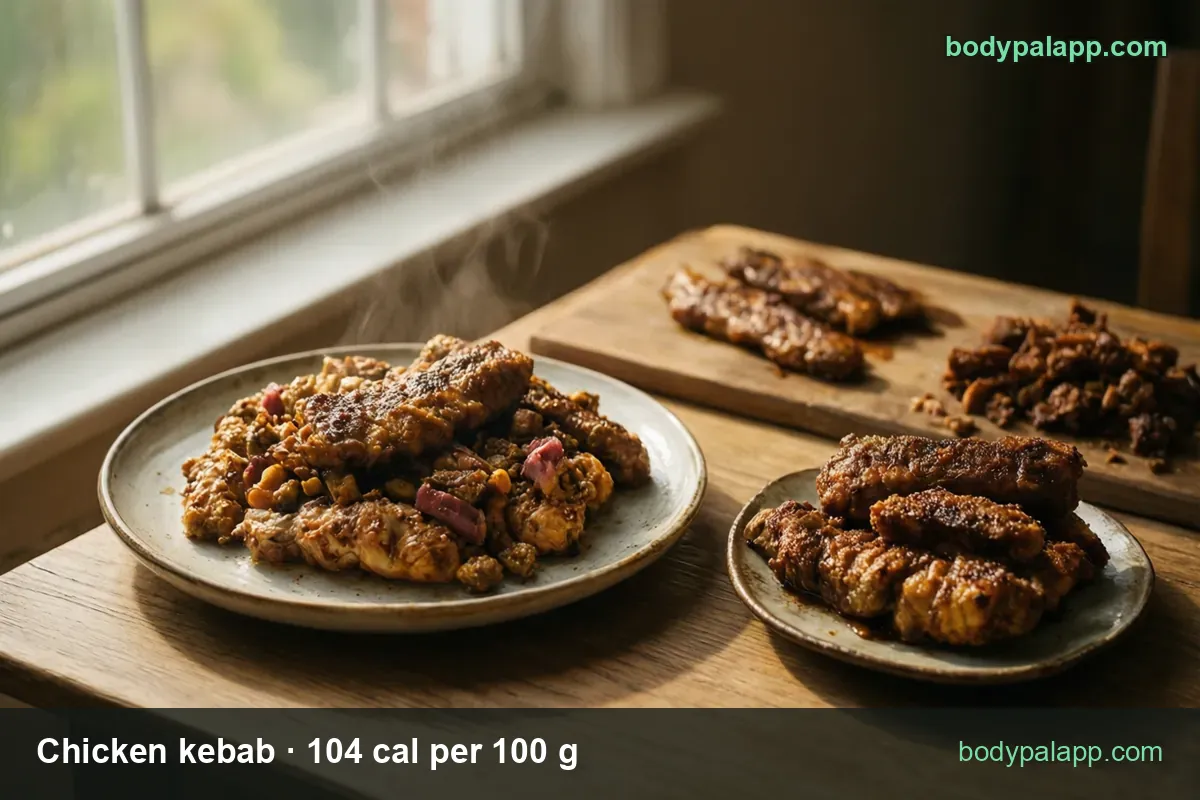
Ground-chicken kofta, the version many US menus simply call chicken kebab, is built from ground meat with onion and spice rather than breast chunks. USDA has no separate record for it, so it is not in the table. If the restaurant lists a weight, the honest move is to log it against the 104 calories per 100 g baseline and accept that a fattier grind will read a little low.
Protein is the win, sodium is the catch
One skewer covers 53% of the Daily Value for protein and only about a tenth of a day's calories in a 2,000-calorie pattern. Very few hot restaurant items do that. MyPlate counts a 1 oz-equivalent of cooked poultry as one serving from the protein group, and a 202 g skewer clears several of them in one go.
Then there is the salt. That same skewer carries 699 mg of sodium, which is 30% of the 2,300 mg FDA Daily Value, roughly a third of a teaspoon of table salt. The chicken is not the source; the marinade is, and restaurant kebabs are usually brined or marinated for hours before they hit the grill. Add a sauce and a side of rice pilaf and a single plate can cross half a day's sodium without ever looking like salty food. If you are watching sodium, the half skewer at about 350 mg by our own arithmetic is the version that fits.
The saturated fat row is the quiet good news: 1.7 g per skewer, 8% of the Daily Value. Compare that with almost any grilled item that arrives with cheese or a cream sauce and the kebab wins the fat column outright.
How does a chicken kebab compare?
| Chicken dish | Per 100 g | US serving | Calories |
|---|---|---|---|
| Chicken kebab, skewered with vegetables | 104 kcal | 1 shish kabob, 202 g | 210 kcal |
| Chili with chicken | 100 kcal | 4 oz, 113 g | 113 kcal |
| Chicken curry | 107 kcal | 4 oz, 113 g | 121 kcal |
| Chicken or turkey hash | 110 kcal | 4 oz, 113 g | 124 kcal |
Our take: on a per-gram basis these four are nearly identical, and only chili with chicken is lighter than the kebab. What separates them is what you get for those calories. The kebab gives 13.04 g of protein per 100 g, second only to the chili's 14.11 g, and it does it on 3.69 g of fat, the lowest of the four. Chicken curry delivers half the protein of the kebab for more fat, because the sauce is doing the work. For a lunch built around fullness rather than volume, order the skewer and keep the rice on the side.
Most popular chicken kebab brands in the United States
Ranked by how widely each product appears among foods sold in the United States, from the BodyPal food database of over 3.3 million products. Calories are the figures printed on each Nutrition Facts label, checked against USDA FoodData Central.
| Product | Calories (per 100 g) |
|---|---|
| Johnsonville Chicken Kabobs | 128 cal |
| Foster Farms Flame Cooked Stickless Chicken Kabobs | 131 cal |
| Foster Farms Take Out Chicken Kabobs | 131 cal |
| Festival Foods Chicken Kabobs with Chicken Breast & Vegetables | 116 cal |
| Archer Farms Chicken Kabobs with Bell Peppers & Onions | 79 cal |
Brand popularity: BodyPal food database. Nutrition: manufacturer labels / USDA FoodData Central.
Chicken kebab FAQs
How many calories are in a chicken kebab?
A standard USDA chicken shish kabob with vegetables weighs 202 g and comes to 210 calories, or 104 calories per 100 g. That figure is for the cooked skewer with onion and peppers on it, no rice and no bread. Half a skewer, by our own arithmetic, is about 105 calories.
How much protein is in a chicken kebab?
One 202 g skewer delivers 26.3 g of protein, which is 53% of the FDA Daily Value from a single item. Per 100 g the kebab holds 13.04 g. That puts it near the top of the grill menu for protein per calorie, since the whole skewer is only 210 calories.
How many calories in a cup of chopped chicken kebab?
A USDA cup of chopped chicken kebab weighs 154 g and comes to 160 calories, 50 fewer than the whole 202 g skewer. The cup is a real USDA household measure rather than our scaling, so it is the safer entry when you pull the meat and vegetables off the stick before logging.
Is chicken kebab good for weight loss?
At 104 calories per 100 g it is one of the leanest hot mains on a grill menu, and 26.3 g of protein per skewer helps a meal stay filling. The catch is what travels with it. Rice, flatbread and garlic sauce are counted separately and routinely outweigh the kebab itself.
Is chicken kebab high in sodium?
One skewer carries 699 mg of sodium, 30% of the FDA Daily Value of 2,300 mg, and that is before any sauce. It is roughly a third of a teaspoon of table salt. The marinade is the source, not the meat, and half a skewer keeps it near 350 mg by our own arithmetic.
How many calories in a store-bought chicken kabob?
Store kabobs run from 100 to 130 calories a piece, but the pieces differ. Johnsonville's raw kabob is 78 g and 100 calories, the Foster Farms fully cooked stickless kabob is 84 g and 110, and Festival Foods lists 130 calories for a 4 oz portion. Check the gram weight first.
Chicken kebab vs chicken curry calories?
Per 100 g they are almost even: chicken kebab is 104 calories, chicken curry 107. Matched at 4 oz, that is 118 calories against 121. The gap opens at the plate, because curry arrives with sauce and rice while the kebab arrives with onion and peppers on the stick.
Does grilling add calories to chicken kebab?
Grilling adds nothing by itself, and the USDA figure of 104 calories per 100 g is already a cooked number. The fire drives off water and dripping fat, which is why cooked weight comes in under raw weight. The calories that do get added come from oil in the marinade and from basting.
Similar foods
- Chicken Kabob — 210 cal per shish kabob
- Chicken Satay — 210 cal per skewer
- Chicken Skewer — 210 cal per skewer
- Salmon Maki Roll — 185 cal per roll
- Salmon Sushi Roll — 185 cal per roll
- Sushi Sashimi — 150 cal per serving
Count it without the math
Point the camera at the plate and BodyPal counts the skewer for you, onions and all.


How long does it take to burn off chicken kebab?
One shish kabob (202 g) is 210 kcal. Enter your weight and the amount you ate to see how long it takes you to burn that off:
lb
| Activity | Time to burn 210 kcal |
|---|---|
| Walking, brisk | 42 min |
| Cycling, moderate | 26 min |
| Swimming, moderate | 30 min |
| Jogging | 25 min |
| Weight training, moderate | 47 min |
Times are for a 155 lb adult at a steady pace; change the weight to see yours. The amount is set to the portion in the text (202 g); change it to what you actually ate. BodyPal works this out from your steps automatically.
Want the bigger picture? Calculate your daily calorie needs — your maintenance figure, a target for losing or gaining, and the date you get there.