
How many calories are in chicken pesto pasta?
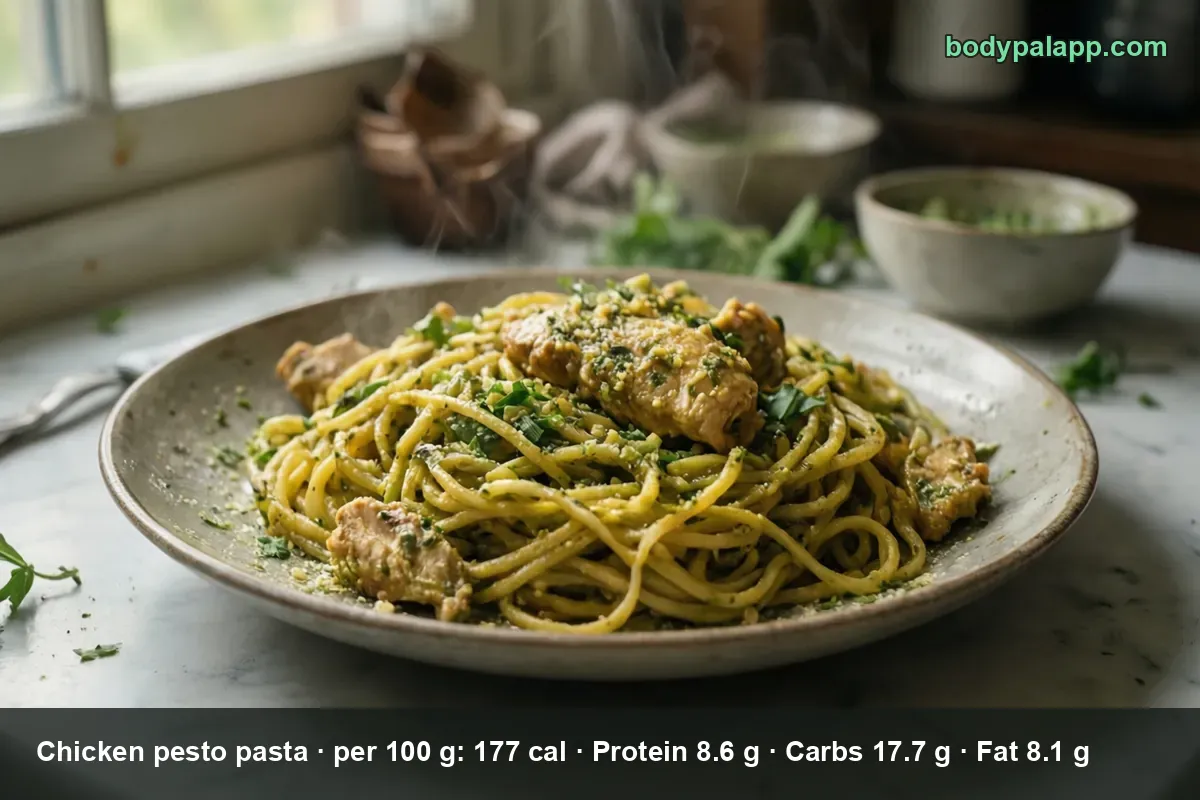
A 1-cup serving of chicken pesto pasta weighs 198 g and carries 350 calories. Per 100 g the dish runs 177 calories, which puts it in the middle of the pasta shelf: lighter than a creamy pesto penne, heavier than a frozen bowl. The pesto, not the chicken, sets that number.
On this page
- Chicken pesto pasta quick facts
- US servings, from one ounce to a two-cup plate
- Deli, frozen and creamy versions
- The pesto is where the calories live
- How one cup lands against the Daily Values
- How does chicken pesto pasta compare?
- Most popular chicken pesto pasta brands
- FAQ
Chicken pesto pasta quick facts
There is no Foundation or FNDDS entry for this exact dish, so the number here comes from the closest real product: FDC 1153878, "Pesto pasta with grilled chicken, penne pasta tossed in basil pesto with white chicken meat, grape tomatoes", a refrigerated deli item sold by the cup. It is the USDA record that best matches what people actually picture, penne coated in basil pesto with cubed white meat, and it carries a label serving of exactly 1 cup.
Frozen boxed meals sit lower per gram because they are padded out with sauce and vegetables. Those get their own section below rather than being blended into the headline figure.
| Nutrient | Per 100 g | Per 1 cup (198 g) | % Daily Value |
|---|---|---|---|
| Calories | 177 | 350 | — |
| Total fat | 8.08 g | 16.0 g | 21% |
| Saturated fat | 1.77 g | 3.5 g | 18% |
| Carbohydrate | 17.68 g | 35.0 g | 13% |
| Dietary fiber | 1.0 g | 2.0 g | 7% |
| Total sugars | 1.01 g | 2.0 g | — |
| Protein | 8.59 g | 17.0 g | 34% |
| Sodium | 182 mg | 360 mg | 16% |
| Cholesterol | 15 mg | 30 mg | 10% |
% Daily Value is based on a 2,000-calorie diet.
Verified nutrition data
Numbers on this page come from USDA FoodData Central, the U.S. Department of Agriculture’s food composition database, and from manufacturer labels where a branded product is named. Last verified September 2026. How we verify our data →
Two rows you will not find above: added sugars and potassium. The deli label behind this record does not declare either one, so there is nothing to report rather than a guess. Total sugars are genuinely tiny at 2.0 g a cup, which is what you would expect from a savory dish whose only sweetness comes from the grape tomatoes.
US servings, from one ounce to a two-cup plate
| Serving | Weight | Calories |
|---|---|---|
| 1 oz | 28 g | 50 kcal |
| 1/2 cup | 99 g | 175 kcal |
| 1 cup, label serving | 198 g | 350 kcal |
| 1 1/2 cups | 297 g | 526 kcal |
| 2 cups, restaurant plate | 396 g | 701 kcal |
| Per 100 g | 100 g | 177 kcal |
Only one line in that table is a USDA household measure: the 1 cup at 198 g, which is the serving printed on the label. Everything else is our own arithmetic from the USDA 100 g figure, not a USDA serving, so the half cup, the ounce and the two-cup plate are simple scalings of 177 calories per 100 g.
The two-cup line is the one worth staring at. A generous home plate or a deli container filled to the rim is 396 g of food and 701 calories, twice what the label implies, and nothing about the dish looks different. If you serve yourself with a pasta spoon rather than a measuring cup, assume you are somewhere between 1 1/2 and 2 cups.
Deli, frozen and creamy versions
| Version | Per 100 g | Typical portion | Calories |
|---|---|---|---|
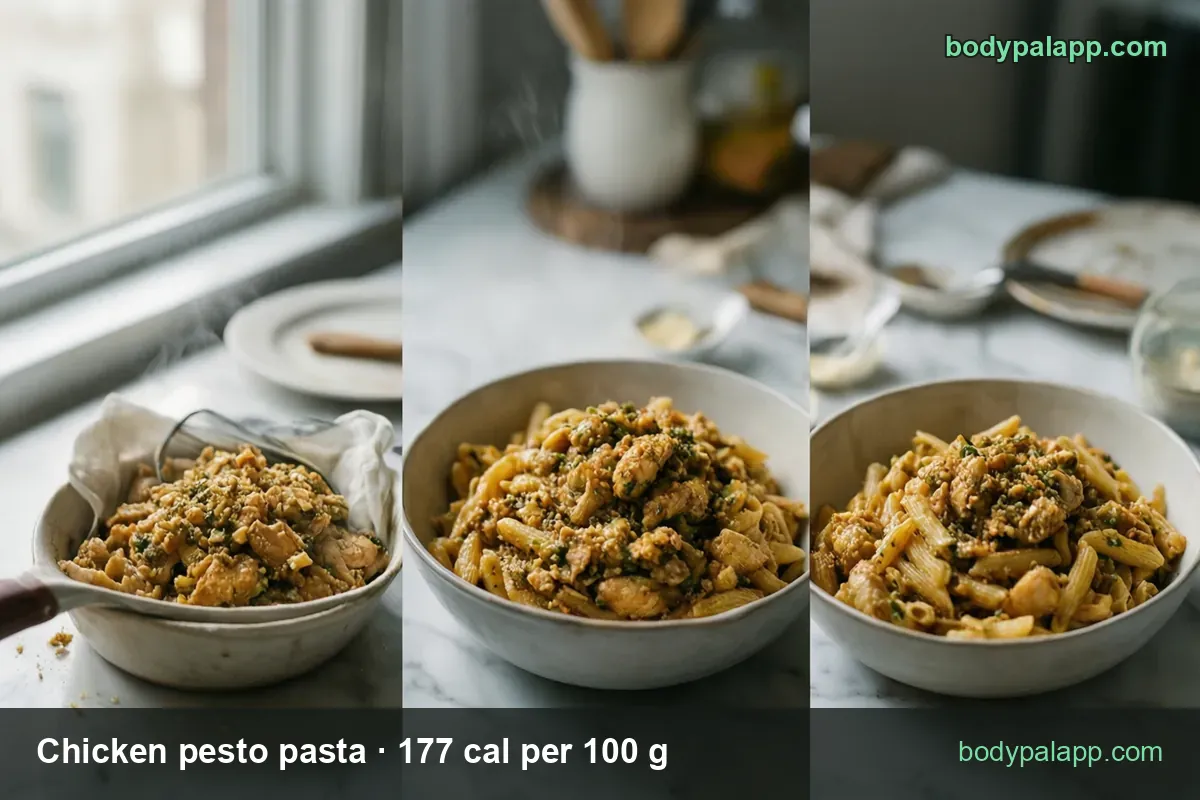
| Deli chicken pesto pasta, penne | 177 kcal | 1 cup, 198 g | 350 kcal |
| Frozen chicken pesto pasta bowl | 119 kcal | 1 meal, 312 g | 371 kcal |
| Rigatoni with chicken and pesto, frozen | 173 kcal | 1 package, 237 g | 410 kcal |
| Creamy pesto penne with chicken | 221 kcal | 1 pack, 140 g | 309 kcal |
| Pesto chicken with cavatappi | 149 kcal | 9 oz, 255 g | 380 kcal |
| Chicken pasta with tomato sauce instead of pesto | 118 kcal | 1 cup, 250 g | 295 kcal |
Read that table by column and it tells two different stories. Per gram, the creamy version is the heaviest at 221 calories per 100 g and the frozen bowl the lightest pesto version at 119, with only the tomato-sauce swap lower at 118. Per portion the order flips almost completely: the creamy pack is the smallest pesto number on the list at 309, because it only weighs 140 g, while the frozen rigatoni package tops it at 410.
Brand labels line up the same way. A Marie Callender's grilled chicken pesto pasta bowl is 371 calories for its 312 g tray, Michael Angelo's cavatappi version 380 for 9 oz, and a LYFE Kitchen creamy pesto pasta with chicken meatballs 300 for a 234 g bowl. Frozen dinners in this category cluster tightly between 300 and 410, which is a narrower band than the per-gram figures suggest.
Swapping pesto for a tomato-based sauce is the single largest change you can make. The same chicken and pasta in tomato sauce (FDC 2708844) is 118 calories per 100 g and 295 a cup, roughly a third less energy per gram than the pesto version.
The pesto is where the calories live
Basil pesto on its own is 580 calories per 100 g, with 59.17 g of fat, because it is essentially oil, cheese and nuts held together by herbs. Two tablespoons, about 32 g, add 186 calories to a bowl of plain pasta. That is more than a half-cup serving of the finished dish, from a quantity of sauce you would spoon on without thinking.
It also explains the cup trap. A cup of chicken pesto pasta weighs 198 g and delivers 350 calories. A cup of chicken pasta in tomato sauce weighs more, 250 g, and delivers fewer, 295. The heavier cup is the lighter meal, because water-based tomato sauce fills volume that oil-based pesto fills with calories. Anyone counting by cup rather than by gram gets this backwards.
The chicken, meanwhile, is doing the opposite job. It is the reason the dish carries 8.59 g of protein per 100 g while a plain pasta with sauce sits closer to 6, and protein is the part of this plate worth keeping.
How one cup lands against the Daily Values
One cup covers 34% of the Daily Value for protein and only 7% for fiber. That gap is the honest summary of the dish: it eats like a protein food and a refined-carbohydrate food at the same time. MyPlate counts the chicken toward the protein group, but the 2.0 g of fiber in a cup does very little for the day.
Sodium is the row that separates fresh from frozen. The deli cup holds 360 mg, 16% of the 2,300 mg Daily Value, or roughly a sixth of a teaspoon of table salt. The frozen rigatoni package is a different animal: at 329 mg per 100 g across a 237 g pack, it works out to about 780 mg, or 34% of a day's sodium from one tray before anything else you eat.
Saturated fat is milder than the pesto reputation suggests. A cup carries 3.5 g, 18% of the Daily Value, because the pesto is mostly olive oil rather than dairy or animal fat. If you are watching saturated fat specifically, the creamy version is the one to skip, not the classic basil one.
How does chicken pesto pasta compare?
| Dish | Per 100 g | US serving | Calories |
|---|---|---|---|
| Chicken pesto pasta, deli | 177 kcal | 1 cup, 198 g | 350 kcal |
| Pasta with tomato sauce and poultry, home recipe | 118 kcal | 1 cup, 250 g | 295 kcal |
| Pasta with tomato sauce and poultry, restaurant | 171 kcal | 1 cup, 250 g | 428 kcal |
| Macaroni or pasta salad with chicken | 213 kcal | 1 cup, 204 g | 435 kcal |
Our take: chicken pesto pasta is not the heavy option people assume. Of these four cups, only the home-cooked tomato version is lighter, and both the restaurant tomato plate and the mayonnaise-based chicken pasta salad beat it by more than 75 calories a cup. Per gram it ranks second of the four, behind the pasta salad at 213. For weight loss, the half-cup portion alongside a salad is the move at 175 calories; for a filling lunch, the full cup at 350 with 17 g of protein is a better trade than most sandwich options. What ruins it is not the pesto, it is the second scoop.
Most popular chicken pesto pasta brands in the United States
Ranked by how widely each product appears among foods sold in the United States, from the BodyPal food database of over 3.3 million products. Calories are the figures printed on each Nutrition Facts label, checked against USDA FoodData Central.
| Product | Calories (per 100 g) |
|---|---|
| Marie Callender's Grilled Chicken Pesto Pasta Bowl | 119 cal |
| Nestle Rigatoni with Chicken & Pesto | 173 cal |
| Michael Angelo's Pesto Chicken with Romano Cheese Cavatappi | 149 cal |
| LYFE Kitchen Creamy Pesto Pasta with Chicken Meatballs | 128 cal |
| Taylor Fresh Foods Pesto Pasta with Grilled Chicken | 177 cal |
Brand popularity: BodyPal food database. Nutrition: manufacturer labels / USDA FoodData Central.
Chicken pesto pasta FAQs
How many calories are in a cup of chicken pesto pasta?
A 1-cup serving weighs 198 g and carries 350 calories, or 177 per 100 g. That cup also brings 17 g of protein, 35 g of carbohydrate and 16 g of fat. Half a cup, 99 g, is 175 calories by our own arithmetic from the USDA 100 g figure.
How much protein is in chicken pesto pasta?
One cup gives 17 g of protein, 34% of the Daily Value, which is high for a pasta dish. Per 100 g it is 8.59 g. The frozen rigatoni with chicken and pesto is denser still at 10.55 g per 100 g, so its 237 g package delivers about 25 g.
How many calories in a plate of chicken pesto pasta?
Two cups, a restaurant-sized plate, is 396 g and 701 calories by our own scaling of the USDA 100 g figure. A more modest 1 1/2 cups, 297 g, comes to 526. Restaurant and deli portions are where this dish stops being a 350-calorie lunch.
How many calories does pesto sauce add to pasta?
Pesto sauce is 580 calories per 100 g, so 2 tablespoons, about 32 g, add 186 calories to a bowl of plain pasta. That is more than a half-cup serving of the finished deli dish, which is 175. The sauce carries 59.17 g of fat per 100 g, mostly oil and nuts.
Is creamy pesto chicken pasta higher in calories?
Per gram, yes: creamy pesto penne with chicken is 221 calories per 100 g against 177 for the deli version, about 25% more. The pack is small though, 140 g, so it lands at 309 calories, below the 350 in a full cup of the classic basil pesto mix.
How many calories in frozen chicken pesto pasta?
A grilled chicken pesto pasta bowl is 119 calories per 100 g and 371 for the whole 312 g meal. The frozen rigatoni with chicken and pesto is denser at 173 per 100 g, giving 410 calories for its 237 g package. Frozen is lighter per gram, not per box.
How much sodium is in chicken pesto pasta?
One cup carries 360 mg of sodium, 16% of the 2,300 mg Daily Value, or roughly a sixth of a teaspoon of table salt. Frozen is the harder hit: the 237 g rigatoni package holds about 780 mg, 34% of a day, before anything else on the tray.
Is chicken pesto pasta good for weight loss?
At 177 calories per 100 g it can work: a 1-cup serving is 350 calories with 17 g of protein, which fits a typical 350 to 450-calorie lunch. Fiber is the weak row at 2.0 g, 7% of the Daily Value, so pairing it with a salad or vegetables helps.
Similar foods
- Baba ganoush — 110 cal for 1/4 cup
- Prosciutto — 55 cal for 3 thin slices
- Penne pasta — 169 cal per cup
- Pasta — 168 cal per cup penne
- Mac And Cheese — 513 cal per cup
- Rice — 205 cal per cup, cooked
Count it without the math
Point the camera at the plate and BodyPal counts the pesto, the penne and the chicken for you.


How long does it take to burn off 350 kcal of chicken pesto pasta?
A 1-cup (198 g) serving is 350 kcal. Enter your weight and the amount you ate to see how long it takes you to burn that off:
lb
| Activity | Time to burn 350 kcal |
|---|---|
| Walking, brisk | 1 hr 10 min |
| Cycling, moderate | 44 min |
| Swimming, moderate | 50 min |
| Jogging | 41 min |
| Weight training, moderate | 1 hr 18 min |
Times are for a 155 lb adult at a steady pace; change the weight to see yours. The amount is set to the portion in the text (198 g); change it to what you actually ate. BodyPal works this out from your steps automatically.
This table assumes you know your daily total. If you do not, the daily calorie calculator works it out from five numbers.