
How many calories are in a chicken salad sandwich?
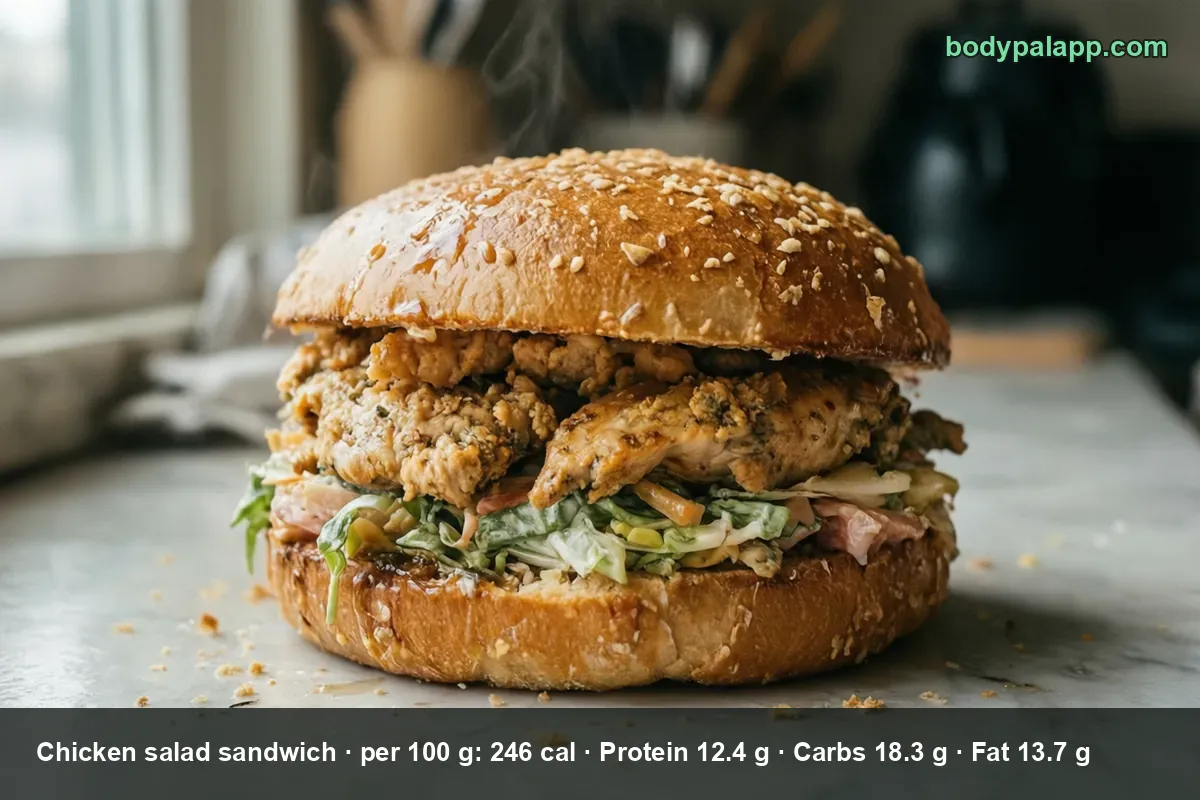
A regular deli chicken salad sandwich weighs 180 g and carries 443 calories. Per 100 g it runs 246 calories. Half of that total is fat — 24.7 g in one sandwich — and in chicken salad the fat is dressing, not meat, which is why it outranks a grilled chicken sandwich built on the same bread.
On this page
- Chicken salad sandwich quick facts
- US servings from a slider to a 6-inch sub
- Every version of the chicken salad sandwich
- Sodium is the row that costs you
- How does a chicken salad sandwich compare?
- Most popular chicken salad sandwich brands
- FAQ
Chicken salad sandwich quick facts
The row behind every number here is FNDDS 2706990, "Chicken salad sandwich on white", from the 2021–2023 survey release. That is the sandwich people actually pick up: chopped chicken bound with mayonnaise, celery and seasoning, between two slices of white bread. Wheat bread and the tortilla wrap are the same filling in a different jacket, so they live further down the page as variants rather than as competing headline numbers.
USDA sets the regular sandwich at 180 g. That is the portion in the middle column below, and it is the one to use unless your deli hands you something visibly bigger.
| Nutrient | Per 100 g | Per 1 regular sandwich (180 g) | % Daily Value |
|---|---|---|---|
| Calories | 246 | 443 | — |
| Total fat | 13.7 g | 24.7 g | 32% |
| Saturated fat | 2.43 g | 4.4 g | 22% |
| Carbohydrate | 18.32 g | 33.0 g | 12% |
| Dietary fiber | 1 g | 1.8 g | 6% |
| Total sugars | 3.18 g | 5.7 g | — |
| Protein | 12.42 g | 22.4 g | 45% |
| Sodium | 473 mg | 851 mg | 37% |
| Cholesterol | 44 mg | 79 mg | 26% |
| Potassium | 177 mg | 319 mg | 7% |
% Daily Value is based on a 2,000-calorie diet.
Verified nutrition data
Numbers on this page come from USDA FoodData Central, the U.S. Department of Agriculture’s food composition database, and from manufacturer labels where a branded product is named. Last verified September 2026. How we verify our data →
Two rows you would see on a store label are missing: added sugars and trans fat. This FNDDS release does not publish either one for any of the three chicken salad sandwich records, so listing them would mean inventing numbers. The 5.7 g of total sugars in one sandwich comes mostly from the bread and the dressing, and total sugars carry no Daily Value of their own.
Store-made sandwiches spread wider than the survey average. Across six US refrigerated deli products in the USDA Branded database the density runs from 196 to 286 calories per 100 g, so a packaged sandwich sold as a single portion can land anywhere between about 350 and 580 calories depending on how much bread and dressing the maker uses. The 180 g survey sandwich sits comfortably in the middle of that spread.
US servings from a slider to a 6-inch sub
| Serving | Weight | Calories |
|---|---|---|
| 1 oz | 28.4 g | 70 kcal |
| One miniature sandwich or slider | 90 g | 221 kcal |
| One regular sandwich | 180 g | 443 kcal |
| One large or 6-inch submarine | 270 g | 664 kcal |
| Per 100 g | 100 g | 246 kcal |
The slider, the regular sandwich and the 6-inch sub are all USDA household portions for this record, which is unusual and useful: you can log a party tray or a deli sub without guessing. The 1 oz line is our own arithmetic from the USDA 100 g figure, not a USDA serving, and it mostly matters when you are eating half of somebody else's plate.
Notice what the portion ladder does. The filling never changes and the density stays at 246 calories per 100 g, but the sub is three times the slider. That 6-inch version is the single biggest trap on this page: it looks like a sandwich, it logs like a meal and a half. If your lunch target sits around 500 calories, the regular 180 g sandwich fits and the sub does not.
Every version of the chicken salad sandwich
| Version | Per 100 g | Typical serving | Calories |
|---|---|---|---|
| On white bread | 246 kcal | 1 regular sandwich (180 g) | 443 kcal |
| On wheat bread | 245 kcal | 1 regular sandwich (180 g) | 441 kcal |
| Chicken salad wrap | 269 kcal | 1 sandwich, any size (200 g) | 538 kcal |
| Slider or mini sandwich | 246 kcal | 1 miniature (90 g) | 221 kcal |
| Large or 6-inch submarine | 246 kcal | 1 large (270 g) | 664 kcal |
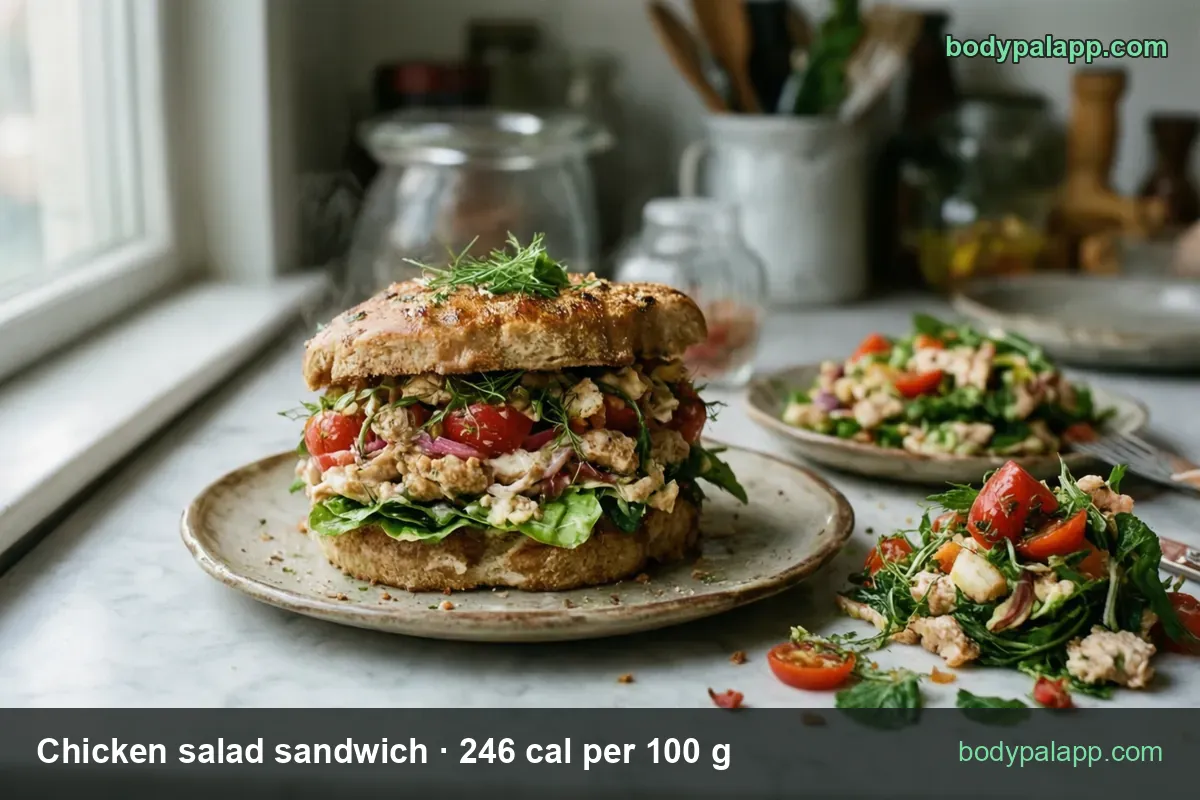
Wheat bread is not a calorie decision. FNDDS 2706991 puts the wheat version at 245 calories per 100 g against 246 for white — a two-calorie gap across a whole sandwich. What wheat actually buys you is fiber: 2.1 g per 100 g instead of 1 g, which works out to 3.8 g in a 180 g sandwich versus 1.8 g. That is 13% of the Daily Value instead of 6%. Order wheat for the fiber and the fullness, not because you think it saves calories, because it does not.
The wrap is the heaviest thing on this list, per gram. FNDDS 2706992 sits at 269 calories per 100 g, and USDA's portion for it is 200 g, so a chicken salad wrap comes to 538 calories — about 95 more than the sandwich. The saturated fat gap is sharper than the calorie gap: 9 g in the wrap, 45% of the Daily Value, against 4.4 g and 22% in the regular sandwich. A flour tortilla is a denser, fattier wrapper than two slices of bread, and the sodium follows it up to 603 mg per 100 g.
The slider is the honest half portion. At 90 g and 221 calories it is exactly half a regular sandwich, and it still delivers 11.2 g of protein. Two of them on a party tray equal one lunch.
Sodium is the row that costs you
One regular sandwich carries 851 mg of sodium — 37% of the FDA Daily Value of 2,300 mg. That is roughly a third of a teaspoon of table salt sitting inside a lunch that most people would not call salty. Scale it to the 6-inch sub and you get 1,277 mg, 56% of the day, from one item. The Dietary Guidelines for Americans put the same 2,300 mg figure as the ceiling for adults, and deli meat and dressing are two of the main reasons sandwiches run high.
The protein side is genuinely good news. A 180 g sandwich gives 22.4 g of protein, 45% of the 50 g Daily Value, which is more than most sandwich fillings manage and enough to keep a lunch from turning into a 3 p.m. snack. MyPlate counts chicken among the leanest of the protein foods, and the chicken here is doing the work — the dressing is what adds the 24.7 g of fat.
So the trade is clear. If you want the protein and you are watching sodium, take the regular sandwich on wheat and skip the salty sides. If you are watching saturated fat, the sandwich beats the wrap by half. What does not help is switching bread and expecting the calorie count to move.
How does a chicken salad sandwich compare?
All four rows are scaled to the same 180 g so the comparison is fair; 180 g is a USDA portion only for the chicken salad sandwich itself, and the other three weights are our own arithmetic from their USDA 100 g figures.
| Sandwich | Per 100 g | Protein per 100 g | US serving | Calories |
|---|---|---|---|---|
| Chicken salad on white | 246 kcal | 12.42 g | one sandwich, 180 g | 443 kcal |
| Grilled chicken fillet sandwich | 226 kcal | 21.5 g | 180 g | 407 kcal |
| Grilled chicken fillet wrap | 252 kcal | 20.83 g | 180 g | 454 kcal |
| Fried chicken fillet sandwich on a white bun | 269 kcal | 12.45 g | 180 g | 484 kcal |
Our take: on calories alone the chicken salad sandwich looks fine — only the grilled fillet sandwich is lighter of the four, and the fried one is 41 calories heavier. On protein it comes last. The grilled fillet sandwich packs 21.5 g per 100 g against 12.42 g here, so the same 180 g gives you about 38.7 g of protein instead of 22.4 g, for fewer calories. Chopping chicken and folding it into mayonnaise roughly halves the protein density and pushes the fat to 13.7 g per 100 g, the highest of the four. Pick chicken salad because you like it, and pick the grilled fillet when the goal is protein per calorie.
Most popular chicken salad sandwich brands in the United States
Ranked by how widely each product appears among foods sold in the United States, from the BodyPal food database of over 3.3 million products. Calories are the figures printed on each Nutrition Facts label, checked against USDA FoodData Central.
| Product | Calories (per 100 g) |
|---|---|
| King Soopers BBQ Chicken Salad Sandwich | 248 cal |
| Sunnyside Farms Chicken Salad Sandwich | 246 cal |
| Walmart Chicken Salad Sandwich | 263 cal |
| Archer Farms Cranberry Almond Chicken Salad Sandwich | 263 cal |
| Hannaford Signature Rolls Chicken Salad Sandwich | 196 cal |
| Raley's Chicken Salad Sandwich | 286 cal |
Brand popularity: BodyPal food database. Nutrition: manufacturer labels / USDA FoodData Central.
Chicken salad sandwich FAQs
How many calories are in a chicken salad sandwich?
443 calories for a regular deli sandwich of 180 g on white bread, or 246 calories per 100 g. That single sandwich also brings 24.7 g of fat, 22.4 g of protein and 851 mg of sodium, which is 37% of the FDA Daily Value for a 2,000-calorie day.
How many calories in a chicken salad sandwich on wheat bread?
441 calories in a 180 g sandwich, two fewer than the same filling on white. Wheat barely moves the calorie count, 245 versus 246 per 100 g, but it doubles the fiber, from 1.8 g to 3.8 g per sandwich, or 13% of the Daily Value instead of 6%.
How much protein is in a chicken salad sandwich?
22.4 g of protein in a 180 g sandwich, 45% of the 50 g Daily Value. Per 100 g that is 12.42 g. It is a solid lunch number, though a grilled chicken fillet sandwich of the same weight carries about 38.7 g because the meat is whole rather than dressed.
Is a chicken salad sandwich healthy?
One sandwich delivers 22.4 g of protein for 443 calories, which is a fair trade at lunch. The catch is 851 mg of sodium at 37% of the Daily Value and 24.7 g of fat. If you are watching sodium, wheat bread with the same filling and a smaller portion is the better pick.
How many calories in a chicken salad wrap?
538 calories for a 200 g wrap, roughly 95 more than the same filling between two slices of white bread. The tortilla pushes the density to 269 calories per 100 g and the saturated fat to 9 g, 45% of the Daily Value against 22% for the sandwich.
How much sodium is in a deli chicken salad sandwich?
851 mg in a regular 180 g sandwich, 37% of the 2,300 mg Daily Value, about a third of a teaspoon of table salt. A 6-inch sub of 270 g takes it to 1,277 mg, or 56% of the day, before anything else lands on the tray.
How many calories in half a chicken salad sandwich?
221 calories for half of a regular sandwich, 90 g of it, and that happens to be the same weight USDA lists for a miniature sandwich or slider, at 221 calories. Half the sandwich also means 11.2 g of protein and 426 mg of sodium, still 19% of the Daily Value.
How many calories in a 6-inch chicken salad sub?
664 calories for a large or 6-inch submarine sandwich of 270 g. It is the same filling and the same 246 calories per 100 g, only the portion changed. It brings 33.5 g of protein, 37 g of fat and 1,277 mg of sodium, 56% of the Daily Value.
Similar foods
- Potato wedges — 138 cal for 3 oz
- Cornmeal — 581 cal per cup
- Ear of Corn — 99 cal per medium ear
- Sweet Potato — 103 cal per medium, baked
- Papaya salad — 190 cal per plate
- Carrot — 53 cal per cup chopped
Count it without the math
Point the camera at the plate and BodyPal counts the sandwich for you, dressing and all.


How long does it take to burn off 443 kcal of chicken salad sandwich?
One regular sandwich (180 g) is 443 kcal. Enter your weight and the amount you ate to see how long it takes you to burn that off:
lb
| Activity | Time to burn 443 kcal |
|---|---|
| Walking, brisk | 1 hr 29 min |
| Cycling, moderate | 55 min |
| Swimming, moderate | 1 hr 3 min |
| Jogging | 52 min |
| Weight training, moderate | 1 hr 38 min |
Times are for a 155 lb adult at a steady pace; change the weight to see yours. The amount is set to the portion in the text (180 g); change it to what you actually ate. BodyPal works this out from your steps automatically.
Burning it off is one side of it. The other is knowing your number: work out how many calories you need a day, with macros and a goal date.