
How many calories are in chicken soup?
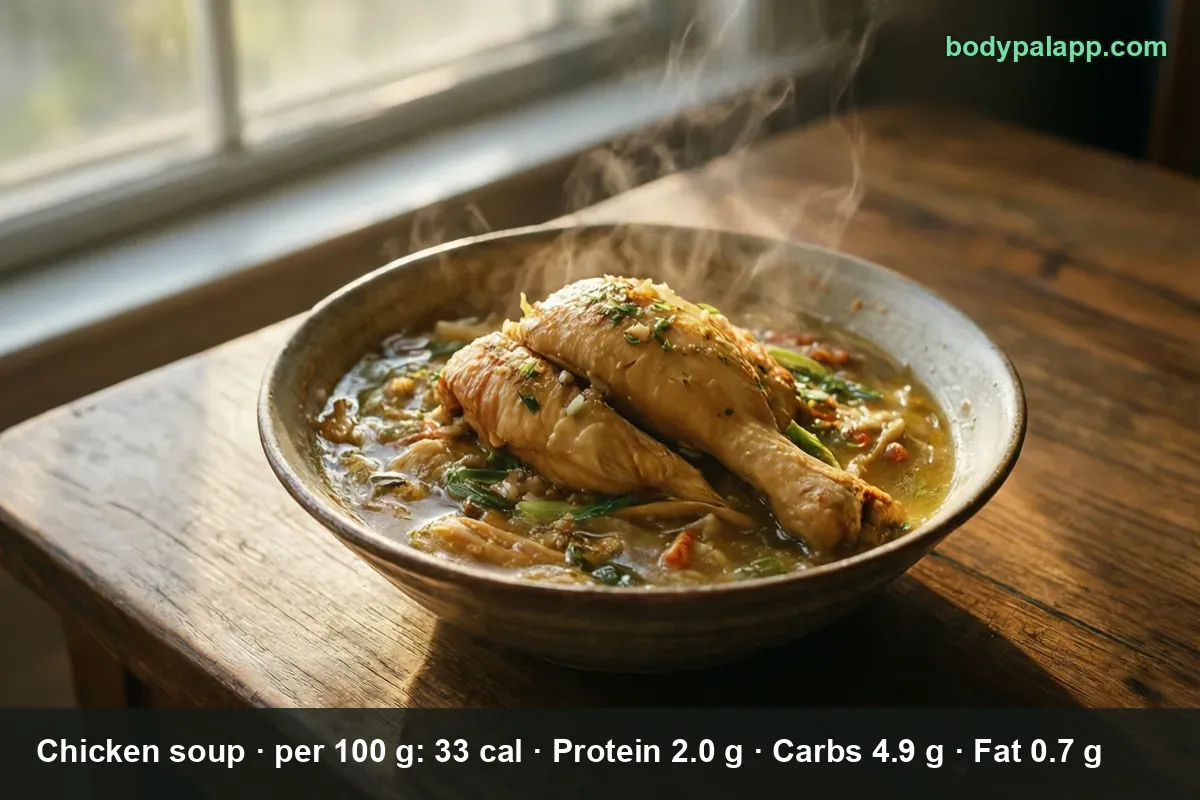
A 1-cup (245 g) serving of canned chicken soup carries 81 calories, and the soup itself runs 33 calories per 100 g — lighter per gram than almost anything else you would call a meal. The calorie line is not the interesting part. The 652 mg of sodium sitting beside it is.
On this page
- Chicken soup quick facts
- US servings, from one cup to the whole can
- Homemade, noodle, chunky and cream of chicken
- Sodium is the row to watch
- How does chicken soup compare?
- Most popular chicken soup brands
- Chicken soup FAQs
Chicken soup quick facts
The row on this page is FNDDS 2707133, "Soup, chicken, canned" — the broth-style chicken soup that comes out of a can or a carton and gets heated on the stove. That is the bowl most people are holding when they look this up, and it is the one USDA gives a full set of household servings for: a cup, an individual container, a whole can.
Homemade chicken soup and the noodle versions are separate USDA records, and they sit in the variants table further down. They differ because of how the pot was built — more meat, less water, noodles added — not because the data came from somewhere else.
| Nutrient | Per 100 g | Per 1 cup (245 g) | % Daily Value |
|---|---|---|---|
| Calories | 33 | 81 | — |
| Total fat | 0.72 g | 1.8 g | 2% |
| Saturated fat | 0.15 g | 0.4 g | 2% |
| Carbohydrate | 4.86 g | 11.9 g | 4% |
| Dietary fiber | 0.9 g | 2.2 g | 8% |
| Total sugars | 1.23 g | 3.0 g | — |
| Protein | 2.02 g | 4.9 g | 10% |
| Sodium | 266 mg | 652 mg | 28% |
% Daily Value is based on a 2,000-calorie diet.
Verified nutrition data
Numbers on this page come from USDA FoodData Central, the U.S. Department of Agriculture’s food composition database, and from manufacturer labels where a branded product is named. Last verified September 2026. How we verify our data →
Added sugars and trans fat have no rows here because this FNDDS edition does not publish either value for the record. Cholesterol comes to 15 mg per cup (5% of the Daily Value) and potassium to 394 mg (8%), both modest for something that tastes this savory.
US servings, from one cup to the whole can
| Serving | Weight | Calories |
|---|---|---|
| 1 oz | 28 g | 9 kcal |
| 1 cup | 245 g | 81 kcal |
| One individual container | 440 g | 145 kcal |
| One soup bowl, two cups | 490 g | 162 kcal |
| One whole can | 525 g | 173 kcal |
| Per 100 g | 100 g | 33 kcal |
The cup, the individual container and the can are USDA household measures for this record. The two-cup soup bowl and the one-ounce line are our own arithmetic from the USDA 100 g figure, not USDA servings — useful because almost nobody stops at a single measured cup.
That gap is the whole story of this food. A cup is 81 calories; the can it came from is 173, just over twice as much, and a can is a normal single lunch for one adult. Eat the container and you have logged more than two servings without noticing, which is exactly what the label's "about 2 servings" line is telling you in small print.
Homemade, noodle, chunky and cream of chicken
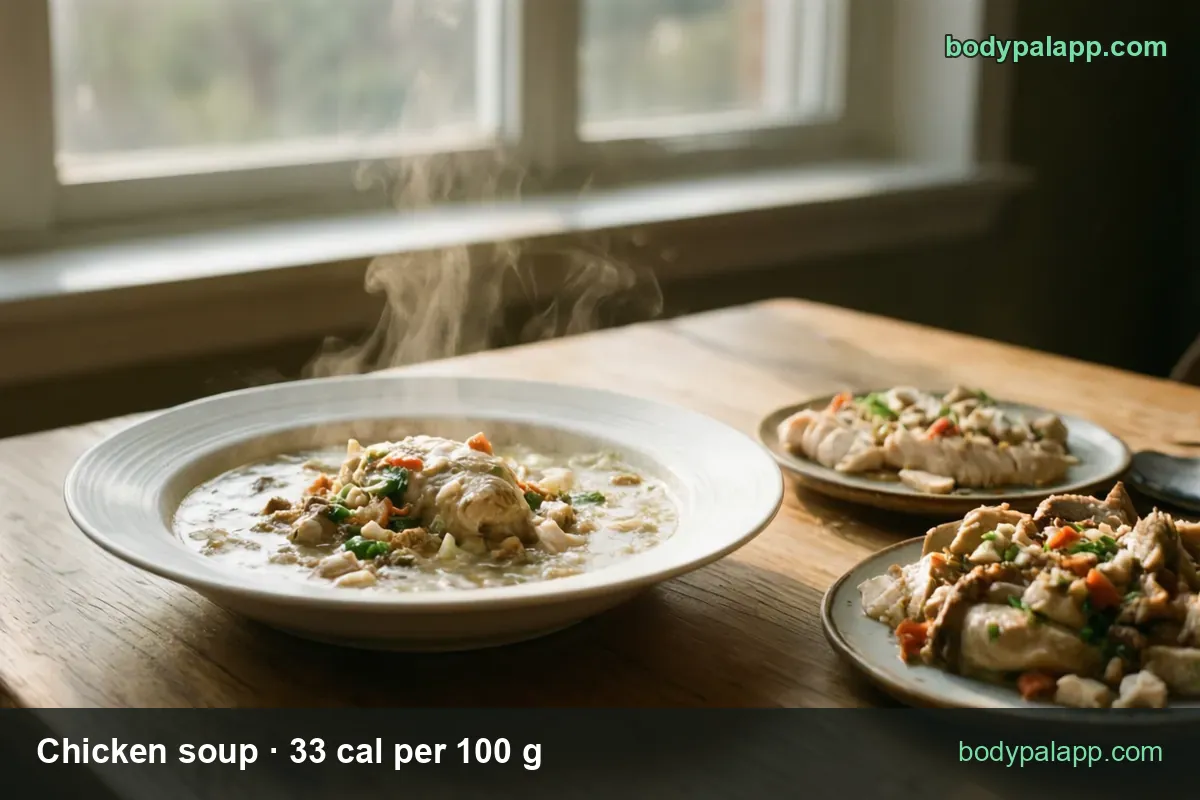
Seven rows, one pot each. The spread from the lightest to the heaviest cup is nearly three times, and most of it comes from what goes in beside the chicken.
| Version | Per 100 g | Typical serving | Calories |
|---|---|---|---|
| Canned chicken soup (the main row) | 33 kcal | 1 cup, 245 g | 81 kcal |
| Reduced-sodium canned | 34 kcal | 1 cup, 245 g | 83 kcal |
| Homemade chicken soup | 40 kcal | 1 cup, 245 g | 98 kcal |
| Chicken noodle, canned | 42 kcal | 1 cup, 245 g | 103 kcal |
| Chicken noodle, homemade | 53 kcal | 1 cup, 245 g | 130 kcal |
| Chunky ready-to-serve | 71 kcal | 1 cup, 245 g | 174 kcal |
| Cream of chicken | 91 kcal | 1 cup, 255 g | 232 kcal |
Homemade lands at 98 calories a cup, higher than the can. Nothing was added — the ratio changed. A home pot carries 3.44 g of protein per 100 g against 2.02 g in the canned version, so the extra calories are mostly extra chicken. The 245 g cup here is our own scaling from the USDA 100 g row.
Chicken noodle adds 22 calories a cup over plain canned soup, and the carbohydrate row explains it: 6.02 g per 100 g against 4.86 g. The homemade noodle pot goes to 130 a cup, which is still a light lunch by any measure.
Chunky ready-to-serve is a different product category. At 71 calories per 100 g it more than doubles the plain canned soup, and it should — 5.06 g of protein per 100 g means about 12.4 g in a cup, scaled from the USDA 100 g figure. This is the can that can stand alone as a meal.
Cream of chicken is where the calorie count stops being small: 232 in a 255 g cup, nearly three times the broth version, because cream and fat replace part of the broth. If the bowl in front of you is opaque and coats the spoon, do not log it as chicken soup.
Brand labels track these bands closely. Campbell's Classic Chicken Noodle with White Meat Chicken lists 120 calories per 1-cup serving, and a can of Progresso Light Zesty Santa Fe Style Chicken Soup is 158 for the whole 524 g can. Dry soup mix is the one number that will fool you: the powder runs 377 calories per 100 g before any water goes in, so weighing the packet tells you nothing about the bowl.
Sodium is the row to watch
One cup of canned chicken soup covers 28% of the 2,300 mg Daily Value for sodium while covering 4% of the carbohydrate value and 2% of the fat value. That imbalance is unusual. Almost every other food in a calorie tracker moves the calorie line faster than the sodium line; canned soup does the opposite, and the FDA's Daily Value reference is what makes the gap visible.
Finish the can and it is 1,396 mg of sodium — 61% of the day's value, our own arithmetic from the USDA 100 g row. For reference, 652 mg is roughly a quarter teaspoon of table salt's worth of sodium, and the Dietary Guidelines for Americans put the adult ceiling at 2,300 mg a day.
If you are watching sodium, the reduced-sodium record is the better pick and costs you nothing: 83 calories a cup instead of 81, with 466 mg of sodium instead of 652 — 20% of the Daily Value against 28%. Same soup, different salt recipe.
The other honest limitation is protein. A cup gives 4.9 g, 10% of the Daily Value, which is not enough to carry a meal on its own. Pairing the bowl with a protein food — a chicken breast, beans, a piece of cheese on the side — is what turns 81 calories of soup into lunch.
How does chicken soup compare?
| Soup | Per 100 g | US serving | Calories |
|---|---|---|---|
| Chicken soup, canned | 33 kcal | 1 cup, 245 g | 81 kcal |
| Reduced-sodium chicken soup | 34 kcal | 1 cup, 245 g | 83 kcal |
| Chicken noodle soup, canned | 42 kcal | 1 cup, 245 g | 103 kcal |
| Cream of chicken soup | 91 kcal | 1 cup, 255 g | 232 kcal |
Our take: plain canned chicken soup is the lightest of these four per gram, and the reduced-sodium version is within two calories of it while cutting the sodium by 186 mg a cup — that is the version to buy if you are choosing on the shelf. Chicken noodle costs 22 calories more per cup and buys you a bit of texture. Cream of chicken belongs in a different conversation: one cup carries 6.9 g of saturated fat, 34% of the Daily Value, more than triple what a whole can of the broth version delivers.
Most popular chicken soup brands in the United States
Ranked by how widely each product appears among foods sold in the United States, from the BodyPal food database of over 3.3 million products. Calories are the figures printed on each Nutrition Facts label, checked against USDA FoodData Central.
| Product | Calories (per 100 g) |
|---|---|
| Campbell's Classic Chicken Noodle with White Meat Chicken | 50 cal |
| Campbell's Condensed Cream of Chicken Soup | 97 cal |
| Chicken Soup for the Soul Chicken Noodle Soup | 41 cal |
| Chix Soup Co Grandma Noodle Chicken Soup | 45 cal |
| Pacific Foods Organic Wild Rice Chicken Soup | 44 cal |
| Progresso Light Zesty Santa Fe Style Chicken Soup | 30 cal |
Brand popularity: BodyPal food database. Nutrition: manufacturer labels / USDA FoodData Central.
Chicken soup FAQs
How many calories are in a cup of chicken soup?
81 calories in a 1-cup (245 g) serving of canned chicken soup, which works out to 33 calories per 100 g. That cup also carries 4.9 g of protein, 11.9 g of carbohydrate and 652 mg of sodium. Ladle two cups into a soup bowl and you are at 162 calories.
How many calories are in a whole can of chicken soup?
173 calories for a full 525 g can, just over twice the 81 in a single cup. Scale the sodium the same way from the USDA 100 g row and the can comes to about 1,396 mg, 61% of the Daily Value. Smaller individual containers of 440 g land at 145 calories.
Is chicken soup good for weight loss?
At 33 calories per 100 g it is one of the lightest hot foods you can log, and a cup costs only 81. The weak spot is protein: 4.9 g a cup, 10% of the Daily Value. Adding chicken, beans or a side of cheese makes the bowl hold better through an afternoon.
How much sodium is in chicken soup?
652 mg in a 1-cup serving, 28% of the 2,300 mg Daily Value, from 266 mg per 100 g. The reduced-sodium USDA record drops that to 466 mg a cup, or 20%, for two extra calories. Finishing a whole can puts you near 1,396 mg in one sitting.
How many calories are in homemade chicken soup?
About 98 calories a cup, from the USDA record for non-canned chicken soup at 40 calories per 100 g, scaled to 245 g by our own arithmetic. It runs higher than the can because a home pot holds more chicken: 3.44 g of protein per 100 g against 2.02 g in the canned version.
Chicken soup vs chicken noodle soup: which has more calories?
Chicken noodle wins by 22 calories a cup: 103 against 81, or 42 calories per 100 g against 33. The noodles show up in the carbohydrate row, 6.02 g per 100 g against 4.86 g. A homemade noodle pot is denser still at 53 per 100 g, or 130 a cup.
How many calories are in cream of chicken soup?
232 calories in a 1-cup (255 g) serving, at 91 calories per 100 g — nearly three times the broth-style canned soup. The saturated fat row is the reason to look twice: 6.9 g in that cup, 34% of the Daily Value, against 0.4 g in a cup of plain chicken soup.
How much protein is in chicken soup?
4.9 g in a 1-cup serving of canned chicken soup, 10% of the Daily Value, from 2.02 g per 100 g. Homemade comes to about 8.4 g a cup and chunky ready-to-serve about 12.4 g, both scaled from their USDA 100 g rows. Only the chunky version reads like a protein dish.
Similar foods
- Tom yum soup — 191 cal per bowl
- Clementine — 35 cal per clementine
- Ceviche — 158 cal per cup
- Pomegranate — 72 cal for 1/2 cup arils
- Clam Chowder — 237 cal per cup
- Chinese Chicken and Broccoli — 206 cal per cup
Count it without the math
Point the camera at the bowl and BodyPal counts it for you, broth or cream.


How long does it take to burn off chicken soup?
A 1-cup (245 g) serving is 81 kcal. Enter your weight and the amount you ate to see how long it takes you to burn that off:
lb
| Activity | Time to burn 81 kcal |
|---|---|
| Walking, brisk | 16 min |
| Cycling, moderate | 10 min |
| Swimming, moderate | 12 min |
| Jogging | 10 min |
| Weight training, moderate | 18 min |
Times are for a 155 lb adult at a steady pace; change the weight to see yours. The amount is set to the portion in the text (245 g); change it to what you actually ate. BodyPal works this out from your steps automatically.
This table assumes you know your daily total. If you do not, the daily calorie calculator works it out from five numbers.