
How many calories are in chicken spaghetti?
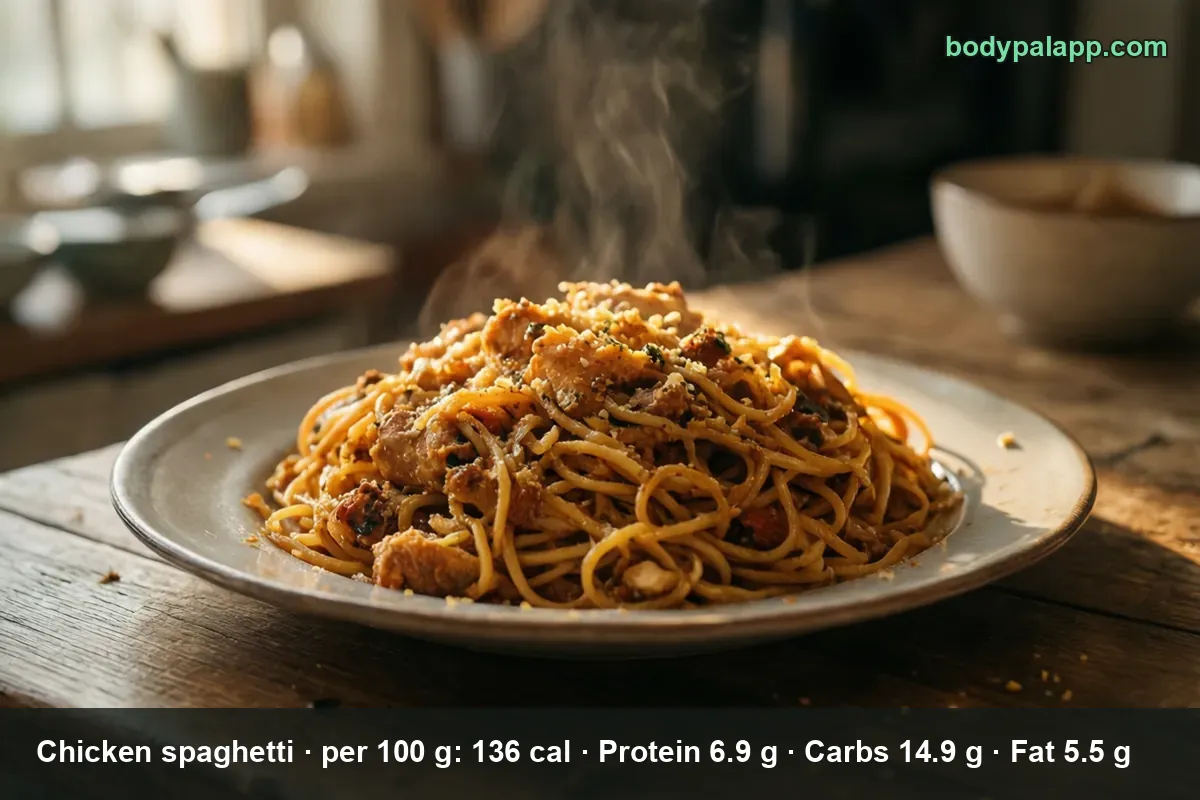
A 1-cup serving of chicken spaghetti is 305 calories, and the dish runs 136 calories per 100 g. That number comes from the USDA record for chicken and noodles in mushroom sauce, the canned-soup-and-spaghetti casserole most American kitchens call chicken spaghetti. The sauce you pick moves it by roughly 20 calories a cup.
On this page
- Chicken spaghetti quick facts
- US servings from one ounce to a plate and a half
- Sauce by sauce from cheese to no sauce at all
- Sodium is the row to watch
- How does chicken spaghetti compare
- Most popular chicken spaghetti brands
- FAQ
Chicken spaghetti quick facts
There is no USDA record actually named "chicken spaghetti." The closest match, and the one this page is built on, is FNDDS 2706531, "Chicken or turkey and noodles with mushroom sauce". That is the dish as most people cook it: spaghetti, cooked chicken, a can of condensed mushroom or cream-of-chicken soup, sometimes a handful of cheese on top. Every figure below is the cooked, sauced dish, not dry pasta.
The reference serving is 1 cup, 224 g. That is a normal dinner scoop, not a restaurant plate.
| Nutrient | Per 100 g | Per 1 cup (224 g) | % Daily Value |
|---|---|---|---|
| Calories | 136 | 305 | — |
| Total fat | 5.46 g | 12.2 g | 16% |
| Saturated fat | 1.077 g | 2.4 g | 12% |
| Carbohydrate | 14.86 g | 33.3 g | 12% |
| Dietary fiber | 0.8 g | 1.8 g | 6% |
| Total sugars | 0.8 g | 1.8 g | — |
| Protein | 6.92 g | 15.5 g | 31% |
| Sodium | 337 mg | 755 mg | 33% |
% Daily Value is based on a 2,000-calorie diet.
Verified nutrition data
Numbers on this page come from USDA FoodData Central, the U.S. Department of Agriculture’s food composition database, and from manufacturer labels where a branded product is named. Last verified September 2026. How we verify our data →
Two label rows are missing on purpose. USDA does not publish added sugars or trans fat for its mixed-dish records, so quoting either one would mean inventing a number. Cholesterol and potassium are published: a cup carries 72 mg of cholesterol (24% DV) and 211 mg of potassium (4% DV). The potassium row is the quiet disappointment here, since Daily Value math puts the target at 4,700 mg.
US servings from one ounce to a plate and a half
| Serving | Weight | Calories |
|---|---|---|
| 1 oz | 28.4 g | 39 kcal |
| 1/2 cup | 112 g | 152 kcal |
| 1 cup | 224 g | 305 kcal |
| 1 serving, USDA unspecified | 280 g | 381 kcal |
| 1 1/2 cups, a full plate | 336 g | 457 kcal |
| Per 100 g | 100 g | 136 kcal |
Only two of those weights come straight from USDA: the 224 g cup and the 280 g "serving, quantity not specified," which is what the survey uses when someone reports a plateful without measuring. The half cup, the ounce and the cup and a half are our own arithmetic from the USDA 100 g figure, not USDA servings.
The gap between 305 and 457 is the whole weight-management story of this dish. Nobody eats chicken spaghetti by the ounce, and very few people stop at half a cup. A second scoop is not a snack; it is another 152 calories.
Here is the trap almost every calorie app walks into. A cup of the sauced dish weighs 224 g, but a cup of chicken and noodles with no sauce weighs only 157 g, because dry noodles pack loosely and sauce fills every gap. Same cup, 67 g apart, 305 calories against 232. If you log by volume, know which version is in the bowl.
Sauce by sauce from cheese to no sauce at all
| Version | Per 100 g | Typical serving | Calories |
|---|---|---|---|
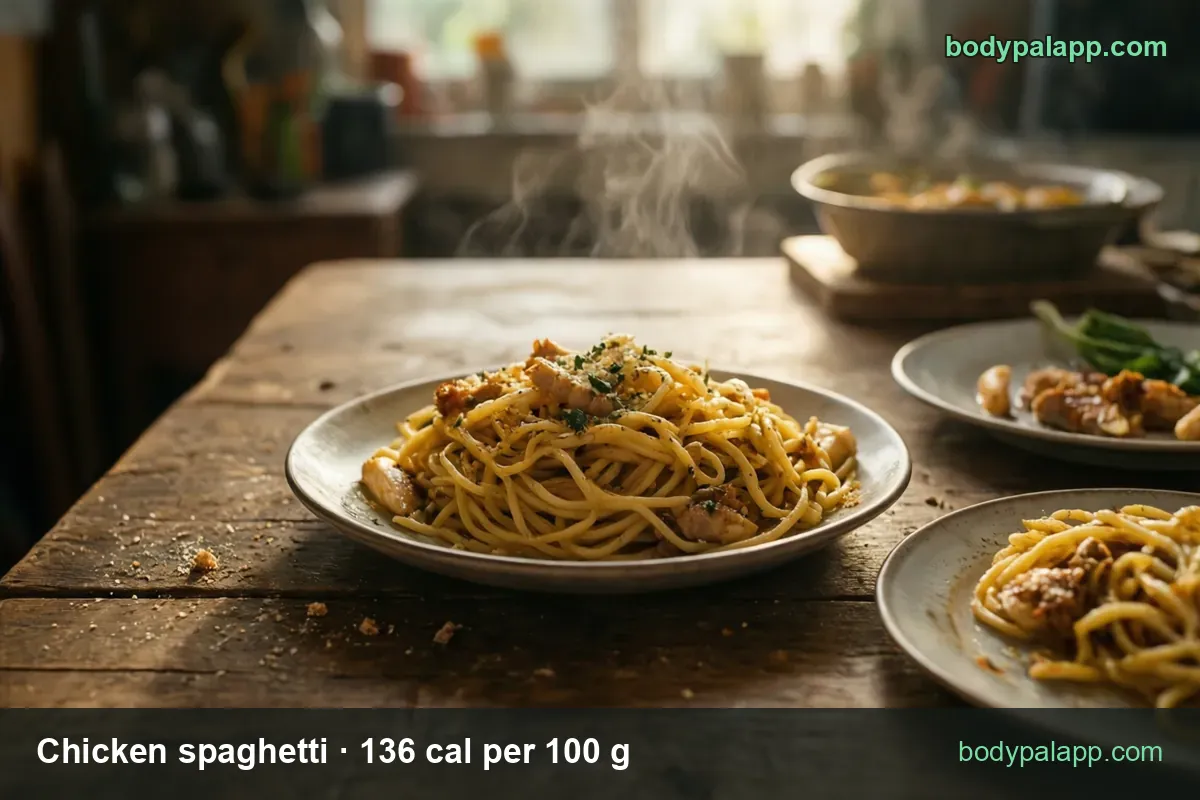
| Chicken spaghetti with mushroom sauce | 136 kcal | 1 cup (224 g) | 305 kcal |
| Chicken spaghetti with tomato-based sauce | 137 kcal | 1 cup (224 g) | 307 kcal |
| Creamy chicken spaghetti, cream or white sauce | 140 kcal | 1 cup (224 g) | 314 kcal |
| Chicken spaghetti with gravy | 140 kcal | 1 cup (224 g) | 314 kcal |
| Chicken spaghetti with cheese sauce | 146 kcal | 1 cup (224 g) | 327 kcal |
| Chicken spaghetti with vegetables, cream sauce | 128 kcal | 1 cup (224 g) | 287 kcal |
| Chicken and spaghetti, no sauce | 148 kcal | 1 cup (157 g) | 232 kcal |
Read that table twice, because it does not behave the way people expect. The heaviest dish per 100 g is the one with no sauce at all, 148 calories, since sauce is mostly water and water has no calories. Per cup, though, the no-sauce version is the lightest on the page at 232, because the same cup holds 67 g less food.
Cheese is the real swing. Moving from mushroom sauce to cheese sauce costs 22 calories a cup, which is nothing, but saturated fat goes from 1.077 g to 2.724 g per 100 g, roughly two and a half times. Cream or white sauce lands in the middle at 1.903 g. If you are watching saturated fat rather than calories, the sauce choice matters far more than the scoop size.
The vegetable version, at 128 calories per 100 g, is the only one that comes in under the base recipe, and it does it by displacing pasta with bell peppers and onions rather than by cutting fat.
Frozen versions play by similar rules. A Banquet Basic Spaghetti with Chicken Nuggets meal is 230 calories for the 198 g tray, while a half package of Bertolli Chicken Alfredo & Penne is 340 g and 500 calories. The tray size, not the recipe, does most of that work.
Sodium is the row to watch
One cup delivers 755 mg of sodium, 33% of the Daily Value, against 15.5 g of protein at 31%. That is the honest summary of this dish: it hands you a third of a day's sodium and a third of a day's protein in the same scoop, and the sodium arrives slightly ahead.
The Dietary Guidelines for Americans put the limit for adults at 2,300 mg a day. A cup and a half of chicken spaghetti is 1,133 mg, close to half of it, before any garlic bread, parmesan or salad dressing joins in. Condensed soup is the source. Every sauced version in the USDA set sits between 337 and 350 mg per 100 g, so swapping mushroom for tomato or gravy changes nothing worth logging.
Protein is the genuinely good news. At 15.5 g a cup this beats plain pasta comfortably, and MyPlate counts the chicken toward the protein group while the spaghetti counts as grains. If you are chasing protein, the cheese-sauce version at 8.95 g per 100 g is the better pick, and it costs only 22 calories a cup to get there.
How does chicken spaghetti compare
| Dish | Per 100 g | US serving | Calories |
|---|---|---|---|
| Chicken spaghetti, mushroom sauce | 136 kcal | 1 cup (224 g) | 305 kcal |
| Chicken and noodles, tomato-based sauce | 137 kcal | 1 cup (224 g) | 307 kcal |
| Chicken and noodles, cheese sauce | 146 kcal | 1 cup (224 g) | 327 kcal |
| Macaroni and cheese with chicken | 178 kcal | 1 cup (230 g) | 409 kcal |
Our take: chicken spaghetti is the lightest dish in this table, and the spread between it and the tomato version is two calories a cup, which is noise. The only meaningful step up is macaroni and cheese with chicken at 409 a cup, a full 104 more, and it earns some of that back with 12.53 g of protein per 100 g. For weight loss, keep the mushroom-sauce version and keep it to one cup. For a filling dinner that holds you until morning, the cheese-sauce version at 327 is the smarter 22-calorie spend, because the protein comes up with it.
Most popular chicken spaghetti brands in the United States
Ranked by how widely each product appears among foods sold in the United States, from the BodyPal food database of over 3.3 million products. Calories are the figures printed on each Nutrition Facts label, checked against USDA FoodData Central.
| Product | Calories (per 100 g) |
|---|---|
| Banquet Basic Spaghetti with Chicken Nuggets | 116 cal |
| Banquet Chicken Pasta Marinara | 158 cal |
| Bertolli Chicken Margherita & Penne | 122 cal |
| Bertolli Chicken Alla Vodka & Farfalle | 126 cal |
| Bertolli Chicken Alfredo & Penne | 147 cal |
| Blake's All Natural Chicken Parmesan with Pasta | 115 cal |
Brand popularity: BodyPal food database. Nutrition: manufacturer labels / USDA FoodData Central.
Chicken spaghetti FAQs
How many calories are in a cup of chicken spaghetti?
A 1-cup serving weighs 224 g and carries 305 calories, based on the USDA record for chicken and noodles in mushroom sauce at 136 calories per 100 g. That cup also brings 15.5 g of protein, 33.3 g of carbohydrate and 12.2 g of fat, so it eats like a full lunch rather than a side dish.
How many calories in a plate of chicken spaghetti?
A full plate of about 1 1/2 cups (336 g) runs 457 calories, our own arithmetic from the USDA 100 g figure rather than a USDA serving. The USDA's own unspecified serving of 280 g lands at 381 calories, so most real plates sit somewhere between 380 and 460 calories.
Is chicken spaghetti high in protein?
One cup gives 15.5 g of protein, 31% of the Daily Value, which is solid for a pasta dish without being high. The cheese-sauce version does better at 8.95 g per 100 g, and macaroni and cheese with chicken reaches 12.53 g per 100 g. Extra chicken is the cheapest way to lift it.
How much sodium is in chicken spaghetti?
A 1-cup serving carries 755 mg of sodium, 33% of the 2,300 mg Daily Value and about a third of a teaspoon of table salt. Every sauced version in the USDA data sits between 337 and 350 mg per 100 g, so switching from mushroom to tomato or gravy will not rescue the number.
Is chicken spaghetti good for weight loss?
At 136 calories per 100 g it is lighter than most creamy pasta dishes, and a 1/2-cup portion of 112 g is only 152 calories. Volume is the trap: a cup and a half is 457. One cup at 305 calories, with 15.5 g of protein and a salad, is a reasonable dinner plate.
How many calories in creamy chicken spaghetti?
Creamy chicken spaghetti made with cream or white sauce is 140 calories per 100 g, so a 1-cup serving of 224 g is 314 calories. That is only 9 calories more than the mushroom-sauce version, but saturated fat nearly doubles, from 1.077 g to 1.903 g per 100 g. The fat row moves, not the calorie row.
How many carbs are in chicken spaghetti?
A cup holds 33.3 g of carbohydrate, 12% of the Daily Value, plus 1.8 g of fiber and 1.8 g of total sugars. The spaghetti does almost all of that work. The cheese-sauce version is slightly lower at 13.56 g per 100 g against 14.86 g, because cheese displaces some of the noodles.
Does chicken spaghetti have more calories than spaghetti with meat sauce?
Chicken spaghetti is 136 calories per 100 g, and the closest tomato-sauce record in the same USDA family is 137, effectively identical. We are not quoting a beef meat-sauce figure, because that dish sits outside the record set this page is built on. Judge by the sauce and the scoop size instead.
Similar foods
- Lasagna — 286 cal per piece
- Chicken Chow Mein — 288 cal per cup
- Half And Half — 20 cal per tbsp
- Snow Cone — 256 cal per snow cone
- Toor Dal — 348 cal per cup
- Egg Foo Yung — 108 cal per patty
Count it without the math
Point the camera at the plate and BodyPal counts the chicken spaghetti for you, sauce and all.


How long does it take to burn off 305 kcal of chicken spaghetti?
A 1-cup (224 g) serving is 305 kcal. Enter your weight and the amount you ate to see how long it takes you to burn that off:
lb
| Activity | Time to burn 305 kcal |
|---|---|
| Walking, brisk | 1 hr 1 min |
| Cycling, moderate | 38 min |
| Swimming, moderate | 44 min |
| Jogging | 36 min |
| Weight training, moderate | 1 hr 8 min |
Times are for a 155 lb adult at a steady pace; change the weight to see yours. The amount is set to the portion in the text (224 g); change it to what you actually ate. BodyPal works this out from your steps automatically.
Want the bigger picture? Calculate your daily calorie needs — your maintenance figure, a target for losing or gaining, and the date you get there.