
How many calories are in chicken stir fry?
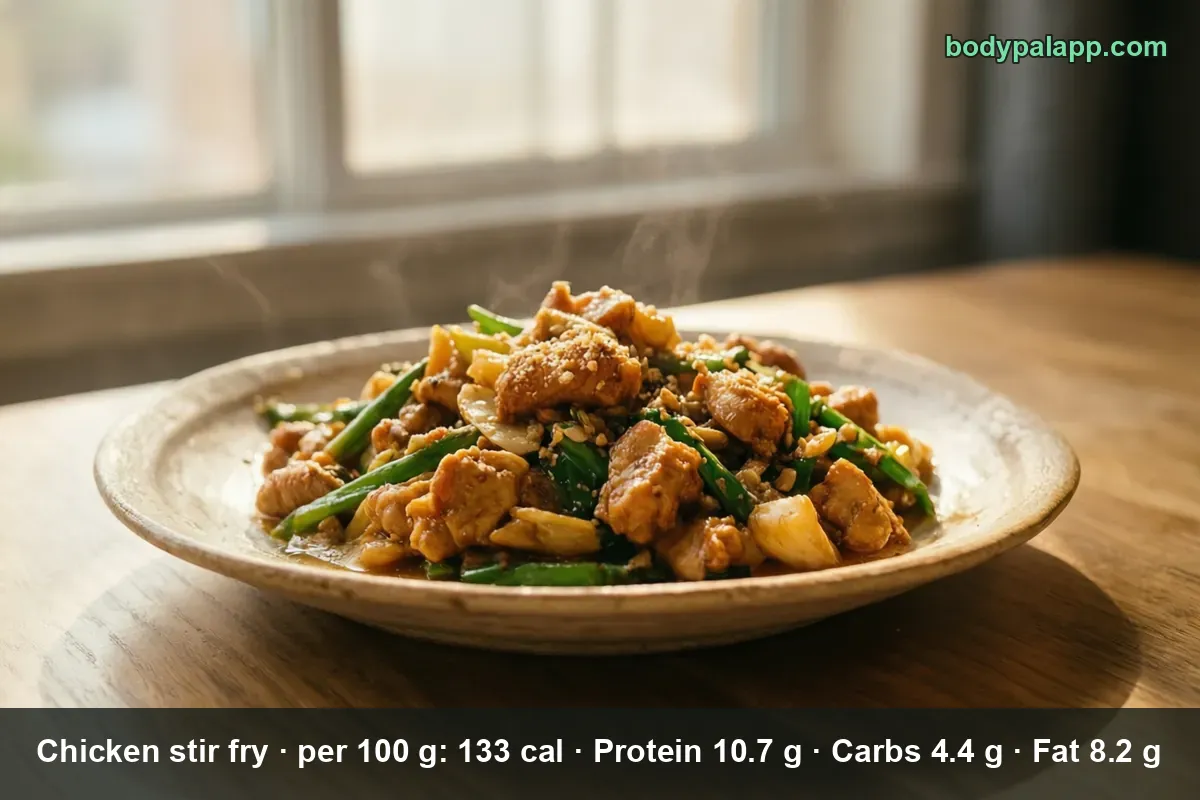
A 1-cup (217 g) serving of chicken stir fry — chicken, green beans, onion and pepper in a soy-based sauce, no rice underneath — comes to 289 calories. Per 100 g it runs 133 calories, which is light for a main dish. The part that surprises people is the sodium: 764 mg in that cup.
On this page
- Chicken stir fry quick facts
- US servings, from one ounce to two cups
- With rice, with broccoli, or from the freezer
- Sodium is the row to watch
- How does chicken stir fry compare?
- Most popular chicken stir fry brands
- FAQ
Chicken stir fry quick facts
The record behind every number on this page is FNDDS 2706791, "Chicken or turkey and vegetables excluding carrots, broccoli, and dark-green leafy; no potatoes, soy-based sauce". That description is a mouthful, but it matches the plate most people actually cook: chicken pieces, green beans, onion, sweet pepper, a splash of oil and a soy-based sauce, with no rice mixed in. USDA has no Foundation or SR Legacy entry for a finished stir fry, so this mixed-dish record is the first valid source.
If your pan has carrots or broccoli in it, or rice stirred through, you want one of the variant records further down — they are separate USDA lines, not adjustments of this one.
| Nutrient | Per 100 g | Per 1 cup (217 g) | % Daily Value |
|---|---|---|---|
| Calories | 133 | 289 | — |
| Total fat | 8.22 g | 17.8 g | 23% |
| Saturated fat | 1.36 g | 3.0 g | 15% |
| Carbohydrate | 4.39 g | 9.5 g | 3% |
| Dietary fiber | 1 g | 2.2 g | 8% |
| Total sugars | 1.62 g | 3.5 g | — |
| Protein | 10.7 g | 23.2 g | 46% |
| Sodium | 352 mg | 764 mg | 33% |
| Cholesterol | 40 mg | 87 mg | 29% |
| Potassium | 234 mg | 508 mg | 11% |
% Daily Value is based on a 2,000-calorie diet.
Verified nutrition data
Numbers on this page come from USDA FoodData Central, the U.S. Department of Agriculture’s food composition database, and from manufacturer labels where a branded product is named. Last verified September 2026. How we verify our data →
Two rows you would see on a packaged label are missing here: added sugars and trans fat. USDA does not publish either value for this mixed-dish record, so rather than guess at them we leave them out. The Daily Values used above are the FDA reference amounts from the Nutrition Facts label.
US servings, from one ounce to two cups
| Serving | Weight | Calories |
|---|---|---|
| 1 oz | 28 g | 38 kcal |
| 3/4 cup, USDA default serving | 163 g | 217 kcal |
| 1 cup | 217 g | 289 kcal |
| 1 1/2 cups | 326 g | 433 kcal |
| 2 cups | 434 g | 577 kcal |
| Per 100 g | 100 g | 133 kcal |
The 3/4-cup and 1-cup lines are USDA household measures. The ounce, the cup and a half, and the two-cup dinner-plate portion are our own arithmetic from the USDA 100 g figure, not USDA servings.
Here is the trap. A cup of stir fry is heavy — 217 g, because the sauce and the vegetables carry water and the chicken is dense. At 133 calories per 100 g, that scoop costs 289 calories, so a "cup" of stir fry runs a lot higher than the word suggests. Meanwhile people routinely eat two cups without thinking of it as a double portion, and at 577 calories that is a full dinner rather than the light plate the ingredient list implies. If you scoop straight from the wok onto a dinner plate, assume a cup and a half.
With rice, with broccoli, or from the freezer
| Version | Per 100 g | Typical serving | Calories |
|---|---|---|---|
| Chicken and vegetables, no rice (main record) | 133 kcal | 1 cup (217 g) | 289 kcal |
| With carrots and broccoli, no rice | 95 kcal | 1 cup (217 g) | 206 kcal |
| With rice stirred through | 133 kcal | 1 cup (217 g) | 289 kcal |
| With rice, carrots and broccoli | 131 kcal | 1 cup (217 g) | 284 kcal |
| Frozen chicken stir fry meal | 109 kcal | 1 meal, 9 oz (255 g) | 278 kcal |
| Kung pao chicken | 129 kcal | 1 oz (28 g) | 37 kcal |
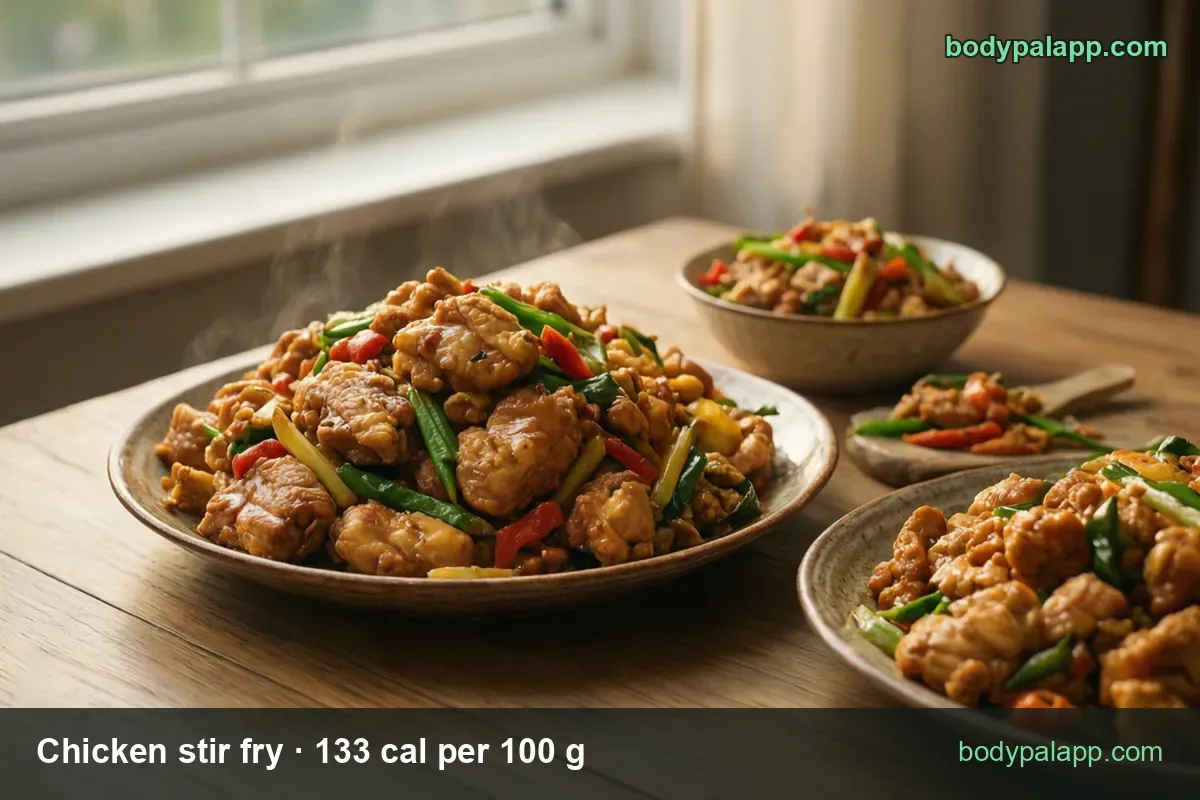
The vegetable basket moves the number more than the chicken does. The same 1-cup serving is 289 calories with green beans, onion and pepper, and 206 calories once carrots and broccoli are in the mix — 83 calories of difference from the produce alone, because those vegetables bring water and bulk while the pan takes less oil.
Rice is the surprise. Adding it does not raise the calories per 100 g at all: the rice record sits at exactly 133 too. What changes is the shape of the food — carbohydrate goes from 4.39 g to 7.79 g per 100 g while fat drops from 8.22 g to 7.15 g. Rice makes the plate bigger, not denser. So a bowl of stir fry over rice costs more than the same bowl without it only because you are holding more grams, and the rice quietly swaps some of the pan oil for starch.
Frozen meals play a different game. The USDA frozen stir fry record is 109 calories per 100 g and just 0.91 g of fat, about nine times less fat than the fresh pan version, with 18.06 g of carbohydrate from the rice bed. A 9 oz tray lands at 278 calories. Retail boxes labeled chicken stir fry are all over the map: USDA's branded records run from 62 calories per 100 g for a Kroger skillet mix up to 107 for Cadence Kitchen, with Gourmet Dining at 105, HT Traders at 101, InnovAsian at 94 and Lemon Grass Kitchen at 74 — a 1.7-fold spread between two boxes wearing the same three words. Read the panel on the box you bought instead of assuming.
Sodium is the row to watch
Calories are not the interesting story on this plate. Sodium is. One cup carries 764 mg, which is 33% of the FDA Daily Value in a single serving — the equivalent of about a third of a teaspoon of table salt, almost all of it from the soy-based sauce rather than the chicken or the vegetables. Eat two cups and you are past 1,500 mg before anything else you ate that day. The Dietary Guidelines for Americans put the limit at 2,300 mg a day, and stir fry is one of the easiest home-cooked dishes to blow through it with.
The frozen version is worse, not better. At 333 mg per 100 g, a 9 oz tray works out to roughly 849 mg of sodium — our own arithmetic from the USDA 100 g figure, not a USDA serving — so it delivers more salt than the fresh cup while delivering fewer calories. If sodium is something you track, the fresh pan with a lighter hand on the sauce is the better pick.
The other standout row is protein: 23.2 g in a cup, 46% of the Daily Value, from a dish that costs 289 calories. That ratio is what makes stir fry work as a weeknight dinner, and it lines up with the MyPlate protein foods guidance on building a meal around lean poultry. Carbohydrate, by contrast, is almost invisible without rice — 9.5 g, or 3% DV.
How does chicken stir fry compare?
| Dish | Per 100 g | US serving | Calories |
|---|---|---|---|
| Chicken stir fry, no rice | 133 kcal | 1 oz (28 g) | 38 kcal |
| Kung pao chicken | 129 kcal | 1 oz (28 g) | 37 kcal |
| Beef, noodles and vegetables in soy-based sauce | 139 kcal | 1 oz (28 g) | 39 kcal |
| Teriyaki chicken with rice, diet frozen meal | 126 kcal | 1 oz (28 g) | 36 kcal |
The servings here are one ounce across the board because USDA does not publish a cup weight for these neighboring records in the same index, and comparing four dishes at the same weight is the honest way to read them.
Our take: by calories, these four dishes are nearly the same food — 126 to 139 per 100 g, a band of 13 calories that no one will feel. The difference is what you get for those calories. Plain chicken stir fry carries the most protein of the four at 10.7 g per 100 g, ahead of the beef and noodle version at 10.4 g and kung pao at 9.76 g. The diet teriyaki tray trails badly at 5.65 g of protein with 22.46 g of carbohydrate, more than five times the carbs of the fresh pan. For a filling dinner, cook the plain one and keep the rice on the side; for the lightest plate per gram, add the carrots and broccoli and drop to 95 calories per 100 g.
Most popular chicken stir fry brands in the United States
Ranked by how widely each product appears among foods sold in the United States, from the BodyPal food database of over 3.3 million products. Calories are the figures printed on each Nutrition Facts label, checked against USDA FoodData Central.
| Product | Calories (per 100 g) |
|---|---|
| Gourmet Dining Chicken Stir Fry | 105 cal |
| Lemon Grass Kitchen Lemongrass Chicken Stir-Fry | 74 cal |
| InnovAsian Lemongrass Chicken Stir Fry | 94 cal |
| HT Traders Chicken Stir Fry | 101 cal |
| Cadence Kitchen Chicken Stir Fry | 107 cal |
| Kroger Chicken Stir Fry | 62 cal |
Brand popularity: BodyPal food database. Nutrition: manufacturer labels / USDA FoodData Central.
Chicken stir fry FAQs
How many calories are in a cup of chicken stir fry?
A 1-cup serving weighs 217 g and carries 289 calories, based on the USDA record for chicken and vegetables in a soy-based sauce with no rice. That works out to 133 calories per 100 g. The same cup delivers 23.2 g of protein, 17.8 g of fat and 9.5 g of carbohydrate.
How many calories are in chicken stir fry without rice?
Without rice it is 133 calories per 100 g, so 289 for a 1-cup serving of 217 g and 217 calories for the USDA default 3/4 cup. Skipping the rice does not lower the calorie density at all — the rice record is also 133 per 100 g. It lowers the total grams on your plate.
How much protein is in chicken stir fry?
A 1-cup serving has 23.2 g of protein, which is 46% of the Daily Value, from 289 calories. Per 100 g that is 10.7 g. Among comparable soy-sauce dishes it is the highest of the group, ahead of beef with noodles at 10.4 g and kung pao chicken at 9.76 g per 100 g.
Is chicken stir fry good for weight loss?
At 133 calories per 100 g it is a light main dish, and 23.2 g of protein in a 289-calorie cup makes it filling for the cost. The version with carrots and broccoli is lighter still at 95 calories per 100 g, or 206 a cup. Portion size decides it: two cups is 577 calories.
How many calories are in frozen chicken stir fry?
The USDA frozen chicken stir fry meal is 109 calories per 100 g, so a 9 oz tray of 255 g is 278 calories. Retail boxes vary far more than that: branded records run from 62 calories per 100 g up to 107, a 1.7-fold spread, so check the panel on the box you bought.
How much sodium is in chicken stir fry?
One cup carries 764 mg of sodium, 33% of the Daily Value, or about a third of a teaspoon of table salt. Nearly all of it comes from the soy-based sauce. The frozen tray is saltier still at roughly 849 mg for a 9 oz meal, our own arithmetic from the USDA 100 g figure.
Is chicken stir fry high in carbs?
No — without rice a 1-cup serving has 9.5 g of carbohydrate, only 3% of the Daily Value, plus 2.2 g of fiber and 3.5 g of total sugars. With rice stirred through, carbohydrate rises to 7.79 g per 100 g from 4.39 g, so the same cup nearly doubles its carb load.
How many calories are in chicken stir fry with rice?
Chicken stir fry with rice is 133 calories per 100 g, the same density as the version without, so a 1-cup serving of 217 g is 289 calories. Add carrots and broccoli to the rice version and it edges down to 131 per 100 g, or 284 calories a cup.
Similar foods
- Poke Bowl — 569 cal per bowl
- Kebab — 449 cal per package
- Oysters Rockefeller — 40 cal per oyster
- Chicken And Broccoli — 284 cal per cup
- Corn Pudding — 328 cal per cup
- Mushroom Chicken — 348 cal per cup
Count it without the math
Point the camera at the plate and BodyPal counts the chicken, the vegetables and the sauce for you.


How long does it take to burn off chicken stir fry?
A 1-cup (217 g) serving is 289 kcal. Enter your weight and the amount you ate to see how long it takes you to burn that off:
lb
| Activity | Time to burn 289 kcal |
|---|---|
| Walking, brisk | 58 min |
| Cycling, moderate | 36 min |
| Swimming, moderate | 41 min |
| Jogging | 34 min |
| Weight training, moderate | 1 hr 4 min |
Times are for a 155 lb adult at a steady pace; change the weight to see yours. The amount is set to the portion in the text (217 g); change it to what you actually ate. BodyPal works this out from your steps automatically.
This table assumes you know your daily total. If you do not, the daily calorie calculator works it out from five numbers.