
How many calories are in chicken teriyaki and rice?
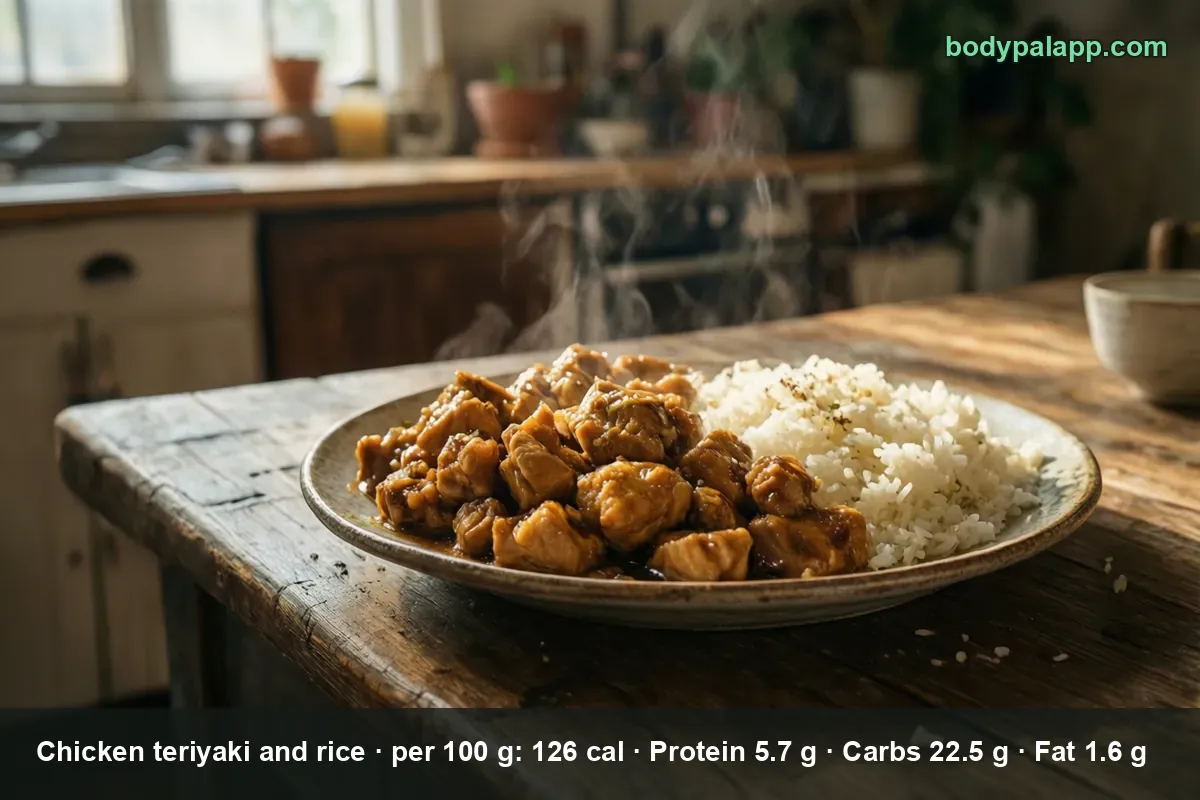
One bowl of chicken teriyaki and rice weighs 340 g and carries 428 calories. Per 100 g the dish runs 126 calories, which is low for anything that eats like takeout, because cooked white rice is mostly water. The number that stings is sodium: 1,132 mg sits in that same bowl.
On this page
- Chicken teriyaki and rice quick facts
- US servings, from one ounce to a full bowl
- Frozen trays, vegetable versions and shrimp teriyaki
- Sodium is the row to watch
- How does chicken teriyaki and rice compare?
- Most popular chicken teriyaki and rice brands
- FAQ
Chicken teriyaki and rice quick facts
The record behind every number here is SR Legacy 173339, "Rice bowl with chicken, frozen entree, prepared", whose description explicitly covers the teriyaki variety. It was chosen for two reasons. SR Legacy outranks the survey database when both describe the same dish, and its only listed household measure is "1 bowl" at 340 g - which is exactly the object a person is holding when they look this up.
There is a second record with an identical nutrient profile, FNDDS 2707109, filed as a diet frozen meal with vegetables. Same numbers, different preparation note. That is a difference in what went into the tray, not a disagreement between sources, so nothing gets averaged.
| Nutrient | Per 100 g | Per 1 bowl (340 g) | % Daily Value |
|---|---|---|---|
| Calories | 126 | 428 | — |
| Total fat | 1.56 g | 5.3 g | 7% |
| Saturated fat | 0.33 g | 1.1 g | 6% |
| Carbohydrate | 22.46 g | 76.4 g | 28% |
| Dietary fiber | 0.7 g | 2.4 g | 8% |
| Total sugars | 4.07 g | 13.8 g | — |
| Protein | 5.65 g | 19.2 g | 38% |
| Sodium | 333 mg | 1132 mg | 49% |
| Cholesterol | 16 mg | 54 mg | 18% |
| Potassium | 123 mg | 418 mg | 9% |
% Daily Value is based on a 2,000-calorie diet.
Verified nutrition data
Numbers on this page come from USDA FoodData Central, the U.S. Department of Agriculture’s food composition database, and from manufacturer labels where a branded product is named. Last verified September 2026. How we verify our data →
Two rows you would expect are missing. Added sugars and trans fat are not measured in this SR Legacy record at all, so writing zeros would be an invention rather than a reading. That matters more than usual here, since a teriyaki glaze is sweetened by design: a frozen tray's own label can report added sugars that the USDA profile simply never counted. The 13.8 g in the bowl is total sugars, and total sugars have no Daily Value to compare against.
US servings, from one ounce to a full bowl
| Serving | Weight | Calories |
|---|---|---|
| 1 oz | 28 g | 36 kcal |
| Per 100 g | 100 g | 126 kcal |
| Half a bowl | 170 g | 214 kcal |
| One small tray, 10.5 oz | 297 g | 374 kcal |
| One frozen-meal tray, 11 oz | 312 g | 393 kcal |
| One bowl | 340 g | 428 kcal |
Only the 340 g bowl is a USDA household measure. The ounce, the half bowl and both tray weights are our own arithmetic from the USDA 100 g figure, scaled to the sizes American freezer aisles actually sell.
The gap between 10.5 oz and 11 oz looks trivial and costs 19 calories, so it is not worth agonizing over. The gap between a tray and a full bowl is not trivial: 393 against 428, and 1,039 mg of sodium against 1,132 mg. If you eat the tray and then finish someone else's rice, you are logging a different meal than the one on the box.
One more trap worth naming. Restaurant teriyaki is not this record. A counter-service bowl is usually heavier than 340 g and glazed more generously, so treat 428 calories as the floor for the frozen and home-portioned version, not as a ceiling for the mall food court.
Frozen trays, vegetable versions and shrimp teriyaki
| Version | Per 100 g | Typical portion | Calories |
|---|---|---|---|
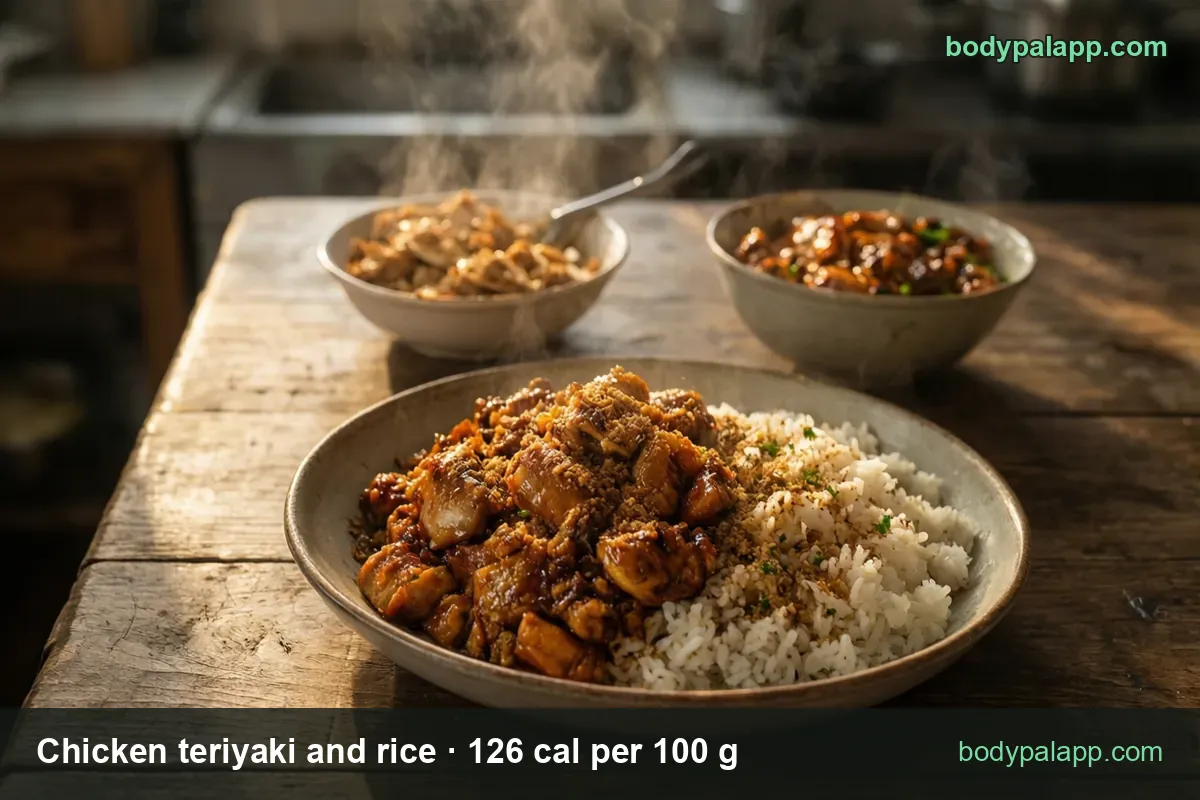
| Frozen rice bowl with chicken, teriyaki included | 126 kcal | 1 bowl, 340 g | 428 kcal |
| Diet frozen teriyaki chicken meal with vegetables | 126 kcal | 11 oz tray, 312 g | 393 kcal |
| Chicken, rice and vegetables in soy-based sauce | 131 kcal | 1 bowl, 340 g | 445 kcal |
| Chicken and rice, soy-based sauce, no dark-green vegetables | 133 kcal | 1 bowl, 340 g | 452 kcal |
| Shrimp teriyaki | 120 kcal | 1 bowl, 340 g | 408 kcal |
| Kung pao chicken | 129 kcal | 1 bowl, 340 g | 439 kcal |
Every bowl portion in that table except the frozen entree is our own arithmetic, scaling each record's 100 g figure to the same 340 g so the comparison is honest.
The spread is the story: six versions, and the widest gap per 100 g is 13 calories. Swapping teriyaki for kung pao, or adding vegetables to the sauce, moves the total by roughly one bite. What actually changes your day is portion size, which moves the number by 214 calories between half a bowl and a full one.
Shrimp teriyaki is the only version on the list that is lighter per 100 g, at 120 calories, and it is the outlier on protein too - 21.62 g per 100 g against 5.65 g for the chicken-and-rice bowl. That is not a knock on chicken. It is the rice, which makes up most of the weight and almost none of the protein.
Sodium is the row to watch
A single bowl covers 49% of the FDA Daily Value for sodium, 2,300 mg. Put differently, 1,132 mg is roughly half a teaspoon of table salt in a meal that costs you 428 calories - a fifth of a 2,000-calorie day. Calorie-for-calorie, few things in a freezer aisle spend your sodium budget that fast.
That ratio is worth knowing because most people meet their sodium ceiling without noticing. The CDC puts average US intake well above the limit, and glazed, soy-based sauces are a textbook route there. If you are watching sodium, the half bowl at 566 mg is the easy lever, and rinsing the pattern - more rice, less glaze - works better than skipping the dish.
Protein is the flip side. At 19.2 g, one bowl is 38% of the Daily Value, which is respectable for 428 calories. But it arrives with 76.4 g of carbohydrate and only 2.4 g of fiber, so the plate is carbohydrate-led however you slice it. The Dietary Guidelines point toward more whole grains and vegetables in exactly this slot; brown rice or a side of broccoli fixes the fiber without touching the calorie total much.
How does chicken teriyaki and rice compare?
| Dish | Per 100 g | US serving | Calories |
|---|---|---|---|
| Chicken teriyaki and rice | 126 kcal | 1 bowl, 340 g | 428 kcal |
| Chicken, rice and vegetables, soy-based sauce | 131 kcal | 1 bowl, 340 g | 445 kcal |
| Chicken and rice, soy sauce, no dark-green vegetables | 133 kcal | 1 bowl, 340 g | 452 kcal |
| Shrimp teriyaki | 120 kcal | 1 bowl, 340 g | 408 kcal |
Every 340 g portion in that table except the teriyaki bowl itself is our own arithmetic, scaling each record's 100 g figure to the same weight - only the 340 g bowl is a USDA household measure.
Our take: for weight loss, the teriyaki chicken bowl is a reasonable pick and the smallest sensible portion is the half bowl at 214 calories. For staying full, it is the weakest of the four per calorie, because 76.4 g of carbohydrate and 2.4 g of fiber do not hold long. Shrimp teriyaki wins the protein argument outright at 21.62 g per 100 g. And if sodium is your constraint, none of these four is a light choice - the sauce is the common ingredient.
Most popular chicken teriyaki and rice brands in the United States
Ranked by how widely each product appears among foods sold in the United States, from the BodyPal food database of over 3.3 million products. Calories are the figures printed on each Nutrition Facts label, checked against USDA FoodData Central.
| Product | Calories (per 100 g) |
|---|---|
| InnovAsian Teriyaki Chicken Rice Bowl | 129 cal |
| MAI Slow Cooked Teriyaki Chicken Rice Bowl | 136 cal |
| Fujisan Teriyaki Chicken Rice Bowl | 128 cal |
Brand popularity: BodyPal food database. Nutrition: manufacturer labels / USDA FoodData Central.
Chicken teriyaki and rice FAQs
How many calories are in chicken teriyaki and rice?
One bowl of chicken teriyaki and rice is 428 calories at 340 g, or 126 calories per 100 g. That figure covers a prepared frozen rice bowl with chicken, which is the format most people log. A restaurant portion is usually heavier and glazed more generously, so treat 428 as the floor.
How much protein is in chicken teriyaki with rice?
A 340 g bowl carries 19.2 g of protein, 38% of the Daily Value, working out from 5.65 g per 100 g. The rice does the diluting. Shrimp teriyaki runs 21.62 g of protein per 100 g, close to four times as dense, because it is almost all seafood and sauce.
How many carbs are in chicken teriyaki and rice?
One bowl holds 76.4 g of carbohydrate, 28% of the Daily Value, alongside 2.4 g of fiber and 13.8 g of total sugars. Per 100 g that is 22.46 g. White rice supplies most of the carbohydrate, and the glaze contributes the sugar that makes the dish taste sweet.
How much sodium is in a teriyaki chicken bowl?
A 340 g bowl delivers 1,132 mg of sodium, 49% of the 2,300 mg Daily Value, from 333 mg per 100 g. That is roughly half a teaspoon of table salt in a single meal. The soy-based glaze, not the chicken or the rice, carries nearly all of it.
How many calories in half a teriyaki chicken bowl?
Half a bowl, 170 g, is 214 calories with 566 mg of sodium and 9.6 g of protein. That is our own arithmetic from the USDA 100 g figure, not a USDA serving. Halving the bowl halves the sodium too, but leaves you under 10 g of protein, which is light for a meal.
How many calories in a frozen teriyaki chicken meal?
An 11 oz tray, 312 g, works out to 393 calories with 17.6 g of protein and 1,039 mg of sodium, all scaled by our own arithmetic from the USDA 100 g figure. A 10.5 oz tray is 374 calories. Diet frozen meals with vegetables sit at the same 126 calories per 100 g.
Is chicken teriyaki and rice good for weight loss?
At 428 calories a bowl and 126 per 100 g, it is one of the lighter takeout-style dishes by weight and fits a 350 to 450-calorie lunch. The weak spot is staying power: 19.2 g of protein against 76.4 g of carbohydrate and 2.4 g of fiber. Add vegetables if you want it to hold.
Is teriyaki chicken healthier than kung pao chicken?
Per bowl it is 428 calories against 439 for kung pao chicken, 11 calories apart, and 126 versus 129 per 100 g. Calories will not decide it. Sodium is the real separator, and the teriyaki bowl already spends 1,132 mg, or 49% of the Daily Value, before anything else on the table.
Similar foods
- Rice — 205 cal per cup, cooked
- Quinoa — 222 cal per cup cooked
- Wild Rice — 166 cal per cup, cooked
- Pasta — 168 cal per cup penne
- Penne pasta — 169 cal per cup
- Baba ganoush — 110 cal for 1/4 cup
Count it without the math
Point the camera at the bowl and BodyPal counts the chicken, the rice and the glaze for you.


How long does it take to burn off 428 kcal of chicken teriyaki?
One bowl (340 g) is 428 kcal. Enter your weight and the amount you ate to see how long it takes you to burn that off:
lb
| Activity | Time to burn 428 kcal |
|---|---|
| Walking, brisk | 1 hr 26 min |
| Cycling, moderate | 54 min |
| Swimming, moderate | 1 hr 1 min |
| Jogging | 50 min |
| Weight training, moderate | 1 hr 35 min |
Times are for a 155 lb adult at a steady pace; change the weight to see yours. The amount is set to the portion in the text (340 g); change it to what you actually ate. BodyPal works this out from your steps automatically.
Burning it off is one side of it. The other is knowing your number: work out how many calories you need a day, with macros and a goal date.