
How Many Calories Are in Chicken Tikka Masala With Rice?
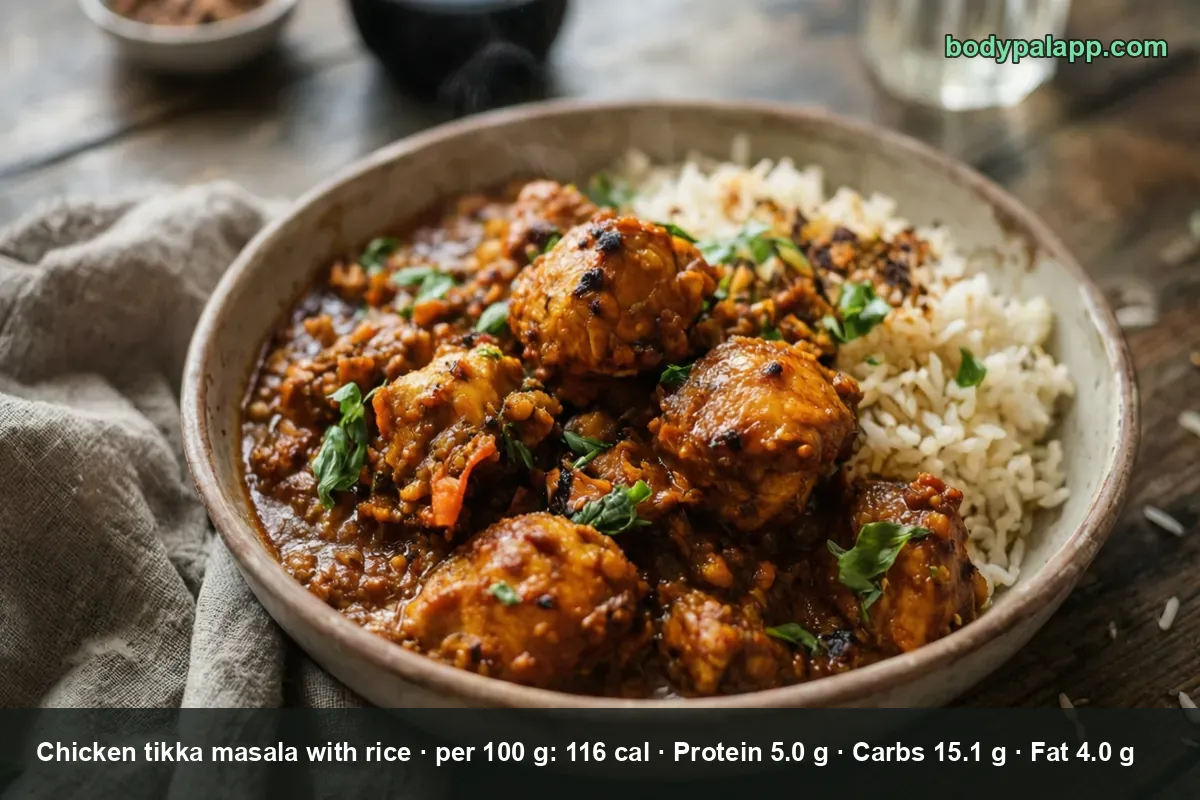
A 1-cup serving of chicken tikka masala with rice weighs 200 g and carries 232 calories. Per 100 g the plate runs 116 calories, which is light for a creamy curry — the rice underneath does the diluting. The number that actually moves is sodium: 648 mg in that one cup.
On this page
- Chicken tikka masala with rice quick facts
- US servings from one ounce to a takeout bowl
- Tikka masala without rice and other versions
- Sodium is the row that runs out first
- How does chicken tikka masala with rice compare?
- Most popular chicken tikka masala with rice brands
- FAQ
Chicken tikka masala with rice quick facts
USDA has no record called "tikka masala with rice." The closest match for the plate you are actually holding is FNDDS 2706438, "Chicken curry with rice", a cooked poultry mixed dish from the 2021-2023 survey release: spiced chicken in a tomato-and-cream style sauce served over white rice. That is the dish, sauce and grain together, in the proportion people put on a plate.
The alternative would be one of the retail tikka masala entrees, but those are packaged either as sauce-and-chicken with no grain at all, or as a specific brand's ratio of curry to rice. They are useful as variants and they appear further down. For the generic question — how many calories are on a plate of curry and rice — the survey record is the honest answer, and it is the one used in the table below.
| Nutrient | Per 100 g | Per 1 cup (200 g) | % Daily Value |
|---|---|---|---|
| Calories | 116 | 232 | — |
| Total fat | 4 g | 8.0 g | 10% |
| Saturated fat | 0.96 g | 1.9 g | 10% |
| Carbohydrate | 15.12 g | 30.2 g | 11% |
| Dietary fiber | 1 g | 2.0 g | 7% |
| Total sugars | 1.56 g | 3.1 g | — |
| Protein | 4.96 g | 9.9 g | 20% |
| Sodium | 324 mg | 648 mg | 28% |
% Daily Value is based on a 2,000-calorie diet.
Verified nutrition data
Numbers on this page come from USDA FoodData Central, the U.S. Department of Agriculture’s food composition database, and from manufacturer labels where a branded product is named. Last verified September 2026. How we verify our data →
Two rows you would see on a package are missing here: added sugars and trans fat. USDA does not publish either for this FNDDS record, so rather than guess at them the rows are left out. Cholesterol comes in at 13 mg per 100 g, or 26 mg per cup — 9% of the Daily Value. Potassium is 182 mg per 100 g, 364 mg per cup, 8%.
US servings from one ounce to a takeout bowl
The cup is the household measure USDA actually publishes for this record, at 200 g. Everything else in the table is our own arithmetic from the 116-calories-per-100-g figure, not a separate USDA serving.
| Serving | Weight | Calories |
|---|---|---|
| 1 oz | 28.35 g | 33 kcal |
| 1/2 cup | 100 g | 116 kcal |
| 1 cup | 200 g | 232 kcal |
| 1 frozen entree tray, 10 oz | 283 g | 328 kcal |
| 1 1/2 cups | 300 g | 348 kcal |
| Per 100 g | 100 g | 116 kcal |
Here is the trap. A cup of curry and rice looks like a modest bowl, and at 232 calories it is. But nobody eats one cup at an Indian restaurant. Two to three cups is the normal plate, which by the same arithmetic is 464 to 696 calories before naan, and the sodium scales right along with it.
The freezer aisle sits in between. Retail trays weigh 255 to 350 g, which is 1.3 to 1.8 cups of food, and they land at 300 to 371 calories per package. That is the single most useful conversion on this page: one store tray is not one cup, it is closer to a cup and a half.
Tikka masala without rice and other versions
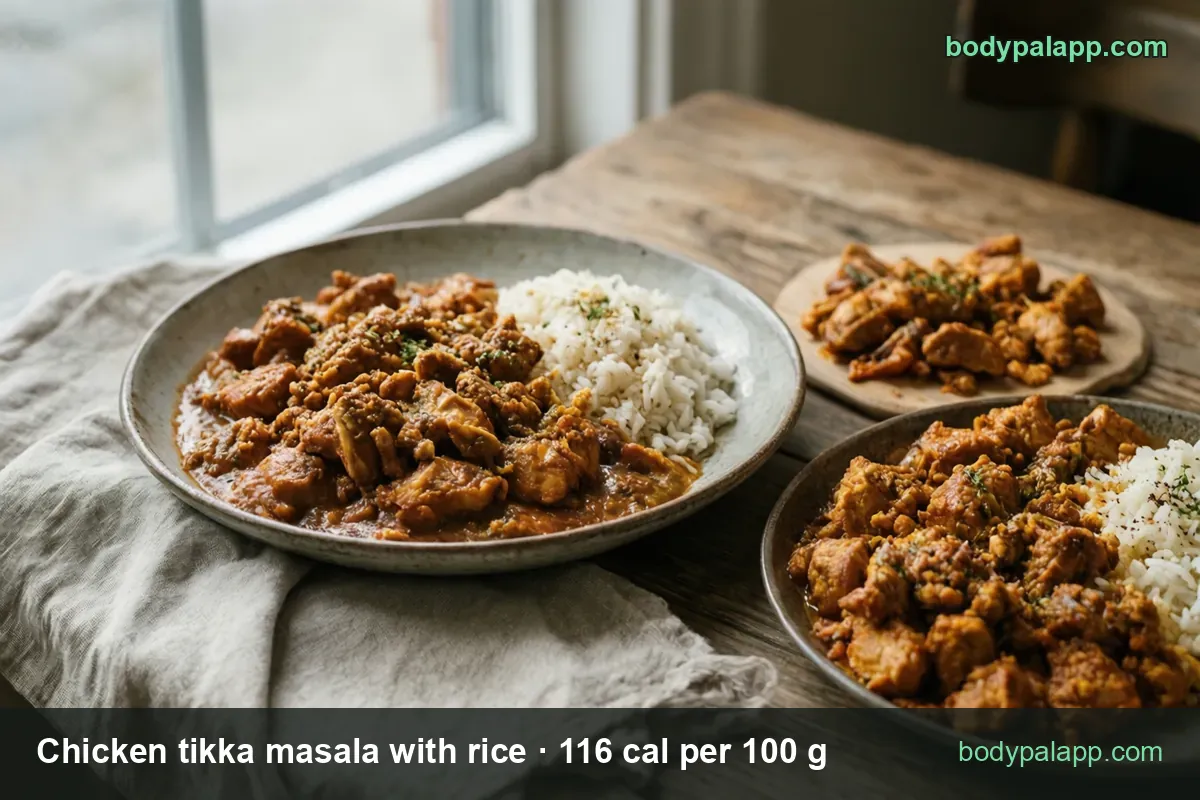
Take the rice away and the density climbs to 145 calories per 100 g, because what is left is chicken and sauce with nothing to dilute it. Put basmati rice back under it, as Chef Bombay's tray does, and it drops to 106.
| Version | Per 100 g | Typical package | Calories |
|---|---|---|---|
| Tikka masala without rice, retail tray | 145 kcal | 1 tray, 255 g | 370 kcal |
| Tikka masala with basmati rice, retail tray | 106 kcal | 1 tray, 350 g | 371 kcal |
| Frozen light meal with riced cauliflower | 73 kcal | 1 meal, 262 g | 191 kcal |
| Frozen tikka masala with rice, Lean Cuisine | 115 kcal | 1 package, 269 g | 309 kcal |
| Tikka masala samosas | 271 kcal | 3 pieces, 85 g | 230 kcal |
| Tikka masala rice wrap | 199 kcal | 1 wrap, 156 g | 310 kcal |
Look at the first two lines together, because they are the whole argument. The no-rice tray is 370 calories. The with-rice tray is 371. One calorie apart — but the second one is 95 g heavier, more than three extra ounces of food for nothing. Skipping the rice does not save you calories at the package level; it just gives you a smaller, richer package.
The riced cauliflower meal is the only version that genuinely cuts the number, at 73 calories per 100 g and 191 for the whole tray. The samosas go the other way: 271 calories per 100 g makes them the densest thing on this list by a wide margin, and three small pieces cost as much as a full cup of curry and rice.
Store shelves back this up. Lidl's tray is 110 calories per 100 g, Signature Select 115, Ethnic Gourmet 122, Saffron Road 106, Deep Indian Kitchen 145 — a spread that mostly tracks how much rice is in the box rather than how rich the sauce is.
Sodium is the row that runs out first
One cup gives you 12% of a 2,000-calorie day and 28% of the 2,300 mg Daily Value for sodium. The salt budget empties more than twice as fast as the calorie budget. In kitchen terms, 648 mg is roughly a quarter teaspoon of table salt sitting in a bowl you would call light.
Scale that to a restaurant plate of two and a half cups and you are at about 1,620 mg, most of a day's allowance from one meal. The CDC's guidance on sodium puts the average American intake well above the limit already, and saucy takeout is a large part of why. If you are watching blood pressure, this is the dish where the frozen tray is genuinely the better buy: retail versions run 134 to 268 mg per 100 g against the survey record's 324 mg.
Protein is the other row worth a look, in the opposite direction. Per cup you get 9.9 g — 20% of the Daily Value, which sounds fine until you notice the whole meal is only 232 calories of a lunch. The chicken is real but there is not much of it per scoop, and the rice does not contribute. MyPlate's protein foods guidance is a reasonable check here: if this is your main course, an extra piece of chicken or a side of yogurt earns its place more than extra rice does.
How does chicken tikka masala with rice compare?
| Dish | Per 100 g | US serving | Calories |
|---|---|---|---|
| Chicken curry with rice | 116 kcal | 1 cup, 200 g | 232 kcal |
| Chicken or turkey tetrazzini | 119 kcal | 1 cup, weight not listed | — |
| Chicken with noodles and cheese sauce, diet frozen meal | 114 kcal | 1 meal, 8.5 oz (241 g) | 275 kcal |
| Chicken and vegetables, no potatoes, no sauce | 118 kcal | 1 cup, weight not listed | — |
Two of these records have no gram weight for their cup in the USDA index, so their per-serving cell stays empty rather than getting a made-up number.
Our take: by calories per 100 g these four dishes are effectively the same food — 114 to 119, a spread of five calories. What separates them is what fills the space. Tikka masala with rice has the most carbohydrate of the group at 15.12 g per 100 g and the least protein at 4.96 g; the tetrazzini carries 11.96 g of protein, nearly two and a half times as much, in the same weight. If you are choosing a saucy chicken dish for satiety, the rice-based one is the weakest pick per calorie. If you are choosing for a filling, cheap, moderate-calorie plate, it is the best of the four — you just want to add protein rather than a second scoop of rice.
Most popular chicken tikka masala with rice brands in the United States
Ranked by how widely each product appears among foods sold in the United States, from the BodyPal food database of over 3.3 million products. Calories are the figures printed on each Nutrition Facts label, checked against USDA FoodData Central.
| Product | Calories (per 100 g) |
|---|---|
| Lidl Chicken Tikka Masala | 110 cal |
| Signature Select Chicken Tikka Masala | 115 cal |
| Chef Bombay Chicken Tikka Masala with Basmati Rice | 106 cal |
| Deep Indian Kitchen Chicken Tikka Masala | 145 cal |
| Ethnic Gourmet Chicken Tikka Masala | 122 cal |
| Saffron Road Chicken Tikka Masala with Basmati Rice | 106 cal |
Brand popularity: BodyPal food database. Nutrition: manufacturer labels / USDA FoodData Central.
Chicken tikka masala with rice FAQs
How many calories are in 1 cup of chicken tikka masala with rice?
A 1-cup serving weighing 200 g carries 232 calories, since the dish runs 116 calories per 100 g. That cup also brings 9.9 g of protein, 30.2 g of carbohydrate and 8.0 g of fat. Restaurant plates hold two to three cups, which is 464 to 696 calories by our own arithmetic.
How much protein is in chicken tikka masala with rice?
9.9 g of protein in a 1-cup (200 g) serving, or 4.96 g per 100 g. That is 20% of the 50 g Daily Value, and it is the weakest column in the dish: the rice dilutes the chicken. A no-rice retail tray carries 9.8 g per 100 g instead.
How many carbs are in chicken tikka masala with rice?
30.2 g of carbohydrate sit in a 1-cup (200 g) serving, 11% of the Daily Value, and that includes 2.0 g of fiber and 3.1 g of total sugars. The rice supplies most of the volume, though the sauce is not carb-free: a no-rice retail tray still lists 15.69 g per 100 g.
Is chicken tikka masala with rice high in sodium?
648 mg in one cup, which is 28% of the 2,300 mg Daily Value and roughly a quarter teaspoon of table salt. Calories only reach 12% at the same time, so the sodium column empties more than twice as fast. Retail trays run 134 to 268 mg per 100 g.
How many calories are in a frozen chicken tikka masala tray?
300 to 371 calories for six widely sold US retail trays. Saffron Road with basmati rice is 300 for a 10 oz (283 g) tray, Chef Bombay 371 for a 350 g tray, and Lidl 311. The tray size moves the number more than the recipe does.
Chicken tikka masala with rice vs without rice: how big is the calorie difference?
145 calories per 100 g without rice against 116 with it, so the sauce alone is about a quarter denser. Whole packages tell a different story: a 255 g no-rice tray is 370 calories and a 350 g with-rice tray is 371. You get 95 g more food for one calorie.
Is chicken tikka masala with rice good for weight loss?
At 232 calories a cup it fits a 400 to 500 calorie lunch with room left over, and 116 calories per 100 g is light for a saucy dish. The catch is protein: 9.9 g per cup. If you are watching sodium, one cup already spends 28% of the day.
Does basmati rice change the calories of tikka masala?
Barely. Two US basmati versions, Chef Bombay and Saffron Road, both land at 106 calories per 100 g, while the generic USDA record with plain rice is 116. The gap comes from how much sauce sits on the rice, not from the grain. Portion size still decides the total.
Similar foods
- Quinoa — 222 cal per cup cooked
- Rice — 205 cal per cup, cooked
- Wild Rice — 166 cal per cup, cooked
- Pasta — 168 cal per cup penne
- Penne pasta — 169 cal per cup
- Milk — 149 cal per cup
Count it without the math
Point the camera at the bowl and BodyPal counts the curry and the rice separately, so the scoop you actually took is the one that gets logged.


How long does it take to burn off 232 kcal of tikka masala rice?
A 1-cup (200 g) serving is 232 kcal. Enter your weight and the amount you ate to see how long it takes you to burn that off:
lb
| Activity | Time to burn 232 kcal |
|---|---|
| Walking, brisk | 46 min |
| Cycling, moderate | 29 min |
| Swimming, moderate | 33 min |
| Jogging | 27 min |
| Weight training, moderate | 52 min |
Times are for a 155 lb adult at a steady pace; change the weight to see yours. The amount is set to the portion in the text (200 g); change it to what you actually ate. BodyPal works this out from your steps automatically.
Burning it off is one side of it. The other is knowing your number: work out how many calories you need a day, with macros and a goal date.