
How many calories are in a clementine?
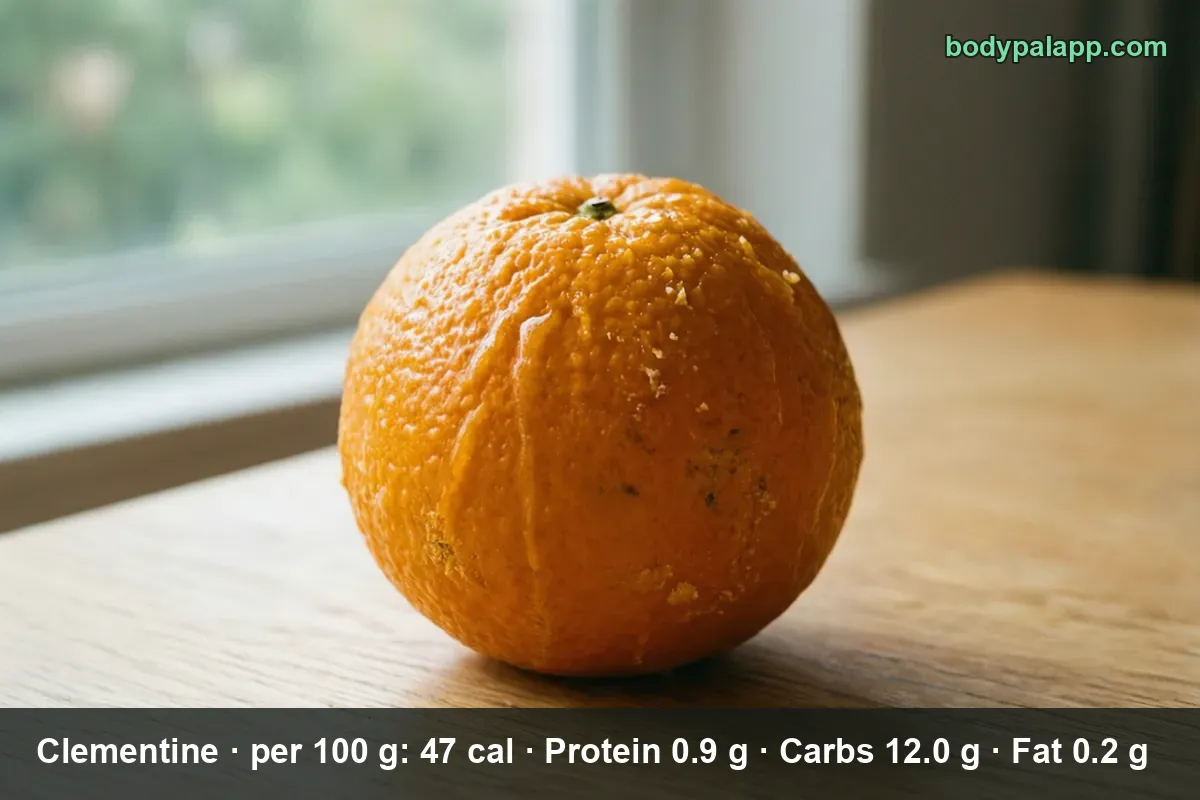
One clementine weighs about 74 g and carries 35 calories. Per 100 g the peeled fruit runs 47 calories, which puts it among the lightest things you can eat with your hands. Two of them, the serving size printed on most mesh bags, come to 70. Nearly all of that is carbohydrate.
On this page
- Clementine quick facts
- US servings, from one ounce to three fruit
- Mandarins, tangerines and the canned aisle
- Fiber and potassium do the work here
- How does a clementine compare?
- Most popular clementine orange brands
- FAQ
Clementine quick facts
The numbers below come from the USDA record SR Legacy 168195, "Clementines, raw". That is the fruit a shopper actually holds: a whole, raw, peeled clementine, not a mandarin and not something out of a can. USDA also attaches a ready-made household portion to that record, "1 fruit, 74 g", so the per-serving column is not guesswork.
Worth knowing before you read the table: USDA has a second entry, FNDDS 2709164 "Clementine, raw", that reports 53 calories per 100 g. It borrows the nutrient profile of the tangerine rather than running a separate clementine analysis, which is why the two records disagree by six calories. This page stays with the SR Legacy row and shows the FNDDS figure further down as a variant.
| Nutrient | Per 100 g | Per 1 clementine (74 g) | % Daily Value |
|---|---|---|---|
| Calories | 47 | 35 | — |
| Total fat | 0.15 g | 0.1 g | 0% |
| Carbohydrate | 12.02 g | 8.9 g | 3% |
| Dietary fiber | 1.7 g | 1.3 g | 4% |
| Total sugars | 9.18 g | 6.8 g | — |
| Protein | 0.85 g | 0.6 g | 1% |
| Sodium | 1 mg | 1 mg | 0% |
| Potassium | 177 mg | 131 mg | 3% |
% Daily Value is based on a 2,000-calorie diet.
Verified nutrition data
Numbers on this page come from USDA FoodData Central, the U.S. Department of Agriculture’s food composition database, and from manufacturer labels where a branded product is named. Last verified September 2026. How we verify our data →
Three rows you would see on a printed label are missing here on purpose. USDA does not publish a saturated fat or a cholesterol value for this record, and it publishes no added sugars figure for raw fruit, so rather than invent them the rows are left out. Total fat is 0.15 g per 100 g, which is close enough to nothing that the saturated share could not move the calorie count anyway. The 6.8 g of sugar in one fruit has no Daily Value at all: the FDA only sets a limit for added sugars, and a clementine's sugar is its own.
US servings, from one ounce to three fruit
| Serving | Weight | Calories |
|---|---|---|
| 1 oz | 28 g | 13 kcal |
| One clementine, USDA "1 fruit" | 74 g | 35 kcal |
| Two clementines, bag label serving | 148 g | 70 kcal |
| Three clementines | 222 g | 104 kcal |
| Per 100 g | 100 g | 47 kcal |
Only the 74 g row is a USDA household measure. The one-ounce, two-fruit and three-fruit rows are our own arithmetic from the USDA 100 g figure, not USDA servings. Clementines are small, so a single fruit sits below the 100 g mark, and per 100 g the fruit reads heavier than what you eat.
Two is the number most brands print. Darling Clementines lists a serving of 2 clementines (148 g) at 70 calories, and Wegmans uses the same 148 g serving with the same 70. That agreement is convenient: the label serving and USDA arithmetic land on the identical figure, so you can log a handful straight off the bag.
Size varies more than people expect. A small one off the bottom of the bag can run 55 g, a big one 90 g, which is a spread of roughly 26 to 42 calories for the same fruit. Counting fruit rather than weighing it is fine at this scale; a two-fruit miss is about the calories in a stick of gum.
Mandarins, tangerines and the canned aisle
| Version | Per 100 g | Typical piece | Calories |
|---|---|---|---|
| Clementine, raw (main record) | 47 kcal | 1 fruit, 74 g | 35 kcal |
| Clementine, FNDDS profile | 53 kcal | 1 fruit, 85 g | 45 kcal |
| Tangerine / mandarin, raw | 53 kcal | 1 medium, 88 g | 47 kcal |
| Mandarin oranges, canned in juice | 37 kcal | 1 cup, 249 g | 92 kcal |
| Mandarin oranges, canned in juice, drained | 38 kcal | 1 cup, 189 g | 72 kcal |
| Mandarin oranges, canned in light syrup | 61 kcal | 1 cup, 252 g | 154 kcal |
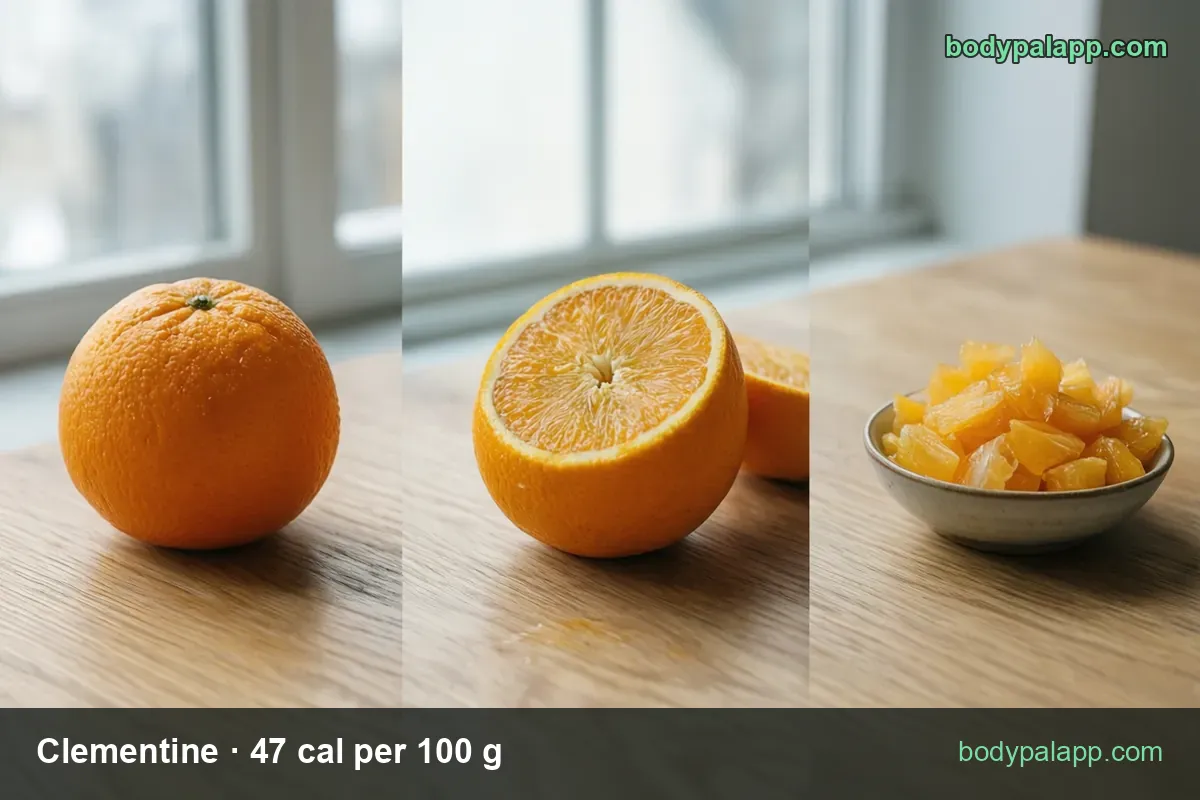
A raw mandarin is not a clementine's twin on the calorie sheet. It carries 53 calories per 100 g against 47, and because a medium one is heavier as well, the fruit comes to 47 calories where the clementine comes to 35. That is a third more for something that looks the same in a bowl.
The canned aisle is where the real spread hides, and it hides inside the cup. A cup of mandarin segments canned in light syrup is 154 calories. The same cup measure, drained and packed in juice, is 72. More than double, from the same fruit, decided entirely by what the segments were sitting in and how much of it you spooned out with them. In clementine terms, that syrup cup is more than four whole fruit.
Undrained juice-pack segments read 37 calories per 100 g, lower than the raw fruit, which looks like a win until you notice why: the packing liquid is mostly water and it dilutes every gram. Fill a cup and you are back to 92 calories, because a cup of wet segments weighs 249 g. Canned brands follow the same logic. Dole Mandarin Oranges come in at 40 calories per 100 g and Del Monte at 44, while Roland's whole mandarins in a heavier pack run 64.
Fiber and potassium do the work here
For 35 calories, one clementine delivers 1.3 g of fiber, or 4% of the 28 g Daily Value, and 131 mg of potassium, 3% of the 4,700 mg Daily Value. Protein is the row that does nothing: 0.6 g, 1% DV. Sodium is 1 mg, which is not even a rounding error against the 2,300 mg limit; matching the sodium in a teaspoon of table salt would take about 2,300 fruit.
Fiber is the useful angle. The Dietary Guidelines put most adults well short of 28 g a day, and MyPlate counts whole fruit toward the daily fruit cup rather than juice for exactly this reason. Two clementines give you 2.6 g of fiber for 70 calories. Canned mandarins in juice give 0.7 g per 100 g against the raw fruit's 1.7 g, so the can loses more than half the fiber before the sugar question comes up.
If you are watching intake, the clementine's advantage is not that it is a "low-calorie fruit" in the abstract. It is that the unit is small and self-limiting. You stop after two because your hands are sticky, which is a better portion control mechanism than most.
How does a clementine compare?
| Fruit | Per 100 g | US serving | Calories |
|---|---|---|---|
| Clementine, raw | 47 kcal | one fruit, 74 g | 35 kcal |
| Oranges, raw, all varieties | 47 kcal | 1 oz, 28 g | 13 kcal |
| Loquats, raw | 47 kcal | 1 oz, 28 g | 13 kcal |
| Orange juice, canned, unsweetened | 47 kcal | 1 oz, 28 g | 13 kcal |
Our take: all four of these land on exactly 47 calories per 100 g, which is the tidiest illustration you will find that per-100 g figures do not decide anything on their own. Unsweetened orange juice matches raw clementine gram for gram, but nobody drinks 74 g of juice, and juicing leaves behind most of the whole fruit's 1.7 g of fiber per 100 g. For cutting calories, eat the clementine and skip the glass. For fullness on the same calories, the whole fruit wins on fiber and on the simple fact that peeling takes time.
Most popular clementine orange brands in the United States
Ranked by how widely each product appears among foods sold in the United States, from the BodyPal food database of over 3.3 million products. Calories are the figures printed on each Nutrition Facts label, checked against USDA FoodData Central.
| Product | Calories (per 100 g) |
|---|---|
| Dole Mandarin Oranges | 40 cal |
| Dole Mandarin Oranges in Fruit Juice | 62 cal |
| Roland Fancy Whole Mandarin Oranges | 64 cal |
| Darling Clementines Clementine | 47 cal |
| Wegmans Clementines | 47 cal |
| Del Monte Mandarin Oranges | 44 cal |
Brand popularity: BodyPal food database. Nutrition: manufacturer labels / USDA FoodData Central.
Clementine FAQs
How many calories are in one clementine?
35 calories for one clementine of 74 g, the household portion USDA attaches to its raw clementine record, which runs 47 calories per 100 g. A small fruit near 55 g is closer to 26, a large one near 90 g about 42. Counting fruit instead of weighing them is accurate enough.
How many calories in 2 clementines?
70 calories for two clementines weighing 148 g together. That is also the serving printed on most bags: Darling Clementines and Wegmans both list 2 clementines, 148 g, 70 calories. Three fruit comes to 104 calories and 222 g. The two-fruit figure is our arithmetic from the USDA 100 g value.
Are clementines and mandarins the same calories?
No. A raw mandarin is 53 calories per 100 g against the clementine's 47, and a medium mandarin weighs 88 g, so it comes to 47 calories versus 35 for one clementine. That is roughly a third more per fruit for two citrus that look nearly identical in a bowl.
How many carbs are in a clementine?
8.9 g of carbohydrate in one 74 g clementine, which is 3% of the 275 g Daily Value. Per 100 g the fruit holds 12.02 g. Of the 8.9 g, 6.8 g is sugar and 1.3 g is fiber, so there is very little else in the fruit besides water.
How much sugar is in a clementine?
6.8 g of total sugars in one 74 g clementine, or 9.18 g per 100 g. There is no % Daily Value for total sugars, because the FDA sets its 50 g limit for added sugars only, and USDA publishes no added sugars figure for raw fruit. Two clementines come to 13.6 g.
How much fiber is in a clementine?
1.3 g of fiber in one clementine, 4% of the 28 g Daily Value, from 1.7 g per 100 g. Two fruit give 2.6 g. Canned mandarin segments packed in juice carry only 0.7 g per 100 g, so the can drops more than half the fiber of the fresh fruit.
Are clementines good for weight loss?
At 35 calories each with 1.3 g of fiber, clementines are one of the cheapest sweet things you can log, and the peeling naturally slows you down. Three fruit still total only 104 calories. If you are choosing between citrus, the clementine beats a mandarin at 47 and unsweetened orange juice per mouthful.
How many calories in a cup of canned mandarin oranges?
154 calories for a cup of segments in light syrup (252 g), 92 for a cup packed in juice with the liquid (249 g), and 72 for a cup drained (189 g). Same fruit, more than double the calories, decided by the packing liquid and whether you drain the can.
Similar foods
- Blood Orange — 62 cal per medium blood orange
- Orange — 62 cal per medium orange
- Plum — 30 cal per plum
- Cara Cara Orange — 69 cal per medium orange
- Nectarine — 31 cal for 1/2 medium
- Pineapple — 83 cal per cup chunks
Count it without the math
Point the camera at the bowl and BodyPal counts the clementines for you, peel off and all.


How long does it take to burn off a clementine?
One clementine (74 g) is 35 kcal. Enter your weight and the amount you ate to see how long it takes you to burn that off:
lb
| Activity | Time to burn 35 kcal |
|---|---|
| Walking, brisk | 7 min |
| Cycling, moderate | 4 min |
| Swimming, moderate | 5 min |
| Jogging | 4 min |
| Weight training, moderate | 8 min |
Times are for a 155 lb adult at a steady pace; change the weight to see yours. The amount is set to the portion in the text (74 g); change it to what you actually ate. BodyPal works this out from your steps automatically.
This table assumes you know your daily total. If you do not, the daily calorie calculator works it out from five numbers.