
How many calories are in cornstarch?
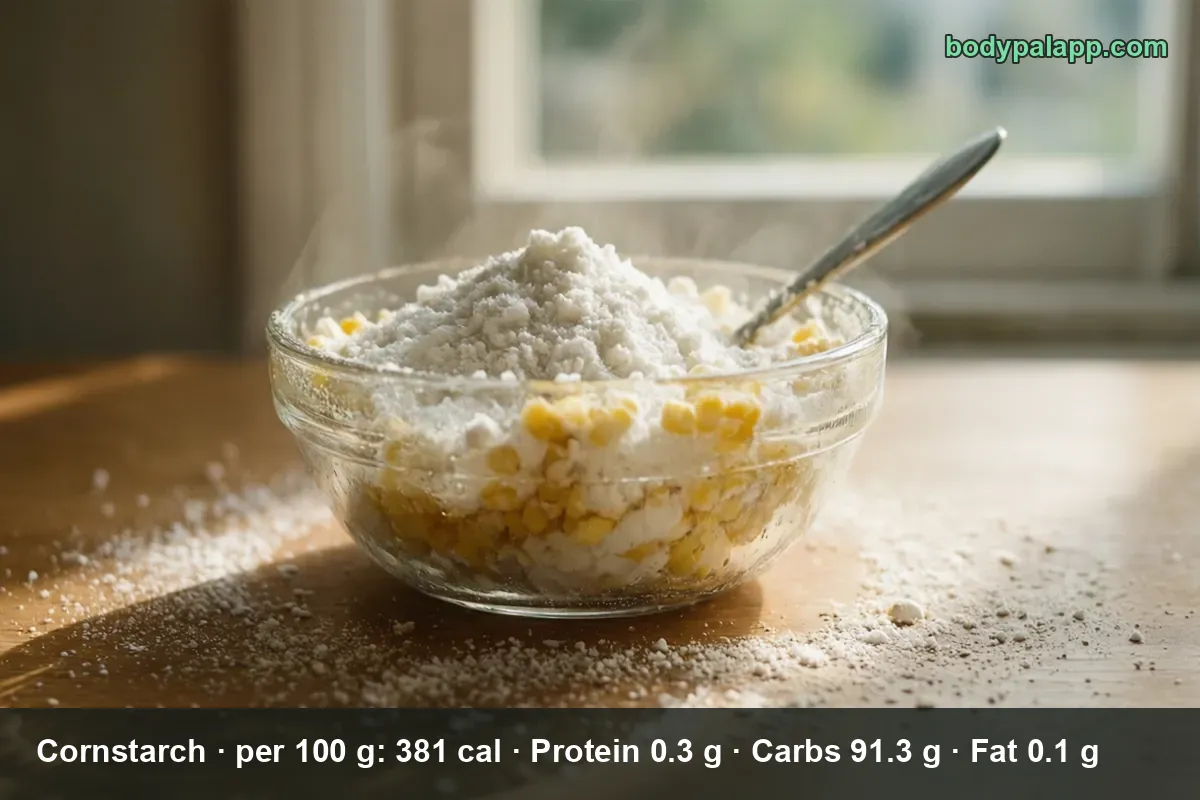
One level tablespoon of cornstarch weighs 8 g and carries 30 calories. Per 100 g the powder runs 381 calories, almost all of it starch: 91.27 g of carbohydrate, 0.26 g of protein and a rounding error of fat. A full cup, 128 g, is 488 calories.
On this page
- Cornstarch quick facts
- US servings from a teaspoon to a full cup
- Gluten-free foods made with cornstarch
- Cornstarch vs corn flour
- What the Daily Values show
- How does cornstarch compare?
- Most popular cornstarch brands
- FAQ
Cornstarch quick facts
USDA lists the pure ingredient once in its reference database: SR Legacy record 169698, "Cornstarch". That is the white powder in the yellow box on the shelf, and it is the row used here. Every other reference entry that mentions corn starch is a finished product built around it, so its calories belong to the bread or the cracker, not to the thickener.
The label serving printed on US boxes is one tablespoon, 8 g, which is what the middle column shows.
| Nutrient | Per 100 g | Per 1 tbsp (8 g) | % Daily Value |
|---|---|---|---|
| Calories | 381 | 30 | — |
| Total fat | 0.05 g | 0.0 g | 0% |
| Saturated fat | 0.01 g | 0.0 g | 0% |
| Carbohydrate | 91.27 g | 7.3 g | 3% |
| Dietary fiber | 0.9 g | 0.1 g | 0% |
| Total sugars | 0 g | 0 g | — |
| Protein | 0.26 g | 0.0 g | 0% |
| Sodium | 9 mg | 1 mg | 0% |
% Daily Value is based on a 2,000-calorie diet.
Verified nutrition data
Numbers on this page come from USDA FoodData Central, the U.S. Department of Agriculture’s food composition database, and from manufacturer labels where a branded product is named. Last verified September 2026. How we verify our data →
Two rows you would see on a modern Nutrition Facts panel are missing here: added sugars and trans fat. The SR Legacy edition of this record does not publish either one, and neither applies to a plain starch, which has no sweetener and no hydrogenated fat in it. Cholesterol is 0 mg and potassium is only 3 mg per 100 g, so both stay out of the table as well.
Store brands print slightly different math. Bob's Red Mill, Let's Do Organic and Tops all declare 375 calories per 100 g against USDA's 381. Multiply either figure by a tablespoon and you get the same rounded 30, which is why the gap never shows up in a food log.
US servings from a teaspoon to a full cup
| Serving | Weight | Calories |
|---|---|---|
| 1 tsp | 2.7 g | 10 kcal |
| 1 tbsp, the label serving | 8 g | 30 kcal |
| 1 oz | 28 g | 107 kcal |
| 1/4 cup | 32 g | 122 kcal |
| 1 cup | 128 g | 488 kcal |
| Per 100 g | 100 g | 381 kcal |
Only the cup is a USDA household measure; the teaspoon, tablespoon, ounce and quarter cup are our own arithmetic scaled from the USDA 100 g figure rather than USDA servings.
This is the trap worth remembering. A cup of cornstarch weighs sixteen times what a tablespoon weighs, so a recipe that calls for a full cup is putting 488 calories into the pan while the person reading it pictures the harmless spoonful they use for gravy. Cornstarch is light and dusty, which makes the jump from spoon to cup feel much smaller than it is.
Working the other way is more useful for logging. Thicken a stew with one tablespoon and the whole pot gained 30 calories. Split it four ways and nobody's plate moved by more than 8.
Gluten-free foods made with cornstarch
Cornstarch does most of its calorie damage indirectly, as the structural flour in gluten-free baking. USDA carries four such products, and they land nowhere near each other.
| Version | Per 100 g | Typical piece | Calories |
|---|---|---|---|
| Cornstarch, plain | 381 kcal | 1 tbsp (8 g) | 30 kcal |
| Gluten-free white bread with corn starch | 248 kcal | 1 slice (35 g) | 87 kcal |
| Gluten-free rolls with corn starch | 239 kcal | 1 roll (78 g) | 186 kcal |
| Gluten-free pretzels with cornstarch | 389 kcal | 1 serving (30 g) | 117 kcal |
| Gluten-free multigrain crackers with corn starch | 456 kcal | 3 crackers (10.7 g) | 49 kcal |
The bread and the rolls sit at 248 and 239 per 100 g because dough is mostly water once it is baked; the dry powder they were built from is 381. Pretzels and crackers dry back out, and the crackers add 15.41 g of fat per 100 g on top, which makes them the densest thing on this page at 456.
Sodium is the other surprise. A tablespoon of cornstarch has 1 mg. The gluten-free pretzels carry 1,567 mg per 100 g, so a 30 g serving is roughly 470 mg, about 20% of the Daily Value, by our own arithmetic from the USDA 100 g figure. The starch is not what salts your snack.
Cornstarch vs corn flour
These two get swapped in recipes constantly, and by calories the swap is almost free. Degermed corn flour is 375 per 100 g against cornstarch at 381, a six-calorie gap that disappears the moment you round a spoonful.
Nutritionally they are not the same thing at all. Corn flour is the milled kernel and keeps 5.59 g of protein per 100 g. Cornstarch is only the starch fraction, and its 0.26 g of protein rounds to zero on any serving a person actually uses. Substituting one for the other changes how the sauce sets, not what it costs you.
What the Daily Values show
Run a tablespoon against the FDA Daily Values and almost every line reads 0%: fat, saturated fat, protein, sodium, fiber. The only row that moves is carbohydrate, at 3%. That single pattern is the whole nutritional story of cornstarch, and it is why a food log entry for it looks so strange next to real foods.
Scale up and the picture changes fast. A cup delivers about 117 g of carbohydrate, roughly 42% of the 275 g Daily Value, with only 1.2 g of fiber and 12 mg of sodium alongside it, all scaled by us from the 100 g row. Refined starch of this kind is what MyPlate counts against your refined-grain allowance rather than toward whole grains, so if you are choosing between thickeners on nutritional grounds, the whole-grain flour is the better pick and cornstarch is the better texture.
For anyone counting carbohydrate closely, the useful number is 7.3 g per tablespoon with 0.1 g of fiber. Practically all of it counts.
How does cornstarch compare?
| Powder | Per 100 g | US serving | Calories | Protein per oz |
|---|---|---|---|---|
| Cornstarch | 381 kcal | 1 oz (28 g) | 107 kcal | 0.1 g |
| Corn flour, degermed | 375 kcal | 1 oz (28 g) | 105 kcal | 1.6 g |
| Millet flour | 382 kcal | 1 oz (28 g) | 107 kcal | 3.0 g |
| Instant white rice, dry | 380 kcal | 1 oz (28 g) | 106 kcal | 2.2 g |
Our take: by the ounce these four are interchangeable, spanning just two calories from 105 to 107, so choosing among them to save energy is wasted effort. What separates them is what comes with the calories. Millet flour brings 3.0 g of protein per ounce, corn flour 1.6 g, and cornstarch 0.1 g. If a thickener is going into a sauce a tablespoon at a time, take the cornstarch and stop thinking about it. If the powder is the bulk of a loaf or a batch of pancakes, the one with protein and fiber is doing more work for the same calories.
Most popular cornstarch brands in the United States
Ranked by how widely each product appears among foods sold in the United States, from the BodyPal food database of over 3.3 million products. Calories are the figures printed on each Nutrition Facts label, checked against USDA FoodData Central.
| Product | Calories (per 100 g) |
|---|---|
| Bob's Red Mill Cornstarch | 375 cal |
| Bob's Red Mill Cornstarch (Thickens Soups, Sauces and Fillings) | 375 cal |
| Let's Do Organic Organic Cornstarch | 375 cal |
| Tops Cornstarch | 375 cal |
Brand popularity: BodyPal food database. Nutrition: manufacturer labels / USDA FoodData Central.
Cornstarch FAQs
How many calories are in 1 tablespoon of cornstarch?
30 calories in a level tablespoon, which USDA weighs at 8 g. That tablespoon carries 7.3 g of carbohydrate and essentially nothing else: 0.0 g of fat, 0.0 g of protein and 1 mg of sodium. Two tablespoons, the usual amount for a large pan of gravy, come to 60.
How many calories are in 1 cup of cornstarch?
488 calories. A cup of cornstarch weighs 128 g, and it is the one household measure USDA publishes for the ingredient. That cup holds about 117 g of carbohydrate, roughly 42% of the Daily Value, so a recipe calling for a full cup is not a small addition to the pan.
How many carbs are in cornstarch?
91.27 g per 100 g, about as close to pure carbohydrate as a kitchen ingredient gets. Only 0.9 g of that is fiber and none of it is sugar. A tablespoon works out to 7.3 g of carbohydrate, 3% of the Daily Value, and a quarter cup to 29.2 g.
Is cornstarch keto-friendly?
A single tablespoon is 7.3 g of carbohydrate with only 0.1 g of fiber, so nearly all of it counts. Against the 275 g Daily Value that is small, but against a strict low-carb allowance one tablespoon is a real dent, and a quarter cup at 29.2 g is more than most such plans allow in a day.
Cornstarch vs corn flour: which has more calories?
Cornstarch, by six calories per 100 g: 381 against 375 for degermed corn flour. Per ounce that is 107 versus 105, a difference you cannot taste or track. Protein is where they split, at 0.26 g per 100 g for cornstarch and 5.59 g for corn flour.
Does cornstarch have protein?
Barely: 0.26 g per 100 g, which rounds to 0.0 g in a tablespoon and 0% of the Daily Value. Even a full cup delivers only about 0.3 g. Cornstarch is the starch fraction of the corn kernel with the germ and protein removed, so there is almost nothing left.
Is cornstarch gluten-free?
Yes, it is milled from corn rather than wheat, and USDA's database shows it as the backbone of gluten-free baking: white gluten-free bread at 248 calories per 100 g, rolls at 239 and multigrain crackers at 456 all list corn starch among the ingredients. If you have celiac disease, check the package for certification, since mills vary.
How many calories does cornstarch add to a sauce?
About 30 per tablespoon, and most pan sauces use one or two, so 30 to 60 calories spread over the whole batch. Split across four servings that is 8 to 15 calories a plate. The thickener is rarely why a sauce is heavy, since the butter and the cream cost far more.
Similar foods
- Cornmeal — 581 cal per cup
- Potato wedges — 138 cal for 3 oz
- Ear of Corn — 99 cal per medium ear
- Sweet Potato — 103 cal per medium, baked
- Papaya salad — 190 cal per plate
- Carrot — 53 cal per cup chopped
Count it without the math
Point the camera at the plate and BodyPal counts the sauce, the thickener and everything under it for you.


How long does it take to burn off cornstarch?
A 1-tablespoon (8 g) serving is 30 kcal. Enter your weight and the amount you ate to see how long it takes you to burn that off:
lb
| Activity | Time to burn 30 kcal |
|---|---|
| Walking, brisk | 6 min |
| Cycling, moderate | 4 min |
| Swimming, moderate | 4 min |
| Jogging | 4 min |
| Weight training, moderate | 7 min |
Times are for a 155 lb adult at a steady pace; change the weight to see yours. The amount is set to the portion in the text (8 g); change it to what you actually ate. BodyPal works this out from your steps automatically.
This table assumes you know your daily total. If you do not, the daily calorie calculator works it out from five numbers.