
How many calories are in a deviled egg?
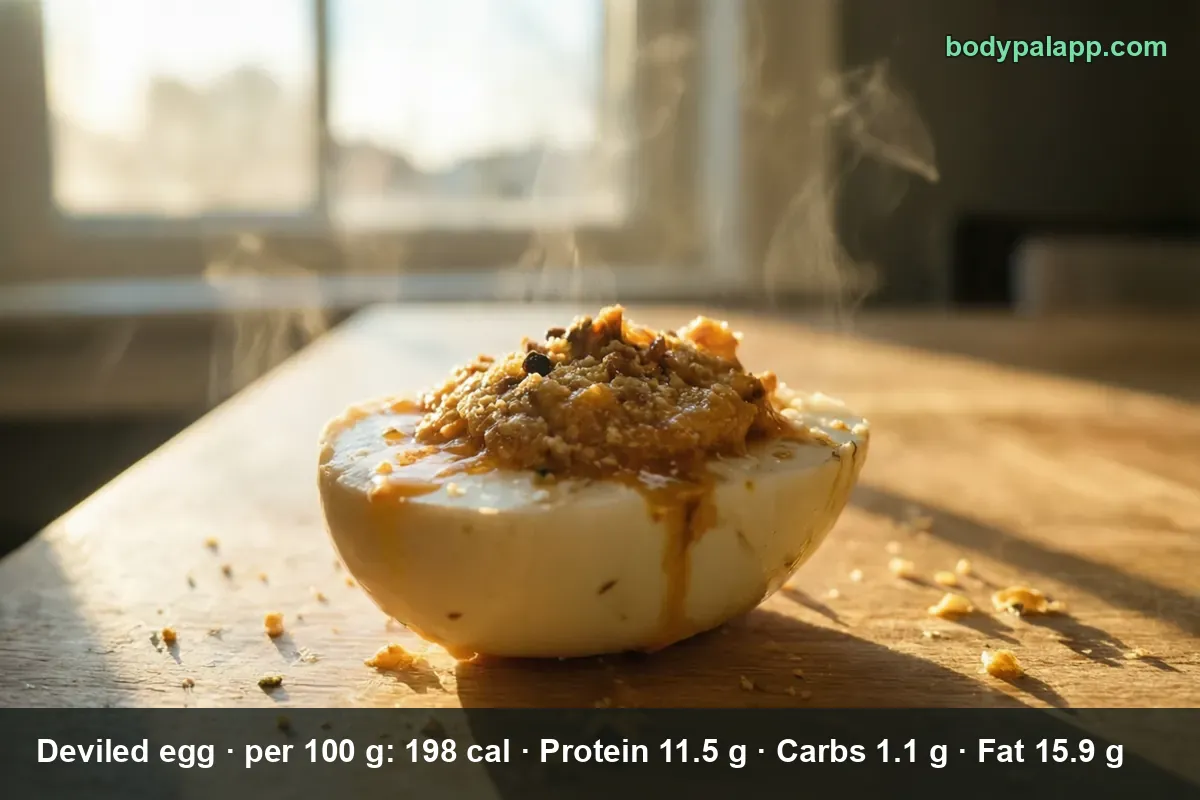
One deviled egg half — a boiled white with its yolk-and-mayo filling piped back in — is 59 calories. Per 100 g the dish runs 198 calories. Two halves, the way most people take them off a platter, come to 119. The filling, not the egg, is what moves the number.
On this page
- Deviled egg quick facts
- US servings, from one half to a party platter
- Store-bought, potato salad and other deviled egg versions
- Cholesterol is the row that moves first
- How does a deviled egg compare?
- Most popular deviled egg brands
- Deviled egg FAQs
Deviled egg quick facts
The row behind every number here is FNDDS 2707181, "Egg, deviled", the only USDA record for the finished dish rather than for a plain boiled egg. It is also the thing a person is actually holding: half a hard-boiled white, filled with mashed yolk, mayonnaise and mustard. USDA's own portion for that record is "1 egg" at 30 g, which is one half with its filling — not a whole egg, and not two halves.
That definition matters more than it sounds. Most people say "one deviled egg" and mean one half off the tray, and that is exactly what the 59-calorie figure covers. If you took both halves of the same egg, double everything below.
| Nutrient | Per 100 g | Per 1 deviled egg half (30 g) | % Daily Value |
|---|---|---|---|
| Calories | 198 | 59 | — |
| Total fat | 15.9 g | 4.8 g | 6% |
| Saturated fat | 3.95 g | 1.2 g | 6% |
| Carbohydrate | 1.07 g | 0.3 g | 0% |
| Dietary fiber | 0 g | 0 g | 0% |
| Total sugars | 1.07 g | 0.3 g | — |
| Protein | 11.52 g | 3.5 g | 7% |
| Sodium | 430 mg | 129 mg | 6% |
| Cholesterol | 343 mg | 103 mg | 34% |
| Potassium | 116 mg | 35 mg | 1% |
% Daily Value is based on a 2,000-calorie diet.
Verified nutrition data
Numbers on this page come from USDA FoodData Central, the U.S. Department of Agriculture’s food composition database, and from manufacturer labels where a branded product is named. Last verified September 2026. How we verify our data →
Two rows you will not find above: added sugars and trans fat. This FNDDS edition does not publish either value for deviled eggs, so listing them would mean inventing them. Everything else on the label is there, including the two rows most calorie pages skip — cholesterol at 103 mg per half and potassium at a modest 35 mg.
US servings, from one half to a party platter
| Serving | Weight | Calories |
|---|---|---|
| 1 oz | 28 g | 55 kcal |
| One deviled egg half | 30 g | 59 kcal |
| Two halves, one whole egg | 60 g | 119 kcal |
| Four halves, a small plate | 120 g | 238 kcal |
| Six halves, a party serving | 180 g | 356 kcal |
| Per 100 g | 100 g | 198 kcal |
Only the 30 g half is a USDA household measure. The 1 oz, two-half, four-half and six-half lines are our own arithmetic from the USDA 100 g figure, not USDA servings — deviled eggs are hand-assembled, so a heaped filling can push a single half toward 70 calories and a stingy one down near 50.
The useful thing about this food is how flat the arithmetic is. Every half is roughly 60 calories, so counting them is counting the calories: three halves, about 180; five, about 300. Very few party foods are that easy to track by eye.
Where it stops being friendly is the salt. Six halves carry 774 mg of sodium, 34% of the Daily Value, from a plate that only cost 356 calories. That is about a third of a teaspoon of table salt handed over with a snack most people do not think of as salty at all.
Store-bought, potato salad and other deviled egg versions
| Version | Per 100 g | Typical piece | Calories |
|---|---|---|---|
| Classic deviled egg, homemade | 198 kcal | 1 half (30 g) | 59 kcal |
| Store-bought deviled eggs, refrigerated pack | 286 kcal | 1 half (28 g) | 80 kcal |
| Deviled egg potato salad | 171 kcal | 1/2 cup (140 g) | 239 kcal |
| Deviled egg sandwich | 218 kcal | 1 sandwich (170 g) | 371 kcal |
| Scrambled egg with cheese and meat | 198 kcal | 1 oz (28 g) | 55 kcal |
The packaged version is the surprise. Eggland's Best Deviled Eggs and its Classic Mustard sibling both come in at 286 calories per 100 g — 44% denser than the USDA record for homemade — and each labeled half is 80 calories in a piece that weighs slightly less than a homemade one. The filling is richer and there is more of it relative to the white. Two packaged halves are 160 calories; two homemade are 119.
Deviled egg potato salad is a different food wearing the same name. At 171 calories per 100 g it is lighter by weight than the eggs themselves, but nobody eats it 30 g at a time: a half-cup scoop is 239 calories, four halves' worth. The sandwich is heavier still, 371 calories for a 170 g build, most of it bread.
The last row is there for scale. A cheese-and-meat scrambled egg lands at the same 198 calories per 100 g as a deviled egg, which tells you the mayonnaise in the filling is doing about what cheese and breakfast meat do to eggs — no more, no less.
Cholesterol is the row that moves first
Calories are not the binding constraint on a deviled egg. Cholesterol is. One half is 103 mg, 34% of the FDA Daily Value of 300 mg. Two halves — 119 calories, a snack most people would not think twice about — are 206 mg, or 69% of the day. Four halves clear the DV outright at 411 mg while still costing only 238 calories.
That is not a warning, it is a ratio worth knowing: this food spends its "budget" in a different currency than most snacks do. The current Dietary Guidelines for Americans advise keeping dietary cholesterol as low as possible within a healthy eating pattern rather than naming a hard cap, and the Daily Value on the label remains the practical yardstick. If a doctor has asked you to watch cholesterol, deviled eggs are worth counting by the half rather than by the plate.
On the other side of the ledger, the protein is real and cheap. Each half brings 3.5 g for 59 calories, 7% of the Daily Value, and the MyPlate protein foods group counts eggs among its core picks. Six halves are 21 g of protein — a genuine protein serving — for 356 calories. Saturated fat stays low per piece at 1.2 g, 6% of the DV, because mayonnaise is mostly unsaturated oil rather than butter.
How does a deviled egg compare?
| Egg dish | Per 100 g | US serving | Calories |
|---|---|---|---|
| Deviled egg | 198 kcal | one half, 30 g | 59 kcal |
| Scrambled egg with cheese and meat, margarine | 198 kcal | 1 oz, 28 g | 55 kcal |
| Egg omelet with meat, made with oil | 199 kcal | 1 oz, 28 g | 56 kcal |
| Egg omelet with meat, made with animal fat | 196 kcal | 1 oz, 28 g | 55 kcal |
All four of these dishes land inside a three-calorie band per 100 g, from 196 to 199. Cooked eggs with fat added are simply a 200-calorie-per-100 g food, and the fat you choose barely shifts the total.
Our take: for weight control, deviled eggs are one of the easier party foods to hold a line on, because the unit is fixed and each unit is about 60 calories — take three, spend 180, and you are done. For satiety per calorie, the omelets beat them on protein, 12.7 to 13.3 g per 100 g against 11.5 g. The place a deviled egg loses is the store-bought tray, where the same-looking half costs 80 calories instead of 59, and the cholesterol column, which fills up roughly eleven times faster than the calorie column does.
Most popular deviled egg brands in the United States
Ranked by how widely each product appears among foods sold in the United States, from the BodyPal food database of over 3.3 million products. Calories are the figures printed on each Nutrition Facts label, checked against USDA FoodData Central.
| Product | Calories (per 100 g) |
|---|---|
| Eggland's Best Deviled Eggs | 286 cal |
| Eggland's Best Deviled Eggs Classic Mustard | 286 cal |
Brand popularity: BodyPal food database. Nutrition: manufacturer labels / USDA FoodData Central.
Deviled egg FAQs
How many calories are in one deviled egg?
One deviled egg half is 59 calories, which is what USDA counts as a single deviled egg: 30 g of egg white plus filling. The dish runs 198 calories per 100 g. Nearly all of that comes from the yolk and mayonnaise filling rather than from the white itself.
How many calories are in 2 deviled eggs?
Two halves are 119 calories, scaled from the USDA 100 g figure rather than taken from a USDA serving. They also carry 6.9 g of protein, 258 mg of sodium and 206 mg of cholesterol, which is 69% of the Daily Value. The calories stay small; the cholesterol does not.
How much protein is in a deviled egg?
3.5 g of protein per half, or 7% of the Daily Value, from 11.52 g per 100 g. Four halves bring 14 g for 238 calories, which is a reasonable protein snack. The white and the yolk both contribute; the mayonnaise adds fat and calories but almost no protein.
How many carbs are in a deviled egg?
0.3 g of carbohydrate per half, from 1.07 g per 100 g, with zero fiber. Even six halves total under 2 g of carbs. The trace amount comes from the mustard, relish or sweetener some fillings include, so a sweeter recipe will sit slightly above this figure.
How much cholesterol is in a deviled egg?
103 mg per half, which is 34% of the 300 mg Daily Value, from 343 mg per 100 g. Three halves reach 309 mg and pass the Daily Value at 177 calories. This is the row that limits deviled eggs long before the calorie count does.
Are deviled eggs keto-friendly?
Yes, on the numbers: 0.3 g of carbohydrate per half against 4.8 g of fat and 3.5 g of protein, so roughly 73% of the 59 calories come from fat. Few foods fit a very low carbohydrate pattern this neatly. Watch the sodium instead, at 129 mg per half.
How many calories are in store-bought deviled eggs?
80 calories per labeled half for the refrigerated packs in USDA's branded database, from 286 calories per 100 g. That is 44% denser by weight than the homemade USDA record's 198, and 21 calories more per piece even though the packaged half weighs 28 g against 30 g.
Are deviled eggs healthy?
Each half gives 3.5 g of protein for 59 calories and almost no carbohydrate, which is a good trade. The counterweights are 129 mg of sodium and 103 mg of cholesterol per piece. If you are watching either one, two halves is a sensible stopping point rather than six.
Similar foods
- Omelet — 305 cal for 3-egg omelet
- Crepe — 179 cal per crepe
- Egg — 72 cal per large egg
- Pancake — 423 cal for 3 medium pancakes
- Toast with butter — 100 cal per slice with butter
- Fish Cake — 180 cal per cake or patty
Count it without the math
Point the camera at the platter and BodyPal counts the halves for you, filling and all.


How long does it take to burn off a deviled egg?
One deviled egg half (30 g) is 59 kcal. Enter your weight and the amount you ate to see how long it takes you to burn that off:
lb
| Activity | Time to burn 59 kcal |
|---|---|
| Walking, brisk | 12 min |
| Cycling, moderate | 7 min |
| Swimming, moderate | 8 min |
| Jogging | 7 min |
| Weight training, moderate | 13 min |
Times are for a 155 lb adult at a steady pace; change the weight to see yours. The amount is set to the portion in the text (30 g); change it to what you actually ate. BodyPal works this out from your steps automatically.
One food is easy to picture; a whole day is harder. See how many calories you need a day and what a deficit actually looks like.