
How many calories are in a Dilly Bar?
One Dairy Queen Dilly Bar weighs 87 g and carries 220 calories. Per 100 g the bar runs 253 calories, lighter than most chocolate-coated ice cream bars because the center is reduced-fat soft serve rather than full-fat ice cream. Two bars out of the grocery box come to 440.
On this page
- Dilly Bar quick facts
- US servings, from one ounce to two bars
- Chocolate, butterscotch and no sugar added
- Saturated fat is the row that bites
- How does a Dilly Bar compare?
- Most popular dilly bar brands
- Dilly Bar FAQs
Dilly Bar quick facts
The record used here is the product you actually hold: USDA Branded 522728, "DILLY BAR", filed by International Dairy Queen under GTIN 073245000098, with a label serving of one bar at 87 g. Generic ice cream bar entries describe full-fat ice cream dipped in chocolate. A Dilly Bar is not that. The center is reduced-fat soft serve, and swapping in a generic record would add roughly 30 calories a bar for the wrong reason.
Everything below comes off that one record, scaled by weight where a serving is not a label serving.
| Nutrient | Per 100 g | Per 1 bar (87 g) | % Daily Value |
|---|---|---|---|
| Calories | 253 | 220 | — |
| Total fat | 14.94 g | 13.0 g | 17% |
| Saturated fat | 10.34 g | 9.0 g | 45% |
| Carbohydrate | 28.74 g | 25.0 g | 9% |
| Dietary fiber | 0.0 g | 0.0 g | 0% |
| Total sugars | 25.29 g | 22.0 g | — |
| Protein | 3.45 g | 3.0 g | 6% |
| Sodium | 121 mg | 105 mg | 5% |
% Daily Value is based on a 2,000-calorie diet.
Verified nutrition data
Numbers on this page come from USDA FoodData Central, the U.S. Department of Agriculture’s food composition database, and from manufacturer labels where a branded product is named. Last verified September 2026. How we verify our data →
Two rows you would expect are missing. Added sugars is not reported on this record, because the label behind it predates the mandatory "Added Sugars" line, so there is no number to publish and the row is left out rather than guessed. Potassium is absent for the same reason. Cholesterol is there: 17 mg per 100 g, 15 mg a bar, 5% of the Daily Value.
US servings, from one ounce to two bars
| Serving | Weight | Calories |
|---|---|---|
| 1 oz | 28 g | 72 kcal |
| Half a bar | 43.5 g | 110 kcal |
| One bar, label serving | 87 g | 220 kcal |
| Two bars | 174 g | 440 kcal |
| Per 100 g | 100 g | 253 kcal |
Only one line there is a USDA serving: the 87 g bar, which is exactly how Dairy Queen files it. The ounce, the half bar and the two-bar row are our own arithmetic from the USDA 100 g figure, not USDA servings.
The half bar is worth a second look, because it is the serving people invent for themselves and then abandon. A bar on a stick does not survive being put back in the freezer half eaten, so 110 calories tends to become 220 within about a minute. If you are counting, the honest unit for this food is the whole bar.
One more practical note: the 87 g weight comes from the retail box. A bar handed to you at the counter of a Dairy Queen store is dipped by hand, and dipped weight varies, so treat 220 as the number for the boxed bar in your freezer.
Chocolate, butterscotch and no sugar added
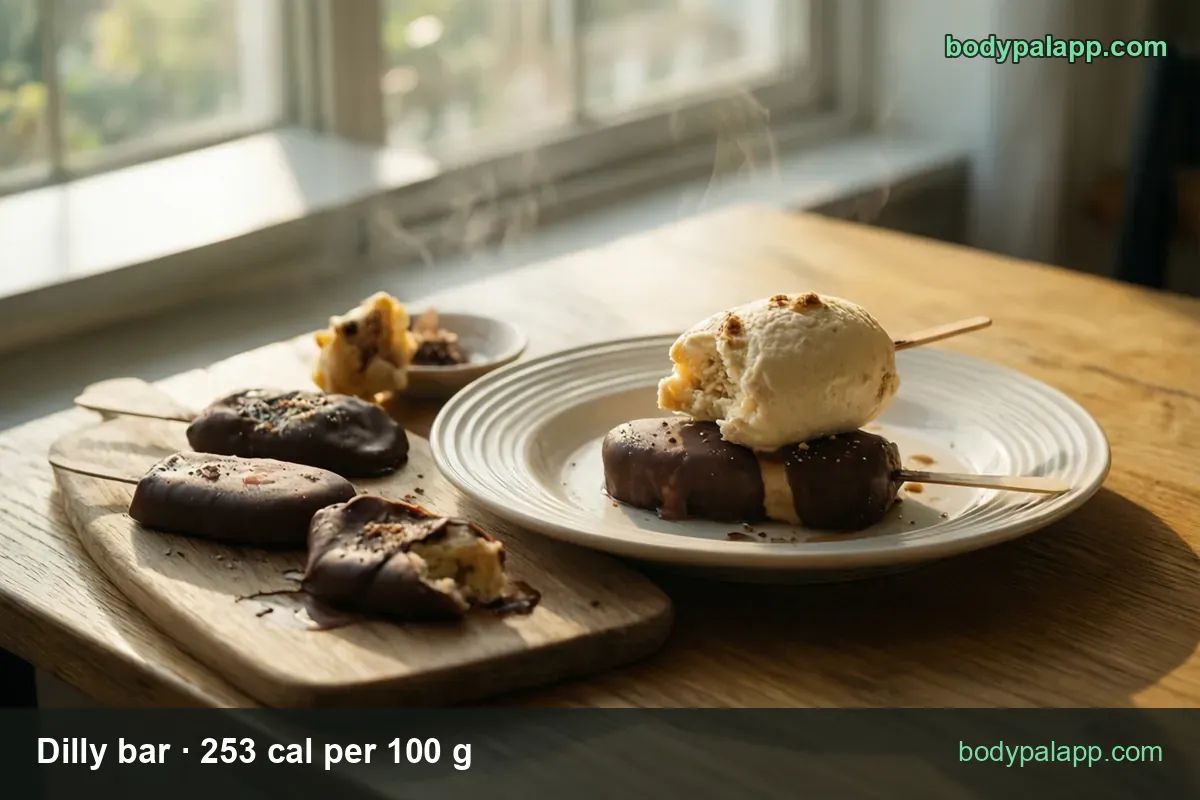
Four Dilly Bar records sit in the USDA Branded database, all from International Dairy Queen, and they do not line up the way the names suggest. Per-bar sugars and saturated fat in the table below are scaled from each record's 100 g values, since only the calorie figure appears on the label.
| Version | Per 100 g | Bar | Calories | Sugars | Saturated fat |
|---|---|---|---|---|---|
| Dilly Bar, original | 253 kcal | 87 g | 220 kcal | 22.0 g | 9.0 g |
| Chocolate Dilly Bar | 253 kcal | 87 g | 220 kcal | 21.0 g | 10.0 g |
| Butterscotch Dilly Bar | 230 kcal | 87 g | 200 kcal | 21.0 g | 9.0 g |
| Dilly Bar, no sugar added | 227 kcal | 88 g | 200 kcal | 6.0 g | 9.0 g |
| Generic chocolate-coated vanilla bar | 331 kcal | 75 g | 248 kcal | 13.7 g | 9.9 g |
| Light chocolate-coated bar | 236 kcal | 75 g | 177 kcal | 7.8 g | 9.8 g |
The chocolate version is a calorie tie with the original, 220 either way, but its cocoa shell pushes saturated fat to 10.0 g a bar against 9.0 g, and drops sodium from 105 mg to 55 mg. It also brings 1.0 g of fiber, where the original has none. Choosing chocolate over the crunch coating is a wash on calories and a small step up on saturated fat.
Butterscotch is the quiet saving. Its shell is built on powdered sugar rather than a fat-heavy dip, so fat falls from 14.94 to 12.64 g per 100 g and the bar lands at 200 calories, 20 under the original for the same 87 g.
The no sugar added bar is the interesting one. Sugars collapse from 25.29 to 6.82 g per 100 g, a drop of nearly three quarters, yet calories fall only from 253 to 227. Maltitol and polydextrose replace the sugar and still carry energy, so the bar comes in at 200 calories, the same as butterscotch. What it does gain is fiber, 5.7 g per 100 g from the polydextrose, versus 0.0 g in the original. If sugar is what you are tracking, the swap is real. If calories are what you are tracking, it buys you 20.
Saturated fat is the row that bites
Calories are not the number that stands out on this label. Saturated fat is. One bar delivers 9.0 g, which is 45% of the FDA Daily Value of 20 g — nearly half a day's allowance from a 220-calorie dessert. Eat two and you are at 90%, with 440 calories spent.
That fat is not really the ice cream. The center is reduced-fat soft serve, which is why the bar sits at 253 calories per 100 g while the generic chocolate-coated ice cream bar sits at 331. The coating is where the saturated fat lives, and switching to the light generic bar does not fix it: that record still carries 9.8 g of saturated fat a bar, essentially the same as the Dilly Bar, while saving 43 calories. A "light" coated bar is light on calories, not on the fat in the shell.
The Dietary Guidelines for Americans suggest keeping saturated fat under 10% of daily calories, about 22 g on a 2,000-calorie day. One bar is roughly 40% of that. It is a dessert, and treating it as one is the sensible read; if you are watching saturated fat that day, the butterscotch bar or a half portion of anything else is the better pick. For the dairy in your day generally, MyPlate counts frozen desserts as a poor substitute for milk or yogurt, and the 3.0 g of protein per bar shows why.
Sodium, by contrast, is a non-issue here: 105 mg is 5% of the Daily Value, and the chocolate version halves even that.
How does a Dilly Bar compare?
| Frozen novelty | Per 100 g | US serving | Calories |
|---|---|---|---|
| Dilly Bar | 253 kcal | one bar, 87 g | 220 kcal |
| Ice cream bar, vanilla, chocolate coated | 331 kcal | one bar, 75 g | 248 kcal |
| Light ice cream bar, vanilla, chocolate coated | 236 kcal | one bar, 75 g | 177 kcal |
| Ice cream bar, chocolate | 329 kcal | 1 oz, 28 g | 93 kcal |
Of the four records here, only the light bar is lower per 100 g than the Dilly Bar, at 236 against 253. Size undoes most of that advantage in the other direction: the Dilly Bar is 87 g against 75 g for the generic bars, so a 78-calorie gap per 100 g against the standard chocolate-coated bar shrinks to 28 calories once you compare bar to bar.
Our take: for a stick-and-coating dessert, the Dilly Bar is a reasonable pick — 220 calories is less than the generic chocolate-dipped bar it looks like, and it is a fixed, portioned amount rather than a scoop you keep topping up. For weight loss, treat it as your one sweet thing for the day and take the butterscotch at 200. For saturated fat, none of these bars are good, and the light version's 9.8 g proves the coating is the problem, not the ice cream. If you want two of something, two half bars is a fiction; buy the smaller box instead.
Most popular dilly bar brands in the United States
Ranked by how widely each product appears among foods sold in the United States, from the BodyPal food database of over 3.3 million products. Calories are the figures printed on each Nutrition Facts label, checked against USDA FoodData Central.
| Product | Calories (per 100 g) |
|---|---|
| Dairy Queen Dilly Bar (original) | 253 cal |
| Dairy Queen Chocolate Dilly Bar | 253 cal |
| Dairy Queen Butterscotch Dilly Bar | 230 cal |
| Dairy Queen Dilly Bar, no sugar added | 227 cal |
Brand popularity: BodyPal food database. Nutrition: manufacturer labels / USDA FoodData Central.
Dilly Bar FAQs
How many calories are in a Dilly Bar?
A standard Dairy Queen Dilly Bar is 220 calories for an 87 g bar, or 253 calories per 100 g. That single bar also carries 13.0 g of total fat, 9.0 g of it saturated, and 22.0 g of total sugars, all straight off the USDA Branded record for the boxed product.
How many calories are in a Chocolate Dilly Bar?
The Chocolate Dilly Bar is also 220 calories per 87 g bar, the same 253 calories per 100 g as the original. The difference sits in the coating: 10.0 g of saturated fat instead of 9.0 g, 55 mg of sodium instead of 105 mg, and 1.0 g of fiber from the cocoa.
How many calories are in a Butterscotch Dilly Bar?
A Butterscotch Dilly Bar is 200 calories for an 87 g bar, or 230 per 100 g. It is the lightest of the three sugar-sweetened bars, because the butterscotch shell carries less fat than the chocolate dip: 12.64 g per 100 g against 14.94 g in the original. Sugars stay close.
How many calories are in a no sugar added Dilly Bar?
The no sugar added Dilly Bar is 200 calories for an 88 g bar, 227 per 100 g. Sugars drop from 25.29 to 6.82 g per 100 g, but calories fall only 26, because the maltitol and polydextrose replacing the sugar still supply energy. Fiber rises to 5.7 g per 100 g.
How much sugar is in a Dilly Bar?
One bar holds 22.0 g of total sugars, which is 25.29 g per 100 g. Total sugars have no Daily Value on the US label, so there is no percentage to quote; the FDA sets a limit only for added sugars, at 50 g a day, and this record does not report that figure separately.
How many carbs are in a Dilly Bar?
A Dilly Bar has 25.0 g of carbohydrate per 87 g bar, 9% of the Daily Value, and 28.74 g per 100 g. Almost all of it is sugar: 22.0 g of the 25.0 g. Fiber is 0.0 g in the original bar, so nothing is subtracted on a net-carb count.
How much fat and saturated fat are in a Dilly Bar?
One bar carries 13.0 g of total fat and 9.0 g of saturated fat, 17% and 45% of the Daily Value. Most of that saturated fat is in the hard coating rather than the reduced-fat soft serve inside. The Chocolate version is higher still, at 10.0 g of saturated fat per bar.
How many calories are in 2 Dilly Bars?
Two Dilly Bars come to 440 calories for 174 g, with 18.0 g of saturated fat, 90% of the Daily Value, and 44.0 g of total sugars. That two-bar figure is our own arithmetic from the USDA 100 g value, not a USDA serving; the label serving is a single 87 g bar.
Similar foods
- Chocolate Gelato — 402 cal per scoop
- Gelato — 398 cal per scoop
- Hot Pockets Pepperoni Pizza — 290 cal per sandwich
- Chips And Guacamole — 210 cal per 3 oz
- Pizza Bites — 220 cal per 6 pieces
- Hot Pocket — 338 cal per pocket
Count it without the math
Point the camera at the bar and BodyPal counts it for you, coating and all.


How long does it take to burn off a Dilly bar?
One bar (87 g) is 220 kcal. Enter your weight and the amount you ate to see how long it takes you to burn that off:
lb
| Activity | Time to burn 220 kcal |
|---|---|
| Walking, brisk | 44 min |
| Cycling, moderate | 28 min |
| Swimming, moderate | 31 min |
| Jogging | 26 min |
| Weight training, moderate | 49 min |
Times are for a 155 lb adult at a steady pace; change the weight to see yours. The amount is set to the portion in the text (87 g); change it to what you actually ate. BodyPal works this out from your steps automatically.
Burning it off is one side of it. The other is knowing your number: work out how many calories you need a day, with macros and a goal date.