
How many calories are in an egg and bacon sandwich?
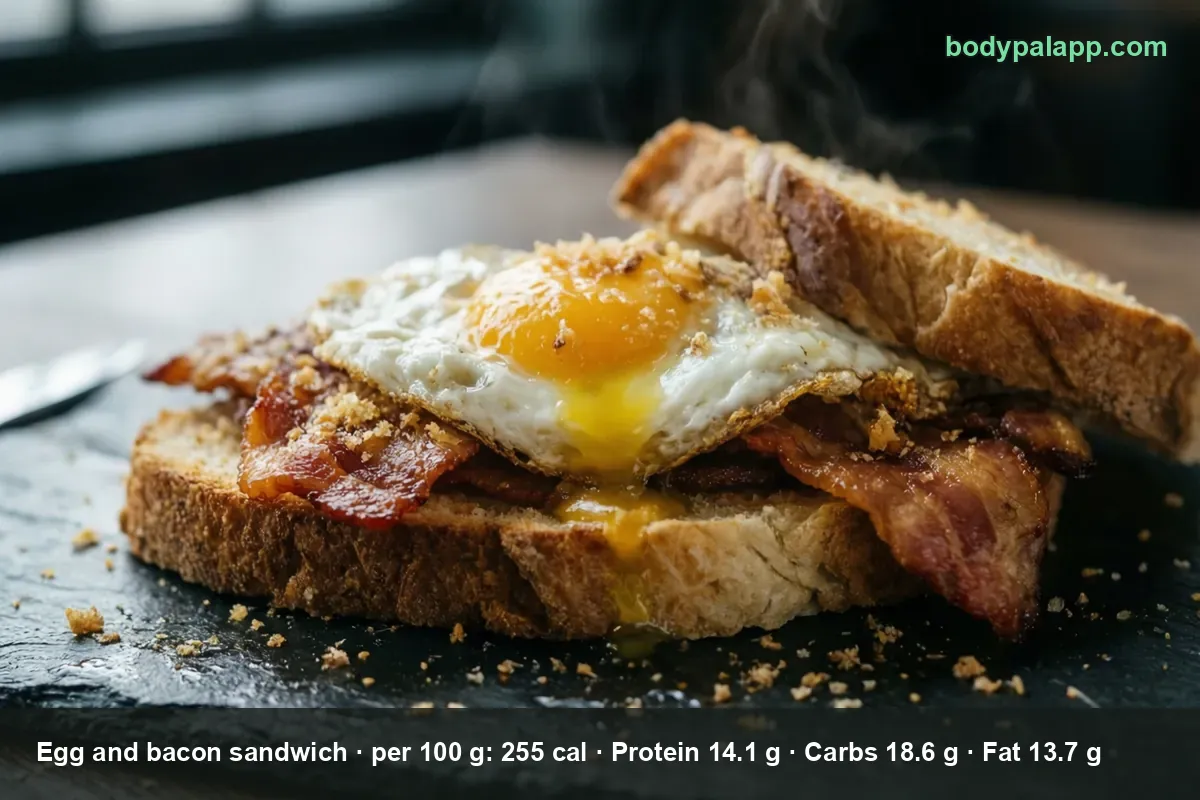
A regular egg and bacon sandwich on an English muffin weighs 150 g and carries 383 calories. Per 100 g the sandwich runs 255 calories, the lowest of the six USDA breakfast-sandwich records on this page. Order the large, 225 g, and you are at 574 before the coffee.
On this page
- Egg and bacon sandwich quick facts
- US servings, from one ounce to a large sandwich
- The bread decides the calories
- Sodium and cholesterol are the rows to watch
- How does an egg and bacon sandwich compare?
- Most popular egg and bacon sandwich brands
- FAQ
Egg and bacon sandwich quick facts
The record behind these numbers is FNDDS 2707317, "Egg sandwich on English muffin, with bacon". It is the one USDA entry that holds egg plus bacon with no cheese layered in, sitting on the most common American breakfast base, and it ships with household portions for a regular and a large sandwich. Every other bacon-and-egg record in the database is the same filling on a different bread, so those live further down as variants rather than as competing averages.
| Nutrient | Per 100 g | Per 1 regular sandwich (150 g) | % Daily Value |
|---|---|---|---|
| Calories | 255 | 383 | — |
| Total fat | 13.72 g | 20.6 g | 26% |
| Saturated fat | 5.43 g | 8.1 g | 41% |
| Carbohydrate | 18.64 g | 28.0 g | 10% |
| Dietary fiber | 1.4 g | 2.1 g | 8% |
| Total sugars | 1.85 g | 2.8 g | — |
| Protein | 14.08 g | 21.1 g | 42% |
| Sodium | 574 mg | 861 mg | 37% |
| Cholesterol | 163 mg | 245 mg | 82% |
| Potassium | 161 mg | 242 mg | 5% |
% Daily Value is based on a 2,000-calorie diet.
Verified nutrition data
Numbers on this page come from USDA FoodData Central, the U.S. Department of Agriculture’s food composition database, and from manufacturer labels where a branded product is named. Last verified September 2026. How we verify our data →
Two rows you would see on a wrapper are missing here on purpose. This FNDDS release does not publish added sugars or trans fat for mixed dishes, so rather than guess at them, they stay off the table. Total sugars are 2.8 g in the whole sandwich, and almost none of that is added anyway; it comes from the bread and the small amount of dairy in the egg mixture.
The protein and cholesterol lines are the ones that separate this sandwich from a pastry breakfast. One sandwich hands over 21.1 g of protein for 383 calories, and 245 mg of cholesterol, which is 82% of the FDA Daily Value of 300 mg. Potassium is modest at 242 mg, 5% of the day.
US servings, from one ounce to a large sandwich
| Serving | Weight | Calories |
|---|---|---|
| 1 oz | 28 g | 71 kcal |
| Half a regular sandwich | 75 g | 191 kcal |
| One regular sandwich | 150 g | 383 kcal |
| One large sandwich | 225 g | 574 kcal |
| Per 100 g | 100 g | 255 kcal |
The regular and the large are USDA household measures, straight from the record. The ounce and the half sandwich are our own arithmetic from the USDA 100 g figure, not USDA servings, and they exist because half a breakfast sandwich is a real thing people log at 10 a.m.
That 75 g half is worth noticing. At 191 calories it lands where a plain bagel with nothing on it lands, and it still carries 10.6 g of protein. The large is where the math turns: 574 calories, 1,292 mg of sodium and 367 mg of cholesterol, which clears the whole Daily Value for cholesterol on its own.
Weighing beats guessing here more than with most foods, because a "sandwich" is not a fixed object. The USDA regular is 150 g and the large is 225 g, a 50% jump for the same three ingredients. If your muffin is a jumbo bakery one, you are closer to the large row than to the regular.
The bread decides the calories
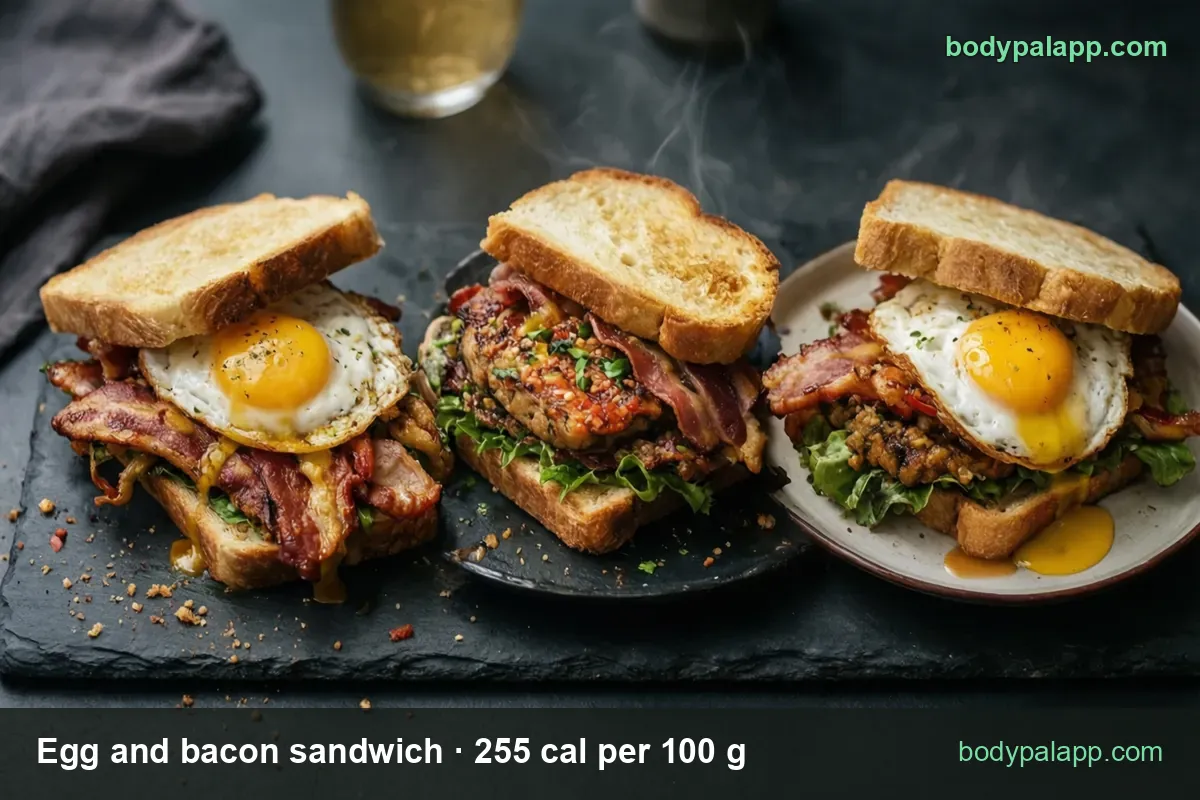
Keep the egg and the bacon identical, change nothing but the bread, and the calorie count moves by more than a hundred. That is the single most useful thing on this page.
| Version | Per 100 g | Typical sandwich | Calories |
|---|---|---|---|
| On an English muffin | 255 kcal | 150 g | 383 kcal |
| On a bagel | 268 kcal | 200 g | 536 kcal |
| On a biscuit | 309 kcal | 140 g | 433 kcal |
| On a croissant | 326 kcal | 150 g | 489 kcal |
| On a biscuit, with cheese | 315 kcal | 160 g | 504 kcal |
| Griddle cake sandwich, egg, cheese and bacon | 272 kcal | 174 g (6.1 oz) | 473 kcal |
At the same 150 g, the croissant version is 489 calories against 383 on the muffin. That is 106 calories of difference bought entirely with butter in the dough. The biscuit is denser still per 100 g, 309, but biscuit sandwiches are built smaller, 140 g, so the plate total lands at 433.
The bagel is the sneaky one. Per 100 g it is 268, barely above the muffin, and people read that as "the bagel is fine." The bagel sandwich weighs 200 g, and 536 calories is the highest per-sandwich number of the six USDA records here. Density did not do that. Size did.
Adding cheese to the biscuit moves 100 g from 309 to 315 calories, six calories, which is less than most people expect. The cheese costs you on sodium, not on calories. And the griddle cake version, a pancake-based sandwich with egg, cheese and bacon, runs 272 calories per 100 g with 9.56 g of sugars per 100 g, because the pancakes are sweetened.
Frozen retail versions track the higher end of that table. USDA's Branded records put Great Value's bacon, egg and cheese croissant at 330 calories for a 103 g sandwich and a store-brand biscuit sandwich at 310 for 99 g, while the outliers are double portions rather than richer food: a Nordic Waffles bacon, egg and cheddar waffle sandwich is 619 calories at 178 g, and a Big Az biscuit stacker with sausage added reaches 633 at 187 g.
Sodium and cholesterol are the rows to watch
The calories on this sandwich are ordinary. The salt is not. One 150 g muffin sandwich is 861 mg of sodium, 37% of the 2,300 mg Daily Value, or about a third of a teaspoon of table salt. On the biscuit version that becomes 1,084 mg for a smaller 140 g sandwich, 47% of the day, and the biscuit with cheese tops the column at 1,286 mg, 56%.
Cholesterol behaves the same way. A single sandwich is 245 mg, 82% DV, and a large one is 367 mg, 122%. Almost all of it is the yolk; bacon contributes fat and sodium far more than it contributes cholesterol.
On the other side of the ledger, 21.1 g of protein for 383 calories is a genuinely good trade at breakfast. MyPlate's protein foods guidance treats eggs as a protein food alongside meat and beans, and this sandwich covers 42% of the 50 g Daily Value in one hand-held item. If you are choosing between this and a pastry of similar size, the sandwich is the one that keeps you full to lunch. If you are watching sodium, the English muffin build is the better pick of the six, and skipping the cheese saves more salt than calories.
How does an egg and bacon sandwich compare?
| Sandwich | Per 100 g | US serving | Calories |
|---|---|---|---|
| On an English muffin | 255 kcal | one sandwich, 150 g | 383 kcal |
| On a bagel | 268 kcal | one sandwich, 200 g | 536 kcal |
| On a biscuit | 309 kcal | one sandwich, 140 g | 433 kcal |
| On a croissant | 326 kcal | one sandwich, 150 g | 489 kcal |
Our take: for weight loss, the English muffin build wins twice over, lowest per 100 g and lowest per sandwich, and half of one at 191 calories is a legitimate small breakfast. For staying full through a long morning, the bagel version delivers the most protein in absolute terms, 27.4 g, but you pay 536 calories and 58.9 g of carbohydrate for it. The croissant is the one to treat as a pastry rather than as breakfast; it is the fattiest base in the set at 21.34 g of fat per 100 g. Nobody needs to give up bacon here. Change the bread and you have already done the work.
Most popular egg and bacon sandwich brands in the United States
Ranked by how widely each product appears among foods sold in the United States, from the BodyPal food database of over 3.3 million products. Calories are the figures printed on each Nutrition Facts label, checked against USDA FoodData Central.
| Product | Calories (per 100 g) |
|---|---|
| Great Value Bacon, Egg & Cheese Croissant Sandwich | 320 cal |
| Morning Delight Bacon, Egg & Cheese Croissant Sandwich | 320 cal |
| Freshness Guaranteed Bacon, Egg & Cheese Biscuit Sandwich | 313 cal |
| ShopRite Bacon, Egg & Cheese Biscuit Sandwich | 305 cal |
| Nordic Waffles Bacon, Egg + Cheddar Waffle Sandwich | 348 cal |
| Big Az Biscuit Stacker Bacon, Egg & Cheese Sandwich | 338 cal |
Brand popularity: BodyPal food database. Nutrition: manufacturer labels / USDA FoodData Central.
Egg and bacon sandwich FAQs
How many calories are in an egg and bacon sandwich?
A regular egg and bacon sandwich on an English muffin weighs 150 g and carries 383 calories, or 255 calories per 100 g. The large size, 225 g, comes to 574. Half a sandwich is 191, which is our own arithmetic from the USDA 100 g figure.
How many calories in a bacon, egg and cheese on a croissant?
489 calories for a 150 g croissant version, against 383 for the same filling on an English muffin. The USDA croissant record does not include cheese; on biscuits, adding cheese moves 100 g from 309 to 315 calories, so a croissant with cheese sits near 500.
Is a bacon and egg sandwich a good source of protein?
One sandwich gives 21.1 g of protein, 42% of the 50 g Daily Value, for 383 calories. That is a strong ratio for a hand-held breakfast. The bagel version goes higher in absolute terms, 27.4 g, but it also carries 536 calories to get there.
How much sodium is in a bacon and egg breakfast sandwich?
861 mg in a 150 g sandwich, 37% of the 2,300 mg Daily Value, roughly a third of a teaspoon of table salt. The biscuit version is saltier: 1,084 mg for only 140 g, 47% of the day. A biscuit with cheese reaches 1,286 mg, 56%.
How much cholesterol is in an egg and bacon sandwich?
245 mg per sandwich, 82% of the 300 mg Daily Value, and almost all of it comes from the yolk. The large 225 g sandwich passes the mark on its own at 367 mg, 122%. Bacon adds far more fat and sodium than it adds cholesterol.
Which is lower in calories, English muffin or biscuit?
The English muffin, and it is not close: 255 calories per 100 g against 309 for the biscuit. Per sandwich the gap narrows because biscuit sandwiches are smaller, 140 g and 433 calories versus 150 g and 383. The muffin also carries much less sodium.
How many calories in a bacon and egg bagel?
536 calories for a 200 g bacon and egg bagel, the biggest per-sandwich number among the six USDA records on this page. Per 100 g it is only 268, close to the muffin at 255. The bagel simply weighs more, with 58.9 g of carbohydrate.
How can I make a lower calorie bacon and egg sandwich?
Start with the base: an English muffin is 255 calories per 100 g, a croissant 326. Eating half is 191 calories instead of 383. Skipping cheese helps less than people expect, since on the USDA biscuit records cheese is worth about six calories per 100 g.
Similar foods
- Pancake — 423 cal for 3 medium pancakes
- Crepe — 179 cal per crepe
- Omelet — 305 cal for 3-egg omelet
- Egg — 72 cal per large egg
- Toast with butter — 100 cal per slice with butter
- Bagel — 277 cal per bagel
Count it without the math
Point the camera at the plate and BodyPal counts the sandwich for you, bread and all.


How long does it take to burn off 383 kcal of bacon egg sandwich?
One regular sandwich (150 g) is 383 kcal. Enter your weight and the amount you ate to see how long it takes you to burn that off:
lb
| Activity | Time to burn 383 kcal |
|---|---|
| Walking, brisk | 1 hr 17 min |
| Cycling, moderate | 48 min |
| Swimming, moderate | 55 min |
| Jogging | 45 min |
| Weight training, moderate | 1 hr 25 min |
Times are for a 155 lb adult at a steady pace; change the weight to see yours. The amount is set to the portion in the text (150 g); change it to what you actually ate. BodyPal works this out from your steps automatically.
This table assumes you know your daily total. If you do not, the daily calorie calculator works it out from five numbers.