
How many calories are in egg custard?
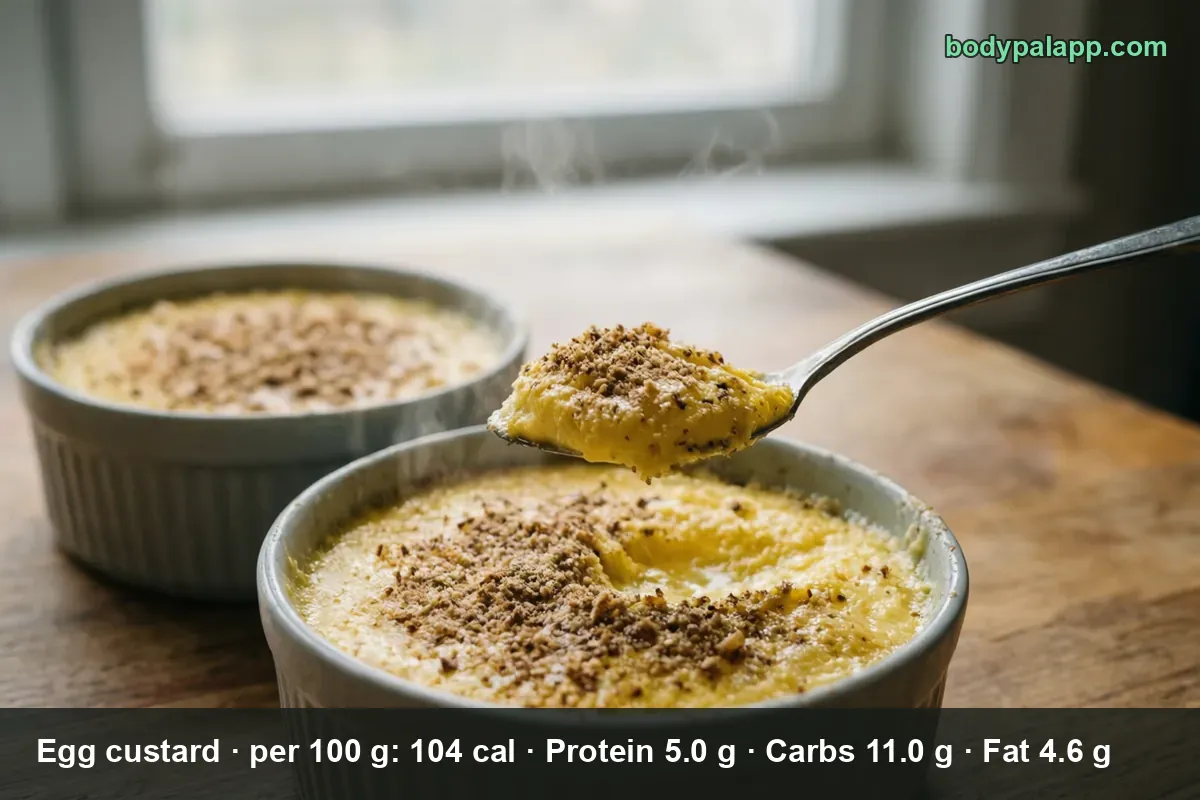
A half-cup ramekin of baked egg custard holds 147 calories, and the custard itself runs 104 calories per 100 g — the milk-and-egg base does most of the work. Buy the same dessert as a slice of commercial custard pie instead and it jumps to 221 calories.
On this page
- Egg custard quick facts
- US servings from one ounce to a whole recipe
- Baked custard versus mix versus pie
- Cholesterol is the row that moves
- How does egg custard compare?
- Most popular egg custard brands
- FAQ
Egg custard quick facts
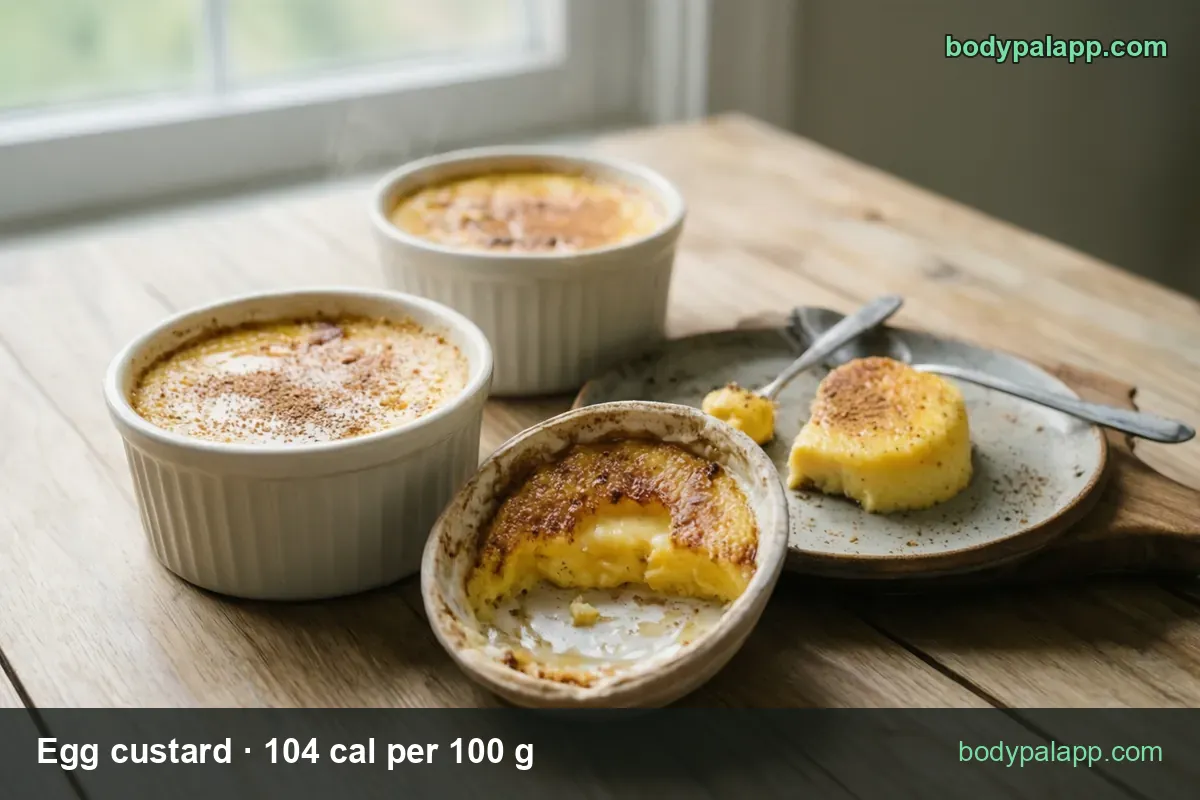
The record behind every number on this page is SR Legacy 169595, "Desserts, egg custard, baked, prepared-from-recipe". That is the dessert most people mean: milk, eggs and sugar whisked together, poured into ramekins and baked in a water bath until it sets. It is not the boxed powder, and it is not a wedge of custard pie. Both of those exist in the database with their own numbers, and both land somewhere else entirely.
USDA's own household measure for that record is a half cup, 141 grams. A standard ceramic ramekin holds almost exactly that, which is why the ramekin is the serving used throughout this page.
| Nutrient | Per 100 g | Per 1/2 cup (141 g) | % Daily Value |
|---|---|---|---|
| Calories | 104 | 147 | — |
| Total fat | 4.58 g | 6.5 g | 8% |
| Saturated fat | 2.16 g | 3.0 g | 15% |
| Carbohydrate | 11 g | 15.5 g | 6% |
| Dietary fiber | 0 g | 0 g | 0% |
| Total sugars | 11 g | 15.5 g | — |
| Protein | 5.02 g | 7.1 g | 14% |
| Sodium | 61 mg | 86 mg | 4% |
| Cholesterol | 84 mg | 118 mg | 39% |
| Potassium | 148 mg | 209 mg | 4% |
% Daily Value is based on a 2,000-calorie diet.
Verified nutrition data
Numbers on this page come from USDA FoodData Central, the U.S. Department of Agriculture’s food composition database, and from manufacturer labels where a branded product is named. Last verified September 2026. How we verify our data →
Two rows you would see on a package are missing here. USDA does not publish added sugars or trans fat for this from-recipe record, so neither can be shown, and the sugar figure below has to stand as total sugars only. Percentages follow the FDA Daily Values printed on US labels.
The carbohydrate line is worth a second look. Carbohydrate and total sugars are the same number, 11 g per 100 g, and fiber is zero. In baked custard there is no flour and no starch — every gram of carbohydrate is sugar, part of it lactose from the milk and part of it the sugar stirred into the batter.
US servings from one ounce to a whole recipe
| Serving | Weight | Calories |
|---|---|---|
| 1 oz | 28 g | 29 kcal |
| One small ramekin, 1/3 cup | 94 g | 98 kcal |
| One ramekin, 1/2 cup | 141 g | 147 kcal |
| 1 cup | 282 g | 293 kcal |
| Full recipe yield | 563 g | 586 kcal |
| Per 100 g | 100 g | 104 kcal |
Only two of those are USDA household measures: the half cup at 141 g and the full recipe yield at 563 g. The ounce, the small ramekin, and the full cup are our own arithmetic from the USDA 100 g figure, not USDA servings.
The recipe yield is the useful one for anyone baking at home. At 563 g it is roughly four standard ramekins, so a batch of custard is 586 calories total and each dish costs 147. Split the same batch into six smaller cups and you are near 98 calories a dish — the batch does not change, only how you cut it.
A cup is the trap. Custard is dense and pours flat, so a cereal bowl filled to the rim holds close to two ramekins, and 293 calories go into the log instead of 147. If you are eyeballing it, count dishes, not spoonfuls.
Baked custard versus mix versus pie
| Version | Per 100 g | Typical serving | Calories |
|---|---|---|---|
| Baked from recipe | 104 kcal | 1/2 cup, 141 g | 147 kcal |
| From dry mix with whole milk | 122 kcal | 1/2 cup, 141 g | 172 kcal |
| From dry mix with 2% milk | 112 kcal | 1/2 cup, 141 g | 158 kcal |
| Egg custard pie, store-bought | 210 kcal | 1 slice, 105 g | 221 kcal |
| Dry mix, as sold | 410 kcal | powder for 1/2 cup, 21 g | 86 kcal |
Baked from a recipe is the 104-calorie baseline and the leanest of the group per gram. It also carries the most protein per serving, 7.1 g in a ramekin, because the eggs are doing the setting rather than a thickener.
From a boxed mix the picture flips. Prepared with whole milk the custard reads 122 calories per 100 g and 172 in a half cup; with 2% milk it drops to 112 and 158. Fourteen calories separate the two, which is the milk fat and nothing else. What is odd is the composition: the mix versions carry more carbohydrate than the baked recipe, 17.6 g per 100 g against 11 g, but only 4.8 g of that is sugar. The rest is starch thickener. Baked custard is the sweeter food; mix custard is the starchier one.
The dry mix as sold is where calorie counters get burned. The powder shows 410 calories per 100 g, and that number circulates as though it were the dessert. It is not — nobody eats dry custard powder. The roughly 21 g of powder that becomes a half cup of prepared custard is 86 calories, and the milk you add supplies the rest. Log the prepared dish, never the box.
Store-bought egg custard pie is a different food with the same name. At 210 calories per 100 g the crust more than doubles the density, and a slice of an 8-inch pie — 105 g, a sixth of the pie — is 221 calories. That slice weighs 36 g less than a ramekin of baked custard and still carries 74 more calories. Sodium moves with it, from 61 mg per 100 g to 275 mg.
Retail pies sit in the same neighborhood. Publix's egg custard pie is 254 calories per 100 g, Table Talk's old-fashioned version and Rocky Mountain Pies both read 240, and Satispie's 10-inch is 214. Their labeled slices land at 300 calories for the first three and 268 for Satispie, which tells you the slice sizes are large before the density is.
Cholesterol is the row that moves
Everything on the panel is modest except one line. A half-cup ramekin carries 118 mg of cholesterol, 39% of the 300 mg Daily Value, while saturated fat sits at 15%, total fat at 8% and sodium at just 4%. Nothing else on the label comes close to that percentage.
That is what a custard is: eggs suspended in milk and set with heat. Scale the dish and the cholesterol scales exactly with it — a full cup is 237 mg, most of a day's Daily Value in one bowl. The pie slice, oddly, is the gentler option on saturated fat per serving at about 2.5 g against the ramekin's 3.0 g, purely because the slice weighs less.
Sugar is the other line to weigh. A ramekin is 15.5 g of total sugars, and while some of that is lactose that came in with the milk, USDA does not publish an added sugars figure for this record, so the split cannot be stated. The Dietary Guidelines for Americans recommend keeping added sugars under 10% of daily calories, and a homemade custard is one of the few desserts where you control that number directly — the milk portion also counts toward the dairy group on MyPlate.
How does egg custard compare?
| Dessert | Per 100 g | US serving | Calories |
|---|---|---|---|
| Baked egg custard | 104 kcal | 1/2 cup, 141 g | 147 kcal |
| Custard from mix, 2% milk | 112 kcal | 1/2 cup, 141 g | 158 kcal |
| Custard from mix, whole milk | 122 kcal | 1/2 cup, 141 g | 172 kcal |
| Egg custard pie, commercial | 210 kcal | 1 slice, 105 g | 221 kcal |
Our take: bake it. The from-recipe custard is the lightest of the four per gram and per serving, it carries the most protein per serving, and the 25-calorie gap between it and the whole-milk mix costs you nothing but ten minutes and an oven. If you are buying rather than baking, the pie is the only version that changes the math meaningfully — 221 calories in a slice you will finish faster than a ramekin. And if the box is already in the cupboard, use 2% milk and take the 14 calories.
Most popular egg custard brands in the United States
Ranked by how widely each product appears among foods sold in the United States, from the BodyPal food database of over 3.3 million products. Calories are the figures printed on each Nutrition Facts label, checked against USDA FoodData Central.
| Product | Calories (per 100 g) |
|---|---|
| Publix Egg Custard Pie | 254 cal |
| Rocky Mountain Pies Egg Custard Pie | 240 cal |
| Table Talk Old Fashioned Egg Custard Pie | 240 cal |
| Satispie 10-inch Egg Custard Pie | 214 cal |
Brand popularity: BodyPal food database. Nutrition: manufacturer labels / USDA FoodData Central.
Egg custard FAQs
How many calories are in egg custard?
A half-cup ramekin of baked egg custard is 147 calories, from a base of 104 calories per 100 g. That is the homemade version, baked from a recipe of milk, eggs and sugar. Custard made from a dry mix with whole milk runs higher, at 172 calories for the same half cup.
How many calories in a cup of egg custard?
A full cup of baked egg custard weighs about 282 g and carries 293 calories — our own arithmetic from the USDA 100 g figure, since USDA lists the half cup as its household measure. That cup also brings 14.2 g of protein, 31 g of carbohydrate and 237 mg of cholesterol.
How many calories in a slice of egg custard pie?
One slice of commercially prepared egg custard pie — a sixth of an 8-inch pie, 105 g — is 221 calories. The crust more than doubles the density, from 104 to 210 calories per 100 g, and pushes sodium from 61 mg to 275 mg per 100 g.
Is egg custard healthy?
A half-cup serving gives 7.1 g of protein for 147 calories, with 3.0 g of saturated fat (15% of the Daily Value) and 15.5 g of sugar. It is a dessert built on milk and eggs, so the protein comes along with the sugar. If calories are the concern, the ramekin lands 74 below a slice of custard pie.
How much protein is in egg custard?
Baked egg custard carries 5.02 g of protein per 100 g, so a half-cup ramekin gives 7.1 g — 14% of the Daily Value. That is more protein than the mix versions: made with whole milk the same half cup gives 5.6 g, and with 2% milk 5.8 g.
How many carbs are in egg custard?
A half-cup ramekin has 15.5 g of carbohydrate, 6% of the Daily Value, and every gram of it is sugar — fiber is zero in the USDA record. The mix versions are starchier: 17.6 g per 100 g against 11 g for the baked recipe, but only 4.8 g of that shows up as sugar.
Does egg custard have a lot of cholesterol?
One half-cup ramekin holds 118 mg of cholesterol, 39% of the 300 mg Daily Value — the biggest percentage on the whole panel. Saturated fat is 15% and sodium only 4%. Cholesterol comes from the eggs, so a bigger custard scales it straight up: a full cup is 237 mg.
Is egg custard high in sugar?
Baked egg custard is 11 g of sugar per 100 g, which works out to 15.5 g in a half-cup ramekin. Part of that is milk sugar and part is added sugar, but USDA does not publish an added sugars figure for this record, so the split cannot be pinned down here.
Similar foods
- Egg — 72 cal per large egg
- Omelet — 305 cal for 3-egg omelet
- Crepe — 179 cal per crepe
- Pancake — 423 cal for 3 medium pancakes
- Toast with butter — 100 cal per slice with butter
- Injera — 118 cal per injera (12 in)
Count it without the math
Point the camera at the ramekin and BodyPal counts the custard for you, dish size and all.


How long does it take to burn off egg Custard?
A 1/2-cup ramekin (141 g) is 147 kcal. Enter your weight and the amount you ate to see how long it takes you to burn that off:
lb
| Activity | Time to burn 147 kcal |
|---|---|
| Walking, brisk | 29 min |
| Cycling, moderate | 18 min |
| Swimming, moderate | 21 min |
| Jogging | 17 min |
| Weight training, moderate | 33 min |
Times are for a 155 lb adult at a steady pace; change the weight to see yours. The amount is set to the portion in the text (141 g); change it to what you actually ate. BodyPal works this out from your steps automatically.
Burning it off is one side of it. The other is knowing your number: work out how many calories you need a day, with macros and a goal date.