
How many calories are in an egg salad sandwich?
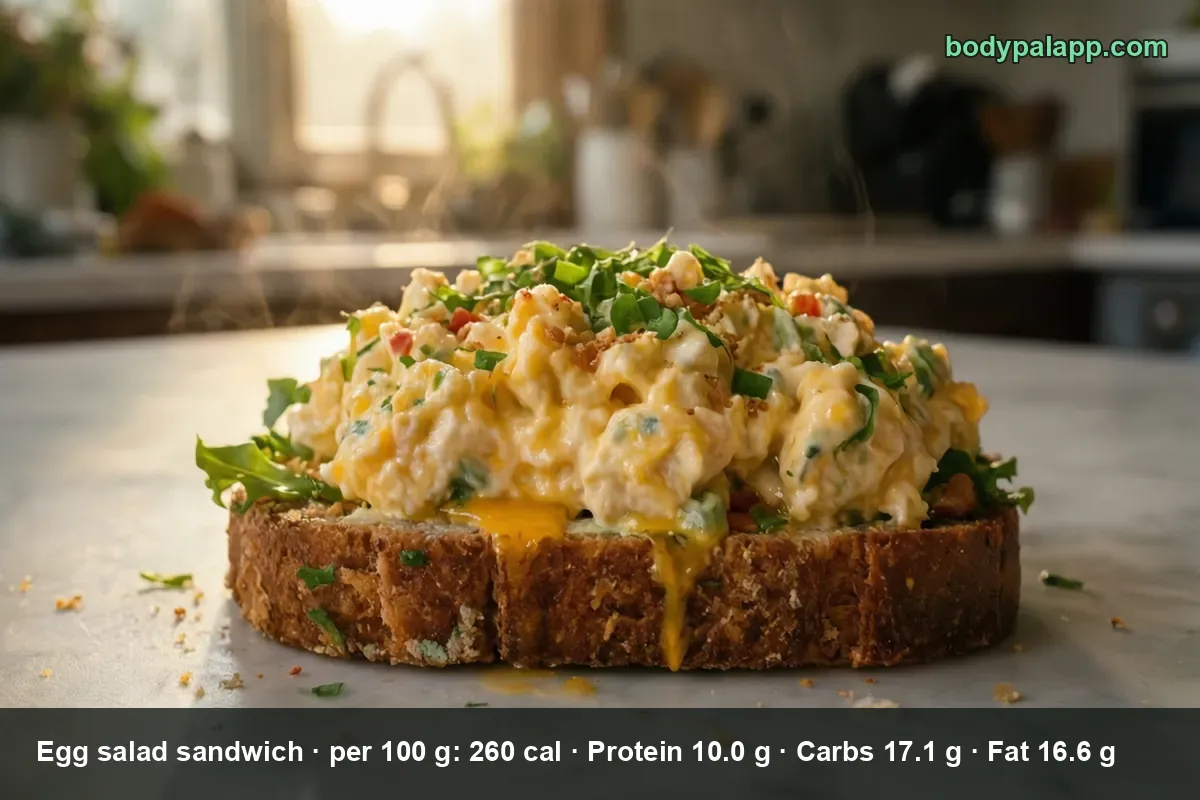
A regular egg salad sandwich on white bread weighs 180 g and carries 468 calories. Per 100 g, bread and filling together, it runs 260 calories. Along with that come 29.9 g of fat and 18 g of protein, so this is a heavy lunch that at least pays you back in protein.
On this page
- Egg salad sandwich quick facts
- US servings from one ounce to a 6-inch sub
- How bread and size change the number
- Cholesterol is the row to watch
- Store-bought sandwiches and the 100 g trap
- How does an egg salad sandwich compare?
- Most popular egg salad sandwich brands
- Egg salad sandwich FAQs
Egg salad sandwich quick facts
The record below is the assembled sandwich, not the salad in the tub. When someone looks up this number they are holding two slices of bread with chopped egg and mayonnaise between them, so the figures come from FNDDS 2707280, "Egg salad sandwich on white", the Survey 2021-2023 entry for a home or deli build on white bread. White is the US default; the wheat version sits a single calorie away and gets its own section further down.
Two rows that appear on a store label are missing here: added sugars and trans fat. This edition of FNDDS does not publish either value for mixed dishes, so rather than guess, those lines are left off the table entirely.
| Nutrient | Per 100 g | Per 1 regular sandwich (180 g) | % Daily Value |
|---|---|---|---|
| Calories | 260 | 468 | — |
| Total fat | 16.62 g | 29.9 g | 38% |
| Saturated fat | 3.54 g | 6.4 g | 32% |
| Carbohydrate | 17.07 g | 30.7 g | 11% |
| Dietary fiber | 0.8 g | 1.4 g | 5% |
| Total sugars | 2.45 g | 4.4 g | — |
| Protein | 9.98 g | 18.0 g | 36% |
| Sodium | 402 mg | 724 mg | 31% |
| Cholesterol | 205 mg | 369 mg | 123% |
| Potassium | 109 mg | 196 mg | 4% |
% Daily Value is based on a 2,000-calorie diet.
Verified nutrition data
Numbers on this page come from USDA FoodData Central, the U.S. Department of Agriculture’s food composition database, and from manufacturer labels where a branded product is named. Last verified September 2026. How we verify our data →
Read the last column before the first one. A single sandwich covers more than a full day of cholesterol, roughly a third of the fat, a third of the sodium and a third of the protein. Potassium is the quiet exception at 196 mg, only 4% of a day, since neither eggs nor white bread bring much of it.
US servings from one ounce to a 6-inch sub
| Serving | Weight | Calories |
|---|---|---|
| 1 oz | 28 g | 74 kcal |
| One slider or half sandwich | 90 g | 234 kcal |
| One regular sandwich | 180 g | 468 kcal |
| One large sandwich or 6-inch sub | 270 g | 702 kcal |
| Per 100 g | 100 g | 260 kcal |
The 90 g, 180 g and 270 g weights are USDA household portions for this record, which is unusually convenient: the slider is exactly half the regular, and the large is exactly one and a half. The 1 oz line is our own arithmetic from the USDA 100 g figure, not a USDA serving, and it is mostly useful for the odd case of weighing a cut wedge on a kitchen scale.
The gap between the smallest and largest real serving is 468 calories, which is the entire regular sandwich again. A luncheonette half with soup and a 6-inch sub from a deli case are the same food and nowhere near the same lunch.
How bread and size change the number

| Version | Per 100 g | Typical piece | Calories |
|---|---|---|---|
| On white bread | 260 kcal | 1 regular, 180 g | 468 kcal |
| On wheat bread | 259 kcal | 1 regular, 180 g | 466 kcal |
| Slider or half sandwich | 260 kcal | 1 miniature, 90 g | 234 kcal |
| 6-inch submarine | 260 kcal | 1 sub roll build, 270 g | 702 kcal |
Swapping white for wheat saves two calories per sandwich, which is nothing. What it does move is fiber: FNDDS 2707281, the wheat record, lists 1.8 g per 100 g against 0.8 g on white, so a 180 g sandwich goes from 1.4 g to about 3.2 g. That is 5% of the fiber Daily Value against 12%, our own arithmetic from the USDA 100 g figures. Protein edges up too, from 18.0 g to about 19.2 g.
Size is the lever that actually matters. Because the filling and the bread scale together, calories track weight almost perfectly at 260 per 100 g. Ordering the 6-inch sub instead of the standard two-slice sandwich adds 234 calories, the same amount you would save by asking for a half.
Cholesterol is the row to watch
Most people brace for the sodium in a deli sandwich. Here the standout is cholesterol: 369 mg in one regular sandwich, or 123% of the 300 mg Daily Value published by the FDA. Sodium, by comparison, is 724 mg, or 31% of a day, roughly a third of a teaspoon of table salt. Both come from the same plate, but only one of them clears 100%.
Saturated fat lands in between at 6.4 g, 32% of the 20 g Daily Value, and that number comes as much from the mayonnaise as from the yolks. Total fat is 29.9 g, 38% of a day, which is why the sandwich reads heavier than its 18 g of protein would suggest.
The protein is real, though. At 18 g per sandwich, or 36% of the 50 g Daily Value, one of these covers a good share of the protein that MyPlate counts toward a day of protein foods. If you want that protein for fewer calories, the half sandwich at 234 calories still brings 9 g and works next to a salad rather than instead of one.
Store-bought sandwiches and the 100 g trap
Six refrigerated deli sandwiches in the USDA Branded database run from 203 to 278 calories per 100 g. Three of those six are lighter per gram than the 260 of a homemade build, which looks like good news until you weigh the package. A Walmart egg salad sandwich is 152 g and 400 calories; a Taylor Farms is 211 g and 490; a Renaissance Food Group container is 227 g and 461. The lightest-per-gram sandwich on the list finishes at 461 calories, more than the heaviest-per-gram one at 450.
That is the trap on this food. Egg salad sandwiches vary far more by size than by recipe, so per-100-g comparisons between brands tell you almost nothing about what you are about to eat. Every packaged sandwich in that set lands between 400 and 490 calories, a tighter band than the 203-to-278 spread would ever predict. Read the pack weight first, then the calories.
How does an egg salad sandwich compare?
| Sandwich | Per 100 g | Scaled to 180 g | Protein per 100 g |
|---|---|---|---|
| Egg salad on white | 260 kcal | 468 kcal | 9.98 g |
| Egg sandwich on wheat with meat | 266 kcal | 479 kcal | 12.86 g |
| Egg sandwich on English muffin with bacon | 255 kcal | 459 kcal | 14.08 g |
| Egg sandwich on bagel | 251 kcal | 452 kcal | 11.97 g |
The three neighbors are USDA records built on different formats, and their real-world portion weights differ with the roll, so the middle column scales each one to 180 g for a like-for-like read. That column is our own arithmetic from the USDA 100 g figures, not a USDA serving size.
Our take: for calorie counting, all four of these are the same lunch, within 27 calories of each other at equal weight. The difference is what you get back. The bacon-and-egg English muffin carries the most protein, 14.08 g per 100 g against 9.98 g for egg salad, because mayonnaise adds fat where a cooked egg does not. If you want the egg salad, take it as a half with something green next to it; if you want the biggest protein return per calorie, the muffin build wins outright.
Most popular egg salad sandwich brands in the United States
Ranked by how widely each product appears among foods sold in the United States, from the BodyPal food database of over 3.3 million products. Calories are the figures printed on each Nutrition Facts label, checked against USDA FoodData Central.
| Product | Calories (per 100 g) |
|---|---|
| Walmart Egg Salad Sandwich | 263 cal |
| Archer Farms Egg Salad Sandwich | 262 cal |
| Good & Gather Dill Egg Salad Sandwich on Brioche | 278 cal |
| Taylor Farms Egg Salad Sandwich | 232 cal |
| Raley's Egg Salad Sandwich | 222 cal |
| Renaissance Food Group Egg Salad Sandwich | 203 cal |
Brand popularity: BodyPal food database. Nutrition: manufacturer labels / USDA FoodData Central.
Egg salad sandwich FAQs
How many calories are in an egg salad sandwich?
468 calories for a regular sandwich made with two slices of white bread, 180 g on the USDA scale. Per 100 g the assembled sandwich runs 260 calories. A slider-sized half comes to 234 calories, and a 270 g large or 6-inch sub build reaches 702.
How many calories in half an egg salad sandwich?
234 calories. USDA lists a miniature or slider portion at 90 g, exactly half of the 180 g regular, so the calories halve cleanly. Cutting a deli sandwich down the middle lands in the same place, which makes half a sandwich plus fruit a workable 300-calorie lunch.
Is an egg salad sandwich healthy?
It brings 18 g of protein for 468 calories, which is a solid return, but 29.9 g of fat and 369 mg of cholesterol come with it, and that cholesterol is 123% of the Daily Value. Sodium is 724 mg, 31% of a day. If you are watching fat, the half is the better pick.
How much protein is in an egg salad sandwich?
18 g of protein in a 180 g regular sandwich, or 36% of the 50 g Daily Value. That works out to 9.98 g per 100 g, most of it from the eggs and a little from the bread. On wheat bread it rises to about 19.2 g, our own arithmetic from the USDA 100 g figure.
How much cholesterol is in an egg salad sandwich?
369 mg in one regular sandwich, or 123% of the 300 mg Daily Value, the highest percentage anywhere on this label. Per 100 g the figure is 205 mg. The yolks and the mayonnaise both contribute. A slider half comes to about 185 mg, our own arithmetic from the 100 g number.
White or wheat bread for egg salad, which has fewer calories?
Neither saves anything worth counting: 260 calories per 100 g on white against 259 on wheat, so a 180 g sandwich is 468 or 466. The real difference is fiber, 0.8 g against 1.8 g per 100 g, which works out to 1.4 g versus about 3.2 g per sandwich, 5% of a day against 12%.
How many calories in a deli egg salad sandwich?
400 to 490 calories for a packaged deli sandwich, based on six USDA Branded labels weighing 152 g to 227 g. Per 100 g they run from 203 to 278, straddling the 260 of a homemade build, but the packages are bigger, so the finished sandwich lands in the same range.
How much sodium is in an egg salad sandwich?
724 mg in a 180 g regular sandwich, 31% of the 2,300 mg Daily Value, or roughly a third of a teaspoon of table salt. Per 100 g it is 402 mg. Wheat bread changes almost nothing at 399 mg per 100 g. Packaged deli versions vary more, since each brand salts its own dressing.
Similar foods
- Pancake — 423 cal for 3 medium pancakes
- Crepe — 179 cal per crepe
- Omelet — 305 cal for 3-egg omelet
- Toast with butter — 100 cal per slice with butter
- Egg — 72 cal per large egg
- Bagel — 277 cal per bagel
Count it without the math
Point the camera at the plate and BodyPal counts the sandwich for you, bread and filling together.


How long does it take to burn off 468 kcal of egg salad sandwich?
One regular sandwich (180 g) is 468 kcal. Enter your weight and the amount you ate to see how long it takes you to burn that off:
lb
| Activity | Time to burn 468 kcal |
|---|---|
| Walking, brisk | 1 hr 34 min |
| Cycling, moderate | 58 min |
| Swimming, moderate | 1 hr 7 min |
| Jogging | 55 min |
| Weight training, moderate | 1 hr 44 min |
Times are for a 155 lb adult at a steady pace; change the weight to see yours. The amount is set to the portion in the text (180 g); change it to what you actually ate. BodyPal works this out from your steps automatically.
One food is easy to picture; a whole day is harder. See how many calories you need a day and what a deficit actually looks like.