
How many calories are in an egg sandwich?
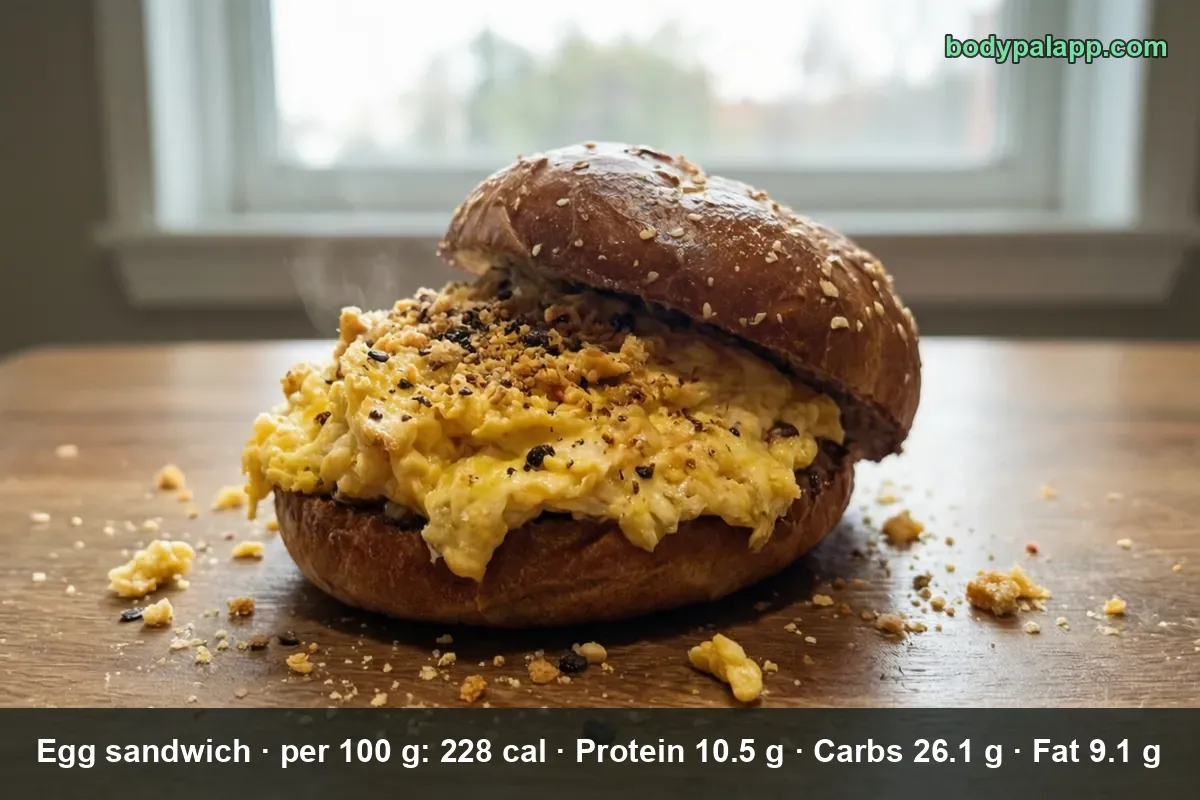
A regular egg sandwich weighs 115 g and carries 262 calories, which works out to 228 calories per 100 g. That is two slices of white bread and a cooked egg, nothing else in it. Add cheese and it becomes 335. Add bacon or ham and it becomes 414. Most of a day's cholesterol rides along with it.
On this page
- Egg sandwich quick facts
- US servings from a slider to a submarine
- The cheese bacon and bagel versions
- Cholesterol is the row to watch
- How does an egg sandwich compare?
- Most popular egg sandwich brands
- FAQ
Egg sandwich quick facts
The record that matches what most people are actually holding is FNDDS 2707307, "Egg sandwich on white bread" from the 2021-2023 survey cycle. It is the plain build: bread, egg, nothing layered in. No cheese, no bacon, no ham. If your sandwich has any of those, skip ahead to the variant table, because each one moves the number by more than the bread ever does.
USDA lists a regular sandwich at 115 g. That is the figure the whole page is built on.
| Nutrient | Per 100 g | Per 1 sandwich (115 g) | % Daily Value |
|---|---|---|---|
| Calories | 228 | 262 | — |
| Total fat | 9.05 g | 10.4 g | 13% |
| Saturated fat | 2.57 g | 3.0 g | 15% |
| Carbohydrate | 26.1 g | 30.0 g | 11% |
| Dietary fiber | 1.2 g | 1.4 g | 5% |
| Total sugars | 2.88 g | 3.3 g | — |
| Protein | 10.46 g | 12.0 g | 24% |
| Sodium | 353 mg | 406 mg | 18% |
% Daily Value is based on a 2,000-calorie diet.
Verified nutrition data
Numbers on this page come from USDA FoodData Central, the U.S. Department of Agriculture’s food composition database, and from manufacturer labels where a branded product is named. Last verified September 2026. How we verify our data →
Two rows are missing on purpose. FNDDS does not publish added sugars or trans fat for this dish, so there is nothing honest to put in those cells. Cholesterol and potassium are published: 213 mg and 138 mg in one sandwich, which is 71% and 3% of their Daily Values. The cholesterol row is the one worth a section of its own, further down.
On sodium, 406 mg is roughly what you would get from a fifth of a teaspoon of table salt, most of it baked into the bread rather than shaken on at the stove.
US servings from a slider to a submarine
| Serving | Weight | Calories |
|---|---|---|
| 1 oz | 28 g | 64 kcal |
| One slider or miniature sandwich | 60 g | 137 kcal |
| One regular sandwich | 115 g | 262 kcal |
| One large sandwich or submarine | 175 g | 399 kcal |
| Per 100 g | 100 g | 228 kcal |
The slider, the regular, the large and the submarine are all USDA household measures for this record, which is unusually generous; most FNDDS entries give you one weight and leave you to guess. The 1 oz line is ours, scaled from the 100 g figure rather than taken from a USDA serving, and it is there mostly so you can price a half or a quarter without doing the division.
The spread between the small and the large is the thing to notice. A slider at 137 calories and a submarine at 399 are the same sandwich by recipe, three times apart by weight. Deli counters and gas station cases sell the 175 g end far more often than the 115 g end, so if you logged "one egg sandwich" from a cooler cabinet, 262 may be the wrong number for you.
Two national retail products sit close to the survey figures. A Lunds & Byerlys Deviled Egg Sandwich runs 218 calories per 100 g, or 371 for its 170 g package, and a Grace Gourmet Bacon, Gouda & Egg Sandwich is 276 per 100 g, or 290 for a 105 g one. Both are in the USDA Branded database. The Grace product lands inside the range the survey records draw; the Lunds & Byerlys one sits just under it, 8 calories per 100 g below the lightest survey build at 226.
The cheese bacon and bagel versions

| Version | Per 100 g | Typical sandwich | Calories |
|---|---|---|---|
| On white bread, plain | 228 kcal | 115 g | 262 kcal |
| On wheat bread | 226 kcal | 115 g | 260 kcal |
| With cheese, white bread | 248 kcal | 135 g | 335 kcal |
| With meat, white bread | 267 kcal | 155 g | 414 kcal |
| With meat and cheese, wheat bread | 266 kcal | 155 g | 412 kcal |
| On an English muffin | 230 kcal | no gram weight published | — |
| On a bagel | 251 kcal | no gram weight published | — |
| On a croissant | 309 kcal | no gram weight published | — |
The last three rows have no calories in the serving column because FNDDS does not publish a gram weight for those builds, and inventing one would be worse than leaving it blank.
Here is the part that gets logged wrong. Cheese adds 73 calories to the sandwich, not because a slice of American is expensive but because it makes the sandwich 20 g heavier as well as denser. Meat adds 152. Those two additions are doing far more work than any choice you make at the bread aisle.
Because wheat bread is a 2-calorie decision. 226 per 100 g against 228, which rounds away to nothing at the sandwich level: 260 against 262. What does change is fiber, from 1.2 g per 100 g to 2.8 g, more than double, and protein edges up from 10.46 g to 11.48 g. Swap the bread for the fiber, not for the calories.
The croissant is the outlier of the eight builds in the table above. At 309 calories per 100 g it is the densest of them, and its saturated fat runs 9.48 g per 100 g against 2.57 g on white bread, nearly four times as much. Butter does that. The bagel goes the other direction, adding carbohydrate rather than fat: 31.81 g per 100 g, the highest of the eight, at 251 calories.
Cholesterol is the row to watch
One 115 g sandwich carries 213 mg of cholesterol, which is 71% of the 300 mg Daily Value the FDA sets for the Nutrition Facts label. Nothing else on this label comes close: protein is 24%, sodium 18%, saturated fat 15%. For a breakfast that reads as modest, that is a single-item chunk of a whole category.
Almost all of it is the egg. The Dietary Guidelines for Americans advise keeping dietary cholesterol as low as possible within a healthy eating pattern, which is a soft target rather than a cap, and eggs remain a listed protein food. If you eat two of these sandwiches you are past the Daily Value on that row before lunch. That is worth knowing; it is not a reason to panic about breakfast.
The protein side is genuinely good value. 12.0 g in a 262-calorie package is 24% of a day's protein for 13% of a day's calories, and MyPlate counts eggs among the protein foods it wants on the plate. Very few 260-calorie breakfast items pay out that ratio.
Sodium is the row that runs away when you build the sandwich up. The plain version is 406 mg, or 18%. The meat and cheese version is 510 mg per 100 g, which at a 155 g sandwich comes to about 791 mg by our own arithmetic from the USDA 100 g figure, not a USDA serving. That is a third of a day in one hand.
How does an egg sandwich compare?
| Food | Per 100 g | Protein | Carbs | Fat |
|---|---|---|---|---|
| Egg sandwich on white bread | 228 kcal | 10.46 g | 26.1 g | 9.05 g |
| Egg sandwich on English muffin with ham | 222 kcal | 12.17 g | 19.32 g | 10.74 g |
| Egg burrito | 249 kcal | 10.91 g | 20.06 g | 13.71 g |
| Biscuit with gravy | 224 kcal | 6.2 g | 16.98 g | 14.68 g |
All four are per 100 g, because FNDDS publishes no gram weight for these three neighbors and a per-serving column would be guesswork.
Our take: the four are within 27 calories per 100 g of each other, so density is not what separates them. Protein is. Biscuit with gravy delivers 6.2 g per 100 g against 10.46 g for the egg sandwich and 12.17 g for the ham-and-muffin build, a little over half, while carrying the most fat of the group at 14.68 g. If you want the calories to buy you something, the egg sandwich on an English muffin with ham is the best trade on this table, and a plain egg sandwich on wheat is the pick if you also want the fiber.
Most popular egg sandwich brands in the United States
Ranked by how widely each product appears among foods sold in the United States, from the BodyPal food database of over 3.3 million products. Calories are the figures printed on each Nutrition Facts label, checked against USDA FoodData Central.
| Product | Calories (per 100 g) |
|---|---|
| Lunds & Byerlys Deviled Egg Sandwich | 218 cal |
| Grace Gourmet Bacon, Gouda & Egg Sandwich | 276 cal |
Brand popularity: BodyPal food database. Nutrition: manufacturer labels / USDA FoodData Central.
Egg sandwich FAQs
How many calories are in an egg sandwich?
262 calories for a regular sandwich of 115 g, made with two slices of white bread and a cooked egg. Per 100 g the same sandwich runs 228 calories. A slider-sized 60 g version is 137 calories, and a large 175 g sandwich or submarine comes to 399.
How many calories in an egg and cheese sandwich?
335 calories for one egg and cheese sandwich on white bread, weighing 135 g. The cheese adds 73 calories over the plain version, partly because it makes the sandwich 20 g heavier. Per 100 g it is 248 calories, and sodium climbs from 353 mg to 455 mg.
How much protein is in an egg sandwich?
12.0 g of protein in a 115 g sandwich, which is 24% of the FDA Daily Value of 50 g. Per 100 g that is 10.46 g. The cheese version carries 11.99 g per 100 g, and the meat and cheese version 13.08 g, the highest of the eight builds compared here.
Is an egg sandwich good for weight loss?
At 262 calories a plain egg sandwich fits inside most breakfast budgets, and 12 g of protein for that price is the reason it works. If you are counting, the build matters more than the bread: cheese takes it to 335 and bacon or ham to 414, over half again as much.
How many calories in a fried egg sandwich?
262 calories for a 115 g sandwich, the same figure as a scrambled one. FNDDS does not publish separate records for fried and scrambled fillings, so both sit under a single entry for egg sandwich on white bread. Butter or oil added beyond the standard recipe is not broken out.
How many calories in an egg sandwich on wheat bread?
260 calories for a 115 g sandwich, two fewer than the white bread version. Per 100 g the gap is 226 against 228, which is nothing. Fiber is the real difference: 2.8 g per 100 g against 1.2 g, more than double, and protein is higher too at 11.48 g.
How many calories in a bacon, egg and cheese sandwich?
412 calories for a 155 g sandwich with meat and cheese on wheat bread. On white bread the same build is 278 calories per 100 g, and scaling that to 155 g gives about 431, our own arithmetic from the USDA figure rather than a USDA serving. Sodium reaches 510 mg per 100 g.
How much cholesterol is in an egg sandwich?
213 mg in a 115 g sandwich, or 71% of the 300 mg Daily Value, almost all of it from the egg. That is the highest percentage on this label, well above protein at 24% and sodium at 18%. Calories are not the number that stands out on an egg sandwich.
Similar foods
- Crepe — 179 cal per crepe
- Omelet — 305 cal for 3-egg omelet
- Pancake — 423 cal for 3 medium pancakes
- Egg — 72 cal per large egg
- Toast with butter — 100 cal per slice with butter
- Fish Cake — 180 cal per cake or patty
Count it without the math
Point the camera at the plate and BodyPal counts the sandwich for you, cheese and all.


How long does it take to burn off 262 kcal of egg sandwich?
One sandwich (115 g) is 262 kcal. Enter your weight and the amount you ate to see how long it takes you to burn that off:
lb
| Activity | Time to burn 262 kcal |
|---|---|
| Walking, brisk | 52 min |
| Cycling, moderate | 33 min |
| Swimming, moderate | 37 min |
| Jogging | 31 min |
| Weight training, moderate | 58 min |
Times are for a 155 lb adult at a steady pace; change the weight to see yours. The amount is set to the portion in the text (115 g); change it to what you actually ate. BodyPal works this out from your steps automatically.
Burning it off is one side of it. The other is knowing your number: work out how many calories you need a day, with macros and a goal date.