
How many calories are in egg soup?
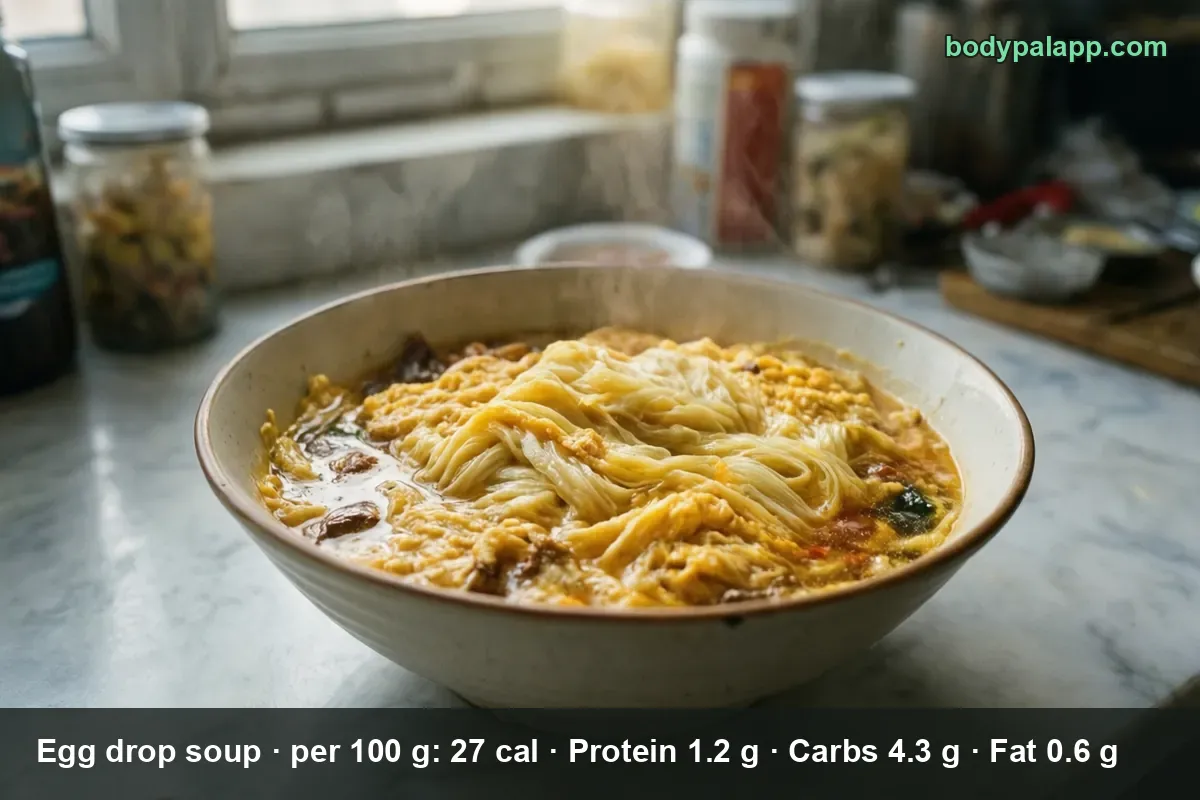
A 1-cup (245 g) serving of egg drop soup is 66 calories, and per 100 g the soup runs 27 calories — thinner than almost anything else on a Chinese takeout menu. The egg ribbons add body, not much else: 2.8 g of protein and 1.5 g of fat. The number that actually moves here is sodium.
On this page
- Egg drop soup quick facts
- US servings, from one ounce to a two-cup bowl
- Restaurant, homemade and the rest of the soup menu
- Sodium is the row to watch
- How does egg drop soup compare?
- FAQ
Egg drop soup quick facts
The row used on this page is FNDDS 2707282, "Soup, egg drop", from the 2021-2023 survey release. That is the finished soup as it reaches the table, whether it came out of a takeout container or off your own stove, which is the thing a person is holding when they look up the number. There is a second record, SR Legacy 174807, "Soup, egg drop, Chinese restaurant", with an identical nutrient profile but an older release date and a slightly different cup weight. It gets its own line further down rather than an average — mixing releases would only blur a figure that both agree on.
| Nutrient | Per 100 g | Per 1 cup (245 g) | % Daily Value |
|---|---|---|---|
| Calories | 27 | 66 | — |
| Total fat | 0.61 g | 1.5 g | 2% |
| Saturated fat | 0.17 g | 0.4 g | 2% |
| Carbohydrate | 4.29 g | 10.5 g | 4% |
| Dietary fiber | 0.4 g | 1.0 g | 3% |
| Total sugars | 0.09 g | 0.2 g | — |
| Protein | 1.16 g | 2.8 g | 6% |
| Sodium | 370 mg | 907 mg | 39% |
% Daily Value is based on a 2,000-calorie diet.
Verified nutrition data
Numbers on this page come from USDA FoodData Central, the U.S. Department of Agriculture’s food composition database, and from manufacturer labels where a branded product is named. Last verified September 2026. How we verify our data →
Two rows you would see on a packaged label are missing here: added sugars and trans fat. USDA does not publish either value for mixed dishes in this FNDDS release, so they are left out instead of guessed at. Cholesterol and potassium do exist for this record — 56 mg of cholesterol per cup (19% of the Daily Value, essentially all of it from the egg) and 54 mg of potassium (1%).
US servings, from one ounce to a two-cup bowl
| Serving | Weight | Calories |
|---|---|---|
| 1 oz | 28 g | 8 kcal |
| Small bowl, 1/2 cup | 123 g | 33 kcal |
| 1 cup | 245 g | 66 kcal |
| Restaurant bowl, 2 cups | 490 g | 132 kcal |
| Per 100 g | 100 g | 27 kcal |
Only the 1-cup line is a USDA household measure. The half cup, the two-cup bowl and the ounce are our own arithmetic from the USDA 100 g figure, not USDA servings — they scale cleanly because soup is uniform in a way a sandwich is not.
The gap between the cup and the bowl is where most people misjudge this soup. A cup of soup is a measuring cup, 245 g of liquid, and it barely fills a small ceramic bowl. What arrives at a table as "a bowl of egg drop soup" is usually closer to two cups, 490 g, which is 132 calories. Even doubled, that is under 7% of a 2,000-calorie day. Calories are simply not the interesting part of this dish.
Restaurant, homemade and the rest of the soup menu
| Version | Per 100 g | Typical serving | Calories |
|---|---|---|---|
| Egg drop soup (FNDDS, main row) | 27 kcal | 1 cup, 245 g | 66 kcal |
| Chinese restaurant egg drop soup (SR Legacy) | 27 kcal | 1 restaurant cup, 241 g | 65 kcal |
| Miso or tofu soup | 24 kcal | 1 cup, 245 g | 59 kcal |
| Wonton soup | 33 kcal | 1 cup, 245 g | 81 kcal |
| Seaweed soup | 37 kcal | 1 cup, 245 g | 91 kcal |
| Pho, no meat | 37 kcal | 1 cup, 245 g | 91 kcal |
| Hot and sour soup | 39 kcal | 1 cup, 245 g | 96 kcal |
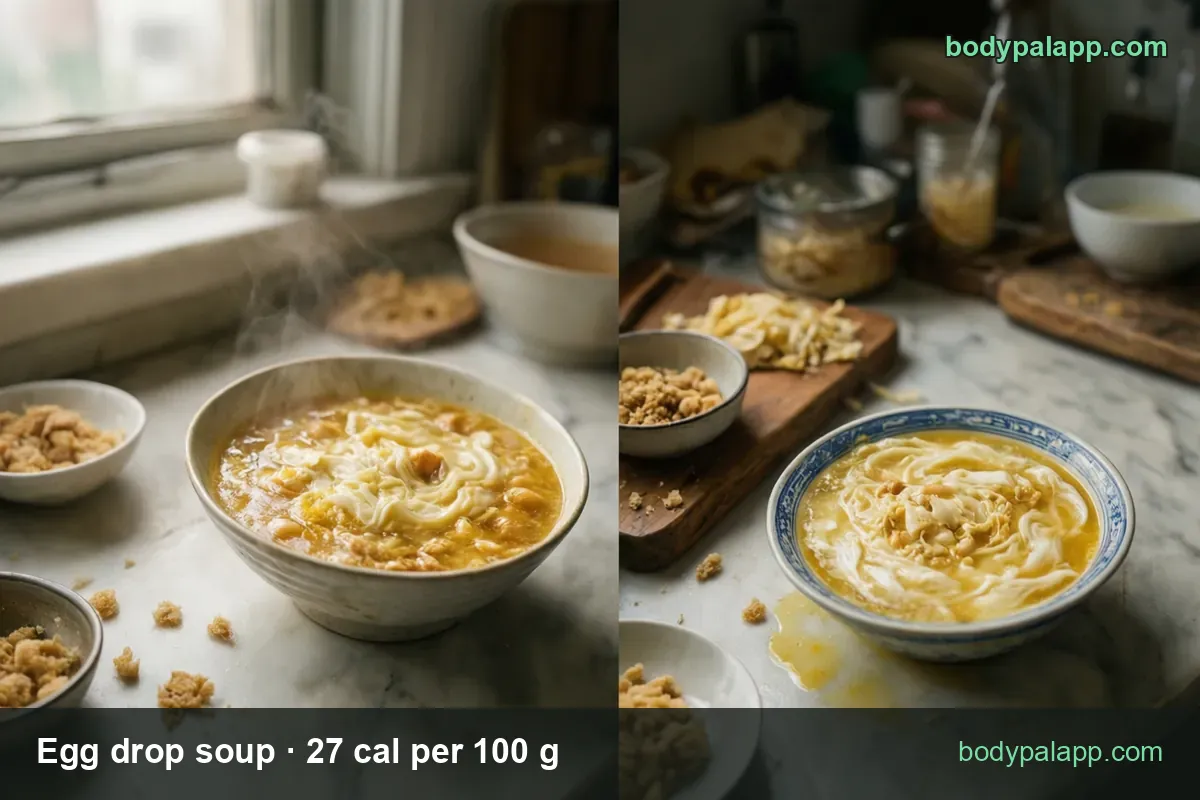
The restaurant record and the survey record land one calorie apart, and that single calorie is a cup-weight difference (241 g against 245 g), not a recipe difference. So there is no separate "restaurant" number to log. Homemade is the same story: USDA has one profile for this soup because the recipe is broth, a beaten egg and a spoon of cornstarch, and none of those three change much from kitchen to kitchen.
What does change at home is the salt, and that is worth more attention than the calorie count. The seaweed and pho lines are here because they sit next to egg drop soup on the same menus and get ordered for the same reason — something hot and light before the main dish. Neither clears 100 calories a cup either.
Sodium is the row to watch
One cup of egg drop soup delivers 907 mg of sodium. Against the FDA Daily Value of 2,300 mg, that is 39% of a day's allowance for 66 calories — about 3% of the calories in a 2,000-calorie day. Very few foods have a ratio that lopsided. In table-salt terms, a cup is roughly two-fifths of a teaspoon dissolved in broth.
Scale it to the bowl that actually shows up at the table and the arithmetic gets sharper. Two cups is about 1,814 mg, or 79% of the Daily Value, before anything else on the table is touched. The Dietary Guidelines for Americans put the limit at less than 2,300 mg per day for adults, so one starter can spend most of it. CDC notes that the bulk of American sodium intake comes from restaurant and packaged foods rather than the shaker, and a soup built on commercial broth and soy sauce is a clean example of why.
None of this makes egg drop soup a bad order. It makes it a soup you order for volume and warmth, with a plan for the rest of the day's salt.
How does egg drop soup compare?
| Soup | Per 100 g | US serving | Calories |
|---|---|---|---|
| Miso or tofu soup | 24 kcal | 1 cup, 245 g | 59 kcal |
| Egg drop soup | 27 kcal | 1 cup, 245 g | 66 kcal |
| Wonton soup | 33 kcal | 1 cup, 245 g | 81 kcal |
| Hot and sour soup | 39 kcal | 1 cup, 245 g | 96 kcal |
Our take: of these four, only miso soup is lighter, and the whole spread from lightest to heaviest is 37 calories a cup — less than a slice of bread. That means the calorie question answers itself and the protein question does not. Egg drop soup gives 2.8 g of protein a cup, against 5.4 g for miso and 5.9 g for wonton, so it is the weakest of the group at holding off the next thing you eat. If the goal is a low-calorie start to a big meal, order it. If the bowl is supposed to be lunch, hot and sour or wonton earns the extra 15 to 30 calories.
Egg drop soup FAQs
How many calories are in a cup of egg drop soup?
66 calories for a 1-cup (245 g) serving, from a USDA figure of 27 calories per 100 g. That is one of the lowest numbers on a Chinese takeout menu, lighter than wonton soup at 81 calories a cup and hot and sour at 96. The egg ribbons weigh almost nothing.
How much sodium is in egg drop soup?
A cup holds 907 mg of sodium, 39% of the 2,300 mg Daily Value, and a two-cup restaurant bowl holds about 1,814 mg, or 79%. That is the real trade in this soup: the calories are trivial at 66 a cup, the salt is not. Broth and soy sauce carry almost all of it.
How many carbs are in egg drop soup?
10.5 g of carbohydrate in a 1-cup serving, with 1.0 g of fiber and only 0.2 g of total sugars. The cornstarch slurry that thickens the broth accounts for most of it. Per 100 g the figure is 4.29 g, so a small half-cup bowl lands near 5 g of carbohydrate.
How much protein is in egg drop soup?
2.8 g of protein per cup, which is less than wonton soup at 5.9 g and miso at 5.4 g for the same 245 g pour. One beaten egg gets spread across an entire pot, so this is a broth with egg in it rather than a protein course.
Is egg drop soup good for weight loss?
At 66 calories a cup it is one of the cheapest hot foods you can order, and warm volume ahead of a heavier plate is genuinely useful. The catch is 2.8 g of protein, which will not hold you long, and 907 mg of sodium, 39% of a day.
Is egg drop soup healthier than wonton soup?
Egg drop soup is lighter: 66 calories a cup against 81 for wonton soup, and 2.8 g of protein against 5.9 g. Wonton wrappers and pork filling add both. If you want the smaller number, egg drop wins; if the bowl has to work as food, wonton does more.
How many calories are in a restaurant bowl of egg drop soup?
A two-cup restaurant bowl (490 g) is about 132 calories, our own arithmetic from the USDA 100 g figure rather than a USDA serving. Sodium scales with it: roughly 1,814 mg, or 79% of the Daily Value. The bowl doubles the cup on every line of the label.
Does homemade egg drop soup have fewer calories?
USDA publishes one profile for egg drop soup, 27 calories per 100 g, and it covers both the restaurant version and the home pot. Calories barely move, since the recipe is broth, egg and a little cornstarch. What you can control at home is the 907 mg of sodium per cup.
Similar foods
- Egg — 72 cal per large egg
- Omelet — 305 cal for 3-egg omelet
- Crepe — 179 cal per crepe
- Pancake — 423 cal for 3 medium pancakes
- Toast with butter — 100 cal per slice with butter
- Injera — 118 cal per injera (12 in)
Count it without the math
Point the camera at the bowl and BodyPal counts the soup for you, cup or bowl.


How long does it take to burn off egg soup?
A 1-cup (245 g) serving is 66 kcal. Enter your weight and the amount you ate to see how long it takes you to burn that off:
lb
| Activity | Time to burn 66 kcal |
|---|---|
| Walking, brisk | 13 min |
| Cycling, moderate | 8 min |
| Swimming, moderate | 9 min |
| Jogging | 8 min |
| Weight training, moderate | 15 min |
Times are for a 155 lb adult at a steady pace; change the weight to see yours. The amount is set to the portion in the text (245 g); change it to what you actually ate. BodyPal works this out from your steps automatically.
Want the bigger picture? Calculate your daily calorie needs — your maintenance figure, a target for losing or gaining, and the date you get there.