
How many calories are in egg wonton soup?
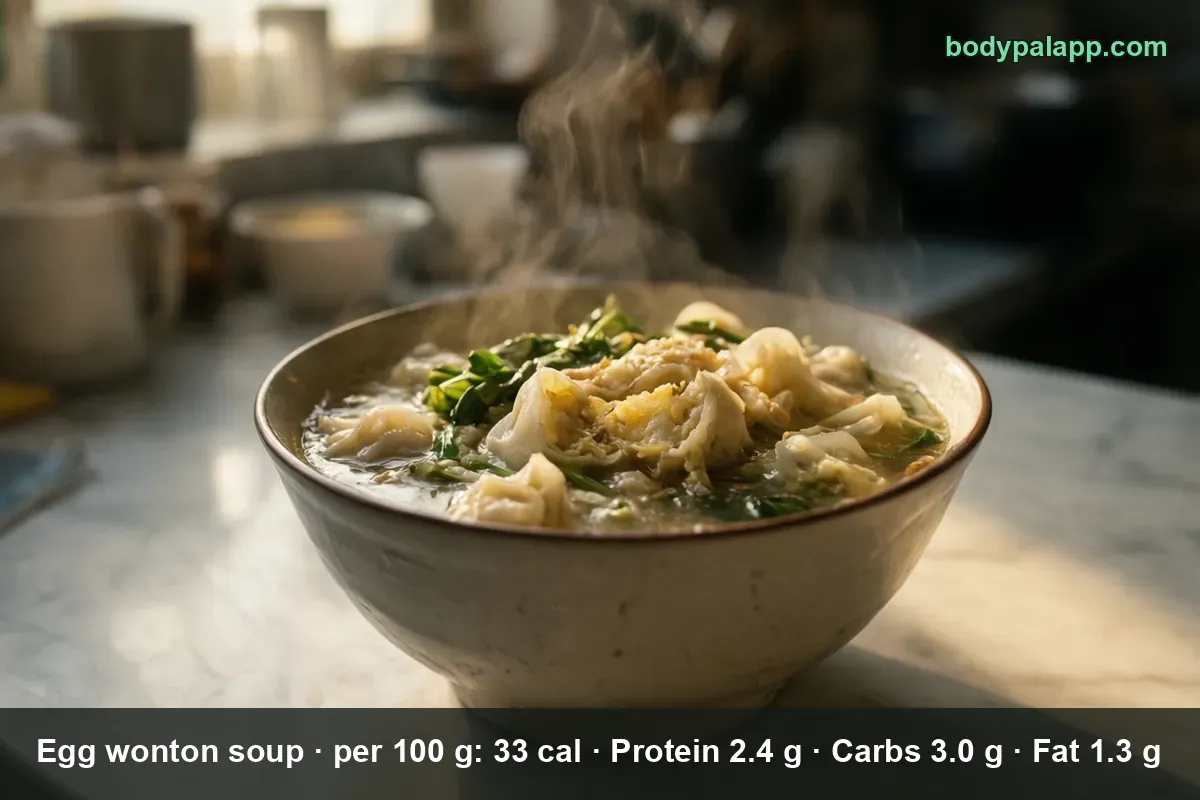
A 1-cup (245 g) serving of egg wonton soup is 81 calories, and the broth runs 33 calories per 100 g, one of the lightest things on a Chinese takeout menu. The wontons carry almost all of it. What the bowl really costs you is salt: 907 mg of sodium in that cup.
On this page
- Egg wonton soup quick facts
- US servings, from half a cup to a restaurant bowl
- Restaurant, egg drop and store bowls
- Sodium is the row to watch
- How does egg wonton soup compare?
- Most popular egg wonton soup brands
- FAQ
Egg wonton soup quick facts
The numbers below come from the USDA record FNDDS 2709160, "Soup, wonton". That is the dish a person is actually holding: broth with wontons, ribbons of egg and greens, measured with a ready household serving of 1 cup. There is a second USDA record for the version cooked in a Chinese restaurant, and it sits in the variants table further down rather than getting averaged into this one.
| Nutrient | Per 100 g | Per 1 cup (245 g) | % Daily Value |
|---|---|---|---|
| Calories | 33 | 81 | — |
| Total fat | 1.31 g | 3.2 g | 4% |
| Saturated fat | 0.41 g | 1.0 g | 5% |
| Carbohydrate | 2.95 g | 7.2 g | 3% |
| Dietary fiber | 0.3 g | 0.7 g | 3% |
| Total sugars | 0.74 g | 1.8 g | — |
| Protein | 2.39 g | 5.9 g | 12% |
| Sodium | 370 mg | 907 mg | 39% |
% Daily Value is based on a 2,000-calorie diet.
Verified nutrition data
Numbers on this page come from USDA FoodData Central, the U.S. Department of Agriculture’s food composition database, and from manufacturer labels where a branded product is named. Last verified September 2026. How we verify our data →
Two label rows are missing here on purpose. FNDDS does not publish added sugars or trans fat for mixed dishes like this one, so neither can be listed honestly. Cholesterol and potassium are published: a cup holds 10 mg of cholesterol (3% DV) and 211 mg of potassium (4% DV), both small enough that they never decide anything about this bowl.
The shape of the record is worth a second look. A cup of this soup is 4% of a 2,000-calorie day and 12% of a day's protein, which is an unusually good trade for something that is mostly water.
US servings, from half a cup to a restaurant bowl
| Serving | Weight | Calories |
|---|---|---|
| 1 oz | 28.4 g | 9 kcal |
| Half a cup, small side | 122.5 g | 40 kcal |
| 1 cup | 245 g | 81 kcal |
| One bowl with about 8 wontons, 1.5 cups | 367.5 g | 121 kcal |
| Restaurant bowl, 2 cups | 490 g | 162 kcal |
| Per 100 g | 100 g | 33 kcal |
The 1-cup line is the USDA household measure. The ounce, the half cup, the 8-wonton bowl and the 2-cup restaurant bowl are our own arithmetic from the USDA 100 g figure, not USDA servings, scaled straight off the 33 calories per 100 g.
That 8-wonton bowl is the one people misjudge. It looks like a meal, and it still lands at 121 calories, half what the same volume of ramen noodle soup would cost. The trap runs the other way with sodium, because the same bowl carries about 1,360 mg, roughly 59% of a day's limit. Volume is cheap in calories and expensive in salt.
Restaurant, egg drop and store bowls
| Version | Per 100 g | Typical serving | Calories |
|---|---|---|---|
| Chinese restaurant wonton soup | 32 kcal | 1 cup (223 g) | 71 kcal |
| Egg drop soup | 27 kcal | 1 cup (245 g) | 66 kcal |
| Hot and sour soup | 39 kcal | 1 cup (245 g) | 96 kcal |
| Miso or tofu soup | 24 kcal | 1 cup (245 g) | 59 kcal |
| Pho, no meat | 37 kcal | 1 cup (245 g) | 91 kcal |
| Shrimp wonton soup with noodles, retail bowl | 99 kcal | 1 bowl (222 g) | 220 kcal |
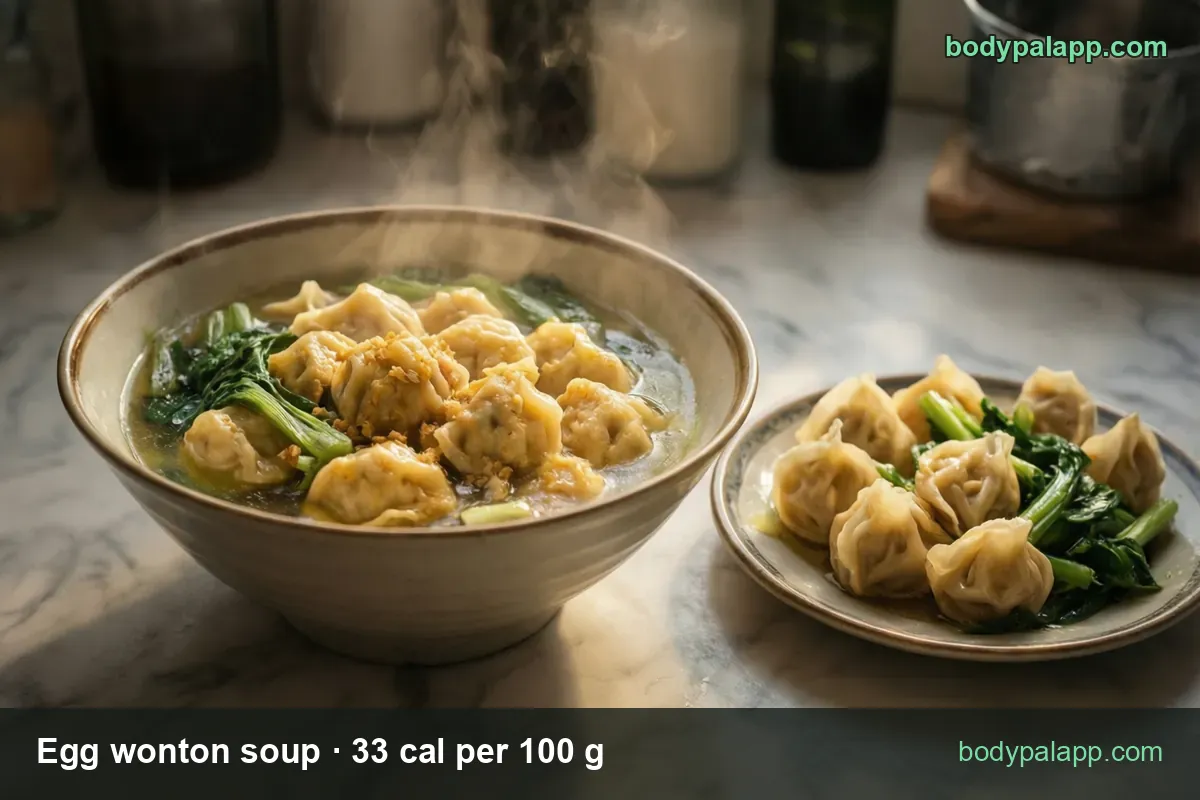
The restaurant record is the interesting one. At 32 calories per 100 g it is barely below the 33 of the home-style version, so the headline number does not move. Underneath, the recipes are different animals: 0.26 g of fat per 100 g against 1.31 g, and 5.25 g of carbohydrate against 2.95 g. The restaurant kitchen puts more dough in the bowl and less egg and fat in the broth. Same calories, different bowl.
Frozen and canned bowls are a different question again. USDA's branded records for store wonton soup run from 35 calories per 100 g for a shrimp-and-bok-choy bowl up to 101 for a shrimp wonton bowl with noodles, nearly three times the density at the same volume. In practical terms, a Royal Asia bowl of 227 g is 79 calories, a La Choy can of 411 g is 238, and a Charoen Pokphand noodle bowl of 222 g is 220. Noodles, not wontons, are what separates them. Note that these retail bowls are all shrimp wonton; the egg-and-wonton version is a restaurant and home dish, not a US label.
One more contrast for scale. A ramen noodle soup made with water comes in at 66 calories per 100 g, exactly double this broth, because the noodles were fried before they were dried.
Sodium is the row to watch
A single cup covers 39% of the Daily Value for sodium while covering 4% of the calories. That is the whole story of this food. If you want it in kitchen terms, 907 mg is a bit under half a teaspoon of table salt dissolved in one cup of broth.
The FDA's Daily Value for sodium is 2,300 mg, and the Dietary Guidelines for Americans use the same limit for adults. CDC reports that US adults average well above it, mostly from restaurant and packaged food rather than the salt shaker. A 2-cup restaurant bowl of wonton soup lands at about 1,813 mg on its own, close to 79% of the limit, before the entree arrives.
So the useful move is not to skip the soup. If you are watching sodium, drink less of the broth and eat the wontons, or order the soup and let it replace something saltier in the same meal. The calories were never the problem.
How does egg wonton soup compare?
| Soup | Per 100 g | US serving | Calories | Sodium per cup |
|---|---|---|---|---|
| Egg wonton soup | 33 kcal | 1 cup (245 g) | 81 kcal | 907 mg |
| Egg drop soup | 27 kcal | 1 cup (245 g) | 66 kcal | 1083 mg |
| Hot and sour soup | 39 kcal | 1 cup (245 g) | 96 kcal | 1056 mg |
| Pho, no meat | 37 kcal | 1 cup (245 g) | 91 kcal | 960 mg |
The sodium column is our own arithmetic from each record's USDA 100 g figure, scaled to a 245 g cup, not a USDA serving.
Our take: for a starter that actually holds you, order the wonton soup. It gives 5.9 g of protein for 81 calories, the most protein per calorie of the four, because the filling is meat and the wontons are small. Egg drop is the lightest at 66 calories a cup and also the saltiest, at about 1,083 mg. Every one of these four clears 900 mg per cup, so the choice between them is about protein and appetite, not about salt.
Most popular egg wonton soup brands in the United States
Ranked by how widely each product appears among foods sold in the United States, from the BodyPal food database of over 3.3 million products. Calories are the figures printed on each Nutrition Facts label, checked against USDA FoodData Central.
| Product | Calories (per 100 g) |
|---|---|
| Charoen Pokphand Shrimp Wonton Soup | 90 cal |
| Charoen Pokphand Shrimp Wonton Soup with Noodles | 99 cal |
| Royal Asia Shrimp Wonton Soup with Bok Choy | 35 cal |
| Authentic Asia Shrimp Wonton Soup with Noodles | 101 cal |
| La Choy Wonton Soup | 58 cal |
| SeaPak Shrimp Wonton Soup | 52 cal |
Brand popularity: BodyPal food database. Nutrition: manufacturer labels / USDA FoodData Central.
Egg wonton soup FAQs
How many calories are in a bowl of egg wonton soup?
A restaurant-size bowl of about two cups (490 g) comes to 162 calories, twice the 81 in a single cup. Most sit-down bowls land between those two numbers. The calories stay small; the sodium does not, since two cups carry roughly 1,813 mg, about 79% of a day's limit.
How many calories are in 1 cup of wonton soup?
81 calories in a 1-cup (245 g) serving, based on the USDA record for wonton soup at 33 calories per 100 g. That cup also gives 5.9 g of protein, 7.2 g of carbohydrate and 3.2 g of fat. Half a cup is 40 calories.
Is wonton soup high in sodium?
Yes: one cup holds 907 mg of sodium, 39% of the 2,300 mg Daily Value, against only 4% of a day's calories. A two-cup bowl reaches about 1,813 mg. Leaving part of the broth in the bowl is the simplest way to cut it without losing the wontons.
Is egg wonton soup good for weight loss?
It fits well: 81 calories a cup with 5.9 g of protein is a lot of volume for very little energy, and a cup before a meal takes up room. The limit is salt, not calories. If you are watching sodium, keep it to one cup rather than a full bowl.
How much protein is in wonton soup?
5.9 g in a 1-cup (245 g) serving, or 12% of the Daily Value, from 2.39 g per 100 g. That is the most protein per calorie among common Chinese soups: hot and sour gives 6.3 g but costs 96 calories, and egg drop only 2.8 g.
Egg drop soup vs. wonton soup: which has fewer calories?
Egg drop is lighter, at 66 calories per cup against 81 for wonton soup, because it has no dough in it. The gap is 15 calories, less than a teaspoon of oil. Wonton soup returns more than twice the protein, 5.9 g against 2.8 g per cup.
How many calories are in restaurant wonton soup?
71 calories in a 1-cup (223 g) serving of the USDA record for Chinese restaurant wonton soup, which runs 32 calories per 100 g. The density is nearly identical to the home version, but the restaurant recipe is leaner and doughier: 0.26 g of fat and 5.25 g of carbohydrate per 100 g.
Are frozen shrimp wonton soup bowls healthy?
They range widely: 35 to 101 calories per 100 g in USDA's branded records, so one bowl can be 79 calories and another 220. The noodle versions are the heavy ones. The retail bowls are all shrimp wonton rather than the egg version, and portions run from a 129 g bowl to a 411 g can.
Similar foods
- Egg — 72 cal per large egg
- Omelet — 305 cal for 3-egg omelet
- Crepe — 179 cal per crepe
- Pancake — 423 cal for 3 medium pancakes
- Toast with butter — 100 cal per slice with butter
- Injera — 118 cal per injera (12 in)
Count it without the math
Point the camera at the bowl and BodyPal counts the wontons, the broth and the egg for you.


How long does it take to burn off egg wonton soup?
A 1-cup (245 g) serving is 81 kcal. Enter your weight and the amount you ate to see how long it takes you to burn that off:
lb
| Activity | Time to burn 81 kcal |
|---|---|
| Walking, brisk | 16 min |
| Cycling, moderate | 10 min |
| Swimming, moderate | 12 min |
| Jogging | 10 min |
| Weight training, moderate | 18 min |
Times are for a 155 lb adult at a steady pace; change the weight to see yours. The amount is set to the portion in the text (245 g); change it to what you actually ate. BodyPal works this out from your steps automatically.
This table assumes you know your daily total. If you do not, the daily calorie calculator works it out from five numbers.