
How Many Calories Are in Fish Soup?
A 1-cup (245 g) serving of fish soup is 74 calories, and the soup itself runs 30 calories per 100 g, lighter than almost anything else you will ladle into a bowl. A full 2-cup bowl is 147. The number that actually matters here is not the calories. It is the 620 mg of sodium.
On this page
- Fish soup quick facts
- US servings from a spoonful to a full bowl
- Fish stock homemade fish soup and clam chowder
- Sodium is the row to watch
- How does fish soup compare?
- Most popular fish soup brands
- Fish soup FAQs
Fish soup quick facts
The record behind every number on this page is FNDDS 2707143, "Soup, fish or shrimp", from the 2021-2023 survey release. It is the broth-based bowl most Americans mean by fish soup: stock, vegetables, a few pieces of white fish or shrimp, no cream. It is also the only fish soup record in FoodData Central that carries a full nutrient profile and a household serving of 1 cup, which is what you need if you are logging a bowl rather than a lab sample.
The other two options are narrower. One is strained fish stock with nothing in it; the other is a thick homemade recipe. Both get their own section below, because the gap between them is bigger than most people expect.
| Nutrient | Per 100 g | Per 1 cup (245 g) | % Daily Value |
|---|---|---|---|
| Calories | 30 | 74 | — |
| Total fat | 0.47 g | 1.2 g | 1% |
| Saturated fat | 0.07 g | 0.2 g | 1% |
| Carbohydrate | 4.04 g | 9.9 g | 4% |
| Dietary fiber | 0.8 g | 2.0 g | 7% |
| Total sugars | 1.1 g | 2.7 g | — |
| Protein | 2.58 g | 6.3 g | 13% |
| Sodium | 253 mg | 620 mg | 27% |
% Daily Value is based on a 2,000-calorie diet.
Verified nutrition data
Numbers on this page come from USDA FoodData Central, the U.S. Department of Agriculture’s food composition database, and from manufacturer labels where a branded product is named. Last verified September 2026. How we verify our data →
Two label rows are missing on purpose. USDA does not publish added sugars or trans fat for this FNDDS record, so rather than guess at them, they are left off. The 1.1 g of total sugars per 100 g comes from the vegetables and the stock, not from a sugar bowl.
A cup also carries 17 mg of cholesterol (6% of the Daily Value) and 375 mg of potassium (8%). Neither is a reason to eat or skip the soup, but the potassium is a quiet bonus in a dish this light.
US servings from a spoonful to a full bowl
The 1 cup at 245 g is the USDA household measure. Everything else in this table is our own arithmetic from the USDA 100 g figure, not a USDA serving, which is why the weights come out to odd numbers.
| Serving | Weight | Calories |
|---|---|---|
| 1 oz | 28 g | 9 kcal |
| Half a cup | 123 g | 37 kcal |
| One cup, standard soup bowl | 245 g | 74 kcal |
| Two cups, a full dinner bowl | 490 g | 147 kcal |
| Per 100 g | 100 g | 30 kcal |
Here is the trap. A "bowl" in an American kitchen is almost never one cup. Standard soup bowls hold 12 to 16 fl oz, so if you fill one and go back for the last ladleful, you are closer to 490 g and 147 calories than to the 74 you probably logged. That is still a small number, which is the good news: even doubling the portion keeps fish soup under 150 calories.
The other direction matters for cooks. If you are tasting from the pot, a couple of tablespoons is under 10 calories, so tasting is genuinely free. The salt you add while tasting is not.
Fish stock homemade fish soup and clam chowder
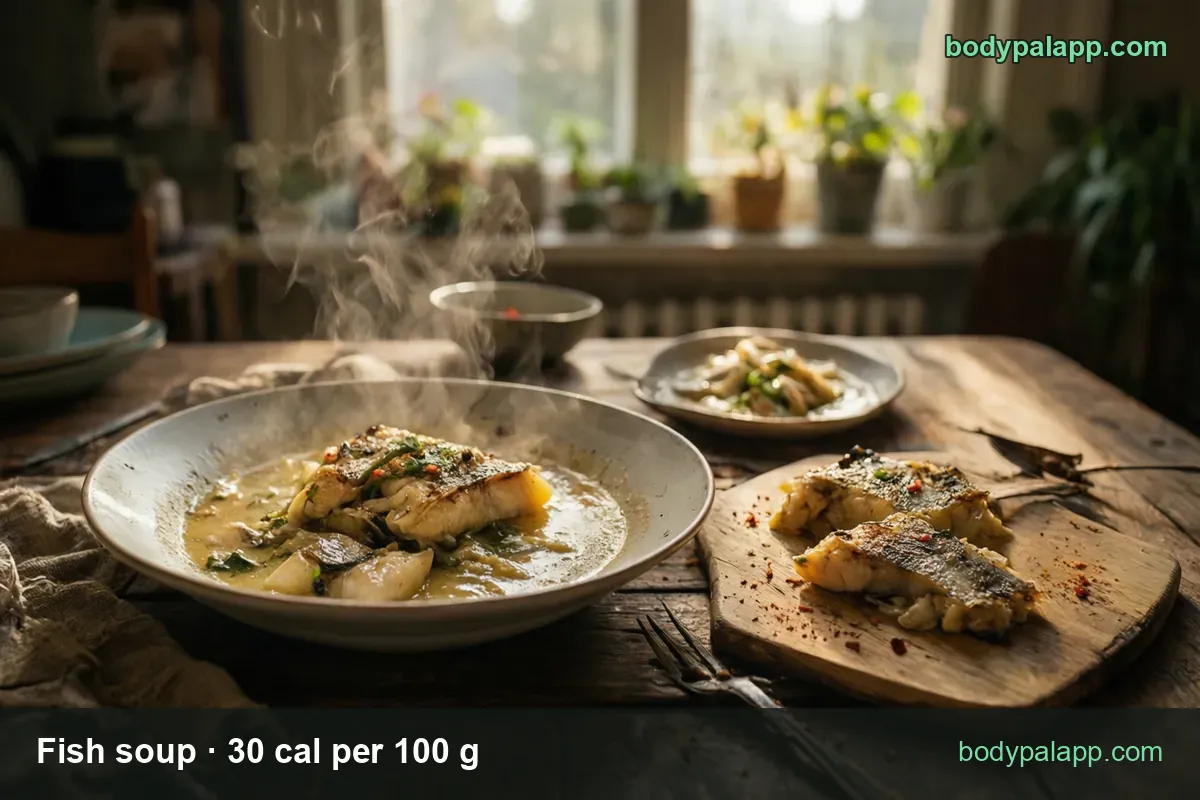
"Fish soup" is a range, not a number. The same cup swings from 37 calories to 176 depending on how much water is in it, a 4.8-fold spread that no single figure can cover.
| Version | Per 100 g | Typical serving | Calories |
|---|---|---|---|
| Fish stock, strained | 16 kcal | 1 cup (233 g) | 37 kcal |
| Fish soup, broth-based | 30 kcal | 1 cup (245 g) | 74 kcal |
| Manhattan clam chowder | 35 kcal | 1 cup (245 g) | 86 kcal |
| Homemade hearty fish soup | 72 kcal | 1 cup (245 g) | 176 kcal |
Fish stock is the floor. Strained, with the bones and trimmings lifted out, it holds 16 calories per 100 g and 2.26 g of protein, with zero carbohydrate. It is a cooking base, not a meal, and at 37 calories a cup it is closer to hot water than to soup.
Homemade hearty fish soup is the ceiling. The USDA record for an Alaska Native home preparation runs 72 calories per 100 g, with 7.4 g of protein, because it is built on fish rather than on broth. At 176 calories a cup it is nearly two and a half times the standard bowl, and it is the version worth cooking if you want the soup to be dinner. Note that this record is salted to taste and lists only 30 mg of sodium per 100 g, a fraction of the 253 mg in the ready-made soup.
Manhattan clam chowder sits just above plain fish soup at 35 calories per 100 g, 86 a cup. It is the tomato-based chowder, not the cream one; anything labeled New England is a different animal entirely and will not be anywhere near these numbers.
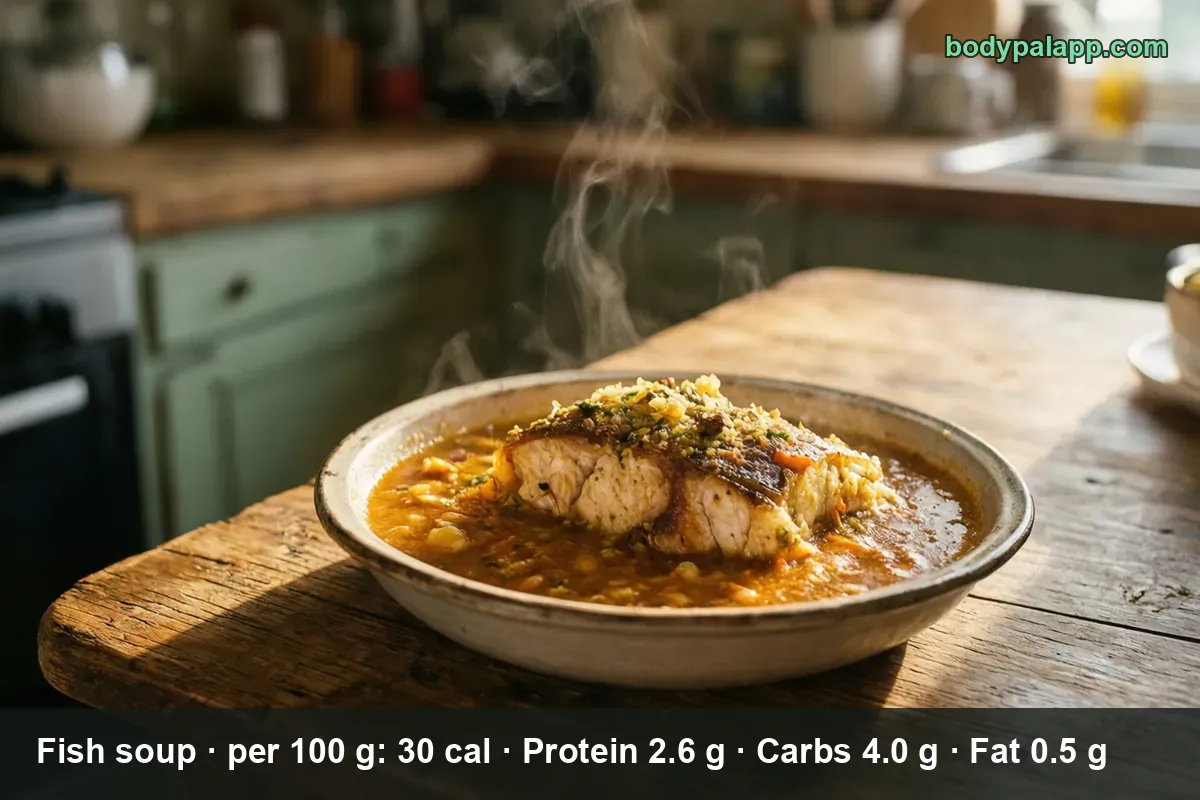
If your bowl looks like the thick, tomato-red soup with a whole fillet sitting in it, you are logging the hearty end of the range, not the broth end. Canned and deli fish soups sold in the US mostly hide under chowder and bisque names, and USDA's Branded database returns no clean "fish soup" product at all, so the FNDDS record is the honest default.
Sodium is the row to watch
This is the whole story of fish soup in one comparison. A cup is 74 calories, about 4% of a 2,000-calorie day. The same cup is 620 mg of sodium, 27% of the FDA Daily Value of 2,300 mg. The sodium share is close to seven times the calorie share. If you want it in kitchen terms, 620 mg is about a quarter teaspoon of table salt dissolved into your bowl.
Fill a 2-cup bowl and you are at 1,240 mg, more than half a day's sodium, from a dish that costs you 147 calories. The Dietary Guidelines for Americans put most adults well over the 2,300 mg limit already, and broth-based soups are one of the reasons. If you are watching sodium, homemade is the lever: the home-prepared record above lands at 30 mg per 100 g because you control the salt, not a factory.
The protein row runs the other way and is easy to miss. At 6.3 g per cup for 74 calories, roughly a third of the soup's calories come from protein. That is a better ratio than most hot dishes at this calorie level, and it is why a cup of fish soup blunts an appetite that a cup of vegetable soup does not. Fish and shellfish are MyPlate protein foods, and a soup is one of the cheapest ways to get them onto a weekday plate.
How does fish soup compare?
| Soup | Per 100 g | US serving | Calories |
|---|---|---|---|
| Fish soup | 30 kcal | 1 cup (245 g) | 74 kcal |
| Manhattan clam chowder | 35 kcal | 1 cup (245 g) | 86 kcal |
| Chicken soup, canned | 33 kcal | 1 cup (245 g) | 81 kcal |
| Vegetable soup | 27 kcal | 1 cup (245 g) | 66 kcal |
The cup weight of 245 g is carried across all four rows from the fish soup record, since FNDDS lists "1 cup" for these soups without its own gram weight. It is our arithmetic, not a USDA serving, and it makes the four directly comparable.
Our take: of these four, only vegetable soup is lighter per 100 g, and it buys that with protein, 2.1 g a cup against 6.3 g for fish soup. For eight extra calories, fish soup gives you three times the protein, which makes it the better pick for a lunch that has to last until dinner. Chicken soup is the closest match and loses on both counts, 81 calories and 4.9 g of protein. If you are choosing purely to keep a day's total down, none of these four will move the needle. Choose on sodium and protein instead, because that is where they actually differ.
Most popular fish soup brands in the United States
Ranked by how widely each product appears among foods sold in the United States, from the BodyPal food database of over 3.3 million products. Calories are the figures printed on each Nutrition Facts label, checked against USDA FoodData Central.
| Product | Calories (per 100 g) |
|---|---|
| Bar Harbor Fish Chowder | 74 cal |
| True Fin Finfish Chowder | 110 cal |
| Whole Foods Market Cioppino Soup | 31 cal |
| Whole Foods Market Maryland-Style Seafood Soup | 41 cal |
| Taste of Inspirations Seafood Chowder | 106 cal |
| Signature Cafe Spanish-Style Seafood & Chourico Soup | 65 cal |
Brand popularity: BodyPal food database. Nutrition: manufacturer labels / USDA FoodData Central.
Fish soup FAQs
How many calories are in a bowl of fish soup?
A 2-cup bowl (490 g) of broth-based fish soup comes to 147 calories, double the 74 in a single cup. That figure is our own arithmetic from the USDA 100 g value of 30 calories, not a USDA serving. A thick homemade version filling the same bowl would land near 350.
How many calories are in 1 cup of fish soup?
One cup, 245 g, is 74 calories. That is the USDA household serving for FNDDS record 2707143, and it carries 6.3 g of protein, 9.9 g of carbohydrate, 1.2 g of fat and 620 mg of sodium. The calories are small; the sodium is 27% of a day.
Is fish soup good for weight loss?
At 30 calories per 100 g it is one of the lightest hot dishes you can log, and a cup gives 6.3 g of protein for 74 calories. That combination keeps hunger down cheaply. If a cup leaves you hungry an hour later, the hearty homemade version at 176 calories a cup is the better trade.
How much protein is in fish soup?
A cup holds 6.3 g of protein, 13% of the 50 g Daily Value. Roughly a third of the soup's 74 calories come from protein, a better ratio than vegetable soup at 2.1 g per cup. The homemade record is denser again, at 7.4 g of protein per 100 g.
Why is fish soup so high in sodium?
One cup carries 620 mg of sodium, 27% of the 2,300 mg Daily Value, against only 74 calories. Broth is salted water by design, and fish and shellfish bring sodium of their own. Two cups put you past half a day's limit before anything else reaches the table.
Fish soup vs chicken soup: which has fewer calories?
Fish soup wins narrowly, 74 calories a cup against 81 for canned chicken soup, or 30 against 33 per 100 g. The wider gap is protein: 6.3 g a cup versus 4.9 g. Neither number is big enough to matter on its own, so pick on protein rather than calories.
How many calories are in fish stock?
Strained fish stock is 16 calories per 100 g, so a cup of 233 g is 37 calories, half the 74 in fish soup. There is no fish left in it, just 2.26 g of protein per 100 g and no carbohydrate at all. Treat it as a cooking base, not a meal.
Is homemade fish soup higher in calories than canned?
Yes, well over double: the USDA record for a home-prepared fish soup is 72 calories per 100 g, or 176 a cup, against 30 and 74 for the standard broth-based soup. More fish and less water is the entire difference, and the homemade version lists far less sodium.
Similar foods
- Tom yum soup — 191 cal per bowl
- Clementine — 35 cal per clementine
- Ceviche — 158 cal per cup
- Pomegranate — 72 cal for 1/2 cup arils
- Clam Chowder — 237 cal per cup
- Chinese Chicken and Broccoli — 206 cal per cup
Count it without the math
Point the camera at the bowl and BodyPal counts the soup for you, fish and broth alike.


How long does it take to burn off fish soup?
A 1-cup (245 g) serving is 74 kcal. Enter your weight and the amount you ate to see how long it takes you to burn that off:
lb
| Activity | Time to burn 74 kcal |
|---|---|
| Walking, brisk | 15 min |
| Cycling, moderate | 9 min |
| Swimming, moderate | 11 min |
| Jogging | 9 min |
| Weight training, moderate | 16 min |
Times are for a 155 lb adult at a steady pace; change the weight to see yours. The amount is set to the portion in the text (245 g); change it to what you actually ate. BodyPal works this out from your steps automatically.
Want the bigger picture? Calculate your daily calorie needs — your maintenance figure, a target for losing or gaining, and the date you get there.