
How many calories are in gnocchi?
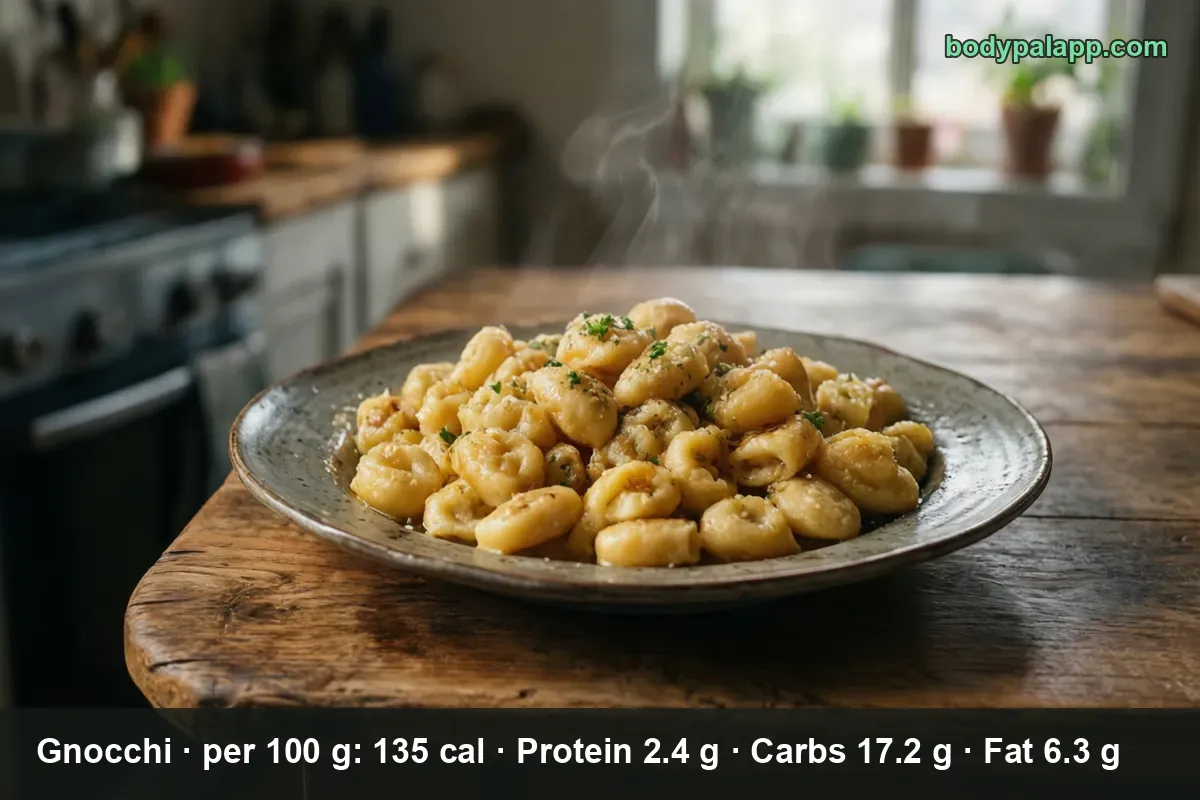
A 1-cup serving of cooked potato gnocchi is 254 calories, and per 100 g the dish runs 135 calories. Lighter than most people expect from a potato dumpling. The catch is not the starch: one cup delivers 6.4 g of saturated fat, 32% of a day's worth, against 12% of the carbohydrate Daily Value.
On this page
- Gnocchi quick facts
- US servings from one piece to a full cup
- Cheese gnocchi packaged packs and cauliflower swaps
- Saturated fat is the row to watch
- How does gnocchi compare to filled pasta?
- Most popular gnocchi brands
- FAQ
Gnocchi quick facts
The row on this page is FNDDS 2708722, "Gnocchi, potato", the survey record for the dish as it is actually eaten in the United States: boiled, sauced, on a plate. That is what someone counting calories is holding. The Foundation and SR Legacy databases carry no gnocchi record at all, so there is nothing to average against, and nothing worth averaging.
Read the fat line before the carb line. The plated dish gives 6.33 g of fat per 100 g, which is not a number a plain potato dumpling can produce on its own. It comes from the butter, oil and cheese that go in the pan after the boiling water.
| Nutrient | Per 100 g | Per 1 cup (188 g) | % Daily Value |
|---|---|---|---|
| Calories | 135 | 254 | — |
| Total fat | 6.33 g | 11.9 g | 15% |
| Saturated fat | 3.42 g | 6.4 g | 32% |
| Carbohydrate | 17.2 g | 32.3 g | 12% |
| Dietary fiber | 1 g | 1.9 g | 7% |
| Total sugars | 0.99 g | 1.9 g | — |
| Protein | 2.44 g | 4.6 g | 9% |
| Sodium | 279 mg | 525 mg | 23% |
% Daily Value is based on a 2,000-calorie diet.
Verified nutrition data
Numbers on this page come from USDA FoodData Central, the U.S. Department of Agriculture’s food composition database, and from manufacturer labels where a branded product is named. Last verified September 2026. How we verify our data →
Added sugars and trans fat are not on the table because this edition of FNDDS does not publish either value for any record, and an empty cell reads better than a guess. Cholesterol comes in at 18 mg per 100 g, so 34 mg a cup, 11% of the Daily Value. Potassium is 139 mg per 100 g, 261 mg a cup, 6% DV. The percentages follow the FDA's Daily Value reference amounts for a 2,000-calorie day.
US servings from one piece to a full cup
| Serving | Weight | Calories |
|---|---|---|
| 1 piece | 26 g | 35 kcal |
| 1 oz | 28 g | 38 kcal |
| 4 pieces | 104 g | 140 kcal |
| 1/2 cup | 94 g | 127 kcal |
| 1 cup | 188 g | 254 kcal |
| Per 100 g | 100 g | 135 kcal |
Two of these are USDA household measures: the 188 g cup and the 26 g single piece. The half cup, the four-piece count and the ounce are our own arithmetic from the USDA 100 g figure, not USDA servings, and they round the way you would expect.
The cup is where people get caught. Gnocchi are dense and they pack tightly, so 188 g of them looks like a modest side dish next to a cup of spaghetti, and a restaurant entree is rarely one cup. Two cups on a plate with sauce is 508 calories before the bread basket. If you are eyeballing rather than weighing, count pieces instead: 35 calories each is easy math, and a dozen is 420.
Cheese gnocchi packaged packs and cauliflower swaps
| Version | Per 100 g | Typical serving | Calories |
|---|---|---|---|
| Potato gnocchi, cooked as eaten | 135 kcal | 1 cup (188 g) | 254 kcal |
| Cheese gnocchi | 178 kcal | 1 cup (70 g) | 125 kcal |
| Store-bought potato gnocchi, uncooked | 148 kcal | 1 cup (162 g) | 240 kcal |
| Cauliflower gnocchi | 150 kcal | 1 cup (140 g) | 210 kcal |
| Cauliflower gnocchi, lighter label | 93 kcal | 1 cup (140 g) | 130 kcal |
| Beet gnocchi | 248 kcal | 1 cup (113 g) | 280 kcal |
Cheese gnocchi is the semolina-and-cheese style, and it is the trap in this table. Per 100 g it is the denser food, 178 against 135, with 8.51 g of protein and 11.96 g of fat, and only 9.38 g of carbohydrate. Yet its cup lands at 125 calories, half the potato version, because USDA weighs that cup at 70 g. Same word, just over a third of the weight. Check the gram weight before you trust a cup.
The uncooked retail packs read higher per 100 g than the finished dish, which surprises people. Giovanni Rana potato gnocchi is 148 per 100 g, De Cecco fresh 184, Signature Select and La Molisana both 164, Dell'Alpa 145, De Cecco mini 152. The range across the six most-logged US packs is 145 to 184. But those raw doughs carry almost no fat, between 0 and 0.3 g per 100 g. The fat in your dinner is entirely a decision you make at the stove, which is also why the same pack can end the night at 240 calories a cup or well past 400.
Cauliflower gnocchi is not one number. One widely sold label reads 150 per 100 g and 210 a cup; a lighter one reads 93 and 130. Both beat the potato cup, though a chunk of that win is the smaller 140 g cup rather than the vegetable. Beet gnocchi goes the other way at 248 per 100 g, the densest thing on this page, and 280 for a 113 g cup. Dry shelf-stable gnocchi made on other flours is a different product again and is not included here.
Saturated fat is the row to watch
One cup covers 32% of the Daily Value for saturated fat and 15% for total fat, while the carbohydrate it is famous for stops at 12%. The Dietary Guidelines for Americans put saturated fat at under 10% of daily calories, which is about 22 g on a 2,000-calorie day. A single cup of gnocchi as served takes 6.4 g of that. Two cups take most of it.
Sodium is the second surprise: 525 mg a cup, 23% DV, roughly a quarter teaspoon of table salt before anything is sprinkled on top. The raw packs are not neutral either, ranging from 269 to 616 mg per 100 g depending on brand. If you are watching sodium, the pack you buy matters as much as the sauce you make.
Fiber and protein both come in low, 1.9 g and 4.6 g a cup. That is a plate that empties fast. Pairing gnocchi with a protein and a vegetable, the way MyPlate frames a grain-based meal, does more for how long it holds you than swapping to a cauliflower version does.
How does gnocchi compare to filled pasta?
| Dish | Per 100 g | Protein per 100 g | Fat per 100 g |
|---|---|---|---|
| Gnocchi, potato | 135 kcal | 2.44 g | 6.33 g |
| Tortellini, meat-filled, with tomato sauce | 134 kcal | 6.62 g | 4.92 g |
| Ravioli, cheese-filled, with meat sauce | 137 kcal | 6.37 g | 6.14 g |
| Manicotti, vegetable- and cheese-filled, with tomato sauce | 135 kcal | 6.43 g | 5.18 g |
Per-serving calories are missing for the three filled pastas on purpose: USDA lists their household measures without gram weights, so there is no honest way to price a cup of tortellini here.
Our take: on calories these four are the same food. Gnocchi at 135 per 100 g sits between tortellini's 134 and ravioli's 137, a spread of three calories across the group. Protein is where they separate, and gnocchi loses badly: 2.44 g per 100 g against roughly 6.4 g for all three filled pastas, because a filling means meat or cheese and a potato dumpling means potato. For weight loss, pick by portion size and sauce, not by shape. For staying full, the filled pastas are the better plate, and if it has to be gnocchi, put the protein next to it.
Most popular gnocchi brands in the United States
Ranked by how widely each product appears among foods sold in the United States, from the BodyPal food database of over 3.3 million products. Calories are the figures printed on each Nutrition Facts label, checked against USDA FoodData Central.
| Product | Calories (per 100 g) |
|---|---|
| Giovanni Rana Potato Gnocchi | 148 cal |
| De Cecco Fresh Potato Gnocchi | 184 cal |
| Signature Select Potato Gnocchi | 164 cal |
| La Molisana Gnocchi di Patate | 164 cal |
| Dell'Alpa Potato Gnocchi | 145 cal |
| De Cecco Mini Potato Gnocchi No. 402 | 152 cal |
Brand popularity: BodyPal food database. Nutrition: manufacturer labels / USDA FoodData Central.
Gnocchi FAQs
How many calories are in a cup of gnocchi?
A 1-cup serving of cooked potato gnocchi is 254 calories, based on the USDA's 188 g cup. That cup also carries 32.3 g of carbohydrate, 11.9 g of fat and 525 mg of sodium. Restaurant portions are usually bigger, so a plated entree can run past two cups.
How many calories in one gnocchi piece?
One gnocchi piece weighs about 26 g and comes to 35 calories. Four pieces land at 140 calories, our own arithmetic from the USDA 100 g figure. Piece size varies a lot by kitchen: hand-rolled dumplings from a trattoria are often twice the size of the machine-cut ones in a supermarket pack.
How many calories in 100 g of gnocchi?
100 g of cooked potato gnocchi is 135 calories, with 17.2 g of carbohydrate, 6.33 g of fat and 2.44 g of protein. That is the plated dish as eaten, butter and sauce included. Uncooked supermarket packs read higher per 100 g, 145 to 184, since raw dough is denser than the boiled dish.
How many carbs are in gnocchi?
A 1-cup serving holds 32.3 g of carbohydrate, 12% of the Daily Value, and 17.2 g per 100 g. Fiber is small at 1.9 g a cup. For a potato dumpling that is a modest carb load, and the fat, at 15% DV per cup, is the bigger number on the label.
How much protein is in gnocchi?
Gnocchi is low in protein: 2.44 g per 100 g, or 4.6 g in a 1-cup serving, which is 9% of the Daily Value. Cheese gnocchi is the exception at 8.51 g per 100 g. If you want the plate to hold you, the protein has to come from what you serve alongside.
Is gnocchi high in sodium?
Fairly high: a 1-cup serving carries 525 mg of sodium, 23% of the 2,300 mg Daily Value and roughly a quarter teaspoon of table salt. Per 100 g it is 279 mg. Uncooked retail packs range from 269 to 616 mg per 100 g before any sauce goes near them.
How many calories in cauliflower gnocchi?
Cauliflower gnocchi runs 150 calories per 100 g on the common label, or 210 for a 1-cup (140 g) portion. A lighter label exists at 93 calories per 100 g and 130 a cup. Both undercut the 254 of a cup of cooked potato gnocchi, partly on the smaller cup weight.
How many calories in chicken gnocchi soup?
There is no USDA record for chicken gnocchi soup, so the only firm numbers are the gnocchi themselves: 135 calories per 100 g and 35 for one 26 g piece. Cream, chicken and oil carry most of a restaurant bowl, and without a published record we will not put a total on it.
Similar foods
- Chicken Chow Mein — 288 cal per cup
- Half And Half — 20 cal per tbsp
- Lasagna — 286 cal per piece
- Snow Cone — 256 cal per snow cone
- Egg Foo Yung — 108 cal per patty
- Toor Dal — 348 cal per cup
Count it without the math
Point the camera at the plate and BodyPal counts the gnocchi for you, sauce and all.


How long does it take to burn off gnocchi?
A 1-cup (188 g) serving is 254 kcal. Enter your weight and the amount you ate to see how long it takes you to burn that off:
lb
| Activity | Time to burn 254 kcal |
|---|---|
| Walking, brisk | 51 min |
| Cycling, moderate | 32 min |
| Swimming, moderate | 36 min |
| Jogging | 30 min |
| Weight training, moderate | 56 min |
Times are for a 155 lb adult at a steady pace; change the weight to see yours. The amount is set to the portion in the text (188 g); change it to what you actually ate. BodyPal works this out from your steps automatically.
One food is easy to picture; a whole day is harder. See how many calories you need a day and what a deficit actually looks like.