
How many calories are in a Halo orange?
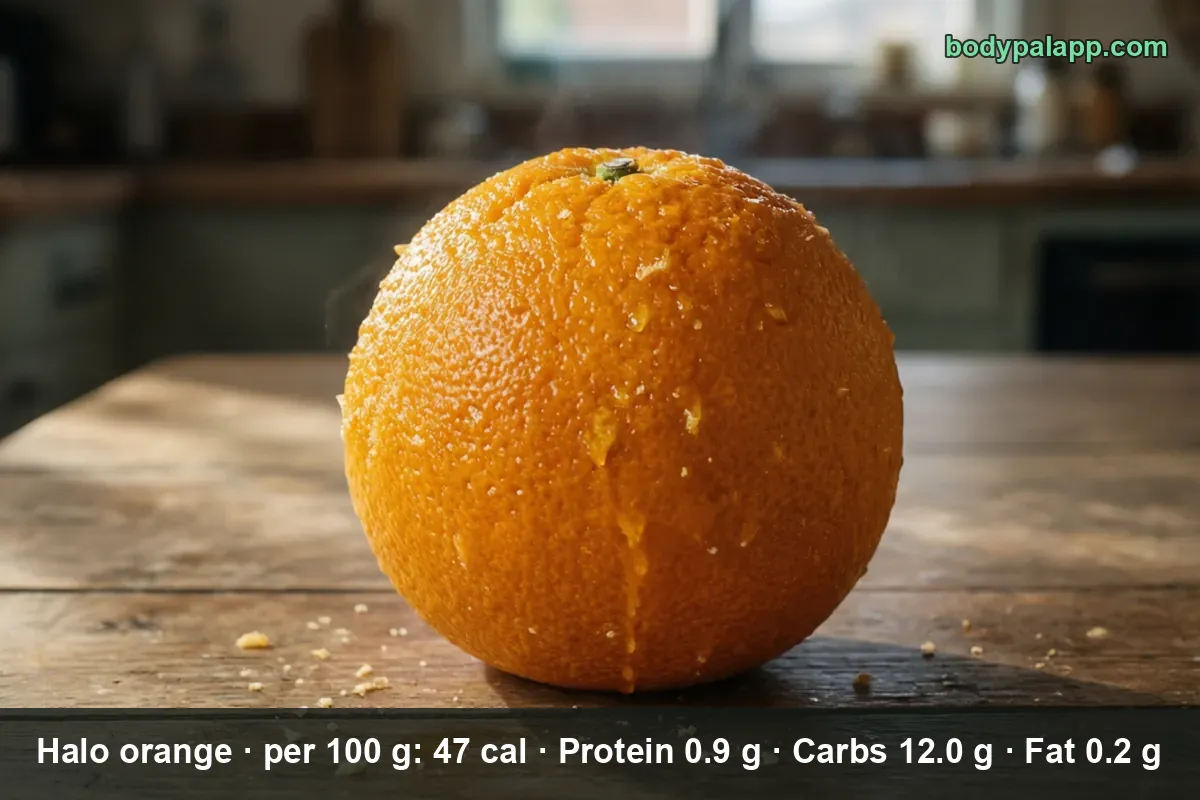
One Halo weighs about 74 g and carries 35 calories, which works out to 47 calories per 100 g. Two of them, the serving printed on the bag, come to 70. That is the whole story for the fresh fruit: a snack you can eat by the handful without moving your day's total much.
On this page
- Halo orange quick facts
- US servings from one Halo to a bag of three
- From the mesh bag to the can
- Fiber and potassium do the work here
- How does a Halo orange compare?
- Most popular halo orange brands
- Halo orange FAQs
Halo orange quick facts
Halos is a brand name for clementines, not a separate kind of citrus, and there is no USDA Branded record for the mesh bag itself. The number that fits the fruit in your hand comes from SR Legacy 168195, "Clementines, raw", at 47 calories per 100 g. The branded clementine rows that do exist agree with it exactly: Darling Clementines and Wegmans clementines are both filed at 47 calories per 100 g with a 148 g label serving worth 70 calories. That is unusual. Most fresh produce brands round their labels away from the generic record, and these two do not.
One clementine is 74 g in the USDA portion table, so every number in the middle column below is that record scaled to a single fruit.
| Nutrient | Per 100 g | Per one clementine (74 g) | % Daily Value |
|---|---|---|---|
| Calories | 47 | 35 | — |
| Total fat | 0.15 g | 0.1 g | 0% |
| Carbohydrate | 12.02 g | 8.9 g | 3% |
| Dietary fiber | 1.7 g | 1.3 g | 4% |
| Total sugars | 9.18 g | 6.8 g | — |
| Protein | 0.85 g | 0.6 g | 1% |
| Sodium | 1 mg | 1 mg | 0% |
| Potassium | 177 mg | 131 mg | 3% |
% Daily Value is based on a 2,000-calorie diet.
Verified nutrition data
Numbers on this page come from USDA FoodData Central, the U.S. Department of Agriculture’s food composition database, and from manufacturer labels where a branded product is named. Last verified September 2026. How we verify our data →
Two rows you would see on a packaged snack are missing here on purpose. USDA publishes no saturated fat and no cholesterol figure for raw clementines, so those lines are out rather than guessed at; with total fat at 0.15 g per 100 g there is almost nothing there to split. There is also no added sugars value, because nothing is added to a peeled fruit. The 6.8 g in one Halo is the clementine's own sugar, and total sugars have no Daily Value, which is why that cell stays blank.
US servings from one Halo to a bag of three
| Serving | Weight | Calories |
|---|---|---|
| 1 oz | 28 g | 13 kcal |
| One Halo, one clementine | 74 g | 35 kcal |
| Two Halos, the label serving | 148 g | 70 kcal |
| Three Halos | 222 g | 104 kcal |
| Per 100 g | 100 g | 47 kcal |
Only two of those lines come straight from USDA: the 74 g single fruit, which is the household measure attached to the record, and the per-100-g row. The one-ounce, two-fruit and three-fruit rows are our own arithmetic from the USDA 100 g figure, not USDA servings. The 148 g pair happens to match what the produce brands print, which is a useful coincidence when you are reading a bag in the store.
The practical takeaway is how flat this scale is. Three Halos, which is a real amount to eat while watching a movie, still land at 104 calories. Very few snacks let you triple the portion and stay under the calorie count of a single granola bar.
From the mesh bag to the can
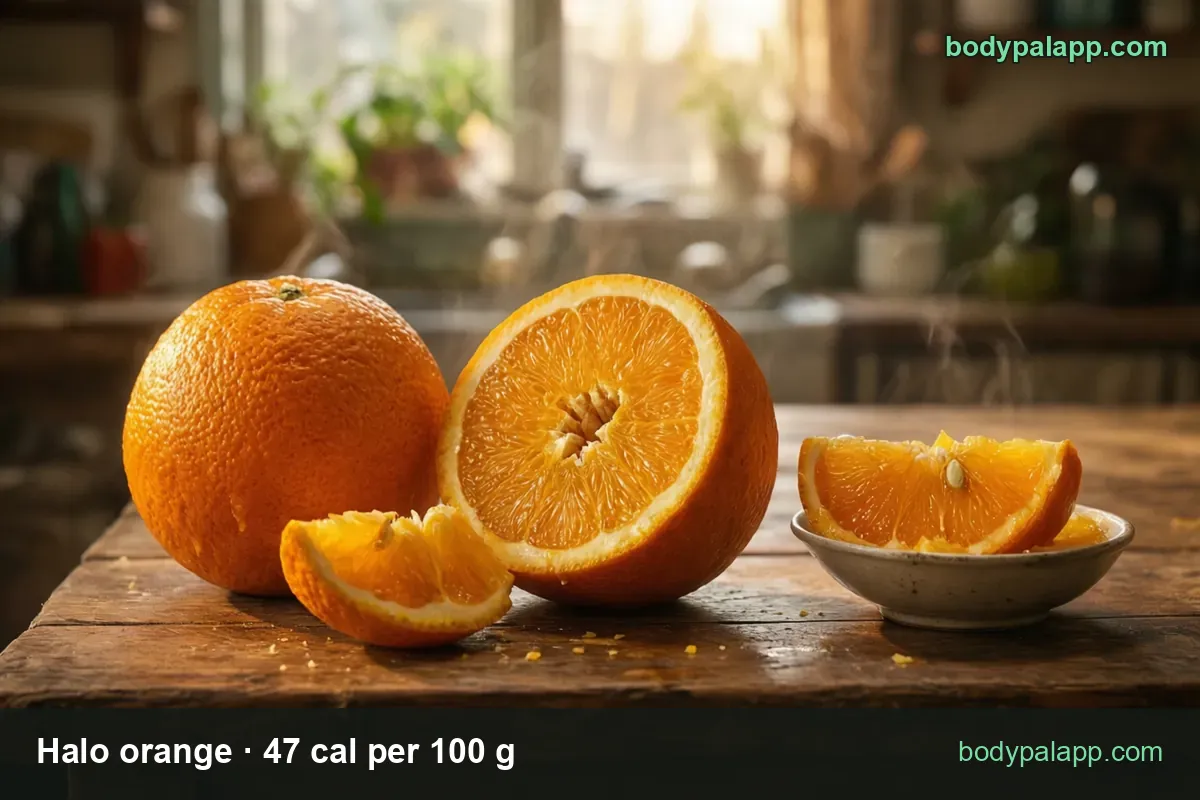
| Version | Per 100 g | Typical serving | Calories |
|---|---|---|---|
| Fresh Halo, clementine, raw | 47 kcal | one fruit, 74 g | 35 kcal |
| Tangerine or mandarin, raw | 53 kcal | one medium, 88 g | 47 kcal |
| Clementine, FNDDS profile | 53 kcal | 1 cup sections, 200 g | 106 kcal |
| Canned mandarin oranges, juice pack | 37 kcal | 1 cup, 249 g | 92 kcal |
| Canned mandarin oranges, juice pack, drained | 38 kcal | 1 cup, 189 g | 72 kcal |
| Canned mandarin oranges, light syrup | 61 kcal | 1 cup, 252 g | 154 kcal |
Start with the row most people log by mistake. Search a food app for "mandarin" and you often land on the tangerine record at 53 calories per 100 g, which is about 13% heavier per gram than the clementine. Run that through the 148 g label serving and two Halos become 78 calories instead of 70. Small, but it is a rounding error you repeat every time you log the bag. The FNDDS clementine entry has the same problem: it borrows the tangerine profile rather than analyzing the fruit separately, which is why it also reads 53.
The canned aisle is where the numbers really move. A cup of segments in light syrup is 154 calories, and a cup packed in juice is 92, even though the two cups weigh within 3 g of each other. Drain the juice pack and you are at 72 for 189 g of fruit. Per gram the juice pack is actually lighter than the fresh fruit, 37 calories per 100 g against 47, because a lot of what you are weighing is packing liquid. That is the trap: the can looks cheap per gram and expensive per cup, since 249 g of loose segments is far more fruit than the two Halos you would peel.
Branded cans sit right in that spread. Dole Mandarin Oranges in Fruit Juice come in at 62 calories per 100 g with a 113 g cup serving worth 70, Geisha at 50 per 100 g, Del Monte at 44 and Dole's plain mandarin oranges at 40. Read the pack rather than assuming all cans behave alike.
Fiber and potassium do the work here
One Halo delivers 1.3 g of fiber, which is 4% of the FDA Daily Value of 28 g, and 131 mg of potassium, or 3% of 4,700 mg. Protein is the row that goes nowhere: 0.6 g, 1% of the Daily Value. Nobody is eating citrus for protein, but it is worth knowing that the full feeling after two or three of them comes from fiber and water, not from any macro doing heavy lifting.
Sodium is essentially absent at 1 mg per fruit, which is 0% of the 2,300 mg Daily Value. If you are watching sodium, whole fruit is one of the few snack categories you never have to think about, and canned segments barely change that, topping out around 6 mg per 100 g.
For context on how much of this you want in a day, MyPlate puts most adults at 1½ to 2 cups of fruit daily. Halos are an easy way to get there because the unit is so small: the counting is in whole fruit rather than in cups you have to estimate.
How does a Halo orange compare?
| Food | Per 100 g | US serving | Calories |
|---|---|---|---|
| Halo, clementine, raw | 47 kcal | one fruit, 74 g | 35 kcal |
| Oranges, raw, all commercial varieties | 47 kcal | 1 oz, 28 g | 13 kcal |
| Loquats, raw | 47 kcal | 1 oz, 28 g | 13 kcal |
| Orange juice, canned, unsweetened | 47 kcal | 1 oz, 28 g | 13 kcal |
Our take: all four of these are identical at 47 calories per 100 g, so density is not what separates them. Form is. A Halo arrives in a 74 g package that ends at 35 calories whether you want it to or not, while 100 g of unsweetened orange juice is two swallows and 100 g of clementine is a fruit and a third that you have to peel first. If you are choosing between the bag and the carton for the same calories, take the one that makes you stop. For sheer stopping power the Halo is the better pick, and the peel is the timer.
Most popular halo orange brands in the United States
Ranked by how widely each product appears among foods sold in the United States, from the BodyPal food database of over 3.3 million products. Calories are the figures printed on each Nutrition Facts label, checked against USDA FoodData Central.
| Product | Calories (per 100 g) |
|---|---|
| Darling Clementines Clementine | 47 cal |
| Wegmans Clementines | 47 cal |
| Dole Mandarin Oranges in Fruit Juice | 62 cal |
| Dole Mandarin Oranges | 40 cal |
| Geisha Mandarin Oranges | 50 cal |
| Del Monte Mandarin Oranges | 44 cal |
Brand popularity: BodyPal food database. Nutrition: manufacturer labels / USDA FoodData Central.
Halo orange FAQs
How many calories are in one Halo orange?
35 calories for a single 74 g clementine, or 47 calories per 100 g. That is small enough that two of them, the serving printed on the bag, still only reach 70. The fruit carries 8.9 g of carbohydrate, 1.3 g of fiber and almost no fat, at 0.1 g.
How many calories are in 2 Halos?
70 calories for two clementines at 148 g, the serving most bags print. Scaled from the USDA 100 g figure, that pair also gives you roughly 17.8 g of carbohydrate, 13.6 g of sugar and 2.5 g of fiber. None of those numbers move a 2,000-calorie day very far.
Are Halos the same as clementines?
Yes. Halos is a brand name for clementines, so the USDA record that fits is "Clementines, raw" at 47 calories per 100 g. Tangerines and mandarins are a different row at 53 calories per 100 g, about 13% heavier per gram, which is why generic mandarin charts read high for a Halo.
How many carbs are in a Halo orange?
8.9 g of carbohydrate in one 74 g clementine, which is 3% of the Daily Value, and 1.3 g of that arrives as fiber. Per 100 g the figure is 12.02 g. Two Halos land near 17.8 g by our own arithmetic from the USDA 100 g number.
How much sugar is in a Halo?
6.8 g of total sugar in one 74 g fruit, and 9.18 g per 100 g. All of it is the fruit's own sugar. USDA publishes no added sugars value for raw clementines because nothing is added, and total sugars carry no Daily Value, so that percentage stays blank on a label.
Are Halos good for weight loss?
At 35 calories each they are among the cheapest sweet things you can pick up. Peeling slows you down, and 1.3 g of fiber plus a lot of water makes two of them feel like more than 70 calories. If you are watching sodium too, one fruit holds just 1 mg.
Halo vs regular orange: which has fewer calories?
They tie at 47 calories per 100 g. USDA lists the same density for clementines and for oranges of all commercial varieties, so the difference is the size of the fruit you pick up, not what is inside it. A Halo wins on portion control simply because one weighs 74 g and stops at 35 calories.
Do canned mandarin oranges have more calories than fresh Halos?
The syrup pack does: a cup at 252 g is 154 calories, against 92 for a cup packed in juice at 249 g. Per gram the juice pack is lighter than fresh fruit, 37 calories per 100 g versus 47, because much of the weight is liquid. The cup size is what costs you, not the can.
Similar foods
- Blood Orange — 62 cal per medium blood orange
- Orange — 62 cal per medium orange
- Plum — 30 cal per plum
- Cara Cara Orange — 69 cal per medium orange
- Nectarine — 31 cal for 1/2 medium
- Pineapple — 83 cal per cup chunks
Count it without the math
Point the camera at the bowl and BodyPal counts the Halos for you, peel and all.


How long does it take to burn off a Halo orange?
One clementine (74 g) is 35 kcal. Enter your weight and the amount you ate to see how long it takes you to burn that off:
lb
| Activity | Time to burn 35 kcal |
|---|---|
| Walking, brisk | 7 min |
| Cycling, moderate | 4 min |
| Swimming, moderate | 5 min |
| Jogging | 4 min |
| Weight training, moderate | 8 min |
Times are for a 155 lb adult at a steady pace; change the weight to see yours. The amount is set to the portion in the text (74 g); change it to what you actually ate. BodyPal works this out from your steps automatically.
This table assumes you know your daily total. If you do not, the daily calorie calculator works it out from five numbers.