
How many calories are in jambalaya?
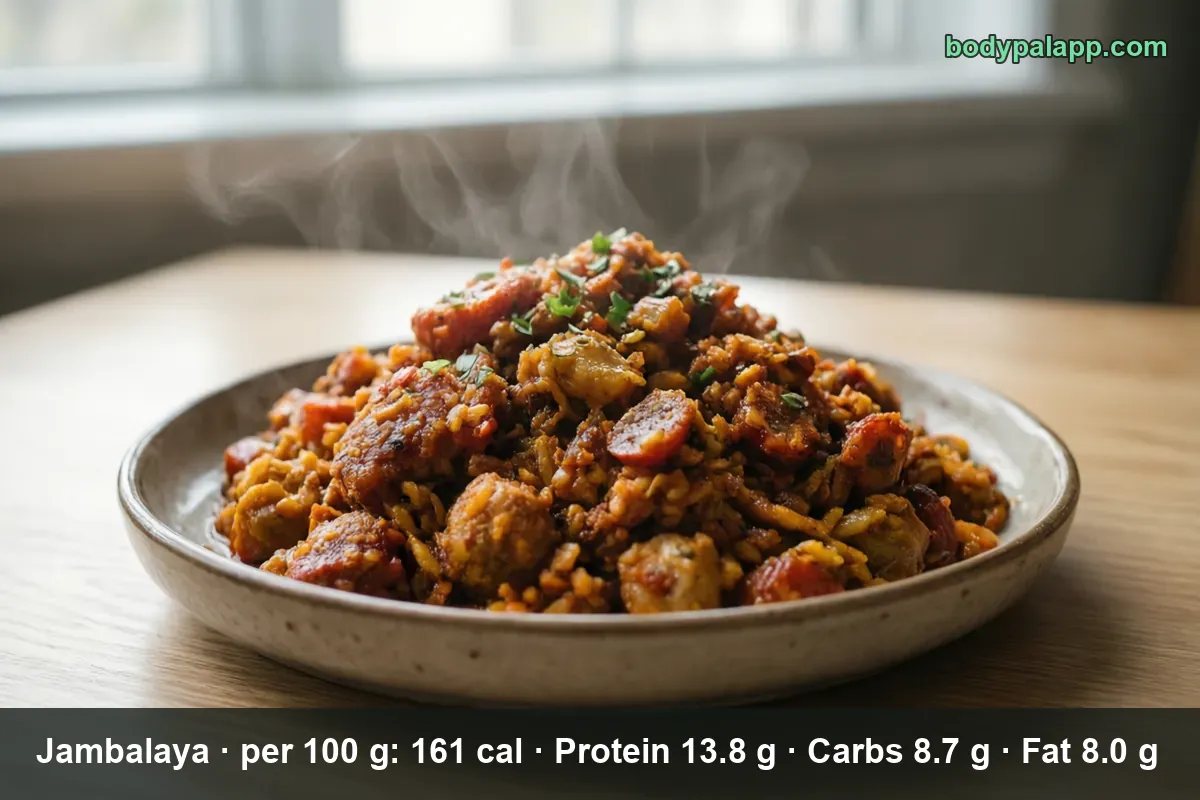
A 1-cup serving of jambalaya with meat and rice weighs 244 g and carries 393 calories. Per 100 g the dish runs 161 calories, which is light for something that eats like a full dinner plate. The rice is stretched thin here. Sausage, chicken and broth do most of the work by weight.
On this page
- Jambalaya quick facts
- US servings, from one ounce to a restaurant bowl
- Dry mix, frozen entree and canned soup
- Sodium is the row that limits the second helping
- How does jambalaya compare?
- Most popular jambalaya brands
- FAQ
Jambalaya quick facts
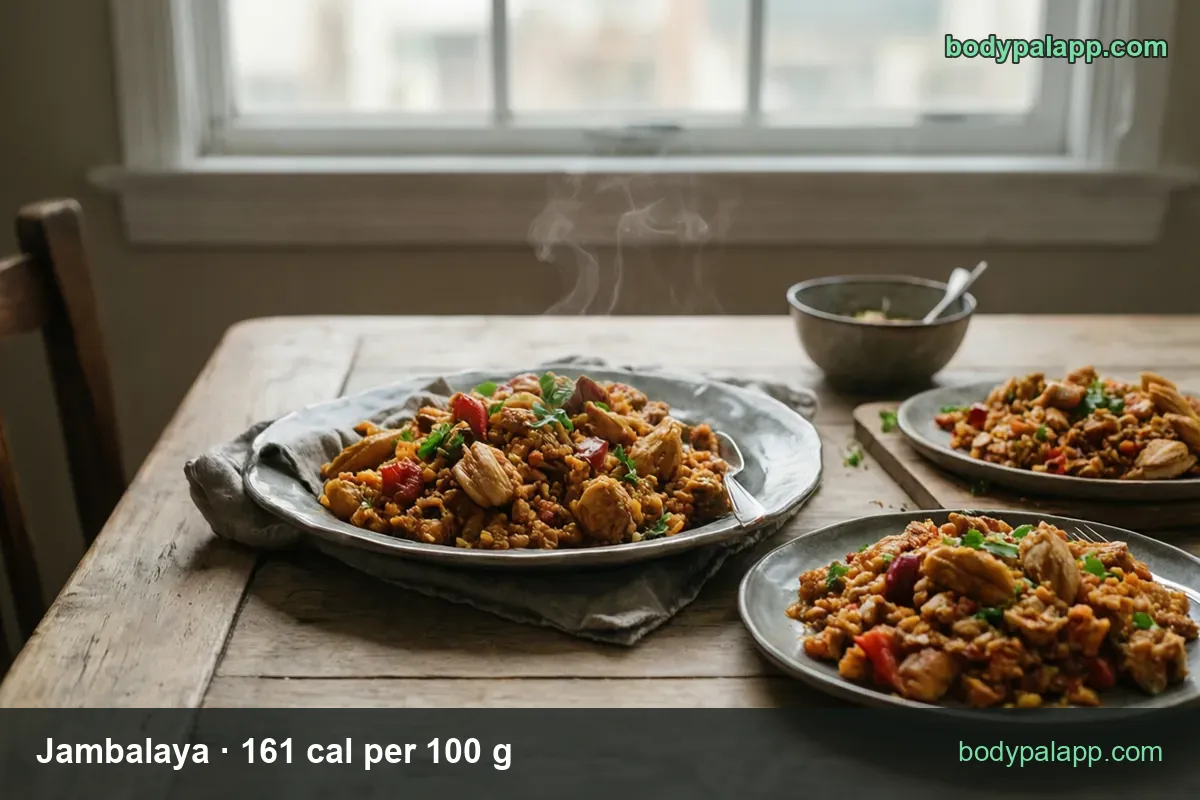
The record behind every number on this page is FNDDS 2706727, "Jambalaya with meat and rice", from the 2021-2023 survey release. It is the only USDA entry for the finished dish rather than a box, a can or a sauce: cooked rice, chicken and sausage, peppers and onion, the plate you actually hold. Everything else filed under the name is a dry mix, a soup or a packaged entree, and those live in their own section further down.
One thing to know before you read the table: the numbers below describe the dish as served, not as sold. Jambalaya is a mixed dish, and MyPlate counts it across the grain and protein groups at once, which is exactly why the carbohydrate row is so much smaller than people guess.
| Nutrient | Per 100 g | Per 1 cup (244 g) | % Daily Value |
|---|---|---|---|
| Calories | 161 | 393 | — |
| Total fat | 7.97 g | 19.4 g | 25% |
| Saturated fat | 2.21 g | 5.4 g | 27% |
| Carbohydrate | 8.65 g | 21.1 g | 8% |
| Dietary fiber | 0.7 g | 1.7 g | 6% |
| Total sugars | 0.94 g | 2.3 g | — |
| Protein | 13.76 g | 33.6 g | 67% |
| Sodium | 379 mg | 925 mg | 40% |
% Daily Value is based on a 2,000-calorie diet.
Verified nutrition data
Numbers on this page come from USDA FoodData Central, the U.S. Department of Agriculture’s food composition database, and from manufacturer labels where a branded product is named. Last verified September 2026. How we verify our data →
Two label rows are missing on purpose. USDA does not publish added sugars or trans fat for this record, so rather than guess, those lines are left out. Cholesterol and potassium do exist: a cup gives 142 mg of cholesterol (47% DV) and 586 mg of potassium (12% DV). The FDA's Daily Value reference is the source for every percentage in that column.
US servings, from one ounce to a restaurant bowl
| Serving | Weight | Calories |
|---|---|---|
| 1 oz | 28 g | 45 kcal |
| 1/2 cup | 122 g | 196 kcal |
| 3/4 cup | 183 g | 295 kcal |
| 1 cup | 244 g | 393 kcal |
| 1 serving, size not specified | 305 g | 491 kcal |
| Per 100 g | 100 g | 161 kcal |
Only two of those weights come from USDA itself: the 244 g cup and the 305 g "serving, quantity not specified," which is the closest thing the database has to a restaurant bowl. The half cup, three-quarter cup and ounce are our own arithmetic from the USDA 100 g figure, not USDA servings.
The gap between the cup and the unspecified serving is where most logging errors happen. A cup of jambalaya is a modest side-sized scoop; what comes out of a skillet at home, or what a Cajun place puts in front of you, is closer to 305 g and 491 calories. If you plate it and it fills the bowl to the rim, log the bigger one. If you press it into a measuring cup and level it off, log 393.
Dry mix, frozen entree and canned soup
| Version | Per 100 g | Typical portion | Calories |
|---|---|---|---|
| Jambalaya with meat and rice, cooked | 161 kcal | 1 cup, 244 g | 393 kcal |
| Zatarain's jambalaya mix, dry as packaged | 378 kcal | 45 g, 1/4 cup dry | 170 kcal |
| Grainful jambalaya with andouille sausage, frozen entree | 124 kcal | 283 g, 1 entree | 351 kcal |
| Spicy jambalaya soup, canned | 53 kcal | 524 g, 1 can | 276 kcal |
| Spanish rice with ground beef, for comparison | 163 kcal | 100 g | 163 kcal |
The dry mix is the trap. At 378 calories per 100 g, a Zatarain's box looks like more than twice the cooked dish, and it is not: that 45 g quarter cup of dry mix is 170 calories, and once it has taken on water and whatever meat you add, it lands near a cooked cup on the plate. Never compare a dry mix and a cooked dish at 100 g. Compare the portion you eat.
Other dry mixes on US shelves sit in the same band as packaged: CookSimple's New Orleans jambalaya with brown rice is 145 calories in a 42 g portion, Louisiana Purchase runs 190 in 57 g, and a ShopRite 45 g portion is 160. Uncle Ben's ready rice is the outlier at 138 calories per 100 g, but its USDA label lists a serving weight in milligrams, which is clearly a data entry error, so no per-serving figure is quoted for it here.
The frozen entree goes the other way. Grainful's andouille version is only 124 calories per 100 g, lighter than homemade, because the tray leans on rice and vegetables rather than sausage fat, yet the tray is 283 g, so it still eats as 351 calories. Canned jambalaya soup is a different food altogether at 53 calories per 100 g, though a whole 524 g can is 276 calories, and soup broth carries salt the way sausage does.
Shrimp jambalaya is the version people search for most after chicken and sausage, and USDA does not publish a separate record for it. Swapping andouille for shrimp lowers the fat, so treat the 393 figure as a ceiling rather than a match.
Sodium is the row that limits the second helping
Look at that table again and the calories are not the problem. One cup is 393 calories, a reasonable dinner. That same cup is 925 mg of sodium, 40% of the 2,300 mg Daily Value, which works out to a bit under half a teaspoon of table salt in a single scoop. Go back for a second cup and you are at 1,850 mg, roughly 80% of the day, from one dish.
The Dietary Guidelines for Americans put the ceiling at 2,300 mg a day for adults, and most people in the US are over it already before dinner. If you are watching sodium, the practical move is to keep jambalaya to one cup and build the rest of the plate from unsalted things: plain greens, a sliced tomato, unseasoned corn. If you cook it yourself, the andouille and the seasoning blend are where the salt sits, not the rice.
The protein row is the pleasant surprise in the other direction. A cup delivers 33.6 g of protein, 67% of the Daily Value, against just 21.1 g of carbohydrate. That is a rice dish with more protein than starch by weight, which almost nothing else on a Cajun menu can say. Saturated fat lands at 5.4 g, 27% DV, and that is sausage doing the talking.
How does jambalaya compare?
Grams are not the whole story with rice dishes, and USDA does not list cup weights for the neighbors below, so this comparison is set at 100 g for all four.
| Dish | Per 100 g | Protein per 100 g | Carbs per 100 g |
|---|---|---|---|
| Jambalaya with meat and rice | 161 kcal | 13.76 g | 8.65 g |
| Spanish rice with ground beef | 163 kcal | 9.68 g | 14.79 g |
| White rice with cream sauce | 166 kcal | 5.16 g | 20.01 g |
| Rice with raisins | 162 kcal | 2.65 g | 32.13 g |
Our take: all four dishes land within 5 calories of each other per 100 g, which makes the calorie column almost useless for choosing between them. The columns that matter are the other two. Jambalaya has the most protein and the least carbohydrate of the four, by a wide margin in both directions, so gram for gram it is the one that will actually keep you full through the evening. Rice with raisins is nearly four times the carbohydrate at a fifth of the protein. If you are eating rice for dinner and want the meal to hold, jambalaya is the pick; if you are watching sodium instead of calories, it is the one to portion carefully.
Most popular jambalaya brands in the United States
Ranked by how widely each product appears among foods sold in the United States, from the BodyPal food database of over 3.3 million products. Calories are the figures printed on each Nutrition Facts label, checked against USDA FoodData Central.
| Product | Calories (per 100 g) |
|---|---|
| Zatarain's Jambalaya with Cheese | 378 cal |
| CookSimple New Orleans Jambalaya | 345 cal |
| Uncle Ben's Jambalaya Rice | 138 cal |
| Louisiana Purchase Jambalaya | 333 cal |
| ShopRite Jambalaya Long Grain Rice | 356 cal |
| Grainful Jambalaya with Andouille Sausage | 124 cal |
Brand popularity: BodyPal food database. Nutrition: manufacturer labels / USDA FoodData Central.
Jambalaya FAQs
How many calories are in a cup of jambalaya?
A 1-cup serving weighs 244 g and holds 393 calories, based on the USDA record for jambalaya with meat and rice. That cup also brings 33.6 g of protein, 21.1 g of carbohydrate and 19.4 g of fat. Half a cup, 122 g, comes to 196 calories.
How many calories in chicken and sausage jambalaya?
393 calories per cup. The USDA record for jambalaya with meat and rice is the chicken-and-sausage style most people cook, so it is the same number: 161 calories per 100 g, 393 in a 244 g cup. Without a restaurant label in front of you, that is the figure to log.
Is jambalaya high in sodium?
Yes: one cup carries 925 mg of sodium, 40% of the 2,300 mg Daily Value, while the same cup is only 393 calories. Two cups reach 1,850 mg, about 80% of the day, before anything else on the table. Sodium, not calories, is what constrains a second helping.
How much protein is in jambalaya?
A 1-cup serving has 33.6 g of protein, 67% of the Daily Value, which is more protein than most people expect from a rice dish. Per 100 g it is 13.76 g. The meat carries it: the same cup holds only 21.1 g of carbohydrate, less than the protein.
How many carbs are in jambalaya?
21.1 g of carbohydrate in a 244 g cup, only 8% of the Daily Value, with 1.7 g of that fiber and 2.3 g sugars. Per 100 g the figure is 8.65 g. That is low for a rice dish because the USDA portion is mostly meat, vegetables and broth by weight.
Is jambalaya healthy for weight loss?
At 161 calories per 100 g it is one of the lighter one-pot dinners by weight, and 33.6 g of protein per cup helps a meal hold. A 122 g half cup is 196 calories. The catch is 925 mg of sodium per cup, so pair it with something unsalted.
How many calories in Zatarain's jambalaya?
One 45 g portion of the dry mix, a quarter cup as packaged, is 170 calories, and the mix reads 378 calories per 100 g. Do not compare that to the 161 for cooked jambalaya: the packet absorbs water and takes on meat, and 45 g dry lands near a cooked cup.
How many calories in a bowl of jambalaya?
USDA lists a 305 g serving with no size specified, the closest thing to a restaurant bowl, at 491 calories. It also brings about 1,156 mg of sodium, half a day's worth. A 183 g three-quarter cup is 295 calories if you want the middle ground.
Similar foods
- Penne pasta — 169 cal per cup
- Pasta — 168 cal per cup penne
- Baba ganoush — 110 cal for 1/4 cup
- Rice — 205 cal per cup, cooked
- Prosciutto — 55 cal for 3 thin slices
- Quinoa — 222 cal per cup cooked
Count it without the math
Point the camera at the bowl and BodyPal counts the jambalaya for you, sausage and all.


How long does it take to burn off jambalaya?
A 1-cup (244 g) serving is 393 kcal. Enter your weight and the amount you ate to see how long it takes you to burn that off:
lb
| Activity | Time to burn 393 kcal |
|---|---|
| Walking, brisk | 1 hr 19 min |
| Cycling, moderate | 49 min |
| Swimming, moderate | 56 min |
| Jogging | 46 min |
| Weight training, moderate | 1 hr 27 min |
Times are for a 155 lb adult at a steady pace; change the weight to see yours. The amount is set to the portion in the text (244 g); change it to what you actually ate. BodyPal works this out from your steps automatically.
Want the bigger picture? Calculate your daily calorie needs — your maintenance figure, a target for losing or gaining, and the date you get there.