
How many calories are in kimbap?
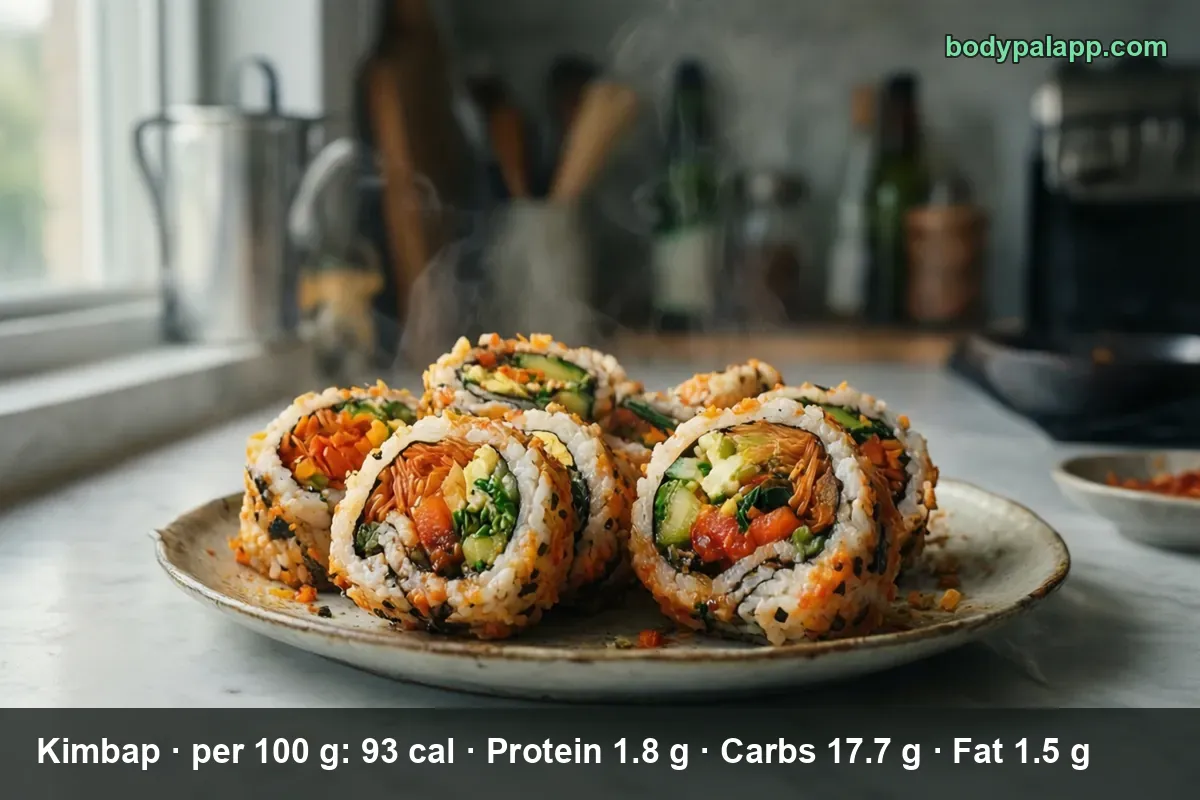
One roll cut into eight pieces weighs about 176 g and carries 164 calories. Per 100 g kimbap runs 93 calories, which makes it one of the lightest handheld lunches in the deli case. A single 22 g piece is 20 calories. The rice does almost all of the work.
On this page
- Kimbap quick facts
- US servings, from one piece to a whole roll
- Tuna, avocado and crab-stick kimbap
- Sodium is the row that moves
- How does kimbap compare?
- Kimbap FAQs
Kimbap quick facts
USDA has no line called kimbap or gimbap. The closest match by composition is the survey record FNDDS 2708966, "Sushi roll, vegetable" — seasoned rice, seaweed and a vegetable filling, which is exactly what a plain vegetable kimbap is: rice, nori, egg, carrot, spinach, cucumber and pickled radish. It is also the only rice-roll record that comes with real US household measures for a piece and a cup, so the serving math below is not invented.
The column on the right is a full roll of eight pieces at 176 g. That is the shape kimbap is actually sold in, wrapped in foil, at a Korean market or a lunch counter.
| Nutrient | Per 100 g | Per 1 roll, 8 pieces (176 g) | % Daily Value |
|---|---|---|---|
| Calories | 93 | 164 | — |
| Total fat | 1.47 g | 2.6 g | 3% |
| Saturated fat | 0.22 g | 0.4 g | 2% |
| Carbohydrate | 17.65 g | 31.1 g | 11% |
| Dietary fiber | 1.4 g | 2.5 g | 9% |
| Total sugars | 1.21 g | 2.1 g | — |
| Protein | 1.8 g | 3.2 g | 6% |
| Sodium | 361 mg | 635 mg | 28% |
% Daily Value is based on a 2,000-calorie diet.
Verified nutrition data
Numbers on this page come from USDA FoodData Central, the U.S. Department of Agriculture’s food composition database, and from manufacturer labels where a branded product is named. Last verified September 2026. How we verify our data →
Two rows you would see on a packaged label are missing here. USDA does not publish added sugars or trans fat for this survey record, so there is nothing honest to print in those lines — and traditional kimbap seasoning is sesame oil and salt rather than sugared vinegar, so the sugar that is there comes mostly from carrot and pickled radish. Cholesterol is 0 mg either way. Potassium is 71 mg per 100 g, or 125 mg in a roll, about 3% of the Daily Value.
US servings, from one piece to a whole roll
| Serving | Weight | Calories |
|---|---|---|
| 1 piece | 22 g | 20 kcal |
| 1 oz | 28 g | 26 kcal |
| Half a roll, 4 pieces | 88 g | 82 kcal |
| 1 roll, 8 pieces | 176 g | 164 kcal |
| 1 cup, sliced | 132 g | 123 kcal |
| Per 100 g | 100 g | 93 kcal |
Only two of those are USDA household measures: the 22 g piece and the 132 g cup. The half roll, the full roll and the ounce are our own arithmetic from the USDA 100 g figure, not USDA servings.
The cup is the line to be careful with. A cup of sliced kimbap is 132 g and 123 calories, which works out to roughly six pieces — not four, not eight. Rounds of kimbap stack with air between them, so a measuring cup flatters you or cheats you depending on how you drop them in. Count pieces instead. It is the one food where the household measure is worse than just looking at the plate.
One more honest caveat on the piece size: USDA calls a piece 22 g, and real kimbap is usually cut thicker than a restaurant sushi roll, closer to 25–30 g. If your local shop cuts fat rounds, add a fifth to the per-piece number and you will be close.
Tuna, avocado and crab-stick kimbap
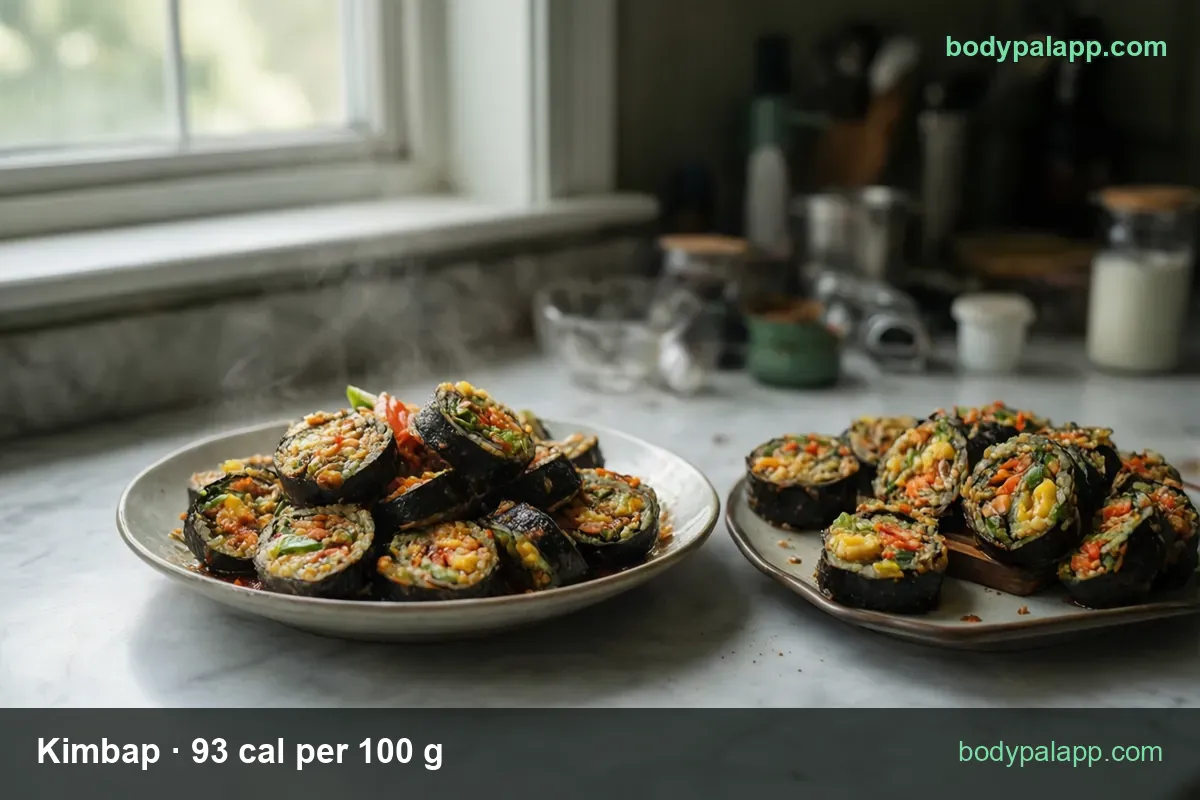
The filling barely moves the calories per gram. It moves the protein a lot.
| Version | Per 100 g | Typical piece | Calories |
|---|---|---|---|
| Vegetable kimbap | 93 kcal | 1 piece (22 g) | 20 kcal |
| Avocado kimbap | 93 kcal | 1 piece (30 g) | 28 kcal |
| Crab-stick, California style | 94 kcal | 1 piece (30 g) | 28 kcal |
| Tuna (chamchi) kimbap | 97 kcal | 1 piece (30 g) | 29 kcal |
| Shrimp roll | 100 kcal | 1 piece (30 g) | 30 kcal |
| Egg-topped rice | 119 kcal | 1 piece (50 g) | 60 kcal |
Across five rolled versions the spread is 93 to 100 calories per 100 g — seven calories, which is nothing. Swapping vegetables for tuna costs you four calories per 100 g and buys you protein: 7.4 g per 100 g instead of 1.8 g, more than four times as much. Avocado kimbap comes in identical to the vegetable record in USDA's own numbers, which surprises people who assume avocado is the expensive part. At these portion sizes it is not; the rice outweighs the filling several times over.
The egg-topped record is the outlier at 119 calories per 100 g, and it is not a roll at all — it is egg over a pad of rice, which is why the density climbs and the carbohydrate drops to 10.25 g per 100 g. Treat it as the ceiling, not as kimbap.
Two things the numbers do not cover. Tuna kimbap in a shop is usually tuna mixed with mayonnaise, and that mayo is not in the USDA record. Fried versions — the crumbed, deep-fried rolls sold as a snack — are a different food entirely and have no clean USDA line, so no figure is quoted here for them.
Sodium is the row that moves
A whole roll is 8% of a day's calories and 28% of a day's sodium. That gap is the single most useful fact on this page. 635 mg is roughly a quarter teaspoon of table salt, against the FDA Daily Value of 2,300 mg. Two rolls and a cup of soup and you are past half a day before dinner.
The salt is not in one place. Seaweed is salty on its own, the rice is seasoned with salt and sesame oil, and the pickled radish strip running through the middle is a brine product. Nothing in that list is a mistake — it is what makes kimbap taste like kimbap — but if you are watching sodium, this is a lunch to eat once rather than twice, and the Dietary Guidelines for Americans put most adults over the limit already.
The protein side is the other honest weakness. 31.1 g of carbohydrate against 3.2 g of protein means roughly three quarters of the roll's calories come from rice. That is fine as fuel and thin as a meal. A roll plus two eggs, or a tuna roll instead of a vegetable one, changes the afternoon more than any calorie swap would.
How does kimbap compare?
Piece for piece, against the rice rolls it sits next to on an American menu:
| Roll | Per 100 g | US serving | Calories |
|---|---|---|---|
| Kimbap, vegetable | 93 kcal | 1 piece, 22 g | 20 kcal |
| California roll | 94 kcal | 1 piece, 30 g | 28 kcal |
| Tuna roll | 97 kcal | 1 piece, 30 g | 29 kcal |
| Egg-topped rice | 119 kcal | 1 piece, 50 g | 60 kcal |
Our take: stop asking which roll is lighter, because three of these four are within four calories per 100 g of each other and the difference disappears into how thick your shop cuts the rounds. Ask what the filling gives you. For weight loss, plain vegetable kimbap wins on volume — 164 calories for a whole roll you eat with your hands is hard to beat. For staying full until dinner, take the tuna: same calories, four times the protein. And whichever you pick, the sodium is the number to spend your attention on, not the calories.
Kimbap FAQs
How many calories are in one piece of kimbap?
One piece of vegetable kimbap weighs 22 g and carries 20 calories, based on the USDA household measure. Eight of those pieces make the standard roll, so the whole thing lands at 164 calories. Thicker homemade pieces run heavier; weigh one once and you'll know your own number.
How many calories are in a whole roll of kimbap?
A full roll of eight pieces weighs 176 g and comes to 164 calories, our own arithmetic from the USDA figure of 93 calories per 100 g. That is a light lunch on its own, which is why kimbap usually shows up with soup or a side.
Is kimbap healthier than sushi?
Calorie-wise they are twins: 93 per 100 g for the vegetable roll versus 94 for a California roll and 97 for tuna. The real split is sodium and protein. Kimbap is seasoned with sesame oil and salt rather than sweetened vinegar, and a vegetable roll gives only 1.8 g protein per 100 g.
How much sodium is in kimbap?
One roll carries 635 mg of sodium, 28% of the 2,300 mg Daily Value and roughly a quarter teaspoon of table salt. Per 100 g that is 361 mg. The rice seasoning, the pickled radish and the seaweed all add salt, so two rolls put you past half a day's limit.
How much protein does kimbap have?
A vegetable roll gives 3.2 g of protein, only 6% of the Daily Value, because 1.8 g per 100 g is nearly all rice. Tuna kimbap more than quadruples that at 7.4 g per 100 g. If protein is the point, order the chamchi version or add eggs.
Is kimbap good for weight loss?
At 93 calories per 100 g it is one of the lighter portable lunches, and a whole roll is 164 calories. The weakness is staying power: 3.2 g of protein and 2.5 g of fiber per roll do not hold long. Pair it with eggs, tofu or a tuna roll.
How many calories are in tuna kimbap?
Tuna kimbap runs 97 calories per 100 g, so a 30 g piece is 29 calories and a roll of eight comes to about 233 - our own arithmetic from the USDA per-100-g figure. The mayo many shops mix into the tuna is not in that number.
Does kimbap have added sugar?
Total sugars are 1.21 g per 100 g, or 2.1 g in a roll - about what the carrot and pickled radish bring. USDA does not publish added sugars for this survey record, so there is no percentage to quote. Traditional kimbap seasoning uses sesame oil and salt, not sugared vinegar.
Similar foods
- Clam Chowder — 237 cal per cup
- Chinese Chicken and Broccoli — 206 cal per cup
- Pomegranate — 72 cal for 1/2 cup arils
- Pork And Beans — 273 cal per cup
- Turkey deli meat — 89 cal for 3 slices
- Chicken Tikka Masala — 257 cal per cup
Count it without the math
Point the camera at the foil-wrapped roll and BodyPal counts the pieces for you, filling and all.


How long does it take to burn off kimbap?
One roll of eight pieces (176 g) is 164 kcal. Enter your weight and the amount you ate to see how long it takes you to burn that off:
lb
| Activity | Time to burn 164 kcal |
|---|---|
| Walking, brisk | 33 min |
| Cycling, moderate | 20 min |
| Swimming, moderate | 23 min |
| Jogging | 19 min |
| Weight training, moderate | 36 min |
Times are for a 155 lb adult at a steady pace; change the weight to see yours. The amount is set to the portion in the text (176 g); change it to what you actually ate. BodyPal works this out from your steps automatically.
One food is easy to picture; a whole day is harder. See how many calories you need a day and what a deficit actually looks like.