
How many calories are in minestrone soup?
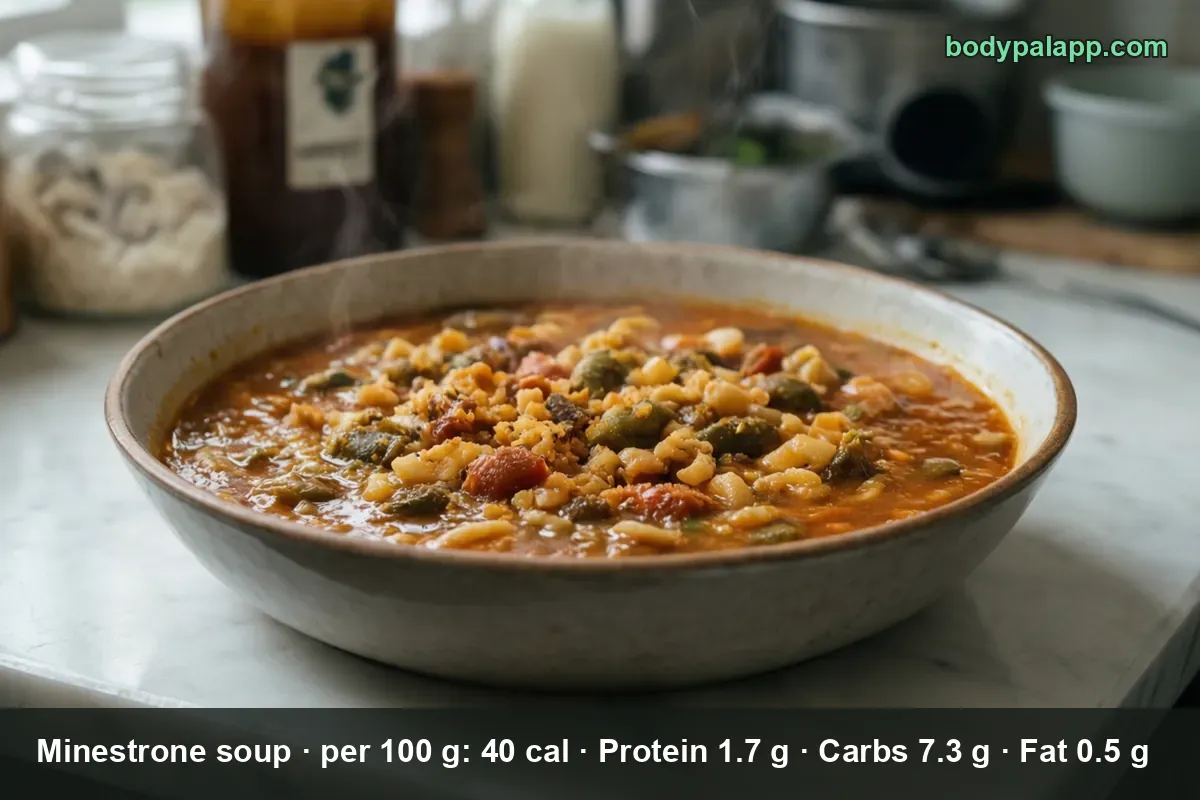
A 1-cup (245 g) serving of minestrone soup is 98 calories, and the soup itself runs 40 calories per 100 g — one of the lightest things you can put in a bowl and still call lunch. The catch is the salt line, not the calorie line: that same cup carries 590 mg of sodium.
On this page
- Minestrone soup quick facts
- US servings from a cup to a whole can
- How the can changes the number
- Sodium is the row to watch
- How does minestrone soup compare?
- Most popular minestrone soup brands
- Minestrone soup FAQs
Minestrone soup quick facts
The row on this page is the USDA's FNDDS 2710114, "Soup, minestrone" — minestrone the way it reaches the table, whether that is a diner bowl, a ready-to-serve carton or a can you already mixed with water. Minestrone is a finished dish, not an ingredient, so the record for the eaten soup is the honest starting point. At 40 calories per 100 g it also sits in the middle of the American brand cloud, which spans 36 to 48.
A separate record covers the concentrate still sitting in the pantry at 68 calories per 100 g. That one is a different food in practice, and it gets its own section below rather than being blended into an average.
| Nutrient | Per 100 g | Per 1 cup (245 g) | % Daily Value |
|---|---|---|---|
| Calories | 40 | 98 | — |
| Total fat | 0.5 g | 1.2 g | 2% |
| Saturated fat | 0.07 g | 0.2 g | 1% |
| Carbohydrate | 7.3 g | 17.9 g | 7% |
| Dietary fiber | 1.5 g | 3.7 g | 13% |
| Total sugars | 1.04 g | 2.5 g | — |
| Protein | 1.71 g | 4.2 g | 8% |
| Sodium | 241 mg | 590 mg | 26% |
% Daily Value is based on a 2,000-calorie diet.
Verified nutrition data
Numbers on this page come from USDA FoodData Central, the U.S. Department of Agriculture’s food composition database, and from manufacturer labels where a branded product is named. Last verified September 2026. How we verify our data →
There is no added sugars row and no trans fat row here, because USDA does not publish either value for this record. Cholesterol is 0 mg, which is what you would expect from a bowl of vegetables, beans and pasta in tomato broth. Potassium is more interesting: 147 mg per 100 g, so 360 mg a cup, 8% of the Daily Value, most of it from the tomato base.
US servings from a cup to a whole can
| Serving | Weight | Calories |
|---|---|---|
| 1 oz | 28 g | 11 kcal |
| Half a cup | 122 g | 49 kcal |
| 1 cup | 245 g | 98 kcal |
| One individual container | 440 g | 176 kcal |
| One can | 525 g | 210 kcal |
| Per 100 g | 100 g | 40 kcal |
The cup, the single-serve container and the full can are all USDA household measures, so those three numbers need no adjusting. The 1 oz line and the half cup are our own arithmetic from the USDA 100 g figure, useful when you are pouring a small side next to a sandwich rather than eating a full bowl.
Two habits trip people up here. The first is treating a soup bowl as a cup: restaurant and deli bowls usually hold closer to two cups, which doubles the line to 196 calories — our own arithmetic from the USDA cup — and, more to the point, doubles the sodium. The second is eating straight from the container. A 440 g single-serve carton is 176 calories, not 98, and a whole 525 g can emptied into one bowl is 210.
How the can changes the number
| Version | Per 100 g | Typical serving | Calories |
|---|---|---|---|
| Minestrone as eaten, the row above | 40 kcal | 1 cup (245 g) | 98 kcal |
| Canned condensed, as packaged | 68 kcal | half a cup (123 g) | 84 kcal |
| Canned, prepared with equal volume water | 34 kcal | 1 cup (241 g) | 82 kcal |
| Canned chunky, ready-to-serve | 53 kcal | 1 cup (240 g) | 127 kcal |
| Canned, reduced sodium, ready-to-serve | 50 kcal | 1 cup (245 g) | 123 kcal |
| SMART SOUP Greek Minestrone | 40 kcal | 10 oz pouch (283 g) | 113 kcal |
Condensed against prepared is the clearest example of a label reading twice as bad as the food. The concentrate is 68 calories per 100 g; add an equal volume of water and the same soup is 34. Nothing about the recipe changed, only the water. Half a can of concentrate is 84 calories on its own, while a 10.5 oz can turned into 586 g of finished soup is about 199 calories for the whole thing — our own arithmetic from the USDA 100 g figure, not a USDA serving.
"Chunky" is not marketing language either. The ready-to-serve chunky record is 53 calories per 100 g against 40 for the standard soup, and 2.4 g of fiber per 100 g against 1.5 g. In a real cup that is 127 calories instead of 98, and 5.8 g of fiber instead of 3.7 g, which is 21% of the Daily Value instead of 13%. Paying 29 calories for two extra grams of fiber is a good trade if the bowl is your lunch.
Store brands land close to the generic. Campbell's Minestrone Soup lists 42 calories per 100 g and Progresso Organic Minestrone 36, while Dr. McDougall's runs 45 and Boulder Organic! 48 — a spread of roughly 12 calories per 100 g, or about 30 calories across a cup. The variety on the label matters far less than the size of the bowl you fill.
Sodium is the row to watch
One cup is 590 mg of sodium, 26% of the FDA Daily Value of 2,300 mg. That is about a quarter teaspoon of table salt in a bowl that costs you fewer than a hundred calories. The Dietary Guidelines for Americans put the same 2,300 mg a day as the ceiling for adults, and canned soup is one of the top contributors in the American diet.
Scale it up and the arithmetic gets loud. A 19 oz can of chunky minestrone, 539 g, is 286 calories and 1,552 mg of sodium — 67% of a day's limit from a single lunch. The reduced-sodium ready-to-serve record cuts a cup to roughly 527 mg, and the Greek pouch above is 391 mg for the whole 283 g pouch. If sodium is what you are managing, the low-sodium can is the better pick even though it carries more calories than the plain soup.
The fiber line runs the other way and deserves credit. At 3.7 g a cup, minestrone covers 13% of the Daily Value from vegetables and beans, which is exactly the pattern MyPlate asks for. It is a rare bowl where the calorie cost of a fiber serving is this low.
How does minestrone soup compare?
| Soup | Per 100 g | US serving | Calories |
|---|---|---|---|
| Minestrone | 40 kcal | 1 cup (245 g) | 98 kcal |
| Vegetable, canned | 38 kcal | 1 cup (245 g) | 93 kcal |
| Chicken noodle, canned | 42 kcal | 1 cup (245 g) | 103 kcal |
| Lentil, canned | 43 kcal | 1 cup (245 g) | 105 kcal |
Our take: all four cups land within 12 calories of each other, so choosing between them on calories alone is a waste of attention. Minestrone is the second-lightest of the four and beats plain vegetable soup on substance, since the beans and pasta give it something to chew. If you want the bowl to hold you until dinner, lentil is the stronger pick at 6.1 g of protein a cup against 4.2 g for minestrone. For a starter in front of a real meal, minestrone wins on cost per bowl.
Most popular minestrone soup brands in the United States
Ranked by how widely each product appears among foods sold in the United States, from the BodyPal food database of over 3.3 million products. Calories are the figures printed on each Nutrition Facts label, checked against USDA FoodData Central.
| Product | Calories (per 100 g) |
|---|---|
| Campbell's Minestrone Soup | 42 cal |
| Progresso Organic Minestrone Soup | 36 cal |
| Progresso Vegetable Classics 99% Fat Free Minestrone | 42 cal |
| Dr. McDougall's Minestrone Soup | 45 cal |
| Health Valley Organic Minestrone Soup | 38 cal |
| Boulder Organic! Minestrone Soup | 48 cal |
Brand popularity: BodyPal food database. Nutrition: manufacturer labels / USDA FoodData Central.
Minestrone soup FAQs
How many calories are in a cup of minestrone soup?
A 1-cup (245 g) serving is 98 calories, based on the USDA's 40 calories per 100 g for minestrone as it is eaten. That cup also brings 4.2 g of protein, 3.7 g of fiber and 590 mg of sodium, so the salt moves faster than the calories do.
How many calories are in a bowl of minestrone soup?
A restaurant bowl is closer to the USDA's 440 g individual container, which is 176 calories; a whole 525 g can is 210. A generous 2-cup bowl at home works out to 196 calories and about 1,180 mg of sodium, our own arithmetic from the USDA 100 g figure.
How much sodium is in minestrone soup?
One cup carries 590 mg, or 26% of the 2,300 mg Daily Value, about a quarter teaspoon of table salt. A 19 oz can of chunky minestrone reaches 1,552 mg, 67% of a day, for only 286 calories. Reduced-sodium versions cut a cup to roughly 527 mg.
How many carbs are in minestrone soup?
A cup holds 17.9 g of carbohydrate, 7% of the Daily Value, and 3.7 g of that is fiber. Total sugars are 2.5 g, most of it from tomatoes, carrots and onions rather than anything added. Chunky canned versions with more pasta and beans run higher, near 21 g a cup.
Is minestrone soup good for weight loss?
At 40 calories per 100 g, minestrone is one of the lighter ways to fill a bowl: a cup is 98 calories with 3.7 g of fiber, 13% of the Daily Value. If you are counting calories, it is a cheap starter; if you are watching sodium, the 590 mg per cup matters more.
Is minestrone soup high in protein?
No — a cup gives 4.2 g of protein, 8% of the Daily Value, because the beans and pasta are a small share of a mostly liquid bowl. Canned lentil soup delivers 6.1 g per cup and chicken noodle 5.8 g. Treat minestrone as a vegetable course, not the protein.
How many calories in Progresso minestrone soup?
Progresso Organic Minestrone is 36 calories per 100 g, so its 249 g cup is 90 calories. Progresso Vegetable Classics 99% Fat Free Minestrone is 42 per 100 g and 99 calories for a 236 g cup. Both sit within a dozen calories of the USDA generic cup at 98.
How many calories in Campbell's minestrone soup?
Campbell's Minestrone Soup lists 42 calories per 100 g, so its 1-cup (240 ml) label serving is 101 calories. If your can says condensed, the USDA row for that runs 68 calories per 100 g as packaged, about 84 for a half cup, and drops to 34 once you add an equal volume of water.
Similar foods
- Tom yum soup — 191 cal per bowl
- Clementine — 35 cal per clementine
- Ceviche — 158 cal per cup
- Pomegranate — 72 cal for 1/2 cup arils
- Clam Chowder — 237 cal per cup
- Chinese Chicken and Broccoli — 206 cal per cup
Count it without the math
Point the camera at the bowl and BodyPal counts the minestrone for you, beans and all.


How long does it take to burn off minestrone soup?
A 1-cup (245 g) serving is 98 kcal. Enter your weight and the amount you ate to see how long it takes you to burn that off:
lb
| Activity | Time to burn 98 kcal |
|---|---|
| Walking, brisk | 20 min |
| Cycling, moderate | 12 min |
| Swimming, moderate | 14 min |
| Jogging | 12 min |
| Weight training, moderate | 22 min |
Times are for a 155 lb adult at a steady pace; change the weight to see yours. The amount is set to the portion in the text (245 g); change it to what you actually ate. BodyPal works this out from your steps automatically.
Burning it off is one side of it. The other is knowing your number: work out how many calories you need a day, with macros and a goal date.