
How many calories are in overnight oatmeal?
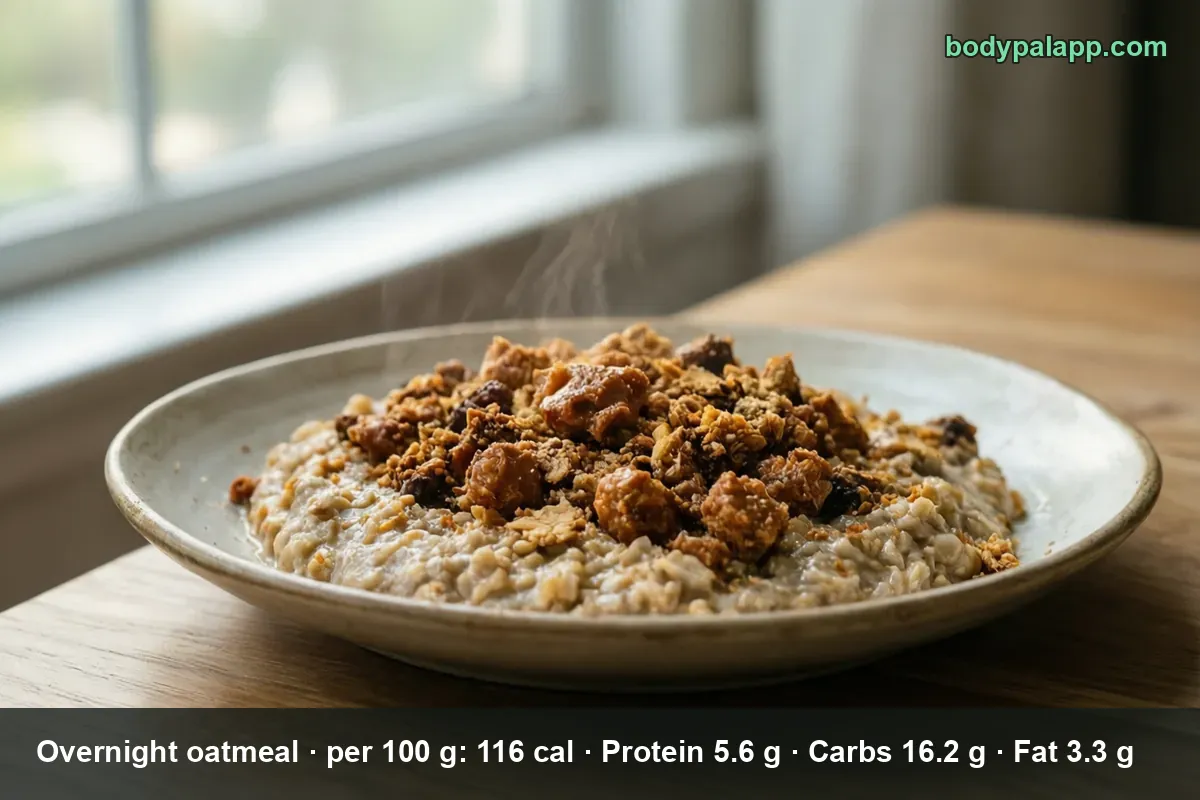
A 1-cup jar of overnight oats soaked in dairy milk is 278 calories, and the oats run 116 calories per 100 g once the liquid is in them. That cup also carries 13.3 g of protein. The jar sat in the fridge instead of a pot, but the numbers are the same either way.
On this page
- Overnight oats quick facts
- US servings, from one ounce to a full cup
- Water, almond milk, instant and store-bought jars
- Protein is the strong row, fiber is the weak one
- How does overnight oatmeal compare?
- Most popular overnight oatmeal brands
- FAQ
Overnight oats quick facts
There is no USDA record called "overnight oats." There does not need to be one. Overnight oats are rolled or quick oats hydrated in milk with no fat added, and that is exactly the food described by FNDDS 2708383, "Oatmeal, regular or quick, made with milk, no added fat". Soaking and simmering do the same job to a flake of oat: water goes in, starch softens. Temperature is not a nutrient.
So the row below is the food in the jar you pulled out of the fridge, before anything goes on top. Berries, peanut butter, chia and honey are all extra, and they are usually where a modest breakfast turns into a large one.
| Nutrient | Per 100 g | Per 1 cup (240 g) | % Daily Value |
|---|---|---|---|
| Calories | 116 | 278 | — |
| Total fat | 3.25 g | 7.8 g | 10% |
| Saturated fat | 1.44 g | 3.5 g | 17% |
| Carbohydrate | 16.23 g | 39.0 g | 14% |
| Dietary fiber | 1.7 g | 4.1 g | 15% |
| Total sugars | 5.08 g | 12.2 g | — |
| Protein | 5.56 g | 13.3 g | 27% |
| Sodium | 105 mg | 252 mg | 11% |
% Daily Value is based on a 2,000-calorie diet.
Verified nutrition data
Numbers on this page come from USDA FoodData Central, the U.S. Department of Agriculture’s food composition database, and from manufacturer labels where a branded product is named. Last verified September 2026. How we verify our data →
Two rows you would see on a package are missing here on purpose: added sugars and trans fat. USDA does not publish either for prepared FNDDS dishes, so there is nothing honest to print. The 12.2 g of total sugars in the cup is mostly lactose from the milk, not sugar someone stirred in. Cholesterol comes in at 22 mg (7% DV) and potassium at 516 mg (11% DV), both from the dairy rather than the grain. The 252 mg of sodium is roughly a tenth of a teaspoon of table salt.
US servings, from one ounce to a full cup
Overnight oats get measured two completely different ways, and this is where most people go wrong. You can measure the dry oats before they soak, or the finished jar after. One ounce of dry oats swells into about 170 g of soaked oatmeal — the same 197 calories, but a portion that looks about six times bigger in the jar.
| Serving | Weight | Calories |
|---|---|---|
| 1 oz | 28 g | 33 kcal |
| 1/2 cup, prepared | 120 g | 139 kcal |
| 1 cup, prepared | 240 g | 278 kcal |
| 1 oz dry oats, yields | 170 g | 197 kcal |
| 1 cup dry oats, yields | 485 g | 563 kcal |
| Per 100 g | 100 g | 116 kcal |
The 1-cup prepared serving is the USDA household measure, and the two dry-oat yields are USDA measures as well. The half cup at 120 g and the 1 oz line are our own arithmetic from the USDA 100 g figure, not USDA servings.
Note the last dry row. A full cup of dry oats is a normal-looking scoop, and it turns into 485 g of soaked oatmeal — 563 calories, two full jars. If you build a week of breakfasts from one big batch, weigh the batch and divide, rather than trusting the jar to be a cup.
Water, almond milk, instant and store-bought jars
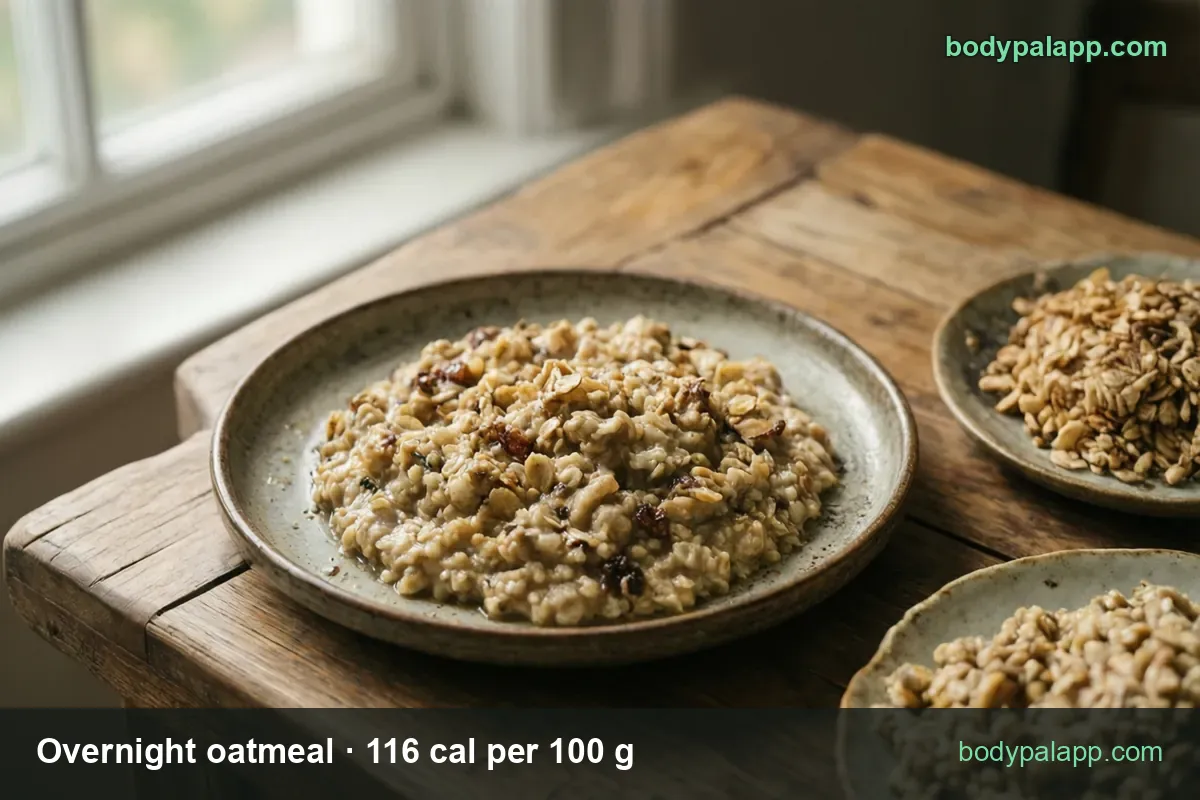
The oats barely move. The liquid does everything.
| Version | Per 100 g | Typical serving | Calories |
|---|---|---|---|
| Made with water | 64 kcal | 1 cup (240 g) | 154 kcal |
| Made with non-dairy milk | 95 kcal | 1 cup (240 g) | 228 kcal |
| Made with dairy milk | 116 kcal | 1 cup (240 g) | 278 kcal |
| Made with milk and added fat | 128 kcal | 1 cup (240 g) | 307 kcal |
| Instant oats soaked in milk | 111 kcal | 1 cup (240 g) | 266 kcal |
| Reduced-sugar oatmeal | 85 kcal | 1 cup (240 g) | 204 kcal |
| Ready-made retail cup, plain | 153 kcal | 1 jar (150 g) | 230 kcal |
Water is the cheapest jar on the list at 154 calories, and it is also the emptiest: 2.21 g of protein per 100 g against 5.56 g for the milk version. Unsweetened almond or oat milk lands in between at 228 a cup, with 8.0 g of protein. Instant oats soaked instead of stirred are 266 — the flakes are cut finer, so a cup holds slightly more liquid and slightly fewer oats than the rolled kind.
Then there is the aisle version, and it is the trap. A ready-made plain overnight oatmeal cup with almond milk is 153 calories per 100 g, well above anything you would make at home, because the jar is deliberately thick — less liquid, more oats. At the 150 g label serving that is 230 calories from a cup that fits in one hand. Flavored jars go further: strawberry with Greek yogurt is 133 per 100 g, plain almond milk 153, raisin and nut 180, banana walnut 193. Across those retail jars the 150 g serving runs 200 to 290 calories, so the biggest jar on the shelf beats a full 240 g bowl you made yourself.
Protein is the strong row, fiber is the weak one
Overnight oats have a reputation as a high-fiber breakfast. The dairy-milk cup gives 4.1 g, which is 15% of the FDA Daily Value of 28 g. Respectable, not remarkable, and identical to stove-cooked oatmeal because it is the same food. Soaking does not manufacture fiber. Berries, chia or ground flax on top are what actually move that row, and MyPlate counts the oats themselves as a whole grain either way.
Protein is the surprise. That cup hits 13.3 g, or 27% DV, before a spoon of yogurt or a scoop of powder — more than a quarter of the daily target from one jar. Almost all of it is the milk, which is why the water version collapses to 5.3 g a cup.
Two rows deserve a glance if you track them. Saturated fat is 3.5 g, 17% DV, again from the dairy; the Dietary Guidelines for Americans put the ceiling at under 10% of daily calories. Sodium is 252 mg, 11% DV, in a breakfast nobody thinks of as salty. Both are already spent before toppings.
How does overnight oatmeal compare?
| Version | Per 100 g | US serving | Calories | Protein |
|---|---|---|---|---|
| Overnight oats, dairy milk | 116 kcal | 1 cup, 240 g | 278 kcal | 13.3 g |
| Oatmeal made with water | 64 kcal | 1 cup, 240 g | 154 kcal | 5.3 g |
| Oatmeal made with non-dairy milk | 95 kcal | 1 cup, 240 g | 228 kcal | 8.0 g |
| Oatmeal made with milk, fat added | 128 kcal | 1 cup, 240 g | 307 kcal | 13.2 g |
Our take: the dairy-milk jar is the one to build. Of these four it delivers the most protein per calorie — 13.3 g for 278 — and the added-fat version costs 29 calories more for essentially the same protein, which is a bad trade unless you want the butter for taste. If you are cutting and the jar is only one part of breakfast, the water version at 154 is the leanest honest option, but plan to get protein somewhere else on the plate. Almond milk sits in the middle and behaves like it: 50 calories saved, 5.3 g of protein given up.
Most popular overnight oatmeal brands in the United States
Ranked by how widely each product appears among foods sold in the United States, from the BodyPal food database of over 3.3 million products. Calories are the figures printed on each Nutrition Facts label, checked against USDA FoodData Central.
| Product | Calories (per 100 g) |
|---|---|
| Zen Monkey Plain Overnight Oatmeal with Almond Milk | 153 cal |
| Zen Monkey Blueberry Overnight Oatmeal with Greek Yogurt | 140 cal |
| Zen Monkey Apple Cinnamon Overnight Oatmeal with Greek Yogurt | 140 cal |
| Zen Monkey Strawberry Overnight Oatmeal with Greek Yogurt | 133 cal |
| Zen Monkey Raisin & Nut Overnight Oatmeal with Greek Yogurt | 180 cal |
| Zen Monkey Banana Walnut Overnight Oatmeal with Almond Milk | 193 cal |
Brand popularity: BodyPal food database. Nutrition: manufacturer labels / USDA FoodData Central.
Overnight oats FAQs
How many calories are in overnight oats?
A 1-cup jar made with milk is 278 calories, or 116 calories per 100 g. That is oats soaked in dairy milk with nothing added on top. Soaking is not the calorie step; the liquid is. The same cup made with water is 154.
How many calories in 1 cup of overnight oats?
278 calories for a 240 g cup made with milk, the USDA household serving for prepared oatmeal. It carries 13.3 g of protein, 39.0 g of carbohydrate and 4.1 g of fiber. Swap to unsweetened almond or oat milk and the same cup drops to 228.
Do overnight oats have fewer calories than cooked oatmeal?
No, it is 278 calories a cup either way. USDA lists one record for regular or quick oats made with milk, and soaking overnight instead of cooking on the stove does not remove or add anything. Heat changes texture, not calories. What changes the number is the liquid and the toppings.
How many calories in overnight oats with almond milk?
228 calories for a 1-cup (240 g) jar made with unsweetened non-dairy milk, at 95 calories per 100 g. That is 50 calories less than the dairy version, and it drops protein from 13.3 g to 8.0 g a cup. Cheaper in calories, weaker in protein.
How much protein is in overnight oats?
13.3 g in a 1-cup jar made with dairy milk, which is 27% of the Daily Value, or 5.56 g per 100 g. Non-dairy milk cuts it to 8.0 g a cup. Store jars made with Greek yogurt run 133 to 180 calories per 100 g, but USDA does not publish protein for those labels.
Are overnight oats good for weight loss?
278 calories a cup with milk, 154 with water, and that gap is the whole decision. Neither is a diet food nor a splurge; the jar is a fixed base you build on. If you are counting, weigh the batch instead of eyeballing the jar, because toppings move the total far more than the oats do.
How many calories in half a cup of overnight oats?
139 calories for 120 g, which is our own arithmetic from the USDA 100 g figure rather than a USDA household serving. Half a cup gives 6.7 g of protein and 2.0 g of fiber. It is a small breakfast alone, which is why most jars in the fridge are the full cup.
Do overnight oats have more fiber than regular oatmeal?
No, 4.1 g per cup and 1.7 g per 100 g, identical to stove-cooked oatmeal because it is the same USDA record. That is 15% of the Daily Value. Soaking creates no fiber at all. Berries, chia or ground flax on top are what actually move that row.
Similar foods
- Egg — 72 cal per large egg
- Omelet — 305 cal for 3-egg omelet
- Crepe — 179 cal per crepe
- Pancake — 423 cal for 3 medium pancakes
- Toast with butter — 100 cal per slice with butter
- Injera — 118 cal per injera (12 in)
Count it without the math
Point the camera at the jar and BodyPal counts the oats, the milk and whatever you piled on top.


How long does it take to burn off overnight oats?
A 1-cup (240 g) serving is 278 kcal. Enter your weight and the amount you ate to see how long it takes you to burn that off:
lb
| Activity | Time to burn 278 kcal |
|---|---|
| Walking, brisk | 56 min |
| Cycling, moderate | 35 min |
| Swimming, moderate | 40 min |
| Jogging | 33 min |
| Weight training, moderate | 1 hr 2 min |
Times are for a 155 lb adult at a steady pace; change the weight to see yours. The amount is set to the portion in the text (240 g); change it to what you actually ate. BodyPal works this out from your steps automatically.
This table assumes you know your daily total. If you do not, the daily calorie calculator works it out from five numbers.