
How many calories are in Parmigiano Reggiano?
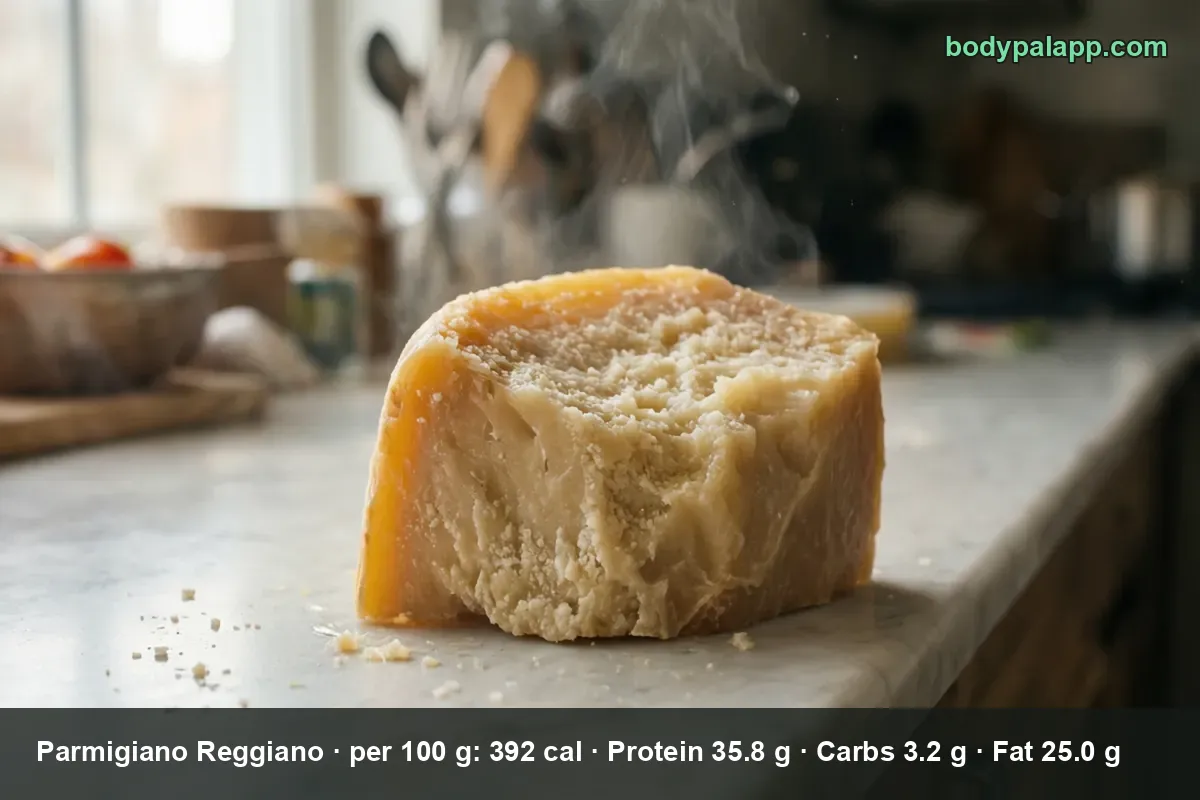
One ounce of Parmigiano Reggiano, a piece about the size of your thumb, carries 111 calories, and the wedge it came off runs 392 calories per 100 g. Grated, the same cheese lands far lighter per spoonful: a tablespoon is 20 calories. Sodium climbs faster than calories on this one.
On this page
- Parmigiano Reggiano quick facts
- US servings from a tablespoon to a five-ounce wedge
- Grated shredded and fat-free parmesans
- Garlic bread and breadsticks with parmesan
- Sodium is the row to watch here
- How does Parmigiano Reggiano compare?
- Most popular parmigiano reggiano brands
- FAQ
Parmigiano Reggiano quick facts
The numbers below come from USDA SR Legacy 170848, "Cheese, parmesan, hard". That is the aged, crumbly grating cheese sold as a wedge with the rind still on, and its 392 calories per 100 g line up with what US importers print on Parmigiano Reggiano labels, where 393 is the usual figure. USDA also keeps a survey-modeled entry, FNDDS 2705730, under nearly the same name. That one is fattier and saltier and belongs in the variants table further down, not in the headline row.
The serving column is one ounce, the household measure most US kitchens actually cut and the one printed on nearly every imported wedge.
| Nutrient | Per 100 g | Per 1 oz (28.35 g) | % Daily Value |
|---|---|---|---|
| Calories | 392 | 111 | — |
| Total fat | 25 g | 7.1 g | 9% |
| Saturated fat | 14.85 g | 4.2 g | 21% |
| Carbohydrate | 3.22 g | 0.9 g | 0% |
| Dietary fiber | 0 g | 0 g | 0% |
| Total sugars | 0.11 g | 0.0 g | — |
| Protein | 35.75 g | 10.1 g | 20% |
| Sodium | 1175 mg | 333 mg | 14% |
% Daily Value is based on a 2,000-calorie diet.
Verified nutrition data
Numbers on this page come from USDA FoodData Central, the U.S. Department of Agriculture’s food composition database, and from manufacturer labels where a branded product is named. Last verified September 2026. How we verify our data →
Two rows you would see on a US label are missing here on purpose: USDA does not publish added sugars or trans fat for this hard-cheese record, so there is nothing honest to put in those cells. Cholesterol works out to 19 mg per ounce, 6% of the Daily Value, and potassium to 26 mg, about 1%.
One small thing worth knowing before you log it. Your wedge probably says 110 calories per ounce and USDA says 111. Both are the same cheese; the label rounds a 28 g serving, USDA scales a true ounce of 28.35 g. Nothing you eat changes by one calorie.
US servings from a tablespoon to a five-ounce wedge
| Serving | Weight | Calories |
|---|---|---|
| 1 tablespoon grated | 5 g | 20 kcal |
| 1 cubic inch | 10.3 g | 40 kcal |
| 1/4 cup grated | 28 g | 110 kcal |
| 1 oz | 28.35 g | 111 kcal |
| 1 package | 142 g | 557 kcal |
| Per 100 g | 100 g | 392 kcal |
The tablespoon, the cubic inch, the ounce and the 5 oz package are USDA household measures for this record. The quarter cup is our own arithmetic from the USDA 100 g figure, scaled to the 28 g that US labels use for shredded cheese, not a USDA serving. The same goes for the per-nutrient splits quoted in this article for anything other than the ounce column above.
Here is the trap. A tablespoon and a quarter cup sound like neighbors, and on a plate they look similar once the cheese melts in. By weight they are not close: 5 g against 28 g, so the quarter cup is 5.6 times heavier and costs 110 calories instead of 20. Grating fine makes the pile look bigger and the number smaller, which is exactly backwards from how most people guess it.
The 5 oz package matters for a different reason. Cut into cubes for a board, a whole one is 557 calories and 1,670 mg of sodium, and it disappears faster than a 557-calorie plate of anything else would.
Grated shredded and fat-free parmesans
| Version | Per 100 g | Typical serving | Calories |
|---|---|---|---|
| Aged wedge (SR Legacy 170848) | 392 kcal | 1 oz (28.35 g) | 111 kcal |
| Hard parmesan, survey profile (FNDDS 2705730) | 412 kcal | 1 oz (28.35 g) | 117 kcal |
| Fat-free grated parmesan topping (172206) | 370 kcal | 1 tablespoon (5 g) | 19 kcal |
The survey profile runs 20 calories per 100 g above the wedge because it is modeled with more fat, 28.75 g against 25 g, and much more sodium, 1,398 mg against 1,175 mg. Six calories an ounce is not worth arguing about; the salt gap is.
The fat-free green-can topping is the interesting one. It is lower in calories per 100 g, 370 against 392, but only just, because the fat that was removed came back as starch and carbohydrate: 40 g per 100 g against 3.22 g in the real cheese. Per tablespoon the difference is one calorie, 19 against 20. If you switched to it to save calories, you saved almost nothing; what changed is that fat gave way to starch, not that the protein went anywhere.
Brand labels are remarkably consistent here. Ambrosi, Cucina Classica and Auricchio all list 393 calories per 100 g and 110 per ounce, and a Zanetti cube of 28 g is also 110. Zanetti's shredded version reads 400 per 100 g, which is the same cheese with air between the strands rather than a richer one; its own label serving, one tablespoon of 5 g, is still 20 calories.
Garlic bread and breadsticks with parmesan
Search for parmesan calories and USDA hands back a lot of bread. These records are worth separating out, because the cheese is a topping and the flour is doing the damage.
| Item | Per 100 g | Typical serving | Calories |
|---|---|---|---|
| Garlic bread with parmesan, frozen (2707630) | 351 kcal | 1 medium slice (79 g) | 277 kcal |
| Breadsticks with parmesan, restaurant (2707695) | 344 kcal | 1 medium stick (43 g) | 148 kcal |
A slice of frozen garlic bread is 277 calories, two and a half times what an ounce of the actual cheese costs, and only 8.78 g of that 100 g is protein against 35.75 g in the wedge. The restaurant version of the same garlic bread lands at the identical 351 calories per 100 g but carries more salt, 642 mg per 100 g against 568 mg. Soft parmesan breadsticks are lighter per piece simply because a stick weighs less than a slice.
Sodium is the row to watch here
For a food most people eat by the spoonful, Parmigiano Reggiano is salty. An ounce is 333 mg of sodium, 14% of the 2,300 mg Daily Value the FDA sets for the Nutrition Facts label, while the same ounce is only about 5.6% of a 2,000-calorie day. Sodium runs roughly two and a half times ahead of calories, ounce for ounce. That is about a seventh of a teaspoon of table salt in one piece of cheese.
Scale it up and the gap gets loud. A whole 5 oz wedge, 557 calories, brings about 1,670 mg of sodium, roughly 73% of the day's Daily Value, which is our own arithmetic from the USDA 100 g figure rather than a USDA serving. If you are watching sodium, this is a cheese to grate rather than cube.
The other pairing is more flattering. One ounce delivers 10.1 g of protein, 20% of the Daily Value, against 4.2 g of saturated fat, 21%. Protein and saturated fat move almost exactly in step, which is unusual: in most hard cheeses the fat column wins by a wide margin. MyPlate counts hard cheese in the dairy group and treats 1.5 oz as a cup-equivalent, so a modest grating still does real work in that group.
How does Parmigiano Reggiano compare?
| Cheese | Per 100 g | US serving | Calories | Protein / 100 g | Fat / 100 g |
|---|---|---|---|---|---|
| Parmigiano Reggiano (hard parmesan) | 392 kcal | 1 oz (28.35 g) | 111 kcal | 35.75 g | 25 g |
| Romano | 387 kcal | 1 oz (28.35 g) | 110 kcal | 31.8 g | 26.94 g |
| Swiss | 393 kcal | 1 oz (28.35 g) | 111 kcal | 26.96 g | 30.99 g |
| Fontina | 389 kcal | 1 oz (28.35 g) | 110 kcal | 25.6 g | 31.14 g |
Our take: on calories, these four are the same cheese. All of them land at 110 or 111 per ounce, a spread of one calorie, so picking parmesan over swiss to save calories does nothing. What separates them is what those calories are made of. Parmigiano Reggiano has the most protein of the four, 35.75 g per 100 g, and the least fat, 25 g, so if you want the protein-heaviest hard cheese for the same calorie cost, this is it. The reason to eat less of it is salt, not fat.
Most popular parmigiano reggiano brands in the United States
Ranked by how widely each product appears among foods sold in the United States, from the BodyPal food database of over 3.3 million products. Calories are the figures printed on each Nutrition Facts label, checked against USDA FoodData Central.
| Product | Calories (per 100 g) |
|---|---|
| Zanetti Parmigiano Reggiano Cheese | 393 cal |
| Zanetti Shredded Parmigiano Reggiano | 400 cal |
| Ambrosi Parmigiano Reggiano | 393 cal |
| Ambrosi Parmigiano Reggiano Cheese | 393 cal |
| Cucina Classica Parmigiano Reggiano Cheese | 393 cal |
| Auricchio Parmigiano Reggiano Cheese | 393 cal |
Brand popularity: BodyPal food database. Nutrition: manufacturer labels / USDA FoodData Central.
Parmigiano Reggiano FAQs
How many calories are in 1 oz of Parmigiano Reggiano?
One ounce is 111 calories, based on USDA's 392 calories per 100 g for hard parmesan. That ounce also brings 10.1 g of protein, 7.1 g of fat and 333 mg of sodium. Most US wedge labels round it to 110 calories per ounce, which is the same cheese, differently rounded.
How many calories in a tablespoon of grated Parmigiano Reggiano?
A tablespoon of grated Parmigiano Reggiano weighs 5 g and is 20 calories, with about 1.8 g of protein and 59 mg of sodium. That is the number for finishing a bowl of pasta. Two heavy spoonfuls still sit under 45 calories, which is why grated cheese rarely moves a daily total much.
How many calories in 1/4 cup shredded Parmigiano Reggiano?
A quarter cup of shredded Parmigiano Reggiano weighs about 28 g and is 110 calories, our own arithmetic from the USDA 100 g figure rather than a USDA serving. It carries roughly 10 g of protein and 329 mg of sodium. A quarter cup is 5.6 times heavier than one tablespoon.
Is Parmigiano Reggiano the same as parmesan?
Nutritionally they are close enough that USDA files both under one record, 392 calories per 100 g for hard parmesan. Legally they are not the same. Parmigiano Reggiano is a protected Italian name with fixed rules on milk, region and aging, while US-made parmesan is a generic hard grating cheese.
How much protein is in Parmigiano Reggiano?
An ounce has 10.1 g of protein, 20% of the Daily Value, which is a lot for 111 calories. Per 100 g the cheese is 35.75 g protein, more than the romano, swiss and fontina compared above. Swiss has 26.96 g per 100 g at nearly identical calories, so parmesan is the denser source.
Is Parmigiano Reggiano high in sodium?
One ounce carries 333 mg of sodium, 14% of the 2,300 mg Daily Value, so yes, by cheese standards it is salty. A whole 5 oz wedge is about 1,670 mg, roughly 73% of a day. If you are watching sodium, grate it thin instead of cutting cubes.
Is Parmigiano Reggiano lactose free?
USDA lists 0.11 g of total sugars per 100 g and 3.22 g of carbohydrate, so a 1 oz piece has 0.0 g of sugars. USDA does not publish a lactose value for this record. Long aging leaves very little milk sugar behind, but a lactose figure is not on the label.
Is Parmigiano Reggiano good for weight loss?
At 111 calories per ounce it is calorie-dense, but a 20-calorie tablespoon of it can carry a whole plate of vegetables. Used as seasoning rather than a snack, it costs very little. Cut into cubes and eaten by hand, a 5 oz wedge is 557 calories, which is a different decision entirely.
Similar foods
- Toast with butter — 100 cal per slice with butter
- Pancake — 423 cal for 3 medium pancakes
- Crepe — 179 cal per crepe
- Omelet — 305 cal for 3-egg omelet
- Egg — 72 cal per large egg
- Chocolate chip muffin — 523 cal per medium muffin
Count it without the math
Point the camera at the plate and BodyPal counts the cheese for you, spoonful or wedge.


How long does it take to burn off 111 kcal of Parmigiano Reggiano?
A 1 oz (28.35 g) piece is 111 kcal. Enter your weight and the amount you ate to see how long it takes you to burn that off:
lb
| Activity | Time to burn 111 kcal |
|---|---|
| Walking, brisk | 22 min |
| Cycling, moderate | 14 min |
| Swimming, moderate | 16 min |
| Jogging | 13 min |
| Weight training, moderate | 25 min |
Times are for a 155 lb adult at a steady pace; change the weight to see yours. The amount is set to the portion in the text (28.35 g); change it to what you actually ate. BodyPal works this out from your steps automatically.
Burning it off is one side of it. The other is knowing your number: work out how many calories you need a day, with macros and a goal date.