
How many calories are in pork breakfast sausage?
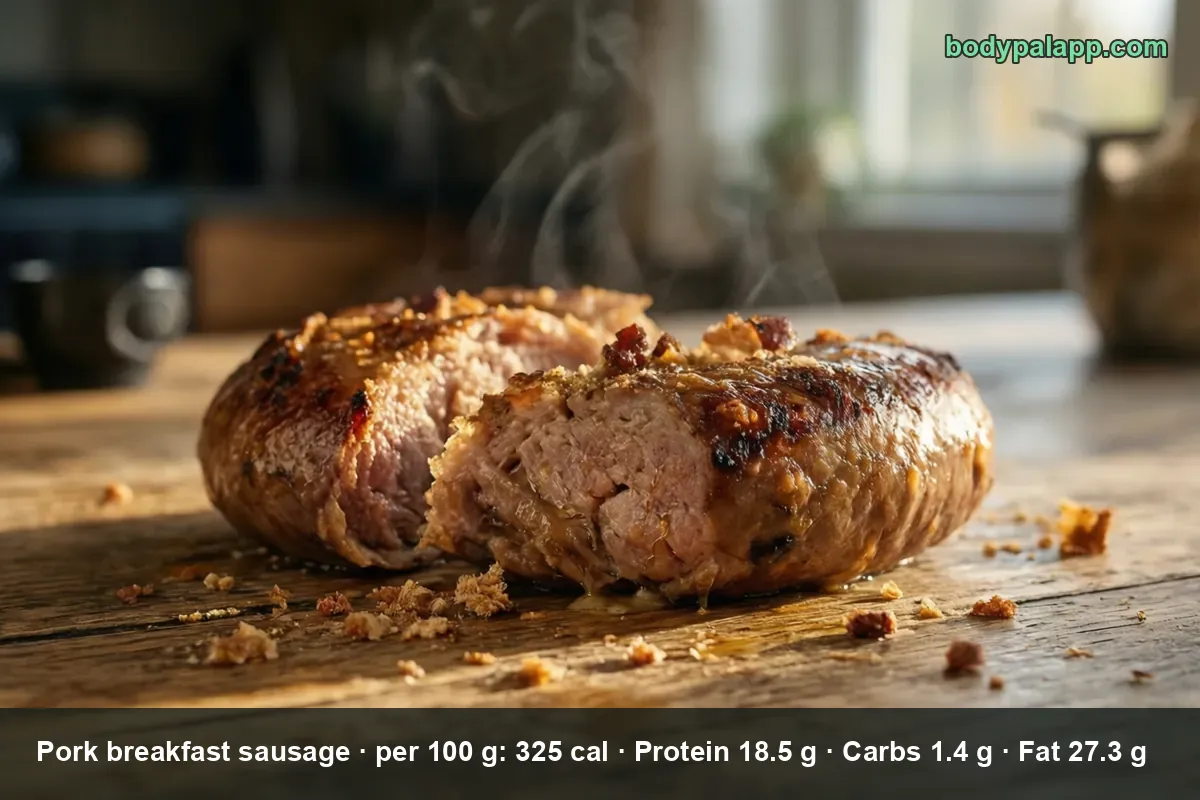
A 48 g serving of pan-fried pork breakfast sausage, about two links, is 156 calories, and per 100 g the same sausage runs 325 calories. One link on its own is 75. Most of that number is fat: 13.1 g in the serving, against 8.9 g of protein.
On this page
- Pork breakfast sausage quick facts
- US servings, from one link to a full plate
- Raw, pan-fried, microwaved and reduced-fat
- Saturated fat and sodium are the rows to watch
- How does pork breakfast sausage compare?
- Most popular pork breakfast sausage brands
- Pork breakfast sausage FAQs
Pork breakfast sausage quick facts
The record behind this page is SR Legacy 174578, "Pork sausage, link/patty, cooked, pan-fried". That is the sausage most people are actually holding on a weekday morning: fresh links or patties out of the skillet, browned, fat left in the pan. USDA also carries the same food as an FNDDS entry, 2706191, with identical figures reissued for different household portions, so nothing is gained by averaging the two.
Added sugars do not appear below because the SR Legacy edition does not measure that nutrient for meat records, and there is no trans fat line for the same reason.
| Nutrient | Per 100 g | Per 1 serving (48 g) | % Daily Value |
|---|---|---|---|
| Calories | 325 | 156 | — |
| Total fat | 27.25 g | 13.1 g | 17% |
| Saturated fat | 8.83 g | 4.2 g | 21% |
| Carbohydrate | 1.42 g | 0.7 g | 0% |
| Dietary fiber | 0 g | 0 g | 0% |
| Total sugars | 1.09 g | 0.5 g | — |
| Protein | 18.53 g | 8.9 g | 18% |
| Sodium | 814 mg | 391 mg | 17% |
| Cholesterol | 86 mg | 41 mg | 14% |
| Potassium | 342 mg | 164 mg | 3% |
% Daily Value is based on a 2,000-calorie diet.
Verified nutrition data
Numbers on this page come from USDA FoodData Central, the U.S. Department of Agriculture’s food composition database, and from manufacturer labels where a branded product is named. Last verified September 2026. How we verify our data →
Read the fat row and the protein row together and the picture is clear. This is a fat-first food with a useful protein tail, not a protein food with some fat attached. The 13.1 g of fat in one small serving is 17% of a day's Daily Value, and it comes from 48 g of food, less than two ounces.
US servings, from one link to a full plate
| Serving | Weight | Calories |
|---|---|---|
| 1 link | 23 g | 75 kcal |
| 1 patty | 27 g | 88 kcal |
| 1 serving, about 2 links | 48 g | 156 kcal |
| 3 links | 69 g | 224 kcal |
| 1 oz | 28 g | 92 kcal |
| Per 100 g | 100 g | 325 kcal |
The 48 g line is USDA's own listed serving. The three-link line and the ounce line are our own arithmetic from the USDA 100 g figure, not USDA servings, and so is the two-link math worth knowing about: two 23 g links weigh 46 g and come to 150 calories, six calories under the 48 g serving USDA prints. That small gap is the reason two people can log "two sausages" and land on different numbers without either being wrong.
The bigger trap is the plate, not the link. Three links look like a modest side next to eggs, and they are 224 calories. Add a patty on the side and you are past 300 before the toast.
Raw, pan-fried, microwaved and reduced-fat
| Version | Per 100 g | Typical piece | Calories |
|---|---|---|---|
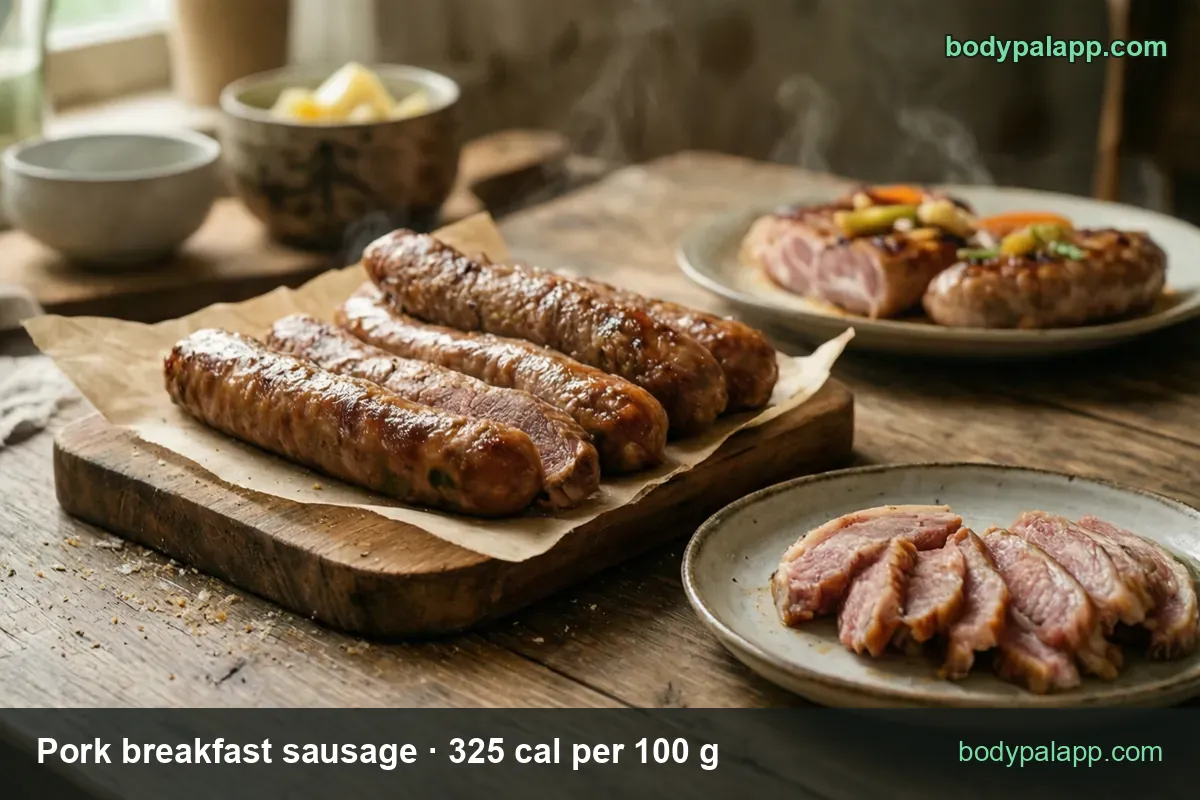
| Pan-fried links and patties | 325 kcal | 1 serving, 48 g | 156 kcal |
| Fully cooked, microwaved | 438 kcal | 1 link, 21 g | 92 kcal |
| Fully cooked, straight from the pack | 392 kcal | 1 link, 23 g | 90 kcal |
| Raw, unprepared | 288 kcal | 1 patty, 27 g | 78 kcal |
| Reduced-fat, pan-fried | 267 kcal | 1 oz, 28 g | 76 kcal |
| Brown-and-serve rice links | 407 kcal | 2 links, 45 g | 183 kcal |
Two of those lines deserve a second look. Fully cooked links reheated in the microwave sit at 438 calories per 100 g, 113 more than fresh links pan-fried. The words "fully cooked" on the box read like a convenience feature, and they are, but the fat that would have run into your skillet stays inside the sausage instead. Gram for gram, that pack is the heaviest breakfast sausage in the USDA set.
The second is raw sausage at 288 calories per 100 g, which is lighter than the 325 of the cooked version. Fat does drip out during frying, but water leaves faster, so the food concentrates as it browns. Weigh after cooking, not before. Weighing 100 g of raw meat and logging 325 calories overstates the meal; weighing it raw and logging 288 for the cooked patty understates it.
The raw patty in the table, at 27 g and 78 calories, and the reduced-fat ounce at 76 calories are our own arithmetic from those 100 g figures rather than USDA servings.
Branded labels sit inside this same range, which is why the fine print matters more than the logo. USDA's Branded records put Bob Evans Original at 140 calories for three pan-fried links (51 g), Jimmy Dean Original at 170 for three cooked links (53 g), and Applegate Classic at 170 for three links (59 g). Per 100 g those three work out at 275, 321 and 288 calories, so the serving weight printed on the panel moves the count as much as the recipe does.
Saturated fat and sodium are the rows to watch
Calories are rarely the row that surprises people here. Saturated fat is. One 48 g serving is 4.2 g, 21% of the Daily Value, and three links take it to 6.1 g, or 30% of the day, from 224 calories of food. The Dietary Guidelines for Americans advise keeping saturated fat under 10% of daily calories, which on a 2,000-calorie day works out near the 20 g Daily Value the label uses.
Sodium climbs on the same curve. The single serving is 391 mg, 17% of the 2,300 mg Daily Value, which is roughly a sixth of a teaspoon of table salt. Three links reach 562 mg, close to a quarter of the day, and that is before cheese, a biscuit, or a hash brown joins the plate.
Protein is the part that pays you back: 8.9 g in the serving, 18% of the Daily Value. If sodium or saturated fat is the number you are managing, the reduced-fat pan-fried record is the better pick at 267 calories, 6.03 g saturated fat and 698 mg sodium per 100 g, with more protein than the standard recipe at 20.94 g.
How does pork breakfast sausage compare?
| Sausage | Per 100 g | US serving | Calories |
|---|---|---|---|
| Pork breakfast sausage, pan-fried | 325 kcal | 1 oz, 28 g | 92 kcal |
| Italian sausage | 317 kcal | 1 oz, 28 g | 90 kcal |
| Pork and beef sausage | 333 kcal | 1 oz, 28 g | 94 kcal |
| Bratwurst | 333 kcal | 1 oz, 28 g | 94 kcal |
Our take: ounce for ounce these four are the same food. Only Italian sausage is lighter than breakfast sausage per 100 g, and the margin is eight calories, which is noise next to how much you serve. Breakfast sausage wins on protein instead, at 18.53 g per 100 g against 13.72 g for bratwurst, so if the choice is about the count rather than the flavor, pick by piece size and let the recipe argument go. Two links and eggs is a sensible 300-calorie breakfast; four links and a biscuit is a different meal entirely.
Most popular pork breakfast sausage brands in the United States
Ranked by how widely each product appears among foods sold in the United States, from the BodyPal food database of over 3.3 million products. Calories are the figures printed on each Nutrition Facts label, checked against USDA FoodData Central.
| Product | Calories (per 100 g) |
|---|---|
| Bob Evans Original Pork Sausage Links | 275 cal |
| Bob Evans Maple Pork Sausage Links | 333 cal |
| Wild Harvest Pork Breakfast Sausage Links | 218 cal |
| Jimmy Dean Original Pork Sausage Links | 321 cal |
| Wild Harvest Pork Breakfast Sausage Patties | 215 cal |
| Applegate Classic Pork Breakfast Sausage | 288 cal |
Brand popularity: BodyPal food database. Nutrition: manufacturer labels / USDA FoodData Central.
Pork breakfast sausage FAQs
How many calories are in one pork breakfast sausage link?
A single 23 g link is 75 calories, based on USDA's pan-fried figure of 325 per 100 g. USDA lists the link as a household portion, so the 23 g weight comes straight from the record. A 27 g patty is a little heavier at 88 calories, since patties are pressed thicker than links.
How many calories are in 2 breakfast sausage links?
Two 23 g links come to 150 calories, our own arithmetic from the USDA 100 g figure. USDA's own listed serving is slightly larger, 48 g and 156 calories. Either way you are looking at roughly 12.5 g of fat and 8.5 g of protein for the pair, plus about 375 mg of sodium.
How many calories in a pork sausage patty?
A 27 g cooked patty is 88 calories, scaled from USDA's 325 per 100 g. Store patties are often bigger than that: one branded label prices a 65 g pair of cooked patties at 140 calories. Weigh yours after cooking, because the count moves with the gram weight, not the shape.
Is breakfast sausage high in sodium?
A 48 g serving carries 391 mg of sodium, 17% of the 2,300 mg Daily Value, or roughly a sixth of a teaspoon of table salt. Per 100 g it is 814 mg. Three links push it to 562 mg, close to a quarter of the day, before anything else reaches the plate.
How much protein is in pork breakfast sausage?
The 48 g serving gives 8.9 g of protein, 18% of the Daily Value, from 18.53 g per 100 g. That is a decent return for two links, but it arrives with 13.1 g of fat. USDA's reduced-fat pan-fried record trades better: 20.94 g protein against 20.32 g fat per 100 g.
Are turkey sausage links lower in calories than pork?
267 calories per 100 g is the lightest record on this page, and it is still pork: USDA's reduced-fat pan-fried sausage, against 325 for the standard recipe. We do not quote a turkey figure here because every USDA record behind this page is a pork one, so check the panel on the turkey pack.
Do calories change when sausage is microwaved instead of pan-fried?
Yes, and by a lot: 438 calories per 100 g for fully cooked links reheated in the microwave, against 325 for fresh links pan-fried. That is a 113-calorie gap. Frying lets fat drip out of the meat, while microwaving a pre-cooked link keeps it in. Method moves the number more than brand does.
How many carbs are in pork breakfast sausage?
0.7 g of carbohydrate sits in the 48 g serving, 0% of the Daily Value, and 1.42 g per 100 g. Fiber is zero and total sugars are 1.09 g per 100 g. That makes it one of the lowest-carb items you can put on a breakfast plate, which is why low-carb eaters lean on it.
Similar foods
- Pancake — 423 cal for 3 medium pancakes
- Toast with butter — 100 cal per slice with butter
- Crepe — 179 cal per crepe
- Omelet — 305 cal for 3-egg omelet
- Egg — 72 cal per large egg
- Pork Roll — 197 cal for 2 slices
Count it without the math
Point the camera at the plate and BodyPal counts the links and patties for you, gram weight and all.


How long does it take to burn off 156 kcal of breakfast sausage?
A 48 g serving (about two links) is 156 kcal. Enter your weight and the amount you ate to see how long it takes you to burn that off:
lb
| Activity | Time to burn 156 kcal |
|---|---|
| Walking, brisk | 31 min |
| Cycling, moderate | 20 min |
| Swimming, moderate | 22 min |
| Jogging | 18 min |
| Weight training, moderate | 35 min |
Times are for a 155 lb adult at a steady pace; change the weight to see yours. The amount is set to the portion in the text (48 g); change it to what you actually ate. BodyPal works this out from your steps automatically.
Burning it off is one side of it. The other is knowing your number: work out how many calories you need a day, with macros and a goal date.