
How many calories are in pork lo mein?
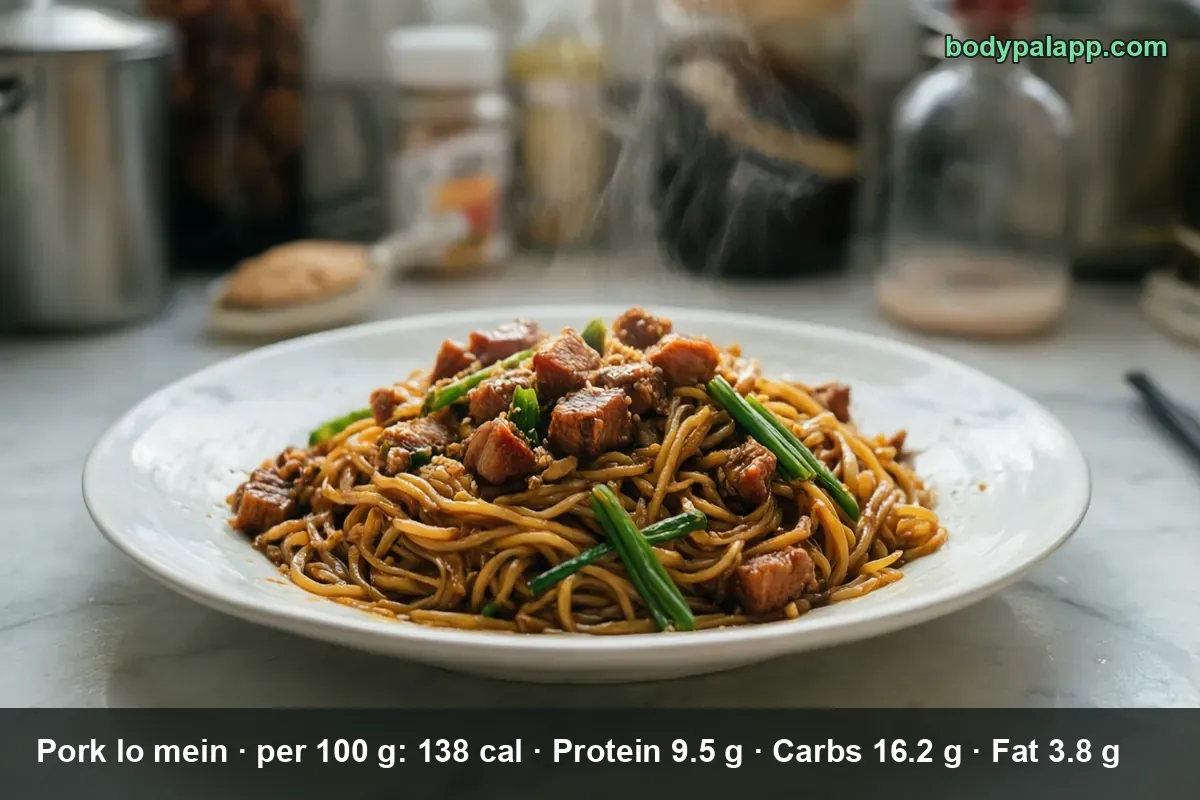
A 1-cup serving of pork lo mein weighs 200 g and carries 276 calories. Per 100 g the dish runs 138 calories, which is light for something that looks this rich. The trouble starts with the container: a takeout box holds two to three cups, not one, and that is 552 to 828 calories.
On this page
- Pork lo mein quick facts
- US servings, from one ounce to a takeout box
- Chicken, beef and the chow mein cousins
- Sodium, not calories, is the row to watch
- How does pork lo mein compare?
- Most popular pork lo mein brands
- Pork lo mein FAQs
Pork lo mein quick facts
The row behind every figure here is FNDDS 2708801, "Lo mein, with pork", from the USDA's 2021-2023 survey food set. It is the only USDA entry that describes exactly what you are holding: soft wheat noodles tossed with pork, vegetables and a thin soy-based sauce. The chow mein and chop suey entries look close on a menu, but they are a different plate of food, with less noodle and more meat and vegetable, so mixing them into an average would only blur the number.
One cup of it, 200 g, is the reference serving used throughout this page.
| Nutrient | Per 100 g | Per 1 cup (200 g) | % Daily Value |
|---|---|---|---|
| Calories | 138 | 276 | — |
| Total fat | 3.79 g | 7.6 g | 10% |
| Saturated fat | 1.07 g | 2.1 g | 11% |
| Carbohydrate | 16.18 g | 32.4 g | 12% |
| Dietary fiber | 1 g | 2.0 g | 7% |
| Total sugars | 2.11 g | 4.2 g | — |
| Protein | 9.48 g | 19.0 g | 38% |
| Sodium | 357 mg | 714 mg | 31% |
% Daily Value is based on a 2,000-calorie diet.
Verified nutrition data
Numbers on this page come from USDA FoodData Central, the U.S. Department of Agriculture’s food composition database, and from manufacturer labels where a branded product is named. Last verified September 2026. How we verify our data →
Two rows you would see on a packaged label are missing above on purpose: added sugars and trans fat. FNDDS does not publish either value for mixed restaurant-style dishes, so rather than guess at them, they are left out. Cholesterol and potassium are published: a cup gives 32 mg of cholesterol, 11% of the Daily Value, and 336 mg of potassium, 7%. The FDA's Daily Value reference is what those percentages are measured against.
US servings, from one ounce to a takeout box
| Serving | Weight | Calories |
|---|---|---|
| 1 oz | 28 g | 39 kcal |
| 1 cup | 200 g | 276 kcal |
| 1.5 cups | 300 g | 414 kcal |
| 2 cups, typical takeout entree | 400 g | 552 kcal |
| Per 100 g | 100 g | 138 kcal |
Only the 1-cup line is a USDA household measure. The ounce, the cup and a half and the two-cup box are our own arithmetic from the USDA 100 g figure, not USDA servings, which is exactly why they are useful: nobody eats a flat 100 g of noodles.
Here is the gap that trips up most people logging this dish. The USDA cup is 200 g, and a white takeout container filled to the top usually holds two cups, sometimes closer to three. Log "one serving of lo mein" and you may have written down 276 calories for a meal that was 552 or 828. Weigh the container from your regular spot once, on any kitchen scale, and you never have to guess again. If you have no scale, a rough rule works: a cup of lo mein fills a standard cereal bowl about halfway.
The ounce row matters for a different reason. Lo mein is often a shared side next to a main dish, and three or four forkfuls off someone else's plate is easily 2 to 3 oz, or 80 to 120 calories, which is small enough to forget and big enough to matter across a week.
Chicken, beef and the chow mein cousins
| Version | Per 100 g | Typical serving | Calories |
|---|---|---|---|
| Pork lo mein | 138 kcal | 1 cup (200 g) | 276 kcal |
| Chicken lo mein | 130 kcal | 1 cup (200 g) | 260 kcal |
| Beef lo mein | 129 kcal | 1 cup (200 g) | 258 kcal |
| Pork chow mein with noodles | 143 kcal | 1 cup (220 g) | 315 kcal |
| Pork chop suey, no noodles | 98 kcal | 1 cup (220 g) | 216 kcal |
| Frozen pork lo mein bowl | 157 kcal | 1 bowl (312 g) | 490 kcal |
Swapping the meat barely moves anything. Pork sits at 138 calories per 100 g, chicken at 130, beef at 129. Over a full cup that is a spread of 18 calories between the heaviest and the lightest. If you have been ordering chicken instead of pork to save calories, the saving is real but tiny: 16 calories a cup. The cup sizes for chicken and beef here are our own arithmetic, scaled from the 200 g weight USDA gives for the pork version.
Dropping the noodles moves everything. Pork chop suey without noodles falls to 98 calories per 100 g, and its carbohydrate drops from 16.18 g to 3.85 g per 100 g. That is the single biggest lever on this page, far bigger than the choice of meat, and it is available at almost every counter that serves lo mein.
Chow mein is not the lighter option. Pork chow mein with noodles comes in at 143 calories per 100 g, slightly above lo mein, and carries 6.38 g of fat per 100 g against 3.79 g. Crisping the noodles and building a heavier sauce costs more than the extra noodle in lo mein does.
The frozen aisle is its own case. P.F. Chang's Home Menu Korean Inspired Pork Lo Mein Noodle Bowl is 157 calories per 100 g, and the bowl is 312 g, so 490 calories for the package. Denser than the restaurant version per gram, but portioned for you, which for a lot of people is the part that actually helps.
Sodium, not calories, is the row to watch
At 276 calories, a cup of pork lo mein is a modest plate of food. The sodium is the row that does the damage. One cup carries 714 mg, 31% of the Daily Value, which is roughly a third of a teaspoon of table salt sitting in your noodles. A two-cup takeout portion pushes that to 1,428 mg, and the frozen bowl reaches 1,030 mg in a single 312 g serving. The Dietary Guidelines for Americans put the ceiling at 2,300 mg a day, so one restaurant lo mein can be more than half a day's allowance while looking like a light lunch.
The good news in the same table is the protein. A cup gives 19 g, 38% of the Daily Value, which is unusual for a noodle dish and the reason lo mein holds off hunger longer than plain fried noodles or fried rice. For context on how much of the day that covers, MyPlate's protein group page is the reference to read.
Saturated fat, meanwhile, is a non-issue: 2.1 g a cup, 11% of the Daily Value. Fiber is thin at 2.0 g, 7%, because refined wheat noodles dominate the bowl and the vegetables are a garnish rather than a base. Asking for extra vegetables is the cheapest fix on the menu.
How does pork lo mein compare?
| Dish | Per 100 g | US serving | Calories |
|---|---|---|---|
| Pork lo mein | 138 kcal | 1 cup (200 g) | 276 kcal |
| Chicken lo mein | 130 kcal | 1 cup (200 g) | 260 kcal |
| Beef lo mein | 129 kcal | 1 cup (200 g) | 258 kcal |
| Pork chow mein with noodles | 143 kcal | 1 cup (220 g) | 315 kcal |
Our take: stop choosing between the meats. The whole spread across pork, chicken and beef lo mein is 18 calories a cup, less than a splash of extra sauce, and all three land between 9.15 g and 9.73 g of protein per 100 g. If you want to eat lighter here, cut the portion or cut the noodles. One cup instead of two saves 276 calories; ordering the no-noodle chop suey instead saves 40 calories per 100 g and most of the carbohydrate. For a filling meal that still leaves room, one cup of pork lo mein next to a plate of steamed vegetables beats a two-cup box of anything on this table.
Most popular pork lo mein brands in the United States
Ranked by how widely each product appears among foods sold in the United States, from the BodyPal food database of over 3.3 million products. Calories are the figures printed on each Nutrition Facts label, checked against USDA FoodData Central.
| Product | Calories (per 100 g) |
|---|---|
| P.F. Chang's Home Menu Korean Inspired Pork Lo Mein Noodle Bowl | 157 cal |
Brand popularity: BodyPal food database. Nutrition: manufacturer labels / USDA FoodData Central.
Pork lo mein FAQs
How many calories are in 1 cup of pork lo mein?
One cup weighs 200 g and carries 276 calories, based on the USDA FNDDS entry at 138 calories per 100 g. That cup also brings 19 g of protein, 32.4 g of carbohydrate and 7.6 g of fat. Most restaurant portions are two or three cups, not one.
How many calories are in a takeout container of pork lo mein?
A 2-cup container comes to 552 calories, and a 3-cup box reaches 828. Both are our own arithmetic from the USDA figure of 138 calories per 100 g, not USDA servings. Weigh the container once and you will know which size your usual spot uses.
Pork lo mein vs chicken lo mein: which has fewer calories?
Chicken lo mein is lighter by 16 calories a cup: 260 versus 276, or 130 against 138 per 100 g. The gap is small enough that the size of the container matters far more than the meat. Beef lo mein sits lowest of the three at 258 calories a cup.
How many carbs are in pork lo mein?
One cup holds 32.4 g of carbohydrate, 12% of the Daily Value, with 2.0 g of that as fiber and 4.2 g as total sugars. Per 100 g the figure is 16.18 g. Drop the noodles and pork chop suey falls to 3.85 g per 100 g.
How much protein is in pork lo mein?
A 1-cup serving delivers 19 g of protein, 38% of the Daily Value, from 9.48 g per 100 g. That is a solid share for a noodle dish, and it is the main reason pork lo mein holds off hunger better than plain fried noodles do.
How much sodium is in pork lo mein?
One cup carries 714 mg of sodium, 31% of the Daily Value, or roughly a third of a teaspoon of table salt. A two-cup takeout portion doubles that to 1,428 mg. The frozen P.F. Chang's Home Menu bowl lands at 1,030 mg for its 312 g serving.
Lo mein vs chow mein: which is lighter?
Per 100 g, pork chow mein with noodles runs 143 calories against 138 for pork lo mein, and a 1-cup 220 g serving comes to 315. Chow mein carries more fat, 6.38 g per 100 g against 3.79 g, because the sauce and the frying do more work.
Is pork lo mein healthy?
At 138 calories per 100 g it is not a heavy dish, and 19 g of protein a cup is a real plus. Sodium is the catch: 714 mg in one cup, 31% of the Daily Value. If you are watching salt, a smaller portion is the easy fix.
Similar foods
- Lasagna — 286 cal per piece
- Chicken Chow Mein — 288 cal per cup
- Half And Half — 20 cal per tbsp
- Toor Dal — 348 cal per cup
- Shrimp Pad Thai — 294 cal per cup
- Snow Cone — 256 cal per snow cone
Count it without the math
Point the camera at the container and BodyPal counts the noodles, the pork and the sauce for you.


How long does it take to burn off pork lo mein?
A 1-cup (200 g) serving is 276 kcal. Enter your weight and the amount you ate to see how long it takes you to burn that off:
lb
| Activity | Time to burn 276 kcal |
|---|---|
| Walking, brisk | 55 min |
| Cycling, moderate | 34 min |
| Swimming, moderate | 39 min |
| Jogging | 32 min |
| Weight training, moderate | 1 hr 1 min |
Times are for a 155 lb adult at a steady pace; change the weight to see yours. The amount is set to the portion in the text (200 g); change it to what you actually ate. BodyPal works this out from your steps automatically.
Want the bigger picture? Calculate your daily calorie needs — your maintenance figure, a target for losing or gaining, and the date you get there.