
How many calories are in pork and rice?
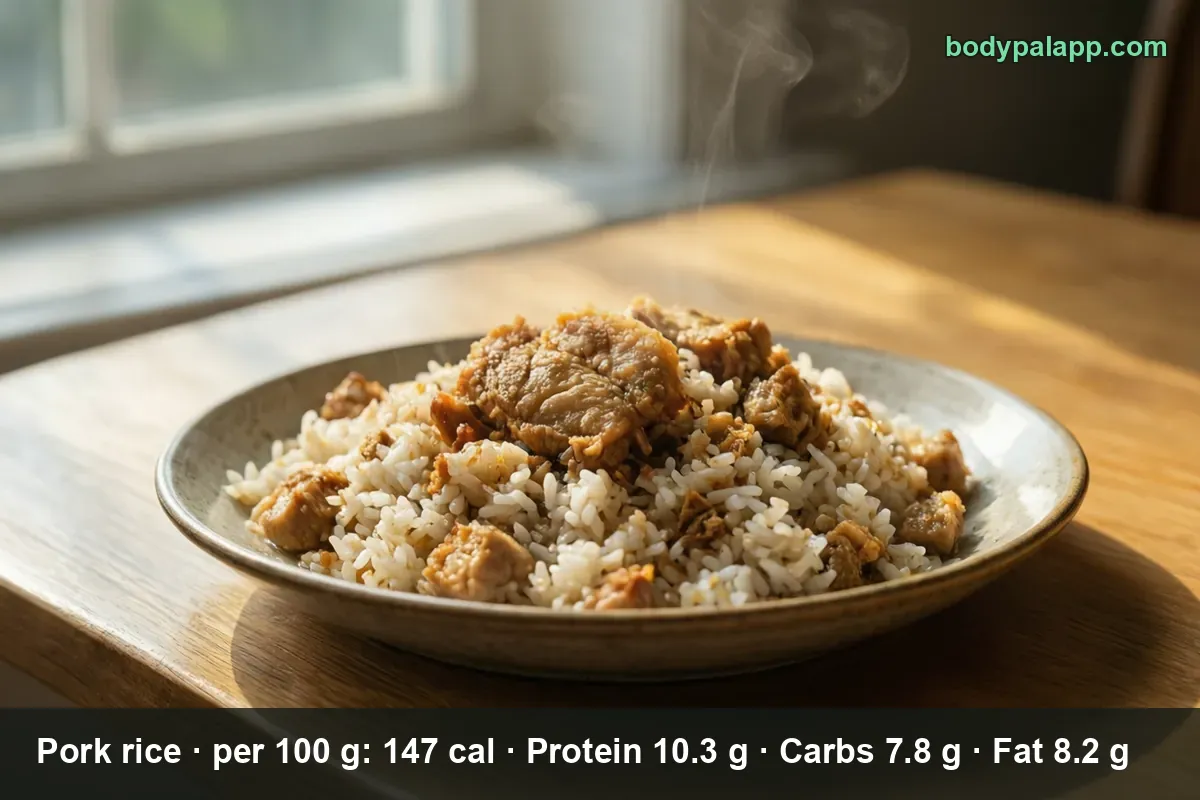
A 1-cup serving of pork and rice in soy sauce weighs 217 g and carries 319 calories. Per 100 g the dish runs 147 calories, which is light for something this filling: the same cup delivers 22.2 g of protein. Half a cup is 159. The sauce, not the pork, decides the rest.
On this page
- Pork rice quick facts
- US servings, from one ounce to a takeout container
- Soy sauce or tomato sauce changes the plate
- Sodium is the row to watch
- How does pork rice compare?
- Most popular pork rice brands
- FAQ
Pork rice quick facts
The record that matches what most people are holding is FNDDS 2706650, "Pork, rice, and vegetables excluding carrots, broccoli, and dark-green leafy; soy-based sauce". That is the plain version: pork, cooked rice, a soy-based sauce, no obvious carrots or broccoli on the plate. It also comes with a ready-made household measure, a 1-cup serving of 217 g, so nothing in the main column is invented.
| Nutrient | Per 100 g | Per 1 cup (217 g) | % Daily Value |
|---|---|---|---|
| Calories | 147 | 319 | — |
| Total fat | 8.15 g | 17.7 g | 23% |
| Saturated fat | 1.79 g | 3.9 g | 19% |
| Carbohydrate | 7.75 g | 16.8 g | 6% |
| Dietary fiber | 0.9 g | 2.0 g | 7% |
| Total sugars | 1.36 g | 3.0 g | — |
| Protein | 10.25 g | 22.2 g | 44% |
| Sodium | 217 mg | 471 mg | 20% |
| Cholesterol | 25 mg | 54 mg | 18% |
| Potassium | 256 mg | 556 mg | 12% |
% Daily Value is based on a 2,000-calorie diet.
Verified nutrition data
Numbers on this page come from USDA FoodData Central, the U.S. Department of Agriculture’s food composition database, and from manufacturer labels where a branded product is named. Last verified September 2026. How we verify our data →
Two rows you would see on a frozen tray are missing here: added sugars and trans fat. USDA does not publish those two values for this mixed-dish record, so we left them out rather than guess. Everything else on the label is covered, including the cholesterol and potassium rows, which most calorie pages skip entirely.
The number that should surprise you is protein. A single cup covers 44% of the Daily Value, and the FDA's Daily Value reference puts the target at 50 g. That is close to half a day's protein for 319 calories, which is not how takeout-style rice dishes usually score.
US servings, from one ounce to a takeout container
| Serving | Weight | Calories |
|---|---|---|
| 1 oz | 28 g | 42 kcal |
| 4 oz | 113 g | 166 kcal |
| Half a cup | 109 g | 159 kcal |
| 1 cup, USDA household measure | 217 g | 319 kcal |
| Two cups, a takeout container | 434 g | 638 kcal |
| Per 100 g | 100 g | 147 kcal |
Only the 1-cup line comes straight from USDA. The half cup, the 4 oz portion, the ounce and the two-cup container are our own arithmetic from the USDA 100 g figure, not USDA servings, and they are rounded to whole calories.
That two-cup line is the one worth staring at. A standard takeout container holds roughly two cups, people eat it out of the box, and 638 calories with 942 mg of sodium is a very different lunch from the 319 the cup suggests. Serve it onto a plate first and the portion becomes visible.
The ounce column matters for a different reason: pork and rice is a leftover food. A 4 oz scoop reheated the next morning is 166 calories, which slots into a breakfast without much thought.
Soy sauce or tomato sauce changes the plate
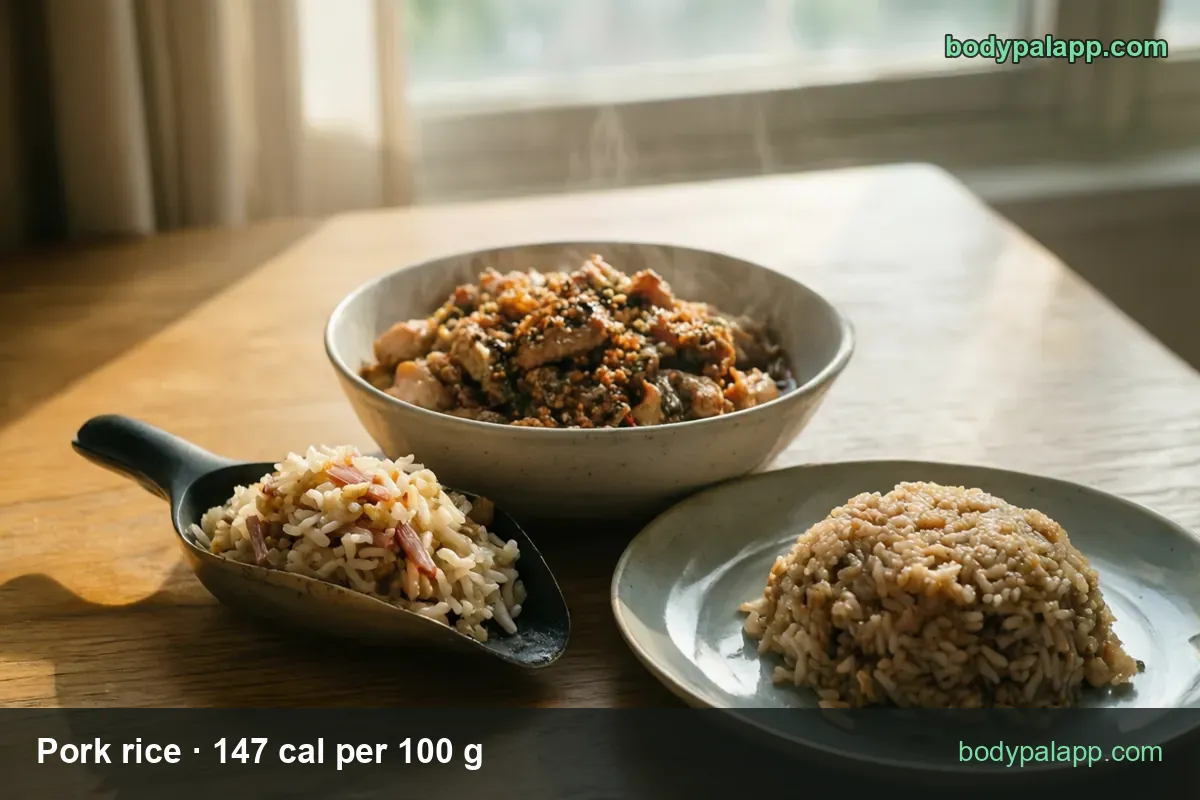
USDA keeps four versions of this dish, split by sauce and by whether carrots, broccoli or dark-green leafy vegetables are in the pan.
| Version | Per 100 g | Protein per 100 g | Cup | Calories |
|---|---|---|---|---|
| Pork and rice in soy sauce, no added vegetables | 147 kcal | 10.25 g | 1 cup (217 g) | 319 kcal |
| Pork and rice with carrots or broccoli, soy sauce | 144 kcal | 9.96 g | 1 cup (217 g) | 312 kcal |
| Pork and rice in tomato sauce | 133 kcal | 5.64 g | 1 cup (249 g) | 331 kcal |
| Pork and rice with vegetables, tomato sauce | 129 kcal | 5.61 g | 1 cup (249 g) | 321 kcal |
Here is the trap. Read the per-100-g column and the tomato-sauce versions look like the diet choice, 133 and 129 against 147. Read the cup column and they are the heaviest plates on the table, 331 and 321 against 319. A cup of the tomato version weighs 249 g instead of 217 g, because the sauce is wetter and the rice-to-pork ratio is higher, so you end up carrying more grams to the table.
The protein column explains why. The soy-sauce records hold almost double the protein of the tomato ones, 10.25 g per 100 g against 5.64 g, while the tomato versions carry roughly twice the carbohydrate, 16.08 g against 7.75 g. Same dish name, different plate: one is mostly pork with rice, the other is mostly rice with pork.
Adding vegetables barely moves calories at all. Carrots and broccoli take the soy version from 147 to 144 per 100 g and lift fiber from 0.9 g to 1.1 g. That is a rounding error in calories and a real gain in volume, which is the cheapest edit on this page.
Frozen and store-bought versions sit in the same band. In USDA's Branded data, InnovAsian Chinese-Style BBQ Pork Fried Rice is 153 calories per 100 g, or 260 for its 1-cup (170 g) label serving, and Signature Cafe Chinese Style BBQ Pork with Fried Rice is 145 per 100 g. The outliers are bacon fried rice at 188 and boudin-style pork and rice at 196, both denser per gram than any of the four FNDDS records.
Sodium is the row to watch
One cup carries 471 mg of sodium, 20% of the Daily Value, or about a fifth of a teaspoon of table salt. Eat the whole container and you are at 942 mg before anything else on the day is counted.
The salt comes from the sauce, not the meat, and the tomato-based record proves it: 304 mg of sodium per 100 g against 217 mg for the soy version, despite being 14 calories lighter. Scaled to its 249 g cup, that is roughly 757 mg, a third of the day, which is our arithmetic from the USDA 100 g figure rather than a USDA serving. The version that looks lighter on the calorie line is the saltier one.
Saturated fat, by contrast, is quiet. A cup brings 3.9 g, 19% of the Daily Value against the 20 g reference, which is modest for a pork dish. The Dietary Guidelines put lean protein foods and grains in the same meal on purpose, and this plate is a fair example: most of its 17.7 g of fat is unsaturated. If you are watching sodium, cut the sauce and keep the pork. If you are watching calories, cut the cup and keep the sauce.
One more thing the label on a frozen tray will not tell you: 2.0 g of fiber per cup is only 7% of the Daily Value, so this is not a fiber meal. The MyPlate grains group suggests making half your grains whole, and a side of vegetables does more for that number here than swapping the rice.
How does pork rice compare?
| Dish | Per 100 g | US serving | Calories |
|---|---|---|---|
| Pork and rice, soy sauce, no vegetables | 147 kcal | 1 cup, 217 g | 319 kcal |
| Pork and rice with vegetables, soy sauce | 144 kcal | 1 cup, 217 g | 312 kcal |
| Pork and rice, tomato sauce | 133 kcal | 1 cup, 249 g | 331 kcal |
| Pork and rice with vegetables, tomato sauce | 129 kcal | 1 cup, 249 g | 321 kcal |
Our take: the soy-sauce version with carrots and broccoli is the best plate on this table, 312 calories a cup with nearly 10 g of protein per 100 g and fiber tied for the highest of the four. The plain soy version is seven calories heavier and the better pick if you want the protein density. The tomato-sauce records only win on paper. They read lighter per gram, then arrive as a bigger, saltier, starchier cup that beats the soy version by up to 12 calories. Across all four, the spread per 100 g is 18 calories, so the portion size you serve matters far more than which recipe you cook.
Most popular pork rice brands in the United States
Ranked by how widely each product appears among foods sold in the United States, from the BodyPal food database of over 3.3 million products. Calories are the figures printed on each Nutrition Facts label, checked against USDA FoodData Central.
| Product | Calories (per 100 g) |
|---|---|
| InnovAsian Chinese-Style BBQ Pork Fried Rice | 153 cal |
| Signature Cafe Chinese Style BBQ Pork with Fried Rice | 145 cal |
| InnovAsian Sweet & Sour Pork with Vegetables and White Rice | 147 cal |
| InnovAsian Bacon Fried Rice | 188 cal |
| Positive Food Co. Gochujang Roast Pork Loin with Kimchi Fried Rice | 114 cal |
| Richard's Premium Boudin Pork & Rice | 196 cal |
Brand popularity: BodyPal food database. Nutrition: manufacturer labels / USDA FoodData Central.
Pork rice FAQs
How many calories are in pork fried rice?
319 calories in a 1-cup (217 g) serving of pork, rice and vegetables in soy sauce, which is 147 calories per 100 g. Half a cup is 159 calories, and a heaped restaurant plate of two cups reaches 638. The sauce and the rice-to-pork ratio move the number more than the cut of pork does.
How much protein is in pork fried rice?
22.2 g of protein in a 1-cup (217 g) serving, or 44% of the Daily Value, from 10.25 g per 100 g. That is one of the better protein-per-calorie ratios in the takeout-style rice category: 319 calories buys close to half a day's protein, and it comes from the pork rather than the rice.
Is pork fried rice high in sodium?
471 mg of sodium in one cup, 20% of the Daily Value and about a fifth of a teaspoon of table salt. The tomato-sauce record is saltier still at 304 mg per 100 g against 217 mg for the soy version. Two cups doubles the figure to 942 mg, roughly 41% of the day.
Does brown rice change the calories?
None of the four USDA records here, spanning 129 to 147 calories per 100 g, splits white rice from brown, so there is no USDA number for that swap. What the data does show is fiber: 0.9 g per 100 g without added vegetables and 1.1 g with carrots or broccoli. Vegetables move that row more than the grain does.
How many calories in a takeout container of pork fried rice?
A takeout container holds roughly two cups, about 434 g, which is 638 calories. That is our own arithmetic from the USDA 100 g figure, not a USDA serving. The same container carries about 44 g of protein and 942 mg of sodium. Containers get shared more often than people admit, and half of one is 319.
Is pork and rice good for weight loss?
319 calories a cup with 22.2 g of protein makes this an efficient lunch by the standards of takeout rice dishes. If you are watching calories, the trap is volume rather than the recipe: two cups is 638. Serve one cup, add a plain vegetable side, and the plate stays near 350.
How many calories in frozen pork fried rice?
Frozen versions run from 114 to 196 calories per 100 g in USDA's Branded data. InnovAsian Chinese-Style BBQ Pork Fried Rice is 153 per 100 g, or 260 for its 1-cup (170 g) label serving, and the same brand's bacon fried rice is 188. Weigh the tray, because one tray is often more than one label serving.
Pork fried rice vs beef fried rice calories?
319 calories per cup is the pork figure, at 147 per 100 g. The four USDA records behind this page cover pork only, and there is no matching beef-and-rice record in that set, so we are not going to build a comparison by borrowing a number from somewhere else. Mixing sources is how these comparisons go wrong.
Similar foods
- Pasta — 168 cal per cup penne
- Penne pasta — 169 cal per cup
- Rice — 205 cal per cup, cooked
- Quinoa — 222 cal per cup cooked
- Baba ganoush — 110 cal for 1/4 cup
- Wild Rice — 166 cal per cup, cooked
Count it without the math
Point the camera at the plate and BodyPal counts the pork and the rice for you, sauce included.


How long does it take to burn off pork rice?
A 1-cup (217 g) serving is 319 kcal. Enter your weight and the amount you ate to see how long it takes you to burn that off:
lb
| Activity | Time to burn 319 kcal |
|---|---|
| Walking, brisk | 1 hr 4 min |
| Cycling, moderate | 40 min |
| Swimming, moderate | 46 min |
| Jogging | 38 min |
| Weight training, moderate | 1 hr 11 min |
Times are for a 155 lb adult at a steady pace; change the weight to see yours. The amount is set to the portion in the text (217 g); change it to what you actually ate. BodyPal works this out from your steps automatically.
One food is easy to picture; a whole day is harder. See how many calories you need a day and what a deficit actually looks like.